
I spent this week – among other things – experimenting with the Art of Memory (it works!) and attempting to memorize Keats’ “Ode on a Grecian Urn” while walking through the Greek section of the Metropolitan Museum in preparation for this past weekend’s inaugural conference for “Can Beauty Save the World”, the Templeton-funded research project on beauty and spiritual yearning I’m co-directing with my colleague Brandon Vaidyanathan at Catholic University of America (where I got to hang out with Charles Taylor, the founder of vibe camp, and a trickster director of a sacred theatre troupe; I will leave it to the reader to interpret the punctuation of that sentence). The following is loosely adapted and significantly expanded from my closing remarks at the conference.
When reading, and at least attempting to memorize, John Keats’ 1819 poem “Ode on a Grecian Urn,” at the Met last week, a few things struck me.
For starters, I’m sorry to report, I don’t actually think “Ode on a Grecian Urn” is that good a poem. At least, it’s a wildly uneven one. I don’t mind this, exactly. One of the most rewarding parts of memorizing poetry is letting it get inside my body; only then, often, do I have the kind of intimate relationship with it that lets me dare to pronounce on its quality. “More happy love, more happy, happy love” comes across like the early Romantic equivalent of vamping for time. (See also: Bold lover, thou canst never, never kiss and ah, happy happy boughs that cannot shed!). There are wildly beautiful lines – thou still’unravished bride of quietness, of course, but there also the evocative if too-pert pipe to the spirit ditties of no tone – but the effect is frustratingly stochastic: as if Keats is only intermittently expressing, or experiencing, beauty directly, and the rest of the time speaking generalities about beauty. Too much of the poem, I think, is pretty rather than beautiful, and sometimes not even that.
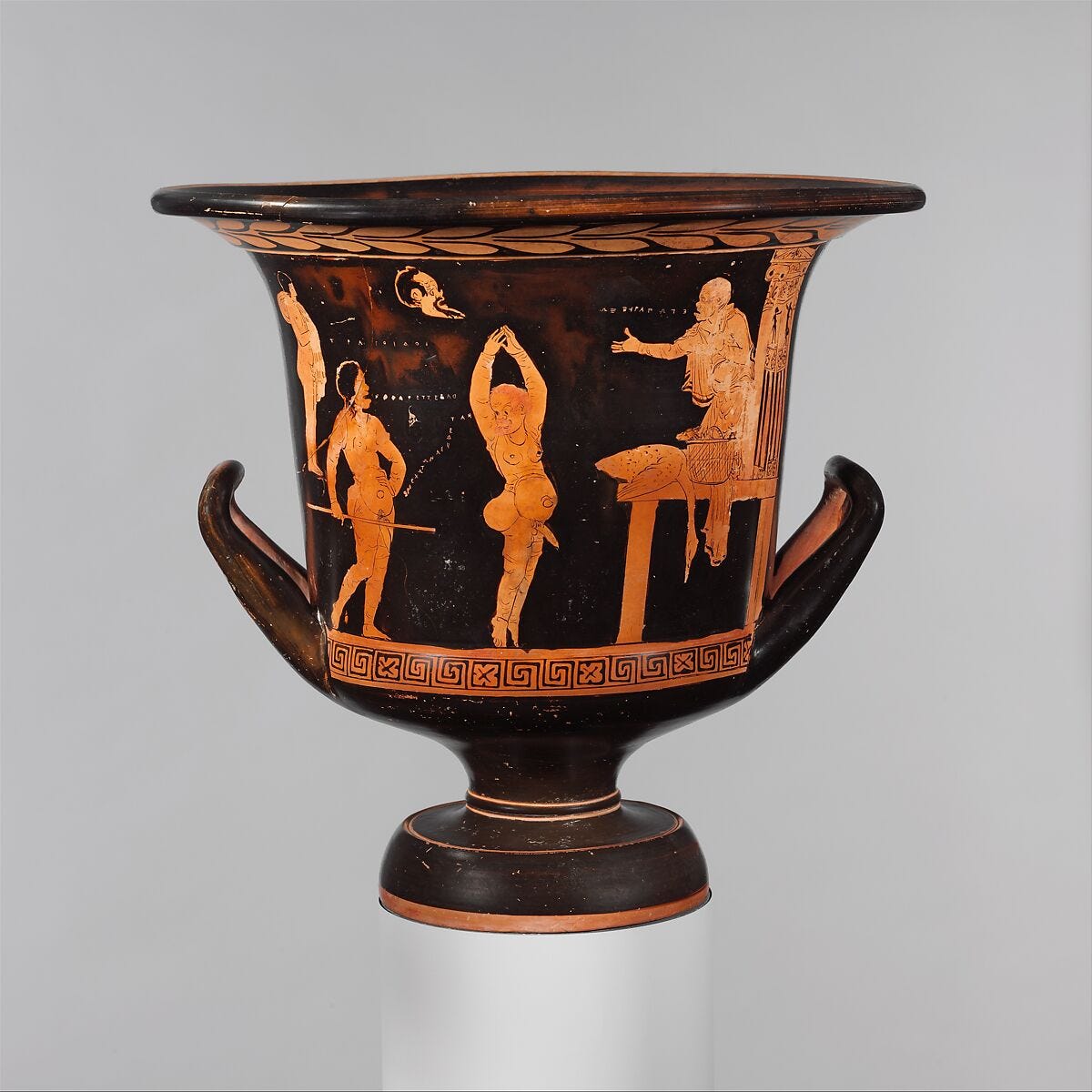
But that’s not what surprised me most. What did was my sense that “beauty is truth, truth beauty” is only the second most interesting line about beauty in the poem. Maybe even third – the spirit ditties of no tone – suggests the possibility of supersensual art: something higher, a form, even, to which beauty must conform.
Don’t get me wrong. I do think “truth is beauty” gets at something. The Platonic triad of transcendentals -- beauty, truth, and goodness -- does, I think, alert us to the idea that beauty does not come downstream of any other suppositions or propositions. We can’t be convinced that something is beautiful (although I think we can probably be shown, or gently led. Half the things I find beautiful now I fell in love with because I fell in love with somebody who loved them.) And I think the faith that there is a connection between beauty, truth, and goodness is also a rejection of certain kinds of other metaphysical possibilities: either a nihilism where nothing at all matters and beauty is as decent a distraction before death as any other), or a sense of beauty as an erotic-aristocratic impulse towards hierarchical valuation in which the beautiful is merely a vehicle for the propagation of a literal or analogical higher race, or an infernal realism – where God or the devil has played a trick on you, beauty is a snare designed to lure you into evil and decay (or a false sense of erotic-aristocratic hierarchy), and goodness can reside only in rejecting it altogether. I think taking the Platonic transcendentals together is also an affirmation of faith that beauty is more than just a snare.
But Keats’ poem is complicated, I think, by the fact that the lines are spoken, metaphorically at least, by the urn itself – albeit through the speaker’s interpretation.
That the urn indicates that truth is beauty – that it is “That is all ye know on earth and ever need to know” – does not indicate that truth is in fact beauty.
It indicates, rather, only that this is the effect the urn has on the speaker. One could just as easily, if far less charitably, make the case that “all ye ever need to knew” is evidence of beauty’s power for distraction – to take beauty for to truth, is to assent to an aesthetic fantasy: that we are lulled into a respite from “human passion far above.” Keats’ speaker forgets his implicit pain – his high-sorrowful heart – when looking at the urn. That doesn’t mean his pain isn’t true.
“Truth is beauty” might just as easily be a noble lie: something that beauty tells us. And that’s before we get to the absence of goodness in the equation. “Beauty is truth” could just as easily be the mantra of aristocratic nihilism: that which purifies the generative line is the highest reality we can access.
Rather, the line that interests me most, and I think gets at something even more exciting about beauty, is one in the speaker’s own voice. “Thou, silent form, dost tease us out of thought as doth eternity.” What does it mean to be teased out of thought? What does it mean to equate beauty, not with truth itself, but with eternity? I think it’s a weaker claim than “beauty is truth” but also a more defensible one. And it’s one that might help us think more precisely about how we relate beauty to either truth or goodness.
I think the starting point might be the teasing. I’ve written quite a bit already in this blog about the relationship between erotic desire, beauty, and magic (as well as on children and art), but I think any conception of beauty that elides its fundamentally erotic character misses the point. This is hardly a new observation – Plato’s accounts of beauty are suffused in it, and in particular on the premise that erotic physical love is but a reflection of our desire for the beautiful as transcendental – but it merits foregrounding.
Beauty makes us want, and it makes us want in a very particular way, that is analogous to the experience of desire for another person. In her 1999 Beauty and Being Just, the philosopher Elaine Scarry (who spoke at our conference!), writes of beauty that it “seems to incite, even to require, the act of replication.” She gives the example of a beautiful face, spied and then drawn by the Renaissance artist Andrea Verrocchio, which “suddenly glides into the perceptual field of a young boy named Leonardo...[then] Pater (who tells us all this about Leonardo) replicates -- no win sentences -- Leonard’s acts, so that the essay reenacts its subject, becoming a sequence of faces.”
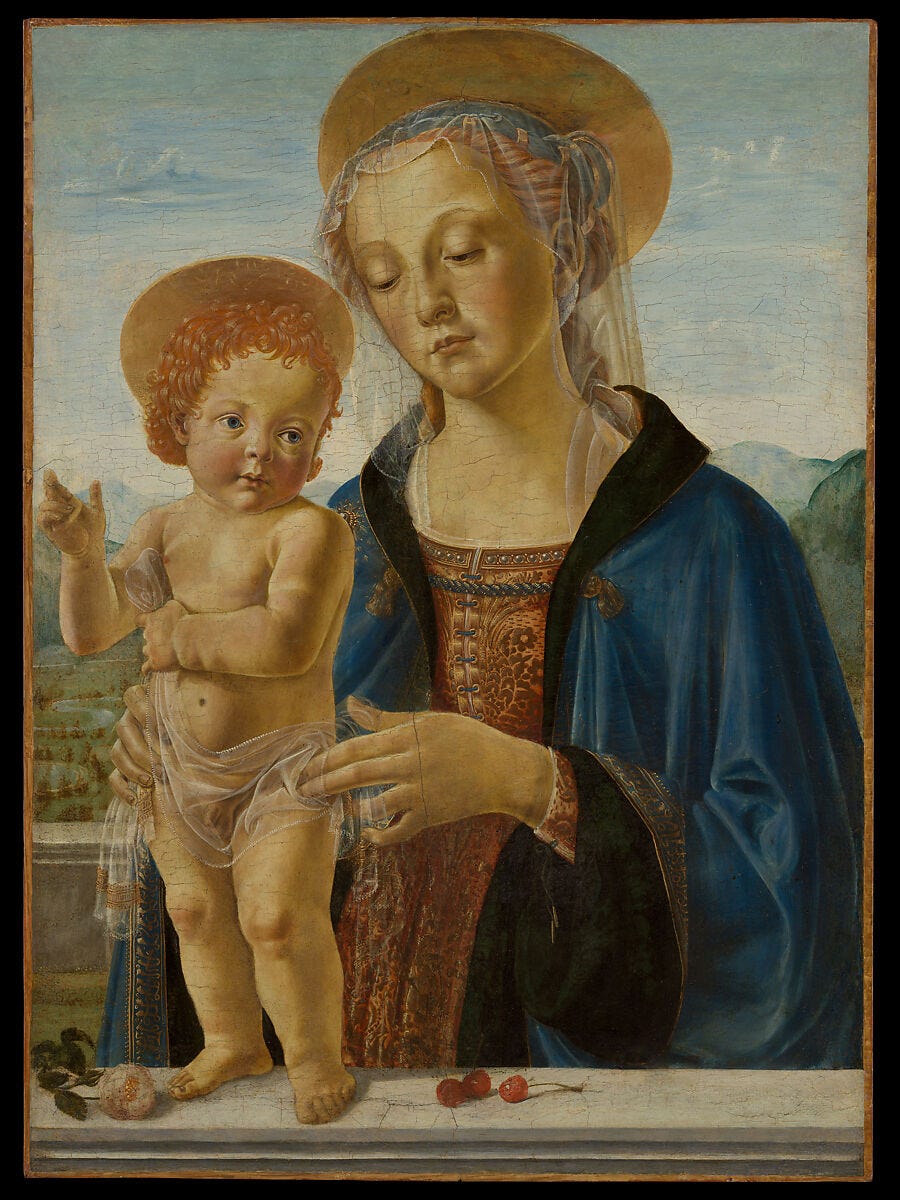
That desire, Scarry argues, is also self-abnegating. dErawing on the work of Simone Weil and Iris Murdoch, she uses the term “decentering.” To an extent I agree. Beauty draws me outwards – out of thought. On my flight home from Montreal, while trying to turn the original version talk into an essay, I caught the sunset reflected on the bottom of the clouds we were passing through, and the embers of the horizon, and forgot all about my writing. But my felt experience of beauty, of that sunset, of the Grecian urns, doesn’t feel like full self-decentering, and I’m not sure desire does either. It draws us out of ourselves, but also draws us into ourselves: something new is within, and changing us. It makes us want something that is outside ourselves, and also engenders a creative chaos within ourselves – the person we are, having encountered something or someone beautiful, is qualitatively different than the person we were before. We are, to push the simile further: the passive party in the encounter; the party that will undergo creative change. Beauty teases us out of thought – and out of its limitations. And, in that creative transformation, it does orient us towards a kind of generativity. We want there to be more.
But more what? More of the beloved; the beautiful? More of our own selves? Certainly not more of what we were before. My desire to create, when I see something beautiful, absolutely is not a desire for there to be more of (the old) me, or more of me at all. Whatever creation comes out of the encounter – if I am the Leonardo here, or the Pater – is wholly unlike, say, cloning, or copying. I do not want eternal, monumental presence. Rather, I want there to be space in the world for something that is both me and not me: a record of my encounter with otherness.
What I am always writing about, when I write my novels, and increasingly when I write everything else, too, are those moments of change: those epiphanies that in my lifetime at least, have come out of, or been evoked by beauty – whether it is the solace-inducing beauty of crystalline order, or the thrill-inducing beauty of what Burke has called the sublime. They are about, and come out of, and are written by someone who has been changed by, a generativity that is not merely self-reproduction.
But here’s the thing. My encounter with otherness is only worthwhile – it is only preferable to hermetic self-enclosure, say, noetic celibacy – if the rest of the world is worthwhile. If creation is worthwhile; if the world outside my imagination is as redeemable as imagination itself. Beauty, at its most profound,, feels like a marriage between me and creation. It teases me out of thought, and into an eternity that outstrips, but contains, my own interior world.
Beauty opens us to creative partnership with the world: a world that, if it is comprised of anything at all, is comprised of so much that not-us: other people, other patterns, other plants and animals and minerals and mountains and all the rest of it.
And I think the worldview that such an experience evokes in us – that there is something to creation, that there is something redeemable or perhaps even redeemed by reality, that it is worth living and making things and holding onto things not as a Schopenhaeurian distraction before our inevitable pointless death, that there is something in both us and the world worth reproducing, and also that we need not have such a tight hold on the people we think we are – is the right worldview to have. It is the worldview of falling in love. Beauty makes you fall in love with creation. I think it makes you aware of a meaningfulness to creation that is equal to your own private reality; indeed, it sacralizes your own private reality, too, because that too is part of what creation is.
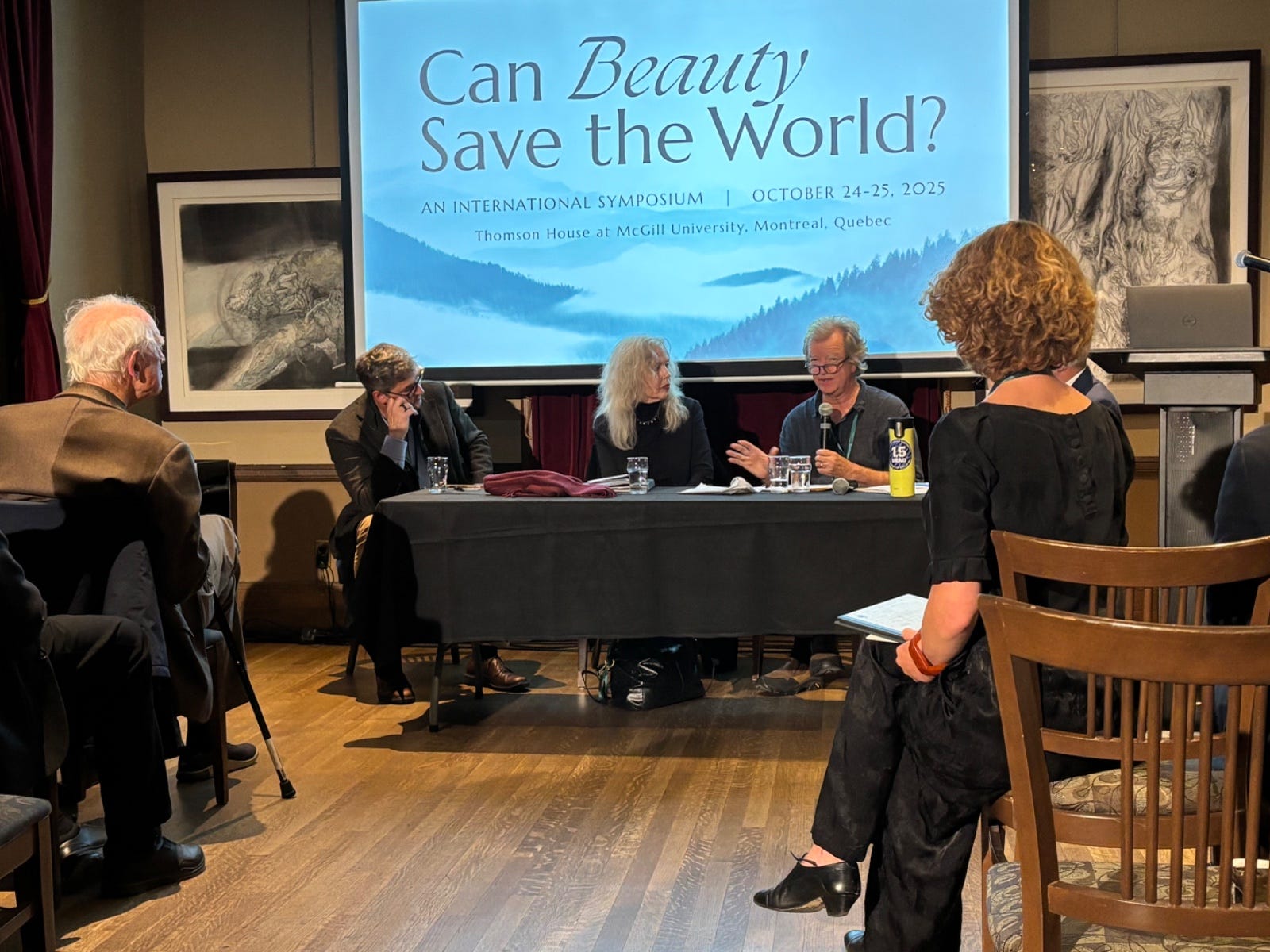
In his remarks on Friday, Charles Taylor emphasized the circularity of beauty: that the relationship of beauty and truth proceeds from first assumptions into which nobody can reason you. Beauty brings you into the eternity part of the equation – moving your affections so that you are disposed towards meaning. But you can’t move someone by telling them about beauty. It’s always a bit like telling an ineffectual joke in which you conclude, lamely, “you had to be there.” But beauty is what gets us to that there.
It gets us to a love for the world, and for what is in it, that our affections, our desires, our impulses, our erotic lives, can be pulled towards what I have elsewhere called wager on meaningfulness: the sense that things are worth doing, that creation is worth existing, even, trite as it may be, that life is worth living.
Thanks for reading The Lost Word! This post is public so feel free to share it.
What’s preserved, once you enter that circle of eternity, is an openness to, a curiosity about, and a hunger for an understanding of a richly textured reality: a reality better expressed by multiplicity and metaphor, in which everything means, and points to, so much else. Beauty gives us a reverence for both the creative process and creation itself that allows us to start thinking, in reverential and self-decentering and generative terms, not in the language of use and possession, if you can even call that a language, but in the language – as Taylor has written in Cosmic Connections – of symbols, of images, of correspondences between things. It helps us see creation as a language: a form of communication.
We live in an all too unreal era, or at least in one seduced by unreality. I’ve written about this too much elsewhere, but the greatest culprit, I think, is not “AI” itself, but rather an attention economy in which our desires are so easily if temporarily stoked and partially satisfied by a digital landscape that changes with us, rather than us changing with it. Algorithmic reality has primed us, and the generations coming up after us, to encounter reality as something entirely downstream of human thought and human imagination. If there is an erotic response to creation, on the Internet, it is fetishistic, maybe even masturbatory: a kind of sterile redoubling of self. There is nothing truly generated from the outside.
I have plenty of reservations about beauty, still – in particular, that beauty might lead us, through eternity, into the kind of Nietzschean erotic-aristocratic worldview. But I still think it can save the world, if it can teach us how to love it.
No posts
Comments
Nothing yet. Say the first thing.
Sign in to join the conversation.