
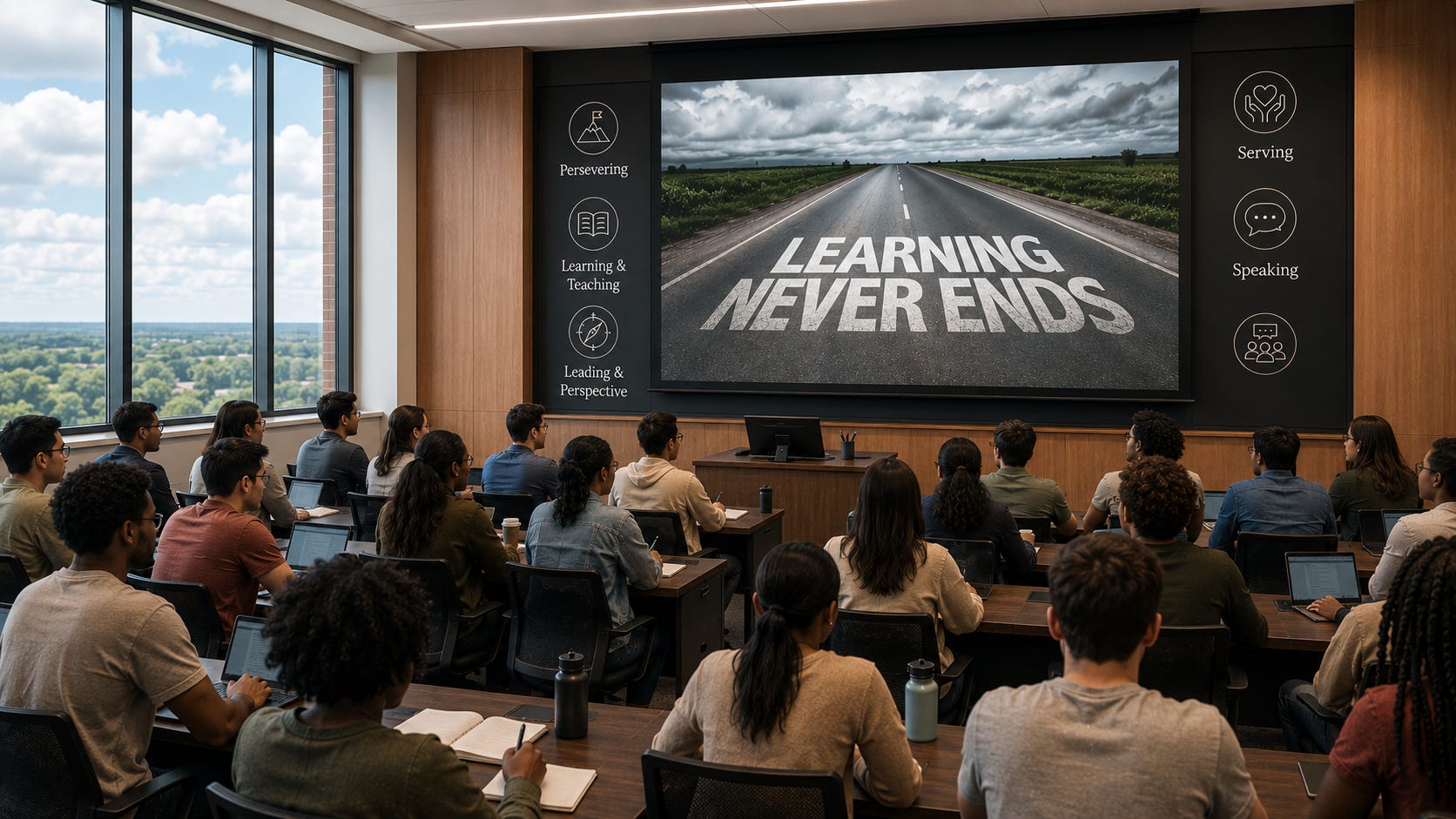
There is a connection between learning and teaching. In retirement, I wanted to allocate a chunk of my time teaching: MBAs, CEOs, managers. I felt this was a way to give back. There is no magic transition from the boardroom to the classroom. I have spoken to 20+ retiring CEOs who want to try their hand at teaching. I give them five suggestions:
You know less than you think. Teaching reveals what you really understand. It takes a year or two to hone your message.
Teaching is not only storytelling. You need to ask questions, build a dialogue.
Get thick skin; class evaluations are much tougher than a 360. After my first year, a student wrote, “Were your town halls this boring?”
No “Caddyshack” references. Very few students have seen it, and after 40 years, it isn’t as funny.
You will learn from watching your guests (in my case, other CEOs). In many cases, they drop their guard, and authenticity shows through.
To teach, you must stay current. My venture firm, NEA, employs 100 people, most of them in their 30s. Seeing new ideas through fresh eyes keeps you “young thinking.” I established a connection with young partners at NEA, becoming a mentor to many. They taught me about new waves of technology and the spirit of founders. Similarly, I learned a lot from my students at Stanford. I enjoy this young generation entering the workforce. They are kind and fun. The best ones don’t want “soft niceness” often associated with this era. They want to be challenged.
I partnered with Rob Siegel, one of the most popular lecturers at Stanford Graduate School of Business. Rob became an important person in my life. Rob had worked at GE, but we had never met. Nonetheless, he understood the GE context. Together, we built a popular second-year MBA class called Systems Leadership, about thriving through chaos. I connected with the students who appreciated seeing the reality ofbusiness leadership, that sometimes you scrape your knees.
We had three goals for the class. First, we taught skills to weather chaos. This included ecosystem analysis, owning a point of view, and managing cycles. Second, they saw leadership in action through the 100+ CEOs/Founders we brought to class. The best leaders demonstrated clarity and courage. Lastly, they could learn how to develop a network. I could teach the power of “relationships” ... bringing an all-star team of my peers to class.
Teaching is easy to do poorly, but hard to do well. I prepared 12 lesson plans each year. A typical one would be “decision-making.” There are thousands of books on decision-making, mainly written by those who never made one. I would start with what happened, but go deeper into “how and why” decisions are made. I would take them into the locker room on decisions that they had seen in the media; what worked and what didn’t. For an operator, teaching must translate your experience into useable tools. You want them to seek a path to good judgment; judgment won’t be replaced by AI.
Rob convinced me to share the bad things first. Students come for the glamour but stay for the grit. It took me a few years to be completely authentic. My students never tire of hearing my story about raising equity from Warren Buffett during the Financial Crisis. I would go “open mic” on GE stuff, and they could ask any question. In 2018, they would ask: Why didn’t you listen to your team and scrap the Alstom acquisition?By 2024, the question was: How did you have the courage to complete the Alstom acquisition?” This is also a lesson.
The stars of my class were my guests; I wanted to bring my students reality through their eyes. I have a strong network and could bring a wide range of leaders, from Ruth Porat to Roger Goodell to Khaldoon Mubarak. They would show that icons were human and fun. But I also wanted to show that humble leaders like Kathy Mazzarella (of Graybar) and Sam Hazen (of HCA) are just as impactful as any tech titan. My guests not only taught class, but they would host small dinners where we could “open up” for the students.
More experienced leaders should teach. This was an evaluation from my final year:
“This is one of those iconic GSB classes you hear about before coming and it fully lives up to the hype. A must-take. Robert and jeff make an incredible duo: their combined experience and insights really bring this class to life. It’s dynamic, thought-provoking, and packed with top-tier guest speakers from a wide range of industries, each tackling different real-world challenges. Learning directly from Jeff Immelt and his time leading GE is a rare and valuable experience.”
I tried to bring reality. One class featured Jesse Cohn, leader of the activist, Elliott. We had a student from Argentina who accused Elliott of harming her country. Without flinching, his reply, “Pay your bills, then you don’t have problems.” Learning is about facing stark reality.
I conducted 30 minutes of office hours with each student. I spent a lot of time listening. I really got my shit together in business school; I quit partying and committed to a path. I only tried to help them take a positive first step. Sometimes, those sessions would lead to me investing in their start-up. Graham and Michael Topol are brothers and GSB grads who founded an AI native insurance company. I’m an investor and on the board. I tell my network, “I will match you stride for stride; you work hard and I will work hard.” The Topols are working hard.
I looked around my class and the students were amazing! I knew they were developing a great network. But I would wonder: Are we teaching them to compete with China? Solve climate change? Lower the cost of healthcare? Build factories? Leverage AI to make companies more effective? One of my students (who was an ex-GE employee) wrote in the Stanford paper:
“My first week at work as a field engineer in Louisiana, I was put in a fake helicopter, dumped upside down in a pool and forced to swim out the window to practice escaping a helicopter crash. Over a series of four to five simulated crashes, more complexity is added to increase the difficulty. When I took too long on my third escape (after getting my life jacket caught on the seat belt and finding myself quickly running out of air), I was required to get back in and repeat the exercise until I did it right. And the people who didn’t know how to swim? They were right there next to me, held to the same standards.
My first week at the Stanford GSB, a group of my peers complained to the Academic Dean that a three-minute quiz was too difficult. The response? An extra minute on future quizzes and an apology from the instructor that she couldn’t make the questions easier.
One of these experiences taught me to push through challenges. The other taught me that with a little bit of noise, I could avoid difficulty entirely. Stanford is supposed to be a place where people learn to change the world, but my first week gravely concerned me. Changing the world is hard. Why was Stanford letting us off so easy?”
The MBA needs to be re-thought. It is too expensive; there are cheaper ways to build a network. Schools exist in a bubble; two years in Boston or Palo Alto don’t bring you closer to Dayton or Lagos. Students -- many of whom are 30 years old -- are discouraged from saying what they think. All of this can be fixed. However, the bigger issue with the modern MBA is that it is “mis-timed.” The “foundational courses” could easily be taught to 20-year-olds, particularly with AI support. The “electives” lack context because students can’t apply the tools in a timeframe to stay sharp. As a result, they are frequently bored; they aren’t being taught to compete.
Stanford is an amazing place, probably the world’s best university. If you want to launch a tech start-up ... go to Stanford. But I found that in other important areas like globalization, they were behind. Even the best schools can’t afford to be teaching from an old playbook.
MBA programs must refocus on impact. We should be building confidence to take big risk; self-awareness to lead people who are different than you are; and curiosity to see the world. We should be teaching students to: solve problems at scale; leverage the world of technology; and how to cut through the noise in a confusing world. We should be developing “life-long learners.” AI is a tool but will not replace “in person” interactions. They should be learning new tools for motivating others. We don’t need more bankers or consultants. I’m sure Stanford will get it right.
If not with an MBA, how can a founder, or leader, get better? Most companies have abandoned executive development. Start-ups have 20 HR people working on compensation for every one person in training. Silicon Valley has a network of “founder gurus.” But developing a psychological profile of a founder won’t create better execution or engagement.
My experience with MBAs and start-ups convinced me that mid-career training is even more important. In other words, meet people where they are ... when they are committed to skill building. This population needs tools they can use right away and practice. This is also when people can maximize their capabilities and understand their ambition.
Post-COVID, I launched an initiative to fill this gap. My goals:
Develop leaders in mid-career
Partner with CEOs to target talent and positions that create organization success
Emphasize “operator-led” training ... teaching skills and contemporary tools
Leverage digital tools and content to accelerate learning.
Fit their workflow ... integrate with their peers
Build a network with other companies and cultures
Price at a level where company could get a fast payback
Be a very hands-on coach
I didn’t have this in mind when I retired from GE but felt compelled to fill a gap that offered no viable substitute today. I do this as a service, not to make money. Together with Kimberly Kleiman-Lee (ran GE’s leadership programs at Crotonville), we launched a 7-month development series for senior leaders at start-ups and public/private companies ... called the Performance Acceleration Journey (PAJ).
Before launching, I interviewed 20+ HR leaders from public and private tech companies. They believe AI will create fewer promotional opportunities, even for the best people.
Therefore, executive development has multiple benefits for retention and culture. HR leaders ... even from digital companies ... didn’t want online learning. They wanted their leaders to develop communication and networking skills. Our goals aligned with their needs: give leaders an immersive learning experience, tools they can use Monday with an expanded peer network to leverage for support. This is from a recent PAJ graduate:
“What stood out most is how immediately actionable the PAJ learning is. I’m already applying these frameworks and practical insights from Jeff’s executive network to how I think about leadership and decision making. Learning alongside such high-caliber peer group made the experience and even more impactful. Thank you!!”
Our target audience is operating leaders, maybe two layers below the “C-suite.” They have the biggest need and the biggest impact on performance and engagement. Our GE backgrounds give credibility to a training model. Crotonville is still referenced byleaders, even those who didn’t work for GE. And GE alums reference this experience as catalytic for their career. PAJ is their Crotonville.
I care about the content and the teachers and want it to feel different than other training. I teach 15 hours to each cohort ... they see my commitment. We bring a collection of academics, operators, founders, CEOs, and investors; and can target the lessons to achieve maximum value. They get to learn from peers and teammates. I have sat in their chair and can identify with their CEOs. I want them to grow their competency and ambition.
Our cohorts include leaders from tech, financial services, healthcare, aviation; they are public and private. We even have a team from the Saudi Ministry of Health. I lean into my network to bring in the best teachers. For strategy, we bring VG Govindarajan, the most popular teacher at Tuck. For operations, we have Jeff Bornstein, former CFO of GE. On leadership, we bring John Donahoe, three-time public company CEO. Kimberly teaches self-awareness, grit, and healthy team dynamics. What good is a network if you can’t use it for others?
In a recent phase, we gave our students a deep dive on AI. We can bring together: academics teaching foundations and data/decision making; founders who outline AI disruption in legacy industries; CTOs from legacy players driving AI outcomes; CEOs driving culture change to leverage AI investment. We ended the day with a fireside chat from a NVIDIA board member. Our goal is to replace fear with competency.
PAJ can be faster than business school and more targeted in delivery. For AI, thousands of managers must be trained immediately. In most professions and industries, new technologies must be applied by people who understand outcomes. In this world, investments in development have immediate impact.
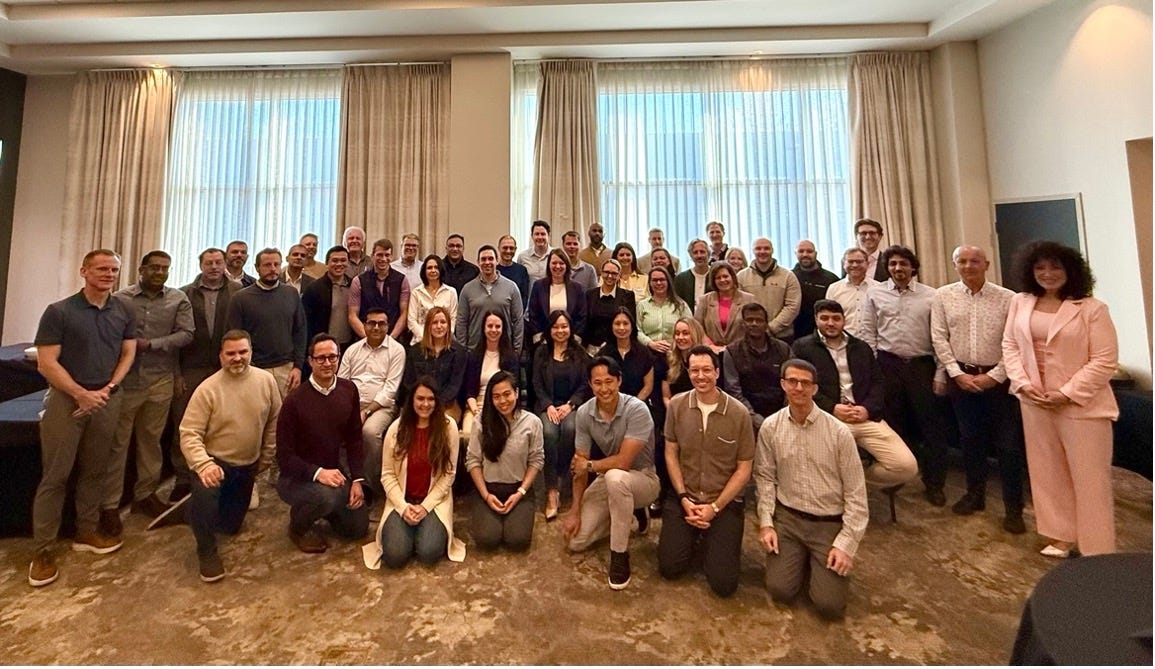
I know PAJ is filling a need. It will also be ever-evolving, by design. We want it to be practical and relevant. I welcome your ideas and help. How can we make it better? So many people helped me. I grew up in a company that valued education in a learningculture. In my second life, I have learned how to teach. I want to find a better way.
TLV Tips:
Teaching is a great way to give back when you have more time. It is hard to do well. In my case, having co-teachers is important; I learned from them.
Schools exist in a bubble, so they need operators to bring practicality. This is particularly important in this moment of macro volatility. But operators should learn to teach. It is different than a town hall.
Business education must be rethought, particularly in the age of AI. Leaders must understand technology and change management. More importantly, we must sharpen old skills like globalization. AI will not solve everything.
Mid-career (ages 35-45) offers an important window for development ... and is largely unserved. Here, leaders can explore ambition and companies can unlockperformance. Curate content that can be practiced quickly.
Companies need to position development in the context of a comprehensivebenefits package. In the future, there will be fewer manager roles. Talented leaders should look for companies willing to invest and develop them as part of their overall comp and benefits package.
We tend to believe that the next generation would love to work for ten companies; that they are mercenaries. Both from MBAs and PAJ, I feel like that is not true. They want to work for companies that are trying to win, where human development and culture are prioritized. We need to do better. Let’s keep exploring.
Comments
Nothing yet. Say the first thing.
Sign in to join the conversation.