
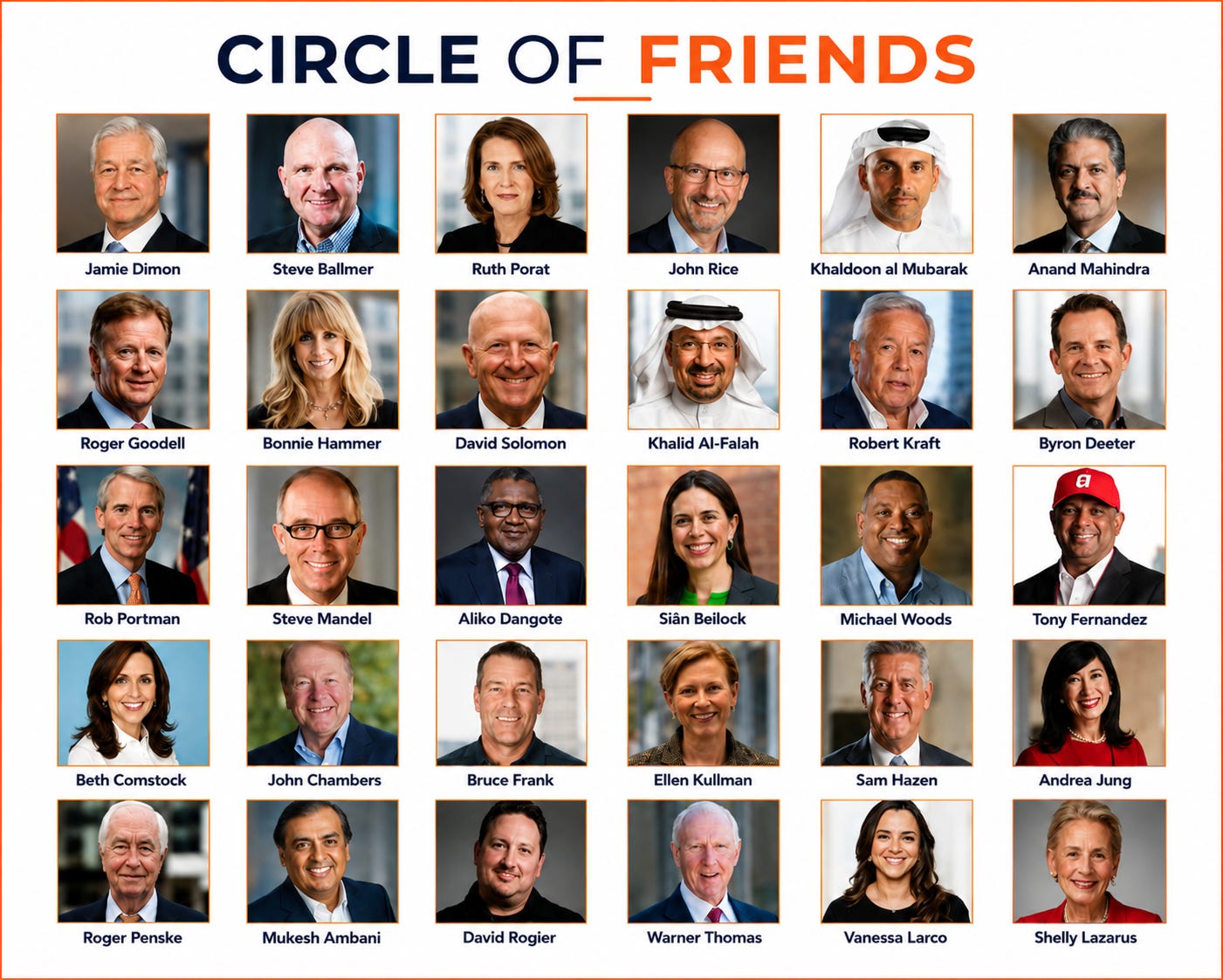
One of the most important business skills is not taught in a classroom; nor is it featured in leadership books. The lesson: how to build a strong network based, one that can weather personal cycles ... how to make friends.
Without thinking, I had prepared for tough times. I had done a million favors when I was on top, asking for nothing in return. I had been a good peer, a friend to many. Those favors came back to help when I struggled.
It may seem obvious, but you see the best and worst in people when you are on the bottom. Your best friends know what they have “seen” in you and do not believe what they read. But there are plenty of “haters” who take joy in your pain.
I would tell my Stanford students: “There are some things you can learn from me and things you should never learn from me. But I will bring you a Top Ten Network.” I was able to recruit 100 CEOs/founders into my class at Stanford. All were friends. My students may have read a few bad things about me, but when Ruth Porat or Roger Goodell said, “he is ok,” it worked.
Building a Network
Your friendships last forever. I built a great network from 35 years at GE. I know thousands of people around the world by their first name. My network multiplied when I hit the west coast. At NEA, other venture partners included: Hilarie Koplow-McAdams, an Oracle/SFDC commercial leader; Mark Hawkins, CFO from Dell and SFDC; Brooke Seawell, a board member at NVIDIA for 30 years; Greg Papadopoulos, former CTO at Sun. I was surrounded by teachers; they became my friends. They were all icons in the community.
Quickly, my network expanded further to include Silicon Valley royalty: People like Byron Deeter (Bessemer), John Doerr (Kleiner Perkins), Mike Spieser (Sutter Hill), Jeff Epstein (Oracle), John Chambers (Cisco), and Elena Donio (Twilio). They also became friends. Look, they all valued and respected GE. At a high level, leaders understand that frequently what is written is wrong ... because they have put up with the same shit. This is an important point. Haters travel with other haters; they love to read angry words from anonymous sources. I weathered two terrible books, filled with anonymous quotes. After they were published, I never received one negative text or email, only support. Haters are lazy. So if no one follows haters, why not be a friend?
On the last day of class, I say to my students that your success is determined by three things: how much you learn every day; how fully you can give to others; and will you persevere on the bad days. If you give to others, it will be repaid over time.
A network is an asset and a differentiator. It must be built naturally and purposefully and continuously. Relationships are built in person. You can add followers online, but you can’t make friends. You must work it every day. I never had an agenda, but I liked people. In the end, my network worked!!
TLV Tips:
See everyone ... all the time. I refereed Jamie Dimon’s basketball games at Harvard Business School in 1981. He yelled at me, but we liked each other. Later, I introduced him to his future wife. Ellen Kullman shared an office with me at GE in 1982. We watched each other’s children grow up. These relationships last a long time.
Stop looking busy ... If you are at a party ... talking to someone ... but looking over their shoulder ... you are not networking. Don’t wear a watch or any device that makes you seem busy. Stay in the moment. The person in front of you is the most important in the world. This is a comment I make to a young investor texting during a founder presentation, “I was responsible for 300,000 people in 110 countries ... I could pay attention to people. So can you.”
Lead with questions and an intent to learn ... making someone a teacher builds common ground. You connect more from listening than speaking. I learned a ton from Dave Cote early in my career ... about operational leadership.
Be known for substance. Frequently, people think networking is about “glad-handing.” Good people want to hang out with depth. In other words, be well read; speak in turn; and bring a point of view.
Communicate when you don’t need anything. Try a phone call or a text that starts with ... “Did you see?” or “What do you think?” If every call starts with “Can you do me a favor?” ... you are not making friends.
Do favors, without expectations ... particularly on the tough days. Say “yes” to speaking engagements, coaching sessions. Respect the little things. I created a GE Day at Penn State right after the Paterno crisis. I didn’t have to, but that action said, “I’m a friend.” You always remember the person who answers the phone when no one else will.
Go to the hard places, not to be seen. I traveled a lot. Networking events are not “fat-cat confabs” in ski resorts. You may “see” people, but you are not “meeting” them. Nigerian business leader, Aliko Dangote, is my friend because I met him in Lagos. Want a good network? Log the miles.
Be intense or fun or generous (or all three). People who aren’t smart ... or are assholes .... tend not to be good at networking. Michael Milken is massively intense ... not a joke teller. He can convene the best group of investors in the world. But it helps to be fun. I integrate into every community. I play golf on Sunday mornings with a crew of “mid-40s” executives from Netflix, Apple, Google, and some startups. They know who I am ... they receive some free coaching a long as they give me a few five-foot putts. In the Valley, everybody looks for help: every interaction is a coaching session.
Be generous. Help others first. The primary purpose of a network is to help others. If you have “banked a lot of favors,” they will come your way when you need them.
Don’t be a hater. This is especially true for social media. Your network will include fellow haters, not friends you need over your life. Kindness beget kindness ... hating brings a different reward. Have a hopeful world view. People don’t want to work for -- or hang with – dark souls. See potential in everyone; want the best for them.
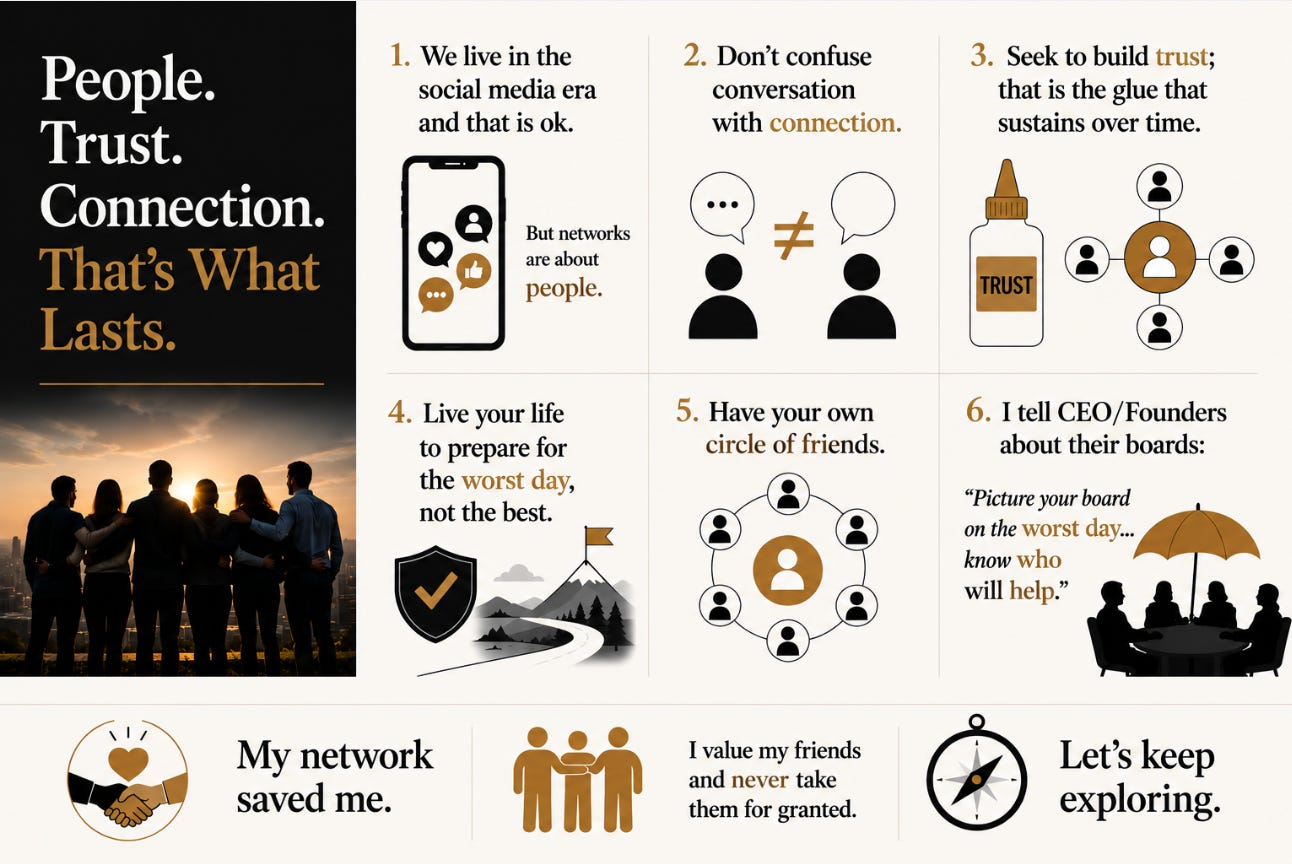
We live in the social media era and that is ok. But networks are about people. Don’t confuse conversation with connection. Seek to build “trust;” that is the glue that sustains over time. Live your life to prepare for the worst day, not the best. Have your own “circle of friends.” I tell CEO/Founders about their boards: “Picture your board on the worst day ... know who will help.”
My network saved me. I value my friends and never take them for granted. Let’s keep exploring.
Comments
Nothing yet. Say the first thing.
Sign in to join the conversation.