
I came across a recent X or Twitter post of Peter Turchin replying to silliness by the economist Noah Smith:
“Can someone explain to me why we still need Russia? What are some reasons that Russia is a good country to have around? Why wouldn’t it be better for China to take over the resource-rich parts, and for the densely populated Western parts to become a regular European country?”
Turchin replied in a measured way, thus kindly trashing the neoconnish Smith:
The answer to this question depends dramatically on who is “we”.
1. For the American ruling class (especially in its pre-Trump configuration) the world hegemony has been extremely lucrative, so it’s in their interest to keep Russia (and China) as weak and hopefully even fragmented. Opinion expressed by people like
2. For common Americans: actually don’t care. However, they are who bear the costs of American empire without benefiting from it, so their preference is to shed it. Opinions of people like
3. For Russia’s ruling class: they need a strong Russia so they don’t have to follow Washington’s orders to their detriment and to exploit the natural resources of Russia for their own benefit. Opinion of people like
4. For the Russian people: the costs of Russian empire are substantial, but the benefits outweigh it, on balance. Russia has always been in a tough geopolitical neighborhood (since 9th century, at least) and Russians need a strong state to protect them. The second and considerable benefit is to preserve Russian language and culture. It is now largely forgotten, but the root cause for the War in Ukraine was that Russians in Donbass wanted their children to learn Russian. Opinions of people like
His four quoted paragraphs are a good look at who and what needs the war (that would be in para 1, and Mr. Smith is part of that demo.
Anyway, apropos of nothing, I remembered a book I reviewed for the December, 2020 edition of the Sturbridge Times Magazine which sadly would succumb during the pandemic.
I enjoyed his Ages of Discord and the review is below:
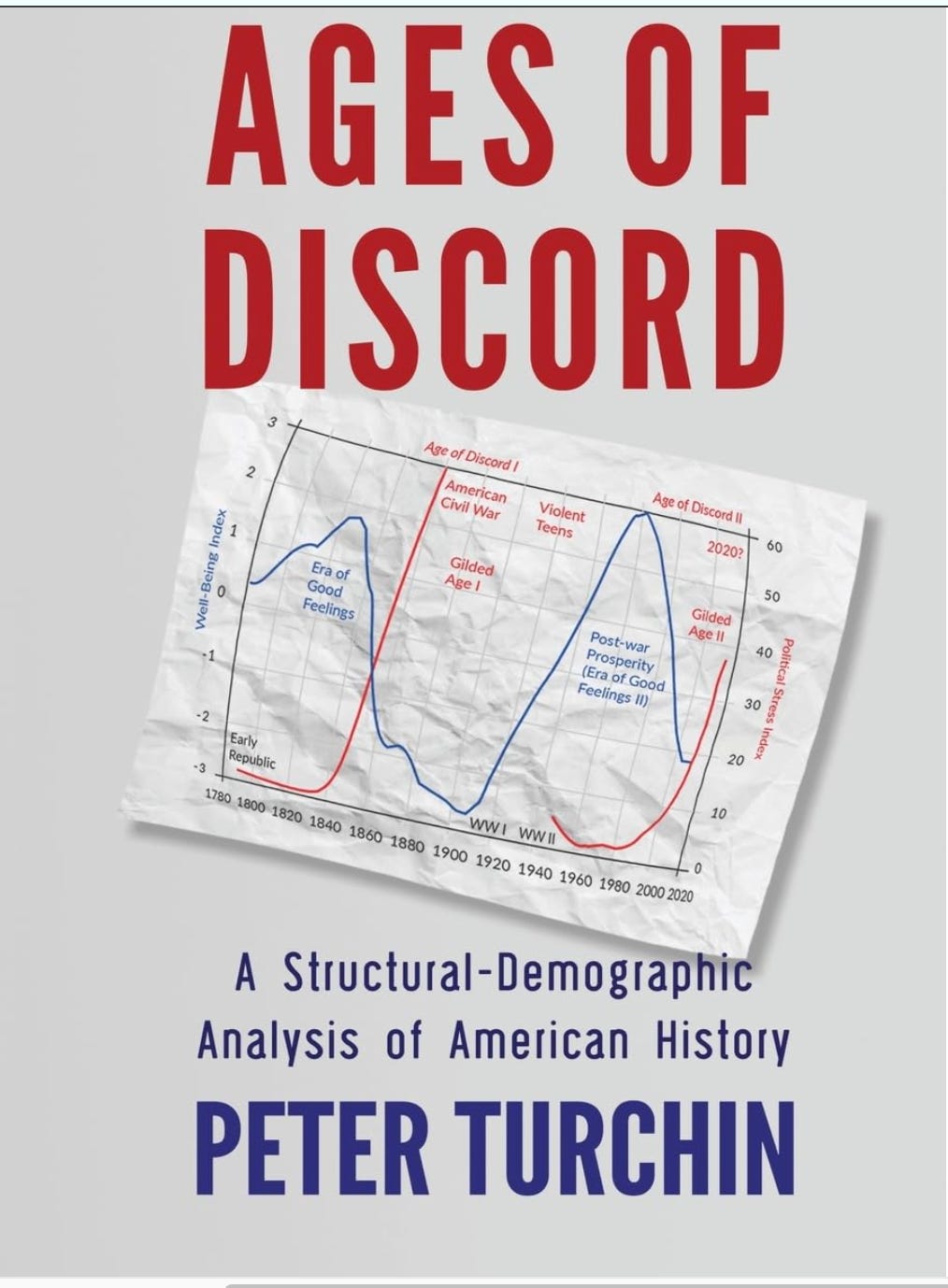
Ages of Discord: A Structural-Demographic Analysis of American History By Peter Turchin
In the 1960s a woman named Jeane Dixon became a small cause célèbre. Ms. Dixon predicted the death of President John F. Kennedy a few years before his election. Apparently, she did, but the whole thing was a bit murky. No matter, she was able to dine out on it for years.
Her track record was mixed, but it would be difficult to check up on her as she claimed inspiration from God and the Supreme Being refused comment.
Peter Turchin is no psychic but he does look at the future. The headline of an article he wrote for a Canadian Newspaper says it all, “I predicted 2020 would be a mess for the U.S. Could that help prevent a second civil war?” As far as one can tell, he does not claim divine guidance. Rather he uses data and math, lots of it.
This does not mean one has to be able to follow arcane equations to obtain anything from his Ages of Discord: A Structural-Demographic Analysis of American History. Published in 2016, it is the book that predicts we are in for a bumpy ride in the decade beginning this year.
Mr. Turchin did not just wake up one day thinking America is on its way to hell in a handbasket and I’m going to write about. He has been around for some time coming up with his theories and backing them up.
Turchin is a professor at the University of Connecticut in the Departments of Ecology and Evolutionary Biology, Anthropology, and Mathematics and he is the founder of a “new transdisciplinary field of Cliodynamics, which uses the tools of complexity science and cultural evolution to study the dynamics of historical empires and modern nation-states.”
His Cliodynamics discipline claims to make the study of history a science. Now, your reviewer looks at the field of Political Science to be a bit of a fraud when it appends science to what should be called Political Studies, but we are willing to give the man a break and he might have something in the array of databases and the use of math. As is said, the proof is in the pudding.
Others have claimed to see patterns in history and some have done well enough without a scientific background.
One of the most entertaining was Sir John Bagot Glubb. Glubb, or Glubb Pasha as he was known to his troops was a British officer seconded to run the Jordanian Arab Legion early in its history. Professional soldier that he was, it never kept him from being a scholar.
His The Fate of Empires and Search For Survival is available on the web in PDF format and is well worth a read.
Like Turchin, Glubb saw danger for states over time. Sir John looked at many empires* and it seems that they kind of run out of gas at around the 250-year mark. Guess where we are? I tend to agree with Glubb. Do I also agree with Turchin?
What sends a country down the road to perdition? It is not the poor rising up to tear apart the shackles. It never is. George Orwell made that point easily enough in 1984 when after Winston Smith wrote in his journal, “If there is hope, it lies in the Proles,” he realizes they are too easily diverted and will never come together to successfully revolt. The lower orders never do, even in revolutions carried out in their name.
What or who does Turchin see as the cause of upheaval? Intra-elite competition would be the driver. Indeed, that makes complete sense if it is not the proles that rise up, then it can only be the upper middle and upper classes fighting over what’s available.
As markers for this competition he uses the proxy of the over-supply of law students who aspire to careers in prestigious firms or the upper reaches of business or congress and even higher. The author also cites MBA candidates seeking wealth through a prestigious degree. The numbers are such that there can only be disappointment or dissatisfaction among many who see themselves worthy to lead. Excessive competition among elites leads to lessening of cooperation among that class and Turchin notes that that is evidenced by the decreasing use of the word “cooperation” when one does a google ngram search over time.
Peter Turchin has divided eras into what he calls secular cycles. They operate through history with different parameters depending on the country. For us there are two, one that has been completed and the one we are in now.
The first cycle began in 1780 and progressed to the Era of Good Feelings when during the Monroe administration the country came together swimmingly. After that, things gradually deteriorated to the civil war.
We are now in the second secular cycle that began in 1930, and saw what was a second era of good feelings beginning in the 1950s and we are now about where we were at the eve of the Civil War with an analogous level of discord, if not as bad.
His data is such that it seems to fit. I won’t say he scares me, as I was already hiding under the bed.
Turchin cites his Instability principle, “The final general principle connects sociopolitical instability to demographic-structural pressures. In order of importance, these pressures are (1) elite overproduction leading to intraelite competition and conflict, (2) popular immiseration, resulting from falling living standards, and (3) the fiscal crisis of the state … shows that there is a strong positive relationship between instability and a measure that combines the first two pressures, elite overproduction and popular immiseration. I focus here on the first two factors because the fiscal crisis of the state is not always present as a factor contributing to the sociopolitical instability,,,”
A pandemic that the financial organs of the government are throwing money at sounds close enough to a “fiscal crisis of the state” for me.
At the end of the book, the figures he pulls together for his Political Stress Indicator (PSI) are off the charts, metaphorically,
“What we see is that the PSI was an accurate leading indicator of rising tide of political instability in the Antebellum America, which culminated in the American Civil War. As to the present, we live in times of intensifying structural-demographic pressures for instability. The PSI has not yet reached the same high level that triggered the Civil War of 1861-65. However, its explosive growth should be a matter of grave concern for all of us—our economic and political elites, as well as the general public. Will we be capable of taking collective action to avoid the worst of the impending demographic-structural crisis? I hope so. More, I hope that the theory and data explained in this book will contribute to finding solutions that will help us find a non-violent escape from the crisis.”
This the most unique time in my life with the Pandemic completely altering existence. How that could have entered his calculations is hard for a reader to say, but here we are. There are still several decades left in the second cycle. Barring a revolution in medical science, we shall not be able to verify the complete validity of the theory.
Will his prognostication be as accurate as the last prediction of Jeanne Dixon? On her deathbed she said, “I knew this would happen.”
*For all practical purposes, a nation as powerful as ours is an empire whether we call ourselves one or not.
No posts
Comments
Nothing yet. Say the first thing.
Sign in to join the conversation.