
Hello everyone,
Hope you are doing well — both in markets and in life.
When most people think about pharmaceutical companies, they imagine strips of tablets sitting inside a medicine cabinet.
But some of the most important medicines in healthcare never reach a pharmacy shelf. They are not consumed after breakfast or taken for everyday illnesses. Instead, they are injected directly into the bloodstream of patients in hospital ICUs, cancer wards, operation theatres and fertility clinics.
Manufacturing these medicines is fundamentally different from making tablets.
Every vial is produced inside highly controlled sterile facilities, where air quality is constantly monitored, temperatures are precisely regulated and every stage of production follows strict quality standards. A small contamination issue can compromise an entire batch and, more importantly, put patient lives at risk.
Unlike oral medicines, injectable drugs bypass the body’s natural defence mechanisms and enter the bloodstream directly. This leaves very little margin for error. This makes injectable pharmaceuticals one of the most specialized and tightly regulated segments within the pharmaceutical industry, requiring advanced manufacturing capabilities, years of technical expertise and rigorous regulatory compliance.
Despite this complexity, injectable pharmaceuticals remain a segment that many investors rarely explore.
Explore the Three-Generation Journey
For investors looking at Gufic for the first time, the business can appear complicated. The investor presentations are filled with unfamiliar drug names, technical manufacturing terms and regulatory details, making it difficult to understand the actual business behind the numbers.
But don’t worry, your favourite analysts are here to simplify the story.
Through this deep dive, we will break down Gufic step by step — starting with understanding the company’s business model, revenue engines, product divisions, customer base and the capabilities that differentiate it. We will explore how specialised areas such as sterile manufacturing, lyophilization, regulatory approvals and decades of process expertise can create a sustainable competitive advantage for the company.
These are the questions this first part aims to answer.
Before analysing future growth drivers, the Indore facility, export opportunities, financial projections or valuation, it is important to first understand the business and the industry it operates in.
Only with that foundation, we can properly evaluate whether Gufic Biosciences has the capabilities to create long-term value for shareholders.
So grab a cup of chai, settle in, and let’s begin with the most important question:
What exactly does Gufic Biosciences do, and why has it chosen to specialize in one of the most complex and tightly regulated segments of the pharmaceutical industry?
A quick note before we begin: This deep dive has been co-written with Ameya Deosthali . Many of the ideas and frameworks explored in this report emerged from our discussions around injectable manufacturing, regulatory barriers and first-principles thinking. If you enjoy detailed business research and long-form company deep dives, do check out his Substack - the link is provided below.
Subscribe to valueequity"s substack
Disclosure: One or both of us may hold a position in Gufic Biosciences. While we’ve done our best to remain objective, our views may naturally carry some bias. As always, treat this report as a starting point for your own research—not as investment advice.
Imagine a patient in an ICU battling a life-threatening infection. A nurse opens a small glass vial, injects sterile water into it, gently shakes it, and within seconds, a life-saving medicine is ready to flow through an IV line.
What most people never see is where that tiny vial came from.
There is a good chance it was manufactured by Gufic Biosciences. Not because the patient recognizes the company’s name—they probably don’t—but because Gufic specialises in manufacturing some of the most complex injectable medicines used in hospitals.
Unlike tablets or syrups, many critical medicines especially antibiotics, antifungals, and certain hormones—are too fragile to remain stable as liquids for long periods. If stored in liquid form, they gradually lose their effectiveness.
The solution is lyophilization—a specialised pharmaceutical freeze-drying process.
Imagine buying fresh strawberries. Leave them on a kitchen counter for a week, and they spoil. Now imagine freezing those strawberries and removing almost all the water while preserving their structure. They become lighter, more stable, and capable of lasting much longer. Add water back later, and they return remarkably close to their original form.
Instead of a strawberries, scientists start with a liquid medicine. It is first frozen to extremely low temperatures, after which the frozen water is removed inside a vacuum chamber without damaging the medicine’s molecular structure. What remains is a dry, sterile powder that can remain stable for years. When the medicine is finally needed, a doctor or nurse simply adds sterile water, restoring it to its original liquid form moments before administration.
The concept sounds simple.
Executing it at industrial scale is anything but.
Every stage of the process—from freezing and drying to filling, sealing, and packaging—must happen in highly controlled sterile conditions. Even tiny variations in temperature, pressure, or contamination can spoil an entire batch. This makes lyophilized injectables one of the most technically demanding categories in pharmaceutical manufacturing.
That manufacturing complexity is exactly where Gufic has built its business.
Rather than competing in mass-market pharmaceutical products, the company focuses on complex injectable medicines where specialised manufacturing know-how creates significant barriers to entry. The harder the product is to manufacture, the fewer companies can produce it consistently and at scale.
In other words, Gufic’s competitive advantage isn’t just the medicines it sells—it’s the ability to manufacture medicines that very few others can.
This specialised manufacturing capability forms the foundation of Gufic’s business model. But owning the expertise to produce complex lyophilized injectables is only the first step—the company monetises this capability through multiple channels across the pharmaceutical value chain.
Gufic’s business is built around four revenue streams: Domestic Branded Formulations (selling its own brand injectables in India), International Formulations (exporting finished injectable products), CMO/CDMO (manufacturing for other pharmaceutical companies), and APIs/Bulk Drugs (producing the active ingredients used in medicines).
While the first three segments represent the company’s core growth engines, APIs is a smaller but strategically important business that supports backward integration,and improves cost efficiency over time.
Together, these segments leverage the same specialised foundation—Gufic’s expertise in sterile injectable manufacturing and lyophilization. Let’s look at each segment in detail.
Gufic’s largest business is its Domestic Branded Formulations segment, where the company develops and sells injectable medicines under its own brands across India.
Unlike a pure contract manufacturer, Gufic owns the brands, markets them directly to healthcare professionals, and captures a larger share of the value chain. Its products are sold to hospitals, nursing homes, IVF clinics, aesthetic centres, and chemists through a nationwide field force of more than 1,000 medical representatives, who engage with over 30,000 prescribers across 15+ therapy areas.
The company’s portfolio spans several specialised therapeutic areas, including Critical Care (anti-infectives), Fertility & IVF, Women’s Health, Botulinum Toxin, Aesthetic Medicine, and Nutraceuticals. These are therapies where injectable medicines often play a critical role due to their faster onset of action, greater precision, or the specialised nature of treatment.
Each of these divisions caters to a distinct set of doctors and healthcare institutions, with its own product portfolio and growth drivers. We will explore these therapeutic segments, key brands, and their role in Gufic’s business in the next section.
During FY26, Gufic also made an important adjustment to the distribution approach for parts of the Critical Care and Sparsh businesses. While this temporarily impacted reported revenues, it was aimed at improving working capital efficiency and strengthening the quality of growth. We will discuss this strategic reset in detail later in the thesis.
For now, the key takeaway is that the Domestic Branded Business remains Gufic’s largest revenue engine, giving the company direct access to doctors, hospitals, and end customers rather than only participating as a manufacturing partner.
Gufic exports finished injectable formulations to more than 20 countries across Europe, Latin America, Africa, Southeast Asia, and the Middle East.
The company is increasingly focusing on expanding its presence in international markets where specialised injectable products can achieve better realisations and stronger margins compared to conventional domestic sales.
Historically, exports were largely driven through distributor partnerships, where local players handled market access and sales. However, Gufic is gradually moving towards a model where it has greater control over product registrations and commercialisation in overseas markets.
The broader objective is to move beyond simply supplying products internationally and build a stronger presence in markets where complex injectable formulations command higher value and stronger margins.
Gufic’s CMO/CDMO business allows the company to monetise the specialised manufacturing capabilities it has built over decades.
Many pharmaceutical companies may have their own drug molecules or brands but do not want to invest in expensive sterile injectable facilities, regulatory infrastructure, and lyophilization capabilities. Instead, they outsource manufacturing to specialists like Gufic.
Under this model, the client provides the molecule or formulation, while Gufic provides the manufacturing infrastructure, sterile production expertise, quality systems, and lyophilization capability required to produce the final injectable medicine.
The company manufactures products for more than 70 pharmaceutical partners and has developed over 150 injectable products through these collaborations. Its customer base includes leading pharmaceutical companies such as Abbott, Cipla, Sun Pharma, Biocon, Lupin, and Hetero.
This segment is strategically attractive because the major investment is made upfront in facilities and technology. Once capacity is established, additional orders improve utilisation and can contribute meaningfully to profitability.
The company is also exploring newer opportunities in complex injectable categories, including products such as GLP-1 therapies like Semaglutide, which could become an additional growth avenue over time.
Along with finished formulations, Gufic also manufactures active pharmaceutical ingredients (APIs) — the core components responsible for a medicine’s therapeutic action.
While the segment contributes a smaller share of revenue, it plays an important strategic role by improving supply-chain control and reducing dependence on external suppliers for critical inputs.
Gufic manufactures APIs across areas such as antifungals, antibiotics, anaesthetics and fertility-related therapies. Currently, a significant portion of API requirements are outsourced, but the company is gradually increasing backward integration with the objective of reducing external dependence.
Management aims to bring outsourced API requirements down from around 65% currently to approximately 50% over time.
Although APIs may not become a major revenue growth driver, greater integration can improve cost control, margins and strengthen Gufic’s overall injectable manufacturing ecosystem.
Together, these 4 segments create a vertically integrated pharmaceutical business: Branded medicines provide market access, international expansion opens new growth opportunities, CDMO monetises manufacturing expertise, and APIs strengthen supply-chain control. All four businesses ultimately benefit from the same core capability - manufacturing complex injectable medicines that few companies can produce at scale.
Understanding Gufic’s business becomes easier when we move from the manufacturing process to the products themselves.
The company’s domestic branded business is divided into specialised healthcare segments, each serving a different ecosystem—from hospital ICUs and critical care departments to IVF clinics and specialty centres. These divisions are where Gufic builds its own brands, develops relationships with doctors, and captures value beyond manufacturing. Let’s dive deeper in each segment.
Revenue Run Rate: ~₹200 Cr
Who buys it: Hospitals, ICUs, infectious disease departments, oncology centres
Critical Care is Gufic’s legacy stronghold and one of its most important business divisions.
To understand this segment, imagine a patient in an ICU battling a severe infection. In such situations, standard medicines may not be sufficient, and doctors often require specialised injectable therapies that can address complex and life-threatening conditions.
For example, patients suffering from sepsis — a life-threatening condition where an infection spreads throughout the body — may require advanced antibiotics. Similarly, cancer patients undergoing chemotherapy or individuals with weakened immune systems can develop serious fungal infections that require specialised antifungal treatments.
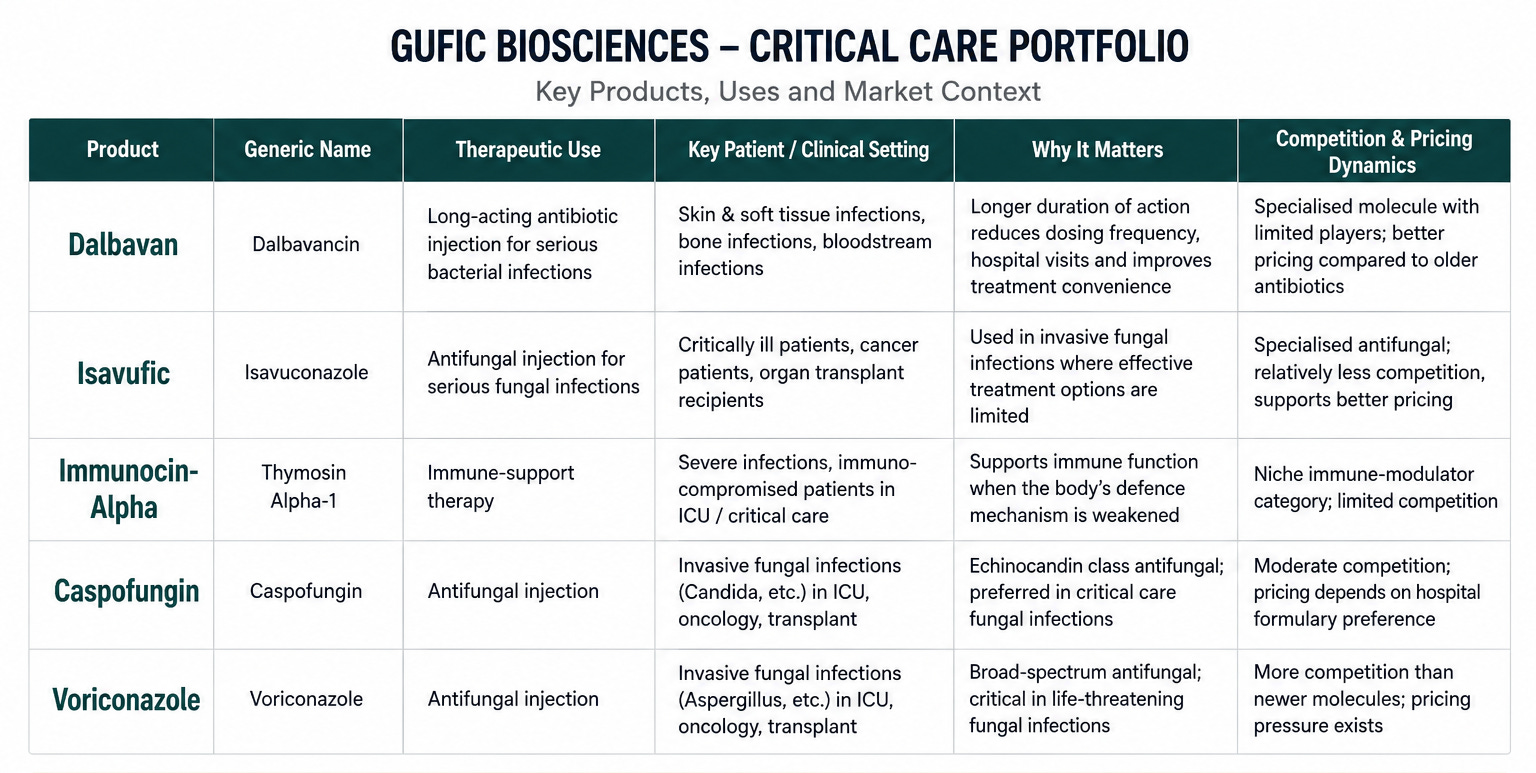
This is where Gufic focuses its expertise — providing injectable antibiotics, antifungals and immune-support therapies used in critical hospital settings. The division operates through three key sub-brands:
COX focuses on antifungal therapies and treatments for difficult-to-manage infections.
MycoCare specialises in fungal infection treatments used for high-risk patients requiring advanced care.
PrimaCare focuses on immunomodulators and other critical care-related therapies.
Management has highlighted that the company follows a hospital-first and science-led approach in this segment, focusing on therapy areas where treatment protocols and clinical requirements drive demand.
“In Critical Care, our approach remains hospital-first and science-led. We concentrate resources where protocols drive segments — sepsis, resistant infection, invasive fungal diseases.”
Some of the important products in this division are highlighted in below snapshot .
The Pricing Challenge in Critical Care
Not all critical care products have the same economics. Mature molecules such as Vancomycin and Pantoprazole face increasing competition, leading to annual price erosion of around 5–7%. As more players enter these categories, pricing pressure remains a challenge. Gufic balances this through specialized products and launching newer molecules where clinical requirements are higher, manufacturing complexity is greater and competition remains relatively limited.
While the Critical Care division focuses on what medicine is being delivered, Sparsh focuses on how that medicine reaches the patient.
In a traditional hospital setting, many injectable medicines require multiple preparation steps before administration. A healthcare worker may need to open a vial, mix the medicine with a separate liquid, prepare the correct dose, and then administer it to the patient.
Every additional step creates the possibility of preparation errors, contamination, or delays—especially in busy hospital environments where speed and accuracy are critical.
Sparsh addresses this challenge through specialised drug delivery formats, with its key innovation being Dual Chamber Bags (DCB)—a closed-system IV delivery format designed to make injectable administration simpler and safer.
Gufic introduced this technology in India for antibiotics through a partnership with Technoflex, a European specialist in advanced IV drug delivery systems.
A simple way to understand a Dual Chamber Bag is to imagine a container with two separate compartments. One compartment contains the medicine, while the other contains the liquid required to dissolve it. The two components remain separated until the medicine is needed. At the time of administration, the internal seal is broken, the contents mix inside the bag, and the medicine is ready to be given to the patient.
The benefit is straightforward: fewer preparation steps, lower chances of error, and a more efficient workflow for healthcare professionals.
Overall, Sparsh represents Gufic’s effort to move beyond simply manufacturing injectable medicines and create specialised hospital solutions where the delivery system itself becomes an important part of the product value.
One of Gufic’s fastest-growing domestic businesses is its Women’s Health platform, built around two specialised areas—Ferticare, focused on fertility and reproductive medicine, and Zenova, focused on broader women’s healthcare.
Gufic’s Ferticare franchise operates in one of the most specialised healthcare ecosystems—assisted reproductive technology (IVF).
India has a rapidly expanding IVF ecosystem with thousands of fertility clinics, where injectable hormones play a critical role in treatment protocols. During IVF, doctors need to stimulate a woman’s ovaries to produce multiple eggs instead of the single egg produced naturally each month. This requires specialised hormone injections called gonadotropins.
Gufic’s key differentiator is its ability to manufacture pharmaceutical-grade urinary gonadotropins, a specialised category that requires significant technical expertise and is produced by only a limited number of companies in India.
The division supplies these fertility therapies to a network of IVF clinics and fertility specialists, with key products including:
This is a gonadotropin injection used during IVF ovarian stimulation.
It helps stimulate egg production and is Gufic’s largest fertility brand, crossing ₹25 Cr+ in annual sales. The product achieved its highest-ever annual sales in FY26.
Guficin Alpha is one of Gufic’s differentiated products in the fertility segment.
It is an Intravenous Immunoglobulin (IVIG) therapy used in selected cases where couples experience repeated IVF failures due to suspected immune-related factors. The therapy helps regulate the body’s immune response, which may improve the chances of successful embryo implantation in certain patients.
By offering Guficin Alpha, Gufic has established a presence in the niche field of reproductive immunology, an emerging area within specialised fertility care.
During IVF treatment, timing is critical. After stimulating the ovaries to produce multiple eggs, doctors need to retrieve those eggs at precisely the right stage.
However, the body can sometimes release eggs naturally before the planned retrieval procedure, which can disrupt the IVF cycle.
Cetrocare is an injectable therapy that helps prevent this premature egg release, giving fertility specialists better control over the timing of the IVF process. It is an important part of IVF protocols and has established itself as one of the leading brands in its category in India.
Supergraf is one of Gufic’s key gonadotropin products used during ovarian stimulation in IVF treatment. The purified formulation is designed to deliver consistent quality while offering a cost-effective alternative to imported fertility hormone injections.
The product strengthens Gufic’s presence in specialised fertility care and was recognised among India’s leading new product introductions by IQVIA market intelligence in 2026.
While Ferticare focuses on IVF and reproductive medicine, Zenova expands Gufic’s presence into broader women’s healthcare. The division focuses on prescription-led therapies used by gynaecologists across different stages of women’s health. Key brands include:
DD1 : DD1 is one of Zenova’s important brands and contributes significantly to the division’s performance. It is used in gynaecological care and forms part of Gufic’s broader women’s health portfolio.
Stretchnil : Stretchnil is another established Zenova brand focused on women’s health. It is used in maternity-related care, particularly in areas where doctors require supportive therapies during pregnancy and childbirth-related conditions.
Ferticare and Zenova together — give Gufic a broader presence across women’s healthcare—from helping couples achieve pregnancy through IVF to supporting women’s health needs beyond fertility.
Most people associate Botox only with cosmetic treatments, but botulinum toxin has a much wider role in both aesthetic medicine and healthcare.
Botulinum toxin is a purified biological substance produced from Clostridium botulinum bacteria. When used in controlled medical doses, it works by blocking signals between nerves and muscles, causing temporary muscle relaxation.
Gufic’s key advantage in this segment is its ability to manufacture botulinum toxin using its own bacterial strain, developed through technology transfer from Prime Bio (USA).
Unlike companies that only source bulk toxin and perform the final formulation, Gufic has capabilities across the entire manufacturing process — from toxin production and purification to formulation and filling of the final injectable.
This is a highly specialised biological manufacturing capability, as maintaining consistency, potency and quality in botulinum toxin production requires significant technical expertise and stringent quality controls. Gufic markets this portfolio under the brand Stunnox, which caters to two major applications:
The most recognised use of botulinum toxin is in aesthetic medicine. It is injected into specific facial muscles to temporarily relax them, helping reduce wrinkles, fine lines and signs of ageing.
The effects typically last around 4–6 months, after which the treatment may need to be repeated. This is the same category of treatment popularly known as “Botox”, widely used by bollywood celebrities and individuals seeking facial rejuvenation.
Beyond aesthetics, botulinum toxin has several important therapeutic applications.
In neurology, it is used to treat conditions where muscles become excessively tight or contract involuntarily. For example, it can help manage post-stroke spasticity, cerebral palsy-related muscle stiffness and other movement disorders by reducing abnormal muscle contractions. Stunnox Neurocare is used by specialists such as neurologists, urologists and ophthalmologists for various medical applications.
Stunnox represents one of Gufic’s most differentiated businesses, combining specialised biological manufacturing expertise with applications across both cosmetic and therapeutic medicine.
Apart from its injectable businesses, Gufic also has a smaller healthcare portfolio focused on chronic care and wellness products.
The division includes products for joint health, pain management and digestive health, catering to patients with long-term medical conditions. Some of the well-known brands in this portfolio include Sallaki, VonpHa and Gufican Oil, which are prescribed by specialists and also sold through pharmacies.
While this business is relatively small compared to Gufic’s core injectable operations, it helps diversify the company’s product portfolio and provides an additional presence in pharmacy-led healthcare segments.
This portfolio overview highlights the diverse healthcare segments where Gufic has built its presence — from critical care hospitals and specialised injectables to IVF clinics, aesthetic medicine and chronic-care therapies.
At this point, you might be thinking — “Itna saara complex medicine samajh liya, kya ab IVF centre kholna hai ya Botox clinic ?”
Not at all , the objective is not to become a doctor or understand every medical detail. The purpose of studying these products is to understand what Gufic sells, where the business creates value, which segments can drive future growth, and which areas deserve more weightage in our investment thesis.
IMPORTANT ANNOUNCEMENT
I’ve officially started my mentorship community. If you’ve been regularly reading my newsletters, you already know the kind of work and market approach I focus on. The goal of this community is simple — to help serious investors think independently, navigate markets with clarity, and grow together over the long term. If you’re interested in joining, you can : Email me at thelogicalinvestor.business@gmail.com Or reach out directly via X /Substack DM (details mentioned above)
When you reach out, include a brief introduction about yourself along with your current investing framework or approach to markets. From there, we can continue the conversation over email or chat. Let’s build a strong community and grow together.
The purpose of this section is to answer a simple but important question: What prevents another pharmaceutical company from replicating what Gufic has built?
Manufacturing complex injectable medicines requires far more than filling vials. It demands specialized infrastructure, years of process expertise, regulatory approvals, continuous R&D investment, and the ability to consistently meet stringent quality standards. These capabilities take decades to build and form the foundation of Gufic’s competitive advantage.
In this section, we will explore the key pillars behind this moat—from manufacturing facilities and regulatory capabilities to R&D and product development expertise.
Gufic operates one of the most complex multi-facility injectable manufacturing setups in Indian pharma. Each facility has been developed with distinct capabilities, product focus areas and regulatory approvals, allowing the company to serve different customer segments across domestic and international markets.
The manufacturing network is spread across three key facilities located in Navsari and Indore, with each plant playing a specific role within Gufic’s overall manufacturing ecosystem.
The illustration below highlights each facility, its location, annual capacity, key regulatory accreditations & the role it plays within Gufic’s overall manufacturing network.
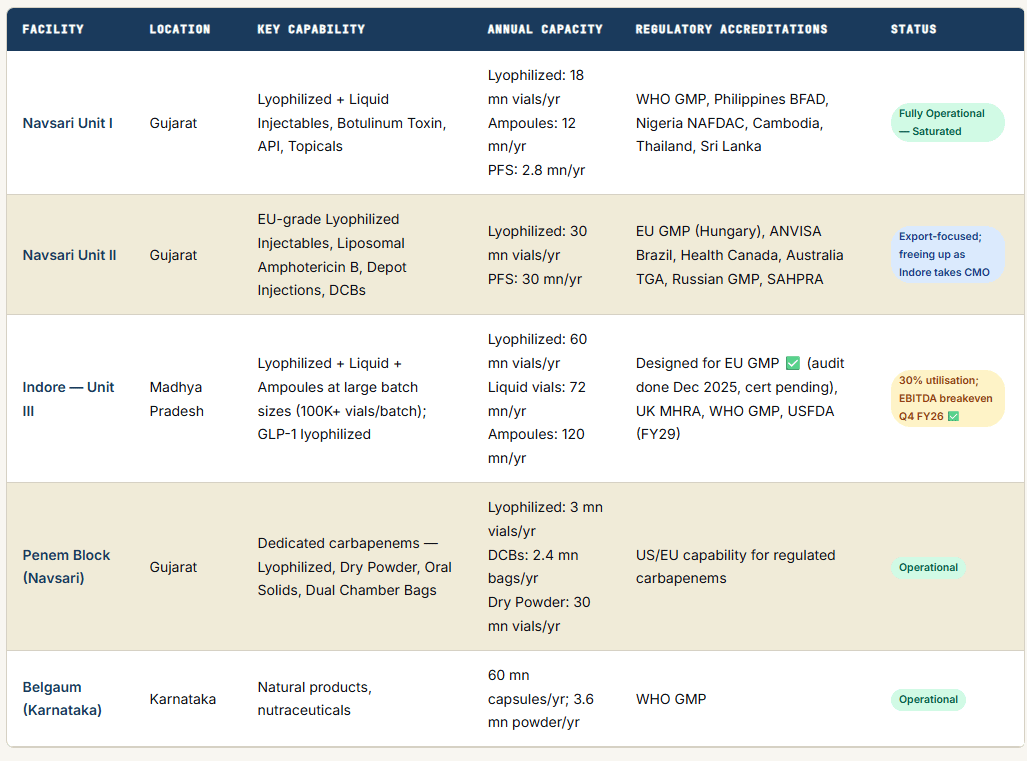
Navsari Unit I and Unit II together form the core of Gufic’s existing manufacturing base.
Unit I is the company’s established sterile injectable facility, with deep process expertise in complex injectable products and consistently operates at very high utilisation levels. Unit II complements this by catering to specialised manufacturing requirements for regulated export markets, including Europe, Brazil and Canada.
For many years, these two facilities formed the backbone of Gufic’s injectable business. However, as the company expanded across domestic markets, exports and contract manufacturing, it required a larger and more modern manufacturing base that could support the next phase of growth while meeting increasingly stringent global regulatory standards.
To address this requirement, Gufic conceptualised the Indore facility in FY22 as a greenfield sterile injectable manufacturing plant. Built with an estimated investment of 300–350 crore (partly funded through a 100 crore preferential allotment at 300 per share, with Motilal Oswal emerging as one of the key institutional participants), the facility has been designed to manufacture lyophilized injectables, liquid vials and ampoules at a substantially larger scale than the existing Navsari plants.
Construction and equipment installation progressed through FY23, with the company initially expecting commercial production to commence by October–November 2023. However, commercial commissioning ultimately took place in October 2024.
The delay was not due to construction or funding challenges but reflected the extensive validation process required before a sterile injectable facility can begin commercial operations. Equipment qualification, process validation, media fills, product technology transfers, stability studies and customer qualification all had to be completed before commercial supplies could commence.
At full scale, the facility has installed capacity of approximately 5 million lyophilized vials, 6 million liquid vials and 10 million ampoules per month. Management has also indicated an asset turnover potential of around 2–2.2x, underscoring the significant revenue opportunity as utilisation increases.
As of FY26, the facility remains in the early stages of its ramp-up, operating at roughly 30% utilisation. More than 40 products have already been transferred to the plant, contract manufacturing has commenced, and regulatory approvals and customer qualifications continue to progress.
While the Navsari facilities represent Gufic’s established manufacturing expertise, the Indore plant is designed to become the company’s primary growth engine. It provides the additional scale, modern infrastructure and regulatory capabilities required to expand production for both domestic and international markets.
Together, the Navsari and Indore facilities create an integrated manufacturing platform spanning lyophilized injectables, liquid injectables, botulinum toxin, APIs and advanced drug delivery systems such as Dual Chamber Bags.
More importantly, Indore is not merely an incremental capacity addition—it is the platform that enables Gufic to scale its established injectable capabilities into regulated global markets over the coming decade.
Building manufacturing capacity is only the first step in creating a successful CDMO platform. The real value comes from years of technical & regulatory experience, and the ability to consistently scale operations across markets.
A useful parallel to understand this journey is Windlas Biotech’s evolution in Oral Solid Dosage (OSD). While the two companies operate in different dosage forms, the underlying playbook is similar: build deep expertise in a core manufacturing area, expand capacity around that strength, earn customer trust and gradually scale into a larger platform.
Windlas spent years strengthening its OSD capabilities by continuously adding capacity and building technical & regulatory expertise around its core segment. Over time, this created the foundation for customer relationships, operating leverage and further expansion opportunities.
The journey also highlights an important characteristic of pharmaceutical manufacturing—scaling a CDMO business is not simply about adding plants. Each dosage form requires specialised process knowledge, regulatory understanding and customer confidence. This becomes even more critical in sterile injectables, where manufacturing complexity and regulatory requirements create significant barriers to entry.
This provides an interesting perspective when looking at Gufic. Unlike companies that are trying to build injectable capabilities from scratch, Gufic has already spent nearly four decades developing expertise in sterile injectables and lyophilized formulations. The Indore facility is therefore not about proving manufacturing capability; it is about scaling an existing competitive advantage.
The opportunity ahead is to leverage this established expertise, expand capacity, enter regulated global markets and convert decades of manufacturing knowledge into a larger international injectable platform.
The comparison below illustrates this broader idea:
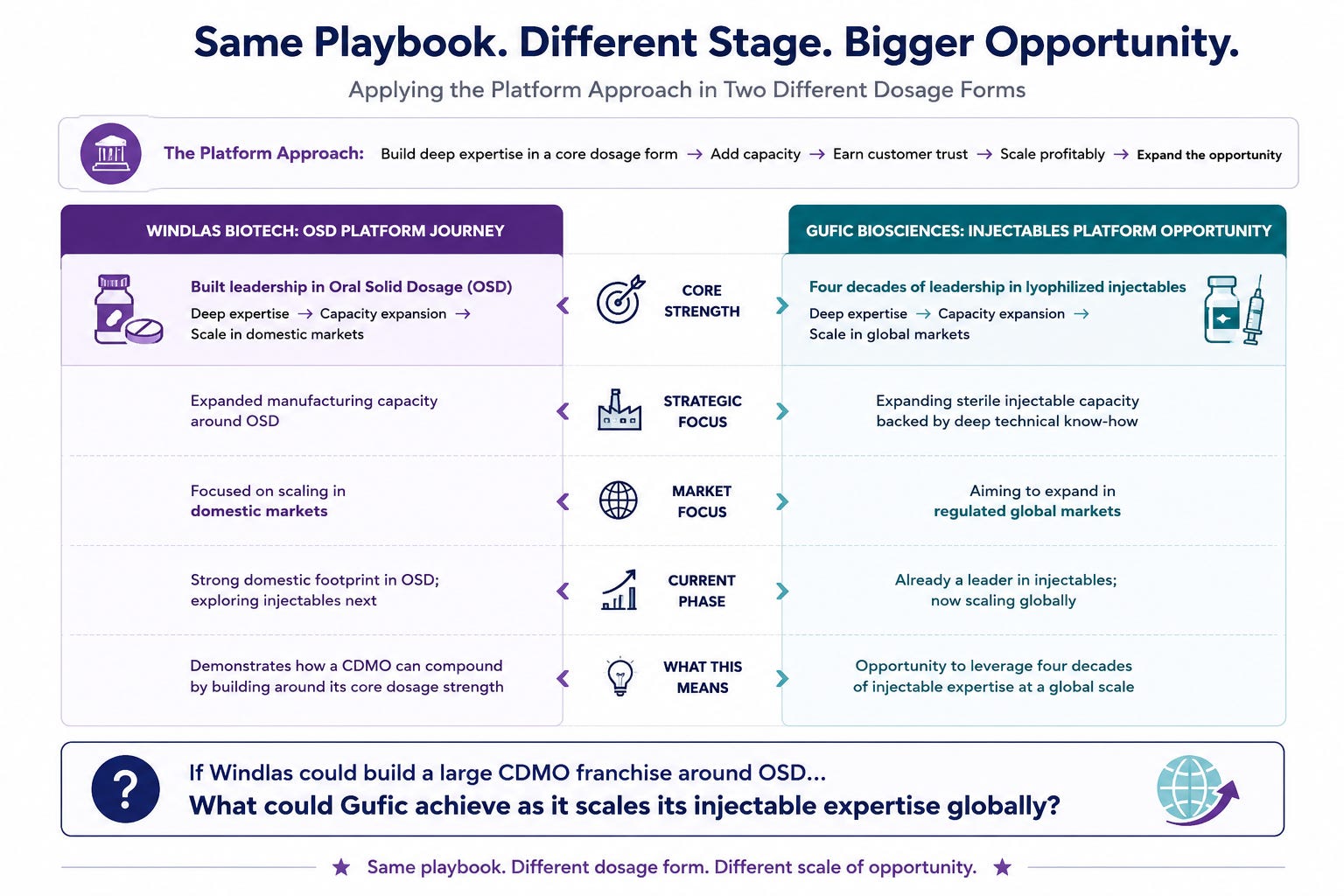
The key understanding is that Windlas demonstrates how a specialised pharmaceutical manufacturer can compound by repeatedly scaling around its core strength. Gufic appears to be following a similar path, but in a more technically complex category- sterile injectables.
If Windlas could build a meaningful CDMO franchise around OSD, the larger question for Gufic is what a company with four decades of leadership in lyophilized injectables can achieve as it scales this expertise globally.
One of the simplest ways to assess a pharmaceutical company is to ask a basic question : How much is it investing in tomorrow’s products?
As the management highlighted repeatedly on quarterly earnings call:
“We spend 8–10% of our top-line revenue on R&D every year. I don’t know how many companies of our size do that.” — Pranav Choksi, CEO
For a company of Gufic’s size, that commitment is notable. Rather than limiting itself to manufacturing existing medicines, the company continues to invest in expanding its scientific capabilities across multiple areas of specialty pharmaceuticals.
Its R&D efforts span across complex injectable formulations, peptide and critical APIs, novel drug delivery systems (NDDS), biosimilars, fertility therapies, botulinum toxin, wound care, and multiple ongoing clinical development programs. Building expertise across such a wide range of specialised technologies requires years of scientific work, regulatory understanding, and sustained investment.
This also explains why Gufic has been able to build differentiated products instead of competing only in commoditised generic medicines. Many of the products discussed in earlier sections —from fertility hormones and reproductive immunology therapies to botulinum toxin and advanced injectable delivery systems—are outcomes of years of research rather than opportunistic product launches.
More importantly, this creates future optionality. Every research program may not become a commercial success, but maintaining a broad development pipeline gives the company multiple opportunities to launch new products, enter adjacent therapies, and strengthen its specialised portfolio over time.
By now, we’ve understood Gufic’s products, manufacturing capabilities, and research efforts individually.
The real strength of the business lies in how these capabilities reinforce one another. Rather than relying on a single blockbuster product or patent, Gufic has built multiple layers of competitive advantage over several decades—creating barriers that are difficult for competitors to replicate. It’s key moats are :
Lyophilization know-how, Regulatory approvals, Indore scale economics, Botulinum toxin platform, Sticky CMO relationships, Science-led product development.
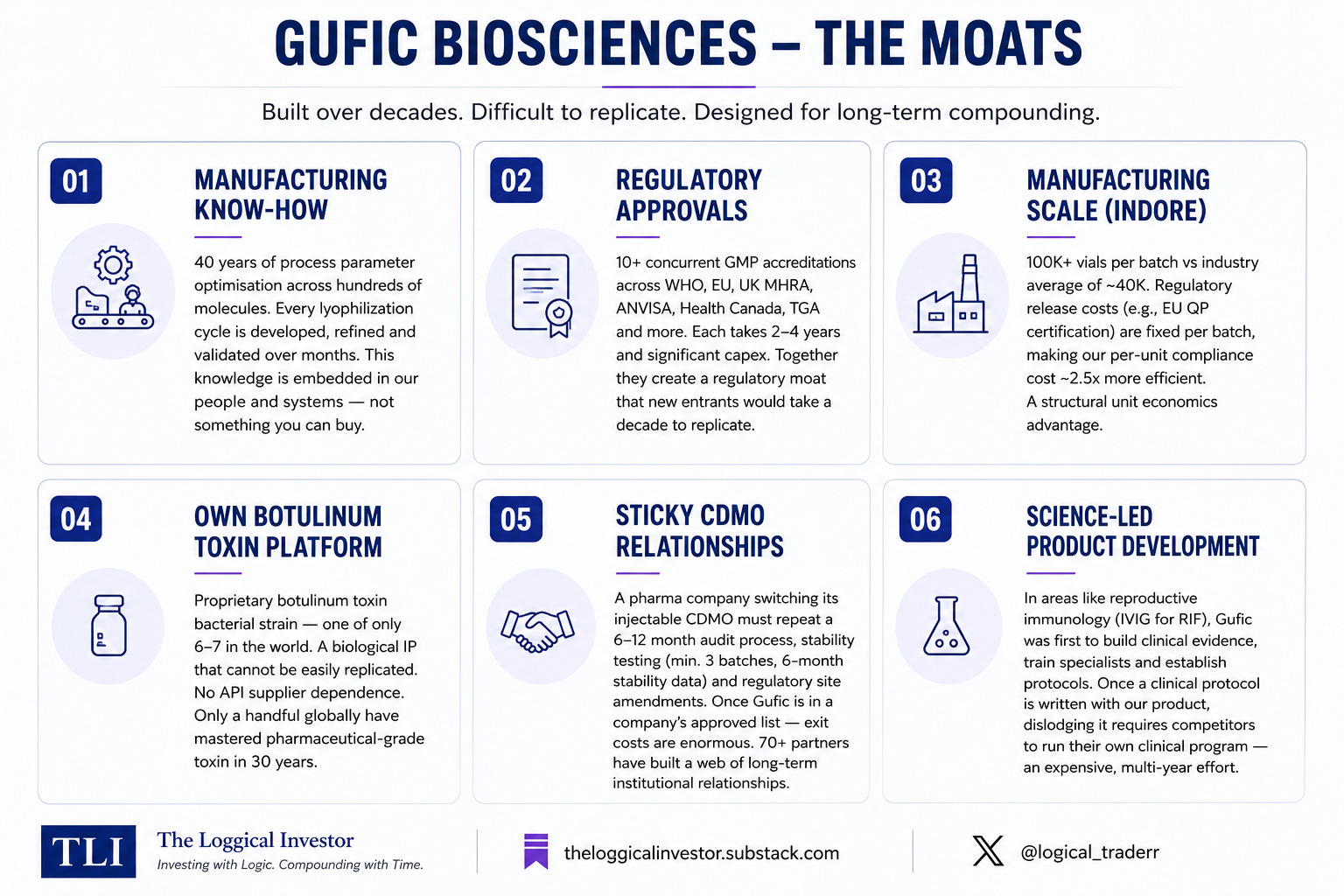
Each of these advantages may appear incremental on its own. Together, however, they form a specialized manufacturing ecosystem that strengthens Gufic’s position across domestic and international markets.
Note: Beyond this newsletter, I've created a 50-page playbook that breaks down my complete stock research framework using Styrenix as a real-world case study. It covers how I research businesses, connect information to insights, and build conviction in an investment. If you'd like to learn the process and access the playbook, DM me using the button below. (Paid resource)
With the commissioning of the Indore facility, FY26 should have marked the beginning of a much stronger growth phase for Gufic. Instead, reported domestic growth appeared softer than many investors expected.
The reason wasn’t weak demand. It was a conscious management decision to reset the company’s distribution model—even at the cost of sacrificing revenue in the short term—to build a healthier, more scalable business.
Understanding this decision is important because the two divisions most affected- Critical Care and Sparsh -are also among Gufic’s largest domestic growth drivers.
Traditionally, pharmaceutical companies don’t sell directly to thousands of hospitals. Instead, they sell to CFA ( carry & forwarding) agents and stockists (distributors), who typically purchase products on 30–45 days’ credit before supplying hospitals. The distributor manages inventory, collections and credit risk, allowing the pharmaceutical company to receive cash relatively quickly.
A few years ago, Gufic decided to experiment with a different approach for parts of its Critical Care and Sparsh businesses.
Instead of selling through distributors, it began supplying hospitals directly.
The logic was sound. Removing the middleman would improve gross margins, strengthen relationships with hospitals and, most importantly, give Gufic direct visibility into secondary sales—understanding which products were actually being prescribed and consumed, something that is usually difficult to track through distributors.
However, the model created an unintended consequence.
Many small and mid-sized hospitals stretched payment cycles to 150–180 days. While reported revenues continued to grow, a large portion of that money remained locked in receivables instead of reaching Gufic’s bank account.
In effect, the company had started financing its customers’ working capital.
Rather than continue chasing higher sales, management decided to prioritise cash generation and long-term financial health.
To lead this effort, Gufic appointed Mr. Rajesh Kaul to head the Sparsh division and redesign its commercial model. The first step was identifying where the problem existed. Hospital accounts were reviewed individually, overdue receivables were analysed, and customers with persistently stretched payment cycles were identified.
At the same time, the company solved the very first problem that had originally pushed it towards direct selling.
Working with more than 1,200 stockists, Gufic integrated its systems with Marg, a widely used pharmaceutical inventory management software. This allowed the company to track secondary sales and inventory movement through distributors without having to invoice hospitals directly.
With this visibility in place, Gufic gradually shifted most accounts back to the traditional CFA and stockist model, allowing distributors to once again handle hospital supplies and collections while Gufic returned to receiving payments within normal credit cycles.
For hospitals with persistently overdue balances, the company tightened credit discipline by stopping fresh supplies until dues were cleared or excess inventory was returned. This cleanup reduced FY26 revenue by roughly ₹22 crore, but significantly improved the quality of receivables.
This wasn’t simply a change in distribution — it fundamentally improved the economics of the business.
As debtor days reduce, less capital remains tied up with customers. Management expects collections to improve from around 140 days towards 100 days, releasing meaningful working capital that can be redeployed into the business instead of being financed through additional borrowings.
The CFO has also indicated that the company expects to begin prepaying its term loans from FY28 onwards. With annual interest costs currently around ₹35–36 crore, every reduction in debt directly lowers finance costs and supports profitability.
Perhaps more importantly, the reset improves the quality of revenue.
Selling directly to hospitals initially improved gross margins by eliminating distributors. But those higher margins came at the cost of waiting nearly six months to collect cash.
Under the distributor-led model, Gufic gives up a small portion of gross margin but typically collects payments within 30–45 days. For a company carrying meaningful debt, the financing cost of funding receivables for an additional four months can easily outweigh the incremental margin earned through direct sales.
In other words, Management consciously traded a small amount of reported revenue(~Rs 20-22 crore) and margin today for stronger cash flows, lower working capital requirements and a healthier balance sheet over the long term.
The success of this reset should become visible in Gufic’s balance sheet over the next few years.
Trade receivables reduced from 314 crore in FY25 to 297 crore in FY26, despite the company reporting higher revenue—a positive early indication that the cleanup has already begun.
Going forward, this will be one of the most important operating metrics to monitor. If the reset is working as intended, trade receivables should continue to decline and could move below 260–270 crore by the end of FY27, even as revenues continue to grow. A declining receivables balance alongside rising sales would be a strong signal that Gufic is converting a larger share of its revenue into cash rather than credit.
With the Indore facility now operational and the distribution reset largely complete, Gufic enters its next phase of growth on a much stronger financial foundation. As Critical Care and Sparsh continue to expand, future growth should be supported not only by additional manufacturing capacity but also by a business model that converts revenue into cash far more efficiently.
That’s it for Part 1 of our Gufic Biosciences deep dive.
So far, we’ve focused on understanding the business from first principles—breaking down Gufic’s business model, decoding its different revenue engines, exploring the economics of complex injectable medicines, and understanding how manufacturing capabilities, regulatory approvals, R&D and decades of lyophilization expertise have created a business that is difficult to replicate.
But the more important questions are still ahead:
Can the Indore facility successfully transition from capacity creation to meaningful earnings growth?
Will Gufic’s international expansion strategy and Marketing Authorization platform become the next major growth engine?
Can businesses like Aesthaderm, Ferticare and the CDMO platform unlock the operating leverage management is aiming for?
And most importantly, is the market still valuing Gufic as a conventional pharmaceutical company while overlooking its evolution into a global specialty injectable platform?
We’ll explore all of this in Part 2, where we shift our attention from understanding the business to evaluating the investment thesis, growth roadmap, financial projections, valuation, risks and the key variables that could ultimately determine shareholder returns.
If you’d like to read Part 2 soon, let me know in the comments - that will help decide how quickly I bring the next part out.
Let’s keep learning, thinking, and compounding together — until we meet again with another deep dive.
Happy investing!
📩 Subscribe for more deep-dive insights.
Understanding a business deeply is a journey I take for myself — but transforming that depth into something simple, structured, and genuinely useful for you… that’s a whole different craft. It takes hours of reading, thinking, questioning, and connecting dots — all to bring you clarity without the noise.
If this work resonates with you, I’d truly appreciate your support.
A like, a share, or a restack helps this reach more curious minds like yours.
And your comments? They mean more than you might think. They keep me going, keep me improving, and remind me why this effort is worth it.
If you’ve found value in my detailed analysis and insights, and would like to support this work, I’d be truly grateful. Your contribution helps me continue creating high-quality, in-depth research.
A contribution of ₹499 or ₹599 would go a long way in keeping this going. You can support via PhonePe or Buy Me a Coffee using the QR code below (optional).

If you’ve already supported—thank you, it genuinely means a lot. Feel free to leave a comment on the blog or send me a message. I’d be happy to share some additional research material on the company with you over a personal chat.
A View-Point from Investor’s Lens 🧐
See you next time, Happy investing!
1. Internal Research from Public Information
2. Management Interviews, Annual Presentations FY25 , Sectoral coverage reports by brokerage houses , Analyst Reports
3. This newsletter is Written based on data as per July 2026. Consider crosschecking.
Comments
Nothing yet. Say the first thing.
Sign in to join the conversation.