
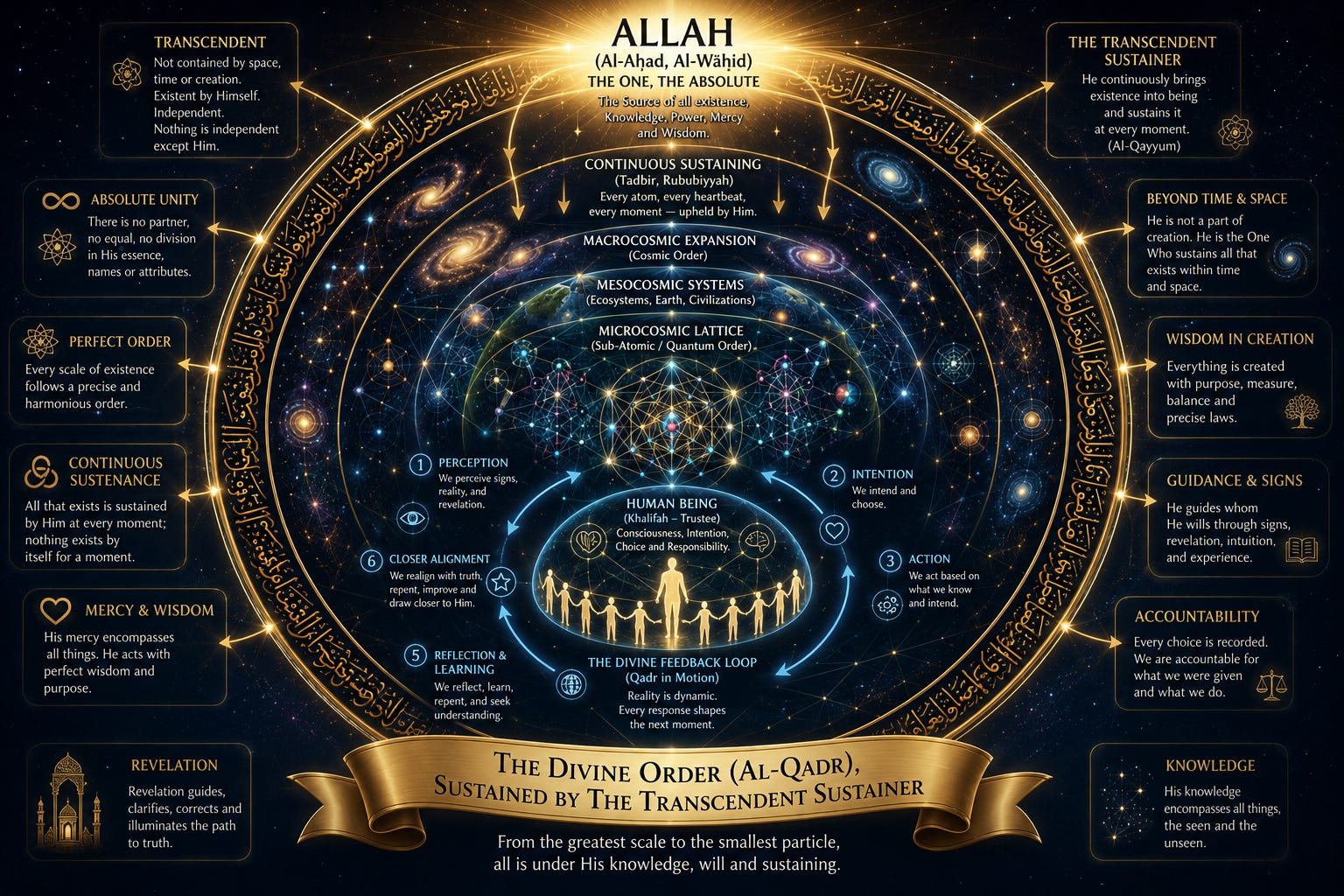
A recurring question has been pressing itself into view:
If something is a choice, does that mean there must be a sovereign chooser making the choice?
At first, this seems obvious. In ordinary language, we often imagine choice as if there were a small independent self inside the person: a private ruler, standing outside all causes, inspecting options, and then freely pulling a lever.
But this picture becomes unstable when examined through neuroscience, systems thinking, biology, cybernetics, and tawḥīd.
Science increasingly challenges the idea of an isolated inner controller. Systems thinking shows that action emerges from networks of relation, feedback, constraint, memory, embodiment, and environment. Biology shows that organisms themselves are not sealed-off individuals but nested, symbiotic, regulatory systems. Tawḥīd adds an even deeper claim: no created thing is independent in its being. Only Allah is absolutely independent. Everything else exists through dependence.
So the real question is not simply:
Do choices exist?
The deeper question is:
What kind of agency can a creature have if the creature is not metaphysically independent?
This page explores that question.
When we say “I chose to drink coffee,” the sentence sounds simple. But if we slow down and examine what happened, the simplicity disappears.
Suppose I reach for coffee in the morning. Where did that action come from?
My body is tired.
My sleep was poor.
Adenosine has accumulated in the brain.
I remember that coffee helped yesterday.
I smell coffee.
My nervous system predicts relief.
My attention moves toward the cup.
My hand reaches.
The action becomes visible.
At which point does a fully independent chooser appear?
It is difficult to identify one.
What appears instead is a chain of interacting processes: bodily state, memory, environment, prediction, attention, habit, valuation, and motor response. None of these processes is sovereign by itself. None stands outside the system as an uncaused ruler.
This does not mean the action is unreal. It means the action may not work the way ordinary language imagines it works.
The everyday idea of “choice” often smuggles in the image of a sovereign inner self: a homunculus, a little commander inside the head. But neuroscience, cybernetics, and embodied cognition all make that picture difficult to defend.
A more careful model would be:
Reality
↓
Perception
↓
Bodily state
↓
Memory
↓
Prediction
↓
Attention
↓
Evaluation
↓
Orientation
↓
Response
↓
Consequences
↓
Correction
↓
Return
In this model, action is not produced by a detached sovereign self. It emerges from a living, embodied, situated organism responding within constraints.
One possible mistake is imagining agency as an object.
We ask:
Where is the chooser?
But perhaps this is like asking:
Where is the whirlpool?
A whirlpool is real. It has a pattern. It affects the river. It can be observed and described. But it is not a separate little object hidden inside the water. It is an organized activity of the water itself.
Agency may be similar.
It may be real without being a sovereign object. It may be an organized process rather than an independent thing.
This changes the question. Instead of asking whether there is a little ruler inside the person, we can ask:
How does the organism regulate itself?
How does attention shift?
How does inhibition happen?
How does memory reshape perception?
How does learning modify future response?
How does awareness allow reorientation?
How does accountability become meaningful within dependence?
This gives us a more precise language than the usual opposition between “free will” and “determinism.”
The traditional phrase “free will” often bundles together many different phenomena:
impulse generation
attention
inhibition
desire
valuation
memory
learning
prediction
moral awareness
responsibility
repentance
correction
Neuroscience increasingly separates these processes. Philosophy may need to do the same.
Perhaps what we call “choice” is not one simple thing. Perhaps it is a coordinated event within a living system.
The phrase “sovereign chooser” matters because it names the hidden metaphysical assumption.
A sovereign chooser would be a self that stands above or outside dependence. It would originate its will from itself. It would be independent, self-grounding, and ultimately unconditioned.
But tawḥīd does not allow any creature to be understood this way.
If tawḥīd is true, then no creature possesses metaphysical independence. No creature sustains itself. No creature owns its own being. No creature creates its own capacities from nothing.
Allah alone is absolutely independent. Allah alone is Al-Qayyūm: the One who sustains all that exists.
That means the human being is real, but not independent. Human agency is real, but not sovereign. Human responsibility is real, but not self-grounding.
So the question becomes:
What kind of agency belongs to a dependent creature?
Not absolute independence.
Not mechanical nonexistence.
Something more nuanced:
bounded, creaturely response-ability.
The word “response-ability” is useful because it shifts the focus.
It does not mean:
“I create my will from nothing.”
It means:
“Within what arises, within what I inherit, within what constrains me, and within what Allah sustains, I am called to respond.”
This response may include:
noticing an impulse
pausing
redirecting attention
inhibiting harm
making duʿāʾ
repenting
learning
correcting course
seeking help
returning to Allah
This is not sovereignty. But it is also not nothing.
A person does not need to be metaphysically independent in order to be morally addressed. A creature can be dependent and still be called. A servant can be sustained by Allah and still be accountable for orientation, response, repentance, and return.
This gives a different account of human agency:
Agency is the capacity of a dependent, embodied, relational creature to orient and respond within the conditions Allah sustains.
That formulation avoids two extremes.
It avoids pretending that the human being is an independent sovereign self.
It also avoids reducing the human being to an inert object with no meaningful response.
Systems thinking helps clarify this.
A human action does not arise from a single isolated point. It arises from a network.
Not:
Self
↓
Choice
But:
Body
↓
Memory
↓
Environment
↓
Perception
↓
Prediction
↓
Attention
↓
Evaluation
↓
Response
↓
Feedback
Agency is distributed across the system. The body matters. The environment matters. Memory matters. Hormones matter. Language matters. Relationships matter. The nervous system matters. The microbiome may matter. Social feedback matters. Revelation matters. Repetition and habit matter.
There is no obvious sovereign node.
But there is still organization.
The person is not a random pile of causes. The person is an integrated living system. Many processes coordinate into a relatively stable “I.” That “I” is not absolute, but it is not fake either. It is an emergent unity.
So when I say “I responded,” this may mean:
This whole contingent organism-system reached a coordinated response.
That is different from saying:
A sovereign self created a choice from nothing.
It is also different from saying:
No one responded at all.
The response belongs to the creature, but the creature belongs to Allah.
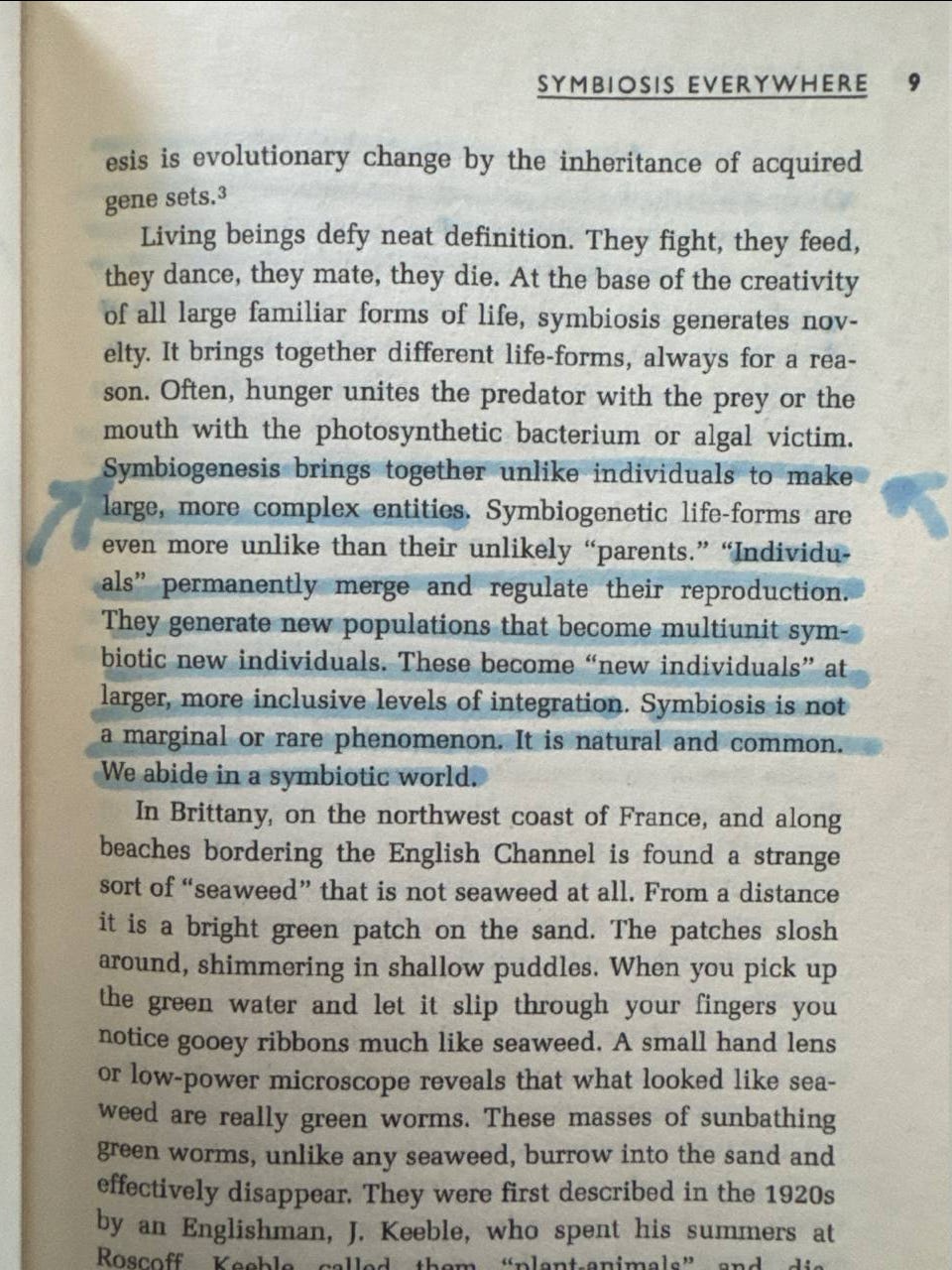
Lynn Margulis’ work on symbiosis and symbiogenesis deepens this question.
Margulis showed that what we call an “individual” is often a stabilized merger of prior relations. A eukaryotic cell is not a simple, sovereign unit. It carries a history of incorporation. Mitochondria were once bacteria. In plants, plastids and chloroplasts also come from ancient bacterial incorporation.
So even the cell is not a pure individual. It is already a living history of relation.
This matters for agency.
Inside the cell, there is no tiny sovereign chooser. There is regulation, signaling, metabolism, constraint, response, correction, and feedback. The cell is not inert, but neither is it ruled by a miniature king. It responds as an organized living process.
This supports a more precise idea:
Agency can exist without sovereignty.
At the cellular level, life is not absolute independence. It is bounded responsiveness within a dependent system.
This becomes even clearer in symbiotic organisms. Margulis describes cases where algae live inside worms, produce food for them, and recycle their waste into nutrients. In such examples, it becomes difficult to say where one organism ends and another begins.
The organism is not merely connected to its environment. It may be an environment for another organism. It may live because another life is living inside it. It may survive through internal ecological loops.
This challenges the idea of the self as a sealed individual.
A better description is:
The organism is a nested regulatory system.
Or even:
The organism is an ecological achievement.
It is tempting to summarize all of this by saying:
“Everything is connected.”
But that is too vague.
Not everything is connected in the same way. Some relationships are causal. Some are structural. Some are symbiotic. Some are ecological. Some are informational. Some are temporary. Some are permanent. Some are conscious. Many are not.
A stronger formulation is:
Everything contingent exists within nested systems of dependence that are continuously sustained by Allah.
This is more precise than “everything is interconnected.”
It includes horizontal dependence within creation:
atoms
molecules
cells
organs
organisms
families
societies
ecosystems
civilizations
And it includes vertical dependence upon Allah:
Allah
↓
continuous sustaining
↓
creation at every level
Biology can describe many of the horizontal dependencies. It can show how organisms, cells, ecosystems, and symbioses function. But biology does not answer why existence continues at all. Tawḥīd addresses that deeper ontological dependence.
The two questions are distinct, but they meet at the concept of dependence.
Margulis also helps explain emergence.
Many living beings are not merely interdependent. Sometimes they become each other. Formerly separate organisms fuse into a new living unity. A larger “one” emerges from the coordination of many.
This has implications for the self.
The human being is also a many-becoming-one:
cells
organs
hormones
nervous system
immune system
microbiome
memory
language
relationships
environment
spiritual orientation
All of these processes bind together into what is experienced as “me.”
The self is therefore not primary in the sense of being isolated and self-sufficient. The self is an emergent unity: real, but dependent; coherent, but composite; accountable, but not sovereign.
This gives a better way to understand choice:
Maybe choice is not made by a sovereign chooser. Maybe “choice” is what emerges when many dependent processes become organized enough to respond as one.
That response can still matter. It can still be morally meaningful. It can still be the site of repentance, discipline, duʿāʾ, and return.
But it does not require the human being to be independent of Allah.
After neuroscience and systems thinking, it may be better to place “intention” later in the process.
We often imagine intention as the first cause:
Intention
↓
Action
But many processes begin before conscious intention appears. The body has already reacted. The nervous system has already predicted. Attention has already been pulled. Emotion has already shaped the field. Memory has already interpreted the situation.
This does not make intention meaningless. It means intention may emerge from earlier processes rather than standing outside them.
A more careful sequence might be:
Reality
↓
Perception
↓
Automatic processes
↓
Awareness
↓
Orientation
↓
Response
↓
Consequences
↓
Correction
↓
Return
The word orientation is important.
Orientation is not the creation of reality from nothing. It is the turning of the creature within what has arisen.
A person may not choose the first impulse. But the person may become aware of it. A person may not choose the trauma history, the bodily state, the first surge of anger, or the inherited tendency. But within awareness, there may be a possibility of turning:
toward Allah or away from Allah
toward humility or ego
toward sabr or reaction
toward duʿāʾ or despair
toward repentance or self-justification
toward truth or avoidance
Orientation is still dependent. It is still sustained by Allah. It is still affected by biology, history, and environment. But it is not meaningless.
It may be where creaturely agency becomes spiritually significant.
Tawḥīd changes the entire frame.
Without tawḥīd, the discussion can remain horizontal: neurons, bodies, organisms, ecosystems, social systems, and feedback loops.
But tawḥīd adds the vertical dimension:
Allah sustains everything.
Creation is not self-explaining. The universe does not hold itself in existence. Bodies do not own their own being. Cells do not sustain themselves independently. Thoughts do not arise outside Allah’s knowledge and permission.
This does not erase created causality. It places created causality in its proper position.
Created causes are real, but they are not ultimate.
Human agency is real, but it is not absolute.
The self is real, but it is not sovereign.
Responsibility is real, but it is creaturely.
The Qur’anic vision is not deism, where God creates the universe and then steps back. Tawḥīd points to continuous dependence. Allah is not merely the first event in a chain. Allah is the One upon whom the entire chain depends at every moment.
This makes the concept of Al-Qayyūm central.
Allah is the One who sustains. Everything else is sustained.
So the human being is not an independent chooser standing in a neutral universe. The human being is a dependent servant living, perceiving, responding, failing, repenting, and returning within Allah’s sustaining.
A major concern remains:
If the human being is not sovereign, how can accountability make sense?
This is a serious question. It should not be dismissed quickly.
But accountability may not require metaphysical independence. It may require a different set of capacities:
awareness
receptivity to guidance
ability to learn
ability to inhibit some responses
ability to be corrected
ability to remember consequences
ability to intend, even if intention itself emerges
ability to repent
ability to return to Allah
A creature does not need to be independent in order to be addressed. A child, a student, a patient, a servant, or a community can be dependent and still responsive.
The key is not sovereignty. The key is answerability.
The human being is answerable because the human being is capable, within Allah’s sustaining, of being addressed, guided, warned, softened, corrected, and returned.
This makes accountability relational rather than autonomous.
I am not accountable because I am an independent godlike chooser.
I am accountable because I am a servant who has been given awareness, guidance, capacity, limits, and a call to return.
The earlier language of:
Consciousness, Intention, Choice, and Responsibility
may need refinement.
After considering neuroscience, cybernetics, Margulis, symbiosis, and tawḥīd, the center of the model may be better expressed as:
Consciousness, Orientation, Response-ability, and Accountability
Each word matters.
Consciousness: awareness arises within the creature. The person becomes present to what is happening.
Orientation: the creature turns within what has arisen. The heart, attention, and body incline in a direction.
Response-ability: the creature has some capacity to respond, inhibit, redirect, learn, repent, and return.
Accountability: the creature is answerable to Allah, not because the creature is independent, but because the creature has been addressed, guided, and given a measure of capacity.
This is not a final doctrine. It is a working framework.
But it seems more precise than the ordinary idea of “free will,” because it avoids smuggling in a sovereign self.
A working definition:
Creaturely agency is the real but dependent capacity of an embodied, relational, sustained being to become aware, orient, respond, be corrected, and return to Allah within the limits Allah creates and sustains.
This definition holds several things together:
Agency is real.
Agency is not sovereign.
The self is real.
The self is not independent.
Biology matters.
Systems matter.
Environment matters.
History matters.
Revelation matters.
Accountability matters.
Allah’s sustaining is ultimate.
This avoids both arrogance and despair.
It avoids arrogance because the creature cannot claim independent authorship over its own existence, capacities, or guidance.
It avoids despair because dependence does not mean meaninglessness. A dependent creature can still be called, helped, guided, forgiven, and transformed.
This is not only an abstract philosophical issue.
It changes how one understands spiritual struggle.
If I imagine myself as a sovereign chooser, then every failure becomes either pride or crushing self-condemnation. I either think, “I should be able to control everything,” or I collapse into shame because I could not.
But if I understand myself as a dependent creature with bounded response-ability, the spiritual path becomes more truthful.
I can say:
I did not create myself.
I did not choose every impulse that arose.
I did not choose every wound, pattern, or nervous system response.
I am not sovereign over my own heart.
But I am still called to turn.
I can ask Allah for help.
I can repent.
I can practice.
I can seek correction.
I can return.
This is gentler, but not permissive.
It does not excuse harm. It does not erase responsibility. It places responsibility inside servanthood rather than egoic control.
The servant does not say:
“I am the master of myself.”
The servant says:
“O Allah, I am dependent on You. Help me respond in a way that pleases You.”
The original question was:
If it is a choice, does that mean there must be a sovereign chooser?
The answer developed here is:
No. Choice does not have to mean metaphysical sovereignty.
A choice may instead be a real selection made by a dependent organism whose selecting capacities are themselves contingent, embodied, relational, and sustained by Allah.
Agency can be real without being absolute.
The self can be real without being independent.
Responsibility can be real without requiring a sovereign chooser.
This is the core insight:
Tawḥīd does not erase human agency. It purifies it from the illusion of independence.
The human being is not a godlike chooser standing outside creation. The human being is a servant: embodied, nested, relational, sustained, limited, addressed, guided, accountable, and always in need of Allah.
So the question becomes less:
Am I absolutely free?
And more:
Within what Allah has allowed to arise, how am I being called to orient, respond, repent, and return?
This article has been co-created with AI. I don’t hide that. But the work I have put into this has been in relationship with 13+ year of real research, books, experience, contemplation, and deep reflection. Still, it is important to recognize that this article makes no absolute claims. It’s a model. Not the absolute truth. It will be updates, corrected by reality if it doesn’t match, and it’s a process. We refuse to make it into an identity. Open.. May Allah correct me if I am wrong. Ameen.
No posts
Comments
Nothing yet. Say the first thing.
Sign in to join the conversation.