
When I started my graduate degree at the University of California, Santa Barbara, my advisor on the psychology side, Leda Cosmides, was a member of the group called Cognitive and Perceptual Science. The group included Russ Revlin and Rich Mayer. (Fun fact: Rich was Shani’s advisor.)
In many ways, it wasn’t a natural grouping. While all of them worked from a cognitive perspective, they disagreed about a great deal and studied very different topics.
By the time I left, the psychology department had been reorganized. Now, Leda was in a group called DEVO, standing for DEvelopmental and EvOlutionary psychology. (Whip it!) To be candid, a big reason for the reshuffling of the areas and faculty had to do with the personalities involved. Leda and Daphne Bugental, a developmental psychologist, got on quite well. Leda and Russ, well…
All of that is to say that there were a few years during which we had to explain why Leda and Russ were, on the one hand, in the same group and, on the other, so frequently in disagreement about relatively fundamental matters. Leda thought the mind consisted of a large number of specialized “modules.” Russ liked to say that the mind wasn’t specialized, but did have “grooves.”
The way Leda put it was this. She studied natural competences. Her work on cheater detection is the exemplar. People are weirdly good at detecting violations of social contracts. They are naturally—in the evolutionary sense—competent. Russ studied tasks people weren’t that great at, often having to do with abstract logical reasoning.
I’ve been thinking a bit about how humans have all these natural competences—I have in mind abilities such as detecting cheating, reasoning about frequencies, recognizing faces—and how, conversely, we humans have all these, well, natural incompetences. The big literature on heuristics and biases should come to mind.
But it has recently seemed to me that some incompetences aren’t exactly heuristics or biases.
One thing I have been thinking about could be called something like Second-Order Blindness. It goes like this.
Someone proposes a policy, and the policy focuses attention on the very basic—first-order—good that it does. In prior posts, one policy I’ve discussed is rent control, a topic that has been in the news, though there are many similar policies one might use.
It seems to me that many people think about only the good that it does. There’s somebody out there who is going to pay less for rent than they otherwise would have. That’s good! When most people think about rent control, they think about the person paying the rent, rather than the person receiving the rent, and from that perspective, the policy seems good. Maybe they think about the landlord, who will obviously now have less money. But maybe you don’t think that’s a bad thing because you are bigoted when it comes to landlords. Ok.
But there are second-order effects.
What about developers? If developers believe that they can’t charge the price they want for a new construction project, then they won’t build it. The person who sells them lumber won’t make those sales. Policies have second- and third-order effects, but we humans don’t seem to consider them when we reflect on policy. I’m not saying the correct policy in this case is intrinsically obvious. I’m saying that discussions of these policies often seem to omit second-order effects.
My sense is that bans are similar. Some people think that doing something is bad and that the remedy is to ban it. Maybe the thing is abortion. Maybe it’s prostitution. So they see a ban as a good thing because they focus on the first-order effect: I don’t like X and the policy bans X so that’s good. But what else does the ban do? Maybe it drives the market underground, which is worse for everyone involved. Maybe it drives the price up, which makes people who run the trade better off than they were before.
And I want to be clear that I’m not saying, at all, that this is a phenomenon unique to one side of the political aisle. My sense is that tariffs, another topic I’ve discussed before, illustrate the same general phenomenon. That is, advocates point to the first-order effects. The steel tariff keeps the mill in Ohio open, and those workers keep their jobs. Great! The second-order effect is that all the businesses that need steel have to pay higher costs, leading to higher prices for the goods they produce. And this is to say nothing of the costs of retaliation. So the steel tariff leads to the soybean tariff, which hurts the farmer who now can’t compete in the foreign market.
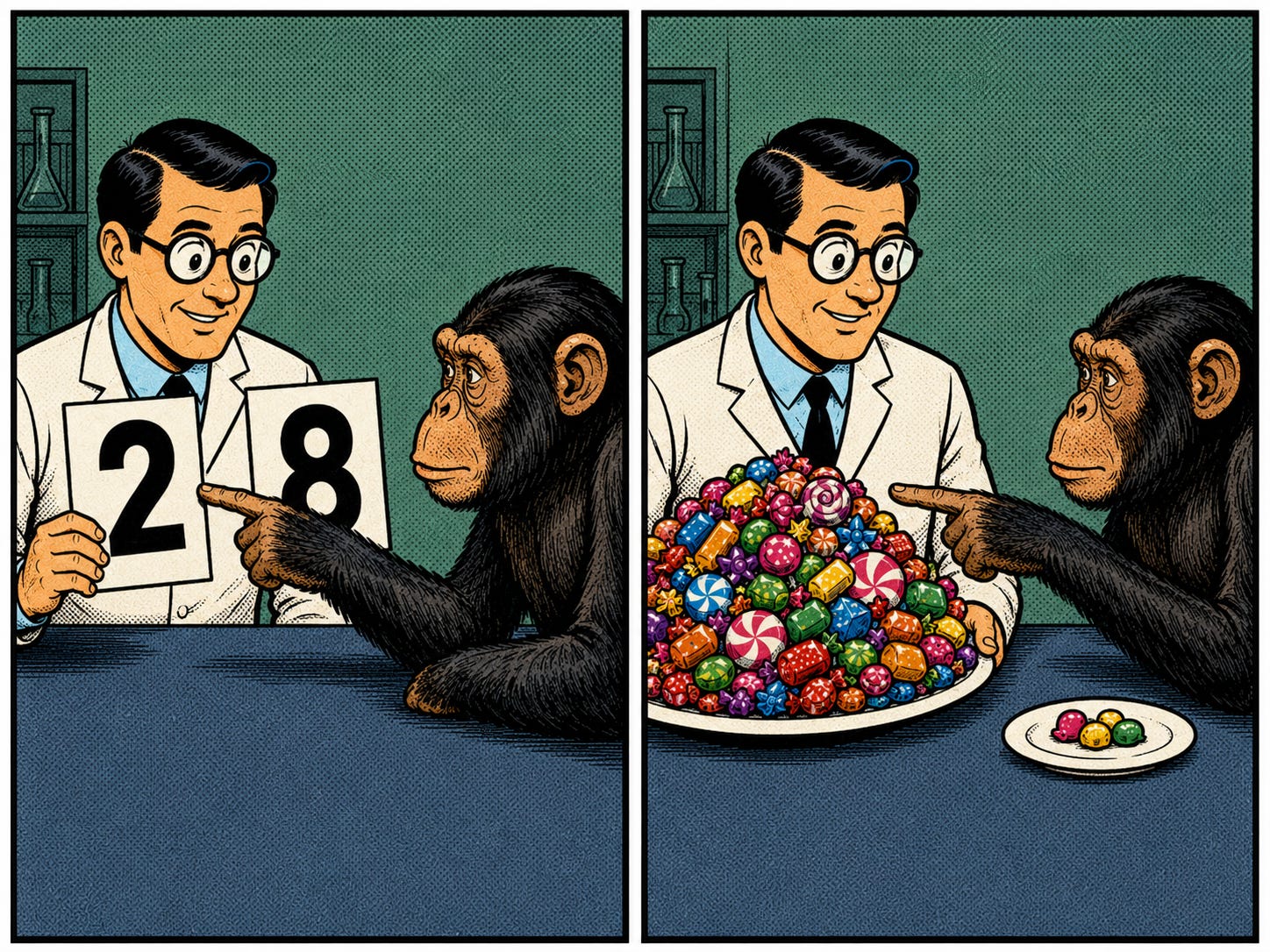
Before concluding, let me just drop in some primate research. In a series of studies beginning in the 1990s, Sarah Boysen and colleagues gave chimpanzees a deceptively simple choice. Boysen showed the animals two piles of candy. The task was to point to one of the piles. The plot twist was that the pile that the animal pointed to was given away. The chooser got the one that they didn’t point to.
The obvious strategy is to point to the smaller pile, thus winning the larger pile. Given this task, the animals couldn’t help themselves. They consistently pointed to the larger pile, getting the smaller pile as a consequence.
However, in a second version of the task, these chimpanzees, who had learned Arabic numerals—the symbols 0 to 8—were given the same task, but with those numbers instead of piles. Now they reliably pointed to the smaller value, winning the larger prize.
The so-called “reverse-reward paradigm” was subsequently run with other primates, including orangutans, bonobos, gorillas, and capuchins, and the results were similar across species. Animals in these studies found it difficult to override the attraction of the bigger reward. As experimenters made the reward more abstract—with symbols or tokens—subjects were able to choose in a way that got them the better outcome.
This reminds me of the squirrel! bit from Up. Dogs are, eh, naturally competent at detecting and attending to squirrels. They can’t not do it. Some of our primate relatives can’t not point to the bigger thing, unless given a way to distance themselves from the tempting larger pile. But faced with a big pile and a little pile… squirrel! I want that big pile of candies!
We see a policy and—squirrel! That’s good for someone so I’m for it! Give me the candies!
I’ll just mention one other idea, drawn from research in economics.
Rosemarie Nagel used a game called the p-beauty contest (also called the “guessing game”) to look at how humans naturally reason. The task for subjects was to pick a number between 0 and 100. In the study, the subjects all knew that 100 people were playing the game. The winner was the person who came closest to two-thirds of the average of all the guesses.
Before continuing, think about what number you would choose.
You might start by supposing everyone will pick randomly. So that puts the average around 50. Two-thirds of that is 33.
But you just worked that out. Maybe everyone else will too. So, hold the phone, you should say two-thirds of that, which is 22.
But wait another tick. What if everyone is thinking the same way? Followed to its logical conclusion—the equilibrium, an economist would say—the right choice is… zero.
Pretty much no one picks zero. (And there is a sense in which they are “right” not to. The winner is the person who correctly forecasts how many iterations others will go through and chooses two-thirds of that.)
In fact, if you run this in the lab, you get a bunch of people not far from 33 and a bunch of people not far from 22. People manage to go one step, maybe two, and then they exit the loop.
The reason this is called a beauty contest goes back to John Maynard Keynes. He was thinking about how to win in the stock market. A good investor will choose the stocks that other investors will be drawn to. That is, you don’t want to choose the “prettiest” stock to you, but rather the stock others find attractive to buy, leading to a higher price.
The results of the p-beauty contest give a little window into how many iterations people go through in a very stripped-down setting. My former colleague at Caltech, Colin Camerer, estimated that when you give people these games that require iterated thinking, on average they go about one and a half steps. Not terribly far.
In the laboratory, these games are stripped of all context and content. There are no landlords, no tenants, no squirrels grabbing the subject’s attention. People just… stop. They go one loop, maybe two, then that’s it.
I have two thoughts about why this might be, neither one of them compelling even to me. I’m open to any ideas, and readers should feel free to drop them in the comments.
The first has to do with my ideas about the notion of effort. Iterated thinking in these games is effortful, probably because doing so uses the part of the mind that can be used for many different purposes, so there’s an opportunity cost to thinking about the game, which is felt as effort, an unpleasant sensation. This motivates most people to exit the loop, ending the unpleasant sense of effort. I suppose that one prediction of this proposal is that as the reward for winning goes up, more subjects should be willing to reason iteratively. I don’t know if that’s the case. This possibility also seems a bit odd in the context of public policy. Surely the huge stakes of policy should motivate people to expend the effort of considering second-order effects.
Second, and probably related, my guess is that we humans are simply not designed for a world in which policy is so complicated. This is a mismatch between current and ancestral conditions. I imagine that, of course, there were decisions to be made by people in groups. Should we hunt for peccaries today or fish for salmon? My hunch—and, yes, this is totally speculative—is that ancestral decisions generally didn’t have complex consequences because society didn’t have so many moving parts. Today, we have webs of interlocking institutions, and everything affects everything else. So maybe our minds are designed to assume that just looking at the first-order consequences is sufficient, especially because there are other issues to think about. So it’s not really a natural competence to work through all these downstream consequences. We have to learn complex ideas about political science and economics to shed light on what the consequences of various policies will be.
Again, I’m not saying that second-order thinking always settles the matter.
All I’m saying is that it seems to me that people focus on the first-order effects—whether from the right or from the left—and just don’t see the second-order effects.
And my guess is that the explanation for this is that, unlike cheater detection, higher-order policy analysis is not a human natural competence.
Comments
Nothing yet. Say the first thing.
Sign in to join the conversation.