
In Part I, I argued that cognitive behavioral therapy (CBT) has overstated its claims to reason, science, and evidence. My sense is that CBT proponents will push back most strongly on the evidence front. Have you seen this new meta-analysis that places CBT back on top? Did you notice that one of the articles you cited is underpowered? Maybe CBT isn’t better than every other orientation for every condition, but the data clearly show it’s better than some for some conditions. That sort of thing.
There’s a time and place for evidence wars. I don’t think psychotherapy research, at its current stage of development, is one of them. The replication crisis has provided ample reason to be cautious about findings across the social sciences, and psychotherapy research has always been especially tricky.
The solution isn’t to abandon science, of course. It’s to do science better. Still, that doesn’t help a person right now. If, as Lee Jussim argues, ~75% of Psychology Claims Are False, how is a person to know if CBT is effective? Meta-analyses can help, but only so much. To paraphrase Eysenck: if you put garbage in, you get garbage out.
Even if we were dead-set on relying on the research, we’d be able to find evidence arguing for nearly every position: CBT is more effective than other psychotherapies, but only for certain conditions; it is not less effective than other psychotherapies (lol); it is no more effective than other psychotherapies; it is less effective than other psychotherapies; and it is statistically superior in ways that are neither robust nor clinically meaningful.
In fact, the only position I cannot seem to find supported by a meta-analysis is the one CBT’s reputation would lead you to expect: that it is clearly better than other psychotherapies in general.1
Usually, I am a fan of data over anecdote. But when the data are this unreliable, I fall back on experience and judgment. I also think that, at a certain point, too much emphasis on the head can dull the stomach. We can become so preoccupied with what can be proven that we forget what can be sensed.
A more straightforward way to judge CBT is to watch it work. What kind of conversation does it produce? What does it focus on, or hurry past? What sort of person does it imagine the client to be? What kind of therapist does it train someone to become?
If we approach CBT this way—not as a stack of studies to be litigated, but as a human exchange to be observed—I think it becomes obvious what it is.
It’s lame.
So, what does CBT look like in practice?
The following example comes from Chapter 3 of Healing by Tom Insel, former director of the National Institute of Mental Health. Insel presents this case favorably—as an example of the kind of care our mental health system could, but too often fails, to deliver.
The client, Sophia, seems to be depressed. She is struggling to meet basic responsibilities and has recently become self-critical. She begins working with a CBT therapist, Dr. Chou. Here is how their work is described (emphasis mine):
In the first session with Sophia, Dr. Chou asked her specifically about problem areas and focused on ways Sophia perceived the world, what Dr. Chou called ‘negative thinking.’ For instance, Sophia mentioned that she had failed to get the girls to day care on time twice in the previous week. Dr. Chou asked her about the verb ‘failed’ and questioned whether she could imagine delaying taking the girls to day care as a chance to spend more time with them. She also challenged Sophia’s sense of being ‘useless’ because she was on the sidelines during the Black Lives Matter demonstrations. Dr. Chou described the importance of looking at this pattern of negative thinking, loaded with self-judgment and blame. She gave Sophia a homework assignment to track these kinds of thoughts in a daily journal. Her task each day was to challenge this tendency to see herself only as a failure, unable to meet her own unrealistic expectations.
Is it just me, or is there something pathetic about this exchange? Many words come to mind—corporate, medicalized, dismissive—but none captures it as cleanly as this: if I knew nothing about Sophia, I would assume she was a child. Because I would only talk to a child like that.
Notice what happens when Sophia describes “failing” to get her children to daycare on time. Dr. Chou doesn’t explore why it happened, whether it matters, or what it means in the context of Sophia’s life. Instead, she moves quickly to soften the language—treating the word failed like a stain to be wiped off the counter—and then offers a more palatable interpretation that, personally, I would find downright insulting: that being late is an “opportunity” for Sophia to spend more time with her children.
Is Sophia speaking to a motivational poster or a person?
The session proceeds in a familiar direction: identify the unhelpful patterns of thinking, track them, challenge them, replace them. The subtext is: “Your interpretations don’t seem to be helping you. Try more useful ones instead.”
Not once does Dr. Chou seriously engage Sophia’s underlying concerns. The interaction stays on the surface, as if polishing a few words and reframing a few thoughts can lift the fog from someone’s soul. Sophia’s session amounts to a pat on the head and a “there, there, everything will be all right.” All that’s missing is the lollipop on the way out.
If I were Sophia, I might leave the appointment feeling more alone than before. Is this what passes for two people speaking authentically about the dilemma of being alive?
CBT’s tendency to reframe rather than understand is a problem because, in therapy, being understood is not a warm-up act before the real intervention. Sometimes it is the intervention. Often, as Camus says, “we merely wish to be pitied and encouraged in the course we have chosen.” We wish to be seen and sat with; to take a breath and look at our lives with someone else; to tell our story to someone who isn’t too busy, or too overwhelmed, to hear it.
I know this may not sound like much, but trust me: it is often enough to make the difference. The client leaves a little lighter, a little less tangled in whatever had been holding them down. That, really, is the magic of therapy: the thing so hard to explain. But when a CBT therapist rushes to correct a client’s thinking, the client can understandably feel as if they have been handled, not heard.
CBT’s reframings are a problem for a second reason. As discussed in Part I, they often teach clients to look away from important information. Sophia’s self-criticism, for example, isn’t something she is conjuring out of thin air. It is tied to real pressures: her responsibilities, her children’s outcomes, her reputation. Discomfort is the cost of taking these pressures seriously—a discomfort Dr. Chou seems unable, or unwilling, to tolerate.
Part of the reason CBT’s reframings don’t receive more criticism is that people are unwilling to admit how judgmental they really are. Fortunately, I suffer from no such inhibition, especially when the reward is knocking CBT down a peg. So here’s what went through my mind as I read the vignette:
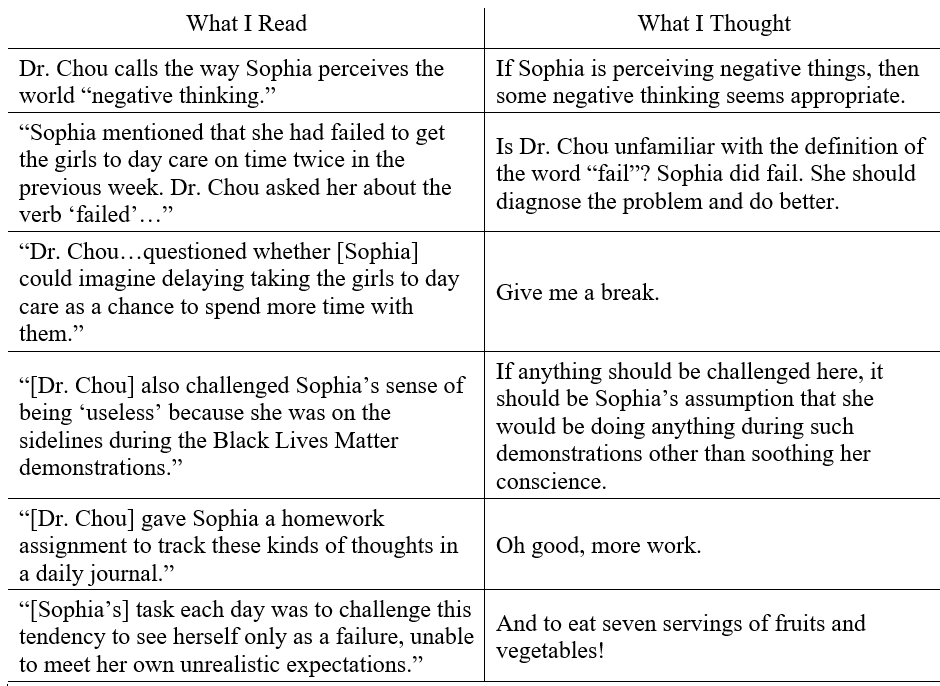
Think me too judgmental? That’s a judgment.
But unless I am uniquely mean, my first reactions show why self-criticism exists. Humans are judgmental creatures. If you don’t judge yourself, others will happily do it for you.
The point of self-judgment, of course, is not to suffer forever. It is to notice what needs to change—and act. If Dr. Chou understood this, she might have asked Sophia what her self-criticism was trying to tell her, and what was preventing her from acting on it. Instead, Dr. Chou tries to fix the feeling rather than listen to its message.2
At best, this kind of intervention offers temporary reassurance. A professional voice, standing in for the broader community’s judgment, tells the client, in effect: “You’re okay. You can relax.” But that is not the same as healing. Even if Sophia had felt relief after her work with Dr. Chou, it would not necessarily mean she had discovered a better way to think. She may have simply been granted a social permission loan.
Unfortunately, Sophia experienced no such relief. “For Sophia,” Insel writes, “the weekly visits, the homework, and the expectations of improvement proved too much. She discontinued CBT after four sessions.” Yes, it sure sounds like the weekly sessions were the problem.
I was surprised to see this from Tom Insel, whose book I otherwise enjoyed. It made me wonder what kind of person, if any, would be drawn into psychotherapy by an example like this. The exchange between Sophia and Dr. Chou reads less like an authentic conversation about complex human problems than a scripted exercise in therapeutic hygiene.
If therapy is headed in this direction, it should be handed over to AI.
Of course, one can always object that this is only one example. Then again, it was a favorable example—CBT in its best light—and it was still lame as hell.
But we don’t need to rely on one example. As a practitioner in the field, I’ve had plenty of run-ins with CBT—anecdotal experiences which, under the circumstances, I hope you’ll allow me to admit as evidence. For background, I got my master’s at La Salle, which had more or less adopted CBT as its main orientation, and did my internship at a psychoanalytic institute. So I got to see Godzilla versus King Kong up close.
Wanting to be an even-handed critic, despite the lopsidedness of my experience, I sometimes wonder how much of my disdain for CBT comes from the introductory class I took on it in graduate school. Among the many boneheaded things my teacher suggested, one stands out. “At the end of the first session,” she advised, “ask the client how much they trust you on a scale from 1 to 10. If it’s not already a 10, ask what you can do to get there by the end of next session.”
I’ve remembered this advice for over a decade, mostly because it is hard to imagine a more revealing misunderstanding of human nature. A client who reported complete trust in me after less than two hours would alarm me far more than one who did not. Trust must be built—I can’t believe I’m having to type this—slowly, over time.
This is what I mean by “hygienic.” CBT all too often approaches the messiness of life with a spray bottle and cloth: we’ll get that taken care of for you right away. Don’t trust me yet? What could possibly be getting in the way? Think you’re no good? Where’s the evidence? Keep ruminating about the future? Stop it.
Clients are not being met as much as moved along: toward cleaner thinking, better habits, and improved outcomes. And many of them can feel it.
The most common complaint from clients who have tried and disliked CBT is that it felt disrespectful toward them and their problems. It treated them as if they were stupid, and their problems as straightforward and easily fixable. They experienced it as patronizing, procedural, shallow, and obvious.
Granted, I advertise myself as someone who “works best with those who think they are too smart for therapy,” so my caseload may be particularly sensitive to being patronized. But still.
A few clients have gone further, saying the method itself seemed to prevent them from forming a genuine connection with their therapist. In CBT, you see, conversation is kept on topic. The number of sessions is often capped. Progress, or the lack of it, becomes the organizing concern. Hell, the treatment is often manualized, the point of which is to make therapy less dependent on the particular person doing it.
Isn’t this odd in a field where the relationship itself is supposed to matter so much?
I do not mean to paint every CBT therapist with the same brush. There are gifted therapists and hopeless hacks in every orientation. But orientations do not randomly attract people, and CBT offers a very particular role: the active, structured, correcting, scientifically-minded guide. That role can bring real virtues—focus, practicality, accountability—but also characteristic vices: impatience, hubris, and a faintly managerial attitude toward suffering.
Nor does a method merely attract a type. Over time, it can cultivate one. Another writer whose work I otherwise respect, Abigail Shrier, says that “a good therapist should do what cognitive behavioral therapists do: prove to a patient that rumination is an unproductive mode of thought and train them to stop.”3
Are we talking about dogs or people here? And what kind of therapist does one become after twenty years of this?
In the end, perhaps the most damning thing I can say about CBT is that it’s entirely possible, in a CBT session, for the therapist to do most of the talking.
Doesn’t that just seem—wrong?
Believe it or not, I don’t think CBT is entirely useless. I can sympathize with it on three fronts.
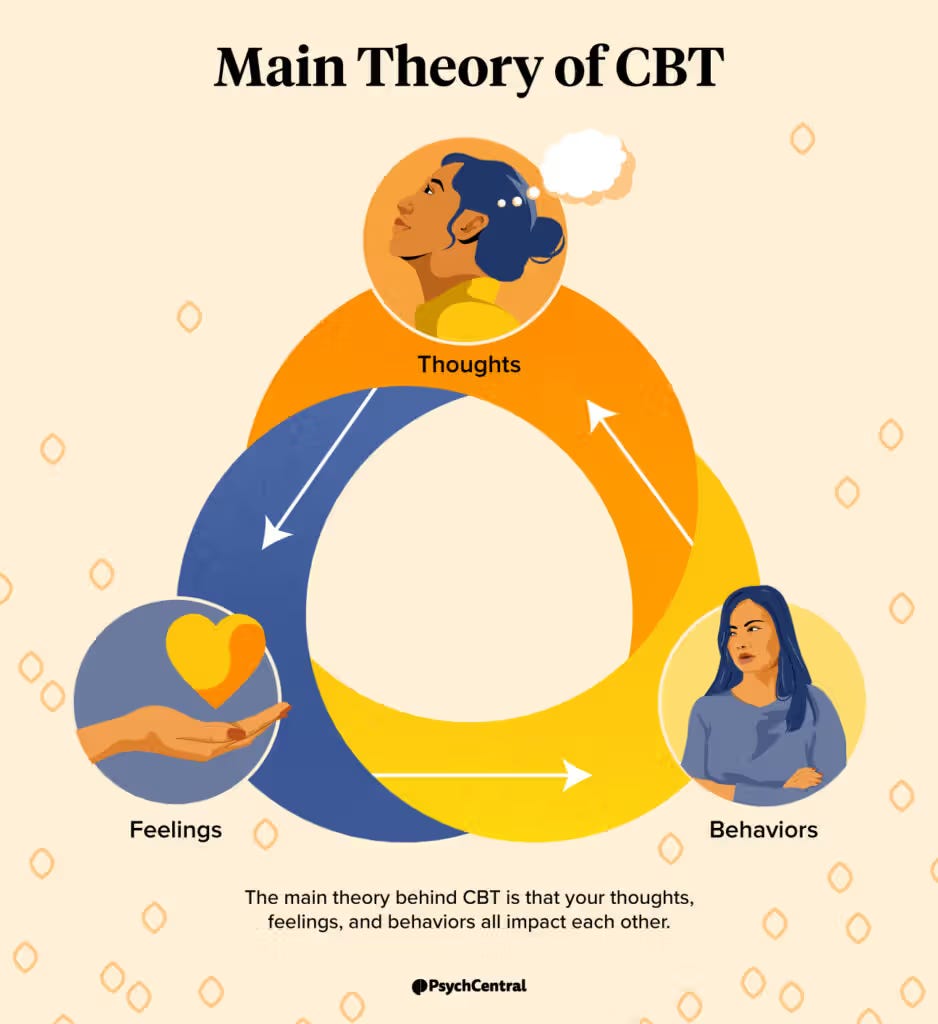
First, CBT’s basic frameworks can be genuinely clarifying. What sounds insultingly obvious to one client may be helpful to another. I might find CBT’s core premise—that thoughts, emotions, and behaviors are interconnected—too obvious to belabor, but I work with this stuff every day. Not everyone does.
Second, CBT is a response to legitimate criticisms of psychotherapy. Therapy has long been expensive, opaque, and difficult to evaluate. If you want to provide mental health care to more people at lower cost, you’ll naturally be tempted to isolate the active ingredients, simplify the method, manualize the treatment, measure the outcomes, and make the whole thing portable. Some kind of McTherapy will likely be the result.
Finally, and annoyingly, CBT does get some things right. Identifying the belief beneath a feeling can be useful. If someone cuts me off in traffic, my anger is usually supported by some assumption: that people should not drive this way, that I have been disrespected, that I am being taken advantage of. Even if I do not abandon the belief, it helps to see that my anger depends on it. More generally, CBT can help people interrupt habits, test beliefs, and find something solid to do when they are drowning in vagueness. Structure, all by itself, can help.
But this is also the problem: CBT is too pleased with its clever little programme. In identifying a few true and useful things, it tends to miss the bigger picture: therapy is more about process—a big part of which is the relationship—than content. As Ivan Illich warned back in the 1970s, the modern doctor “prides himself on the knowledge of pain mechanics and thus escapes the patient’s invitation to compassion.”4
In short, clients deserve better from the best my field has to offer.
If CBT is so lame, why is it still here?
In Walden, published in 1854, Thoreau observed: “I perceive that we inhabitants of New England live this mean life that we do because our vision does not penetrate the surface of things. We think that is which appears to be.”
That is precisely the problem with the session between Sophia and Dr. Chou: it appears helpful. It seems legitimate. An insurance company would trip over itself trying to reimburse it. Indeed, the reason I settled on the word “lame” to describe CBT is that there isn’t a more obviously damning adjective. On the surface, at least, it has all the trappings of scientific authority and professional credibility you could want: it is evidence-based, measurable, expert-led, and rational. What’s the issue?
The issue is that these are just words. What matters is whether there is any substance behind them.
For example, in Where Is the Evidence for “Evidence-Based” Therapy?, Jonathan Shedler argues that the term “evidence-based,” in the context of psychotherapy, may be “a perversion of every founding principle of evidence-based medicine.” He claims the evidence actually shows that such therapies, including CBT, “are ineffective for most patients most of the time.”
Measurement has a related problem: it is only as helpful as the measure is valid. The ability to measure something tempts us into thinking we are measuring what counts. This is how a client can get through ten CBT sessions and still feel there is plenty of work left, only to be told that, according to their Beck Depression Inventory scores, they are much better now and ready to be discharged.
Expertise, too, is not always as foolproof as it seems. As my favorite therapy writer, Kenneth Fisher, puts it: “No doubt, the therapist is a specialist; still, considering what he is faced with—the complexity of life itself—can there really be any expert?”5
Then there is rationality itself. In Part I, I argued that CBT, despite its emphasis on rationality, reasons quite poorly about it. But the deeper problem is that reason is not the whole of wisdom.
Even in Western thought, there is plenty of recognition of this—that “the height of reason,” as Fisher says, “is to know when it no longer serves, when some other response is called for.”6 Josiah Royce makes a similar point in Race Questions, Provincialism, and Other American Problems (1908): “As a professional reasoner, I have a profound contempt for deliberate excesses in the work of reasoning.”7
Evidence, measurement, expertise, rationality. None of these are bad things. That is what makes them dangerous. CBT reminds me of that student—God bless him or her—whose essay satisfies every criterion on the rubric, forcing the teacher to come up with another way to say: “Yeah, but it still sucks.”
Likewise, CBT hits every point on our culture’s rubric. It masquerades as the hero we asked for. It belongs to a society increasingly suspicious of whatever cannot be reduced, explained, proven, scaled, operationalized, measured, or, in many cases, monetized. The result is not the old nonsense psychotherapy was once awash in, but something much harder to criticize, much harder to dislodge: a professionally respectable way of missing the point.
Of course I worry sometimes that I’ve gone too far—that I’m waterboarding a perfectly decent approach that helps plenty of people make better sense of their thoughts and emotions. But then, invariably, I return to a novel, play, poem, or short story, and am reminded that if I could teach CBT one thing, it wouldn’t be the evolutionary perspective. It would be the depth found in the humanities. We’ll turn there in Part III.
The Contra CBT Series
I could be wrong about this. Let me know if I am. I spent about an hour searching on Google Scholar. That seemed like enough.
Another version of this mistake is the common CBT move of asking clients to judge themselves from a friend’s point of view. The friend’s judgment is supposed to stand in for “objective evidence,” but really what’s going on is that the friend is less exposed to the consequences. For basic evolutionary reasons, Sophia should care more about her life, her children, her failures, and her reputation than her friend does. If friends are more forgiving, it’s because they have less at stake.
Comments
Nothing yet. Say the first thing.
Sign in to join the conversation.