
When I held a temporary position with a fancy title in the Department of Economics at the University of Alaska Anchorage, I was lucky enough to spend some time with an economist named Jeff Carpenter, arguably among the foremost experts on the economics of charity auctions.
I did nothing at all with all I learned from Jeff in 2012 until, well, I guess now.
And the reason I’m doing something about it now goes back to 2020, the year I joined a small non-profit organization and got to see up close how it, and other similar organizations, ran their fundraising auctions.1
While most people think of auctions as the sort of thing at Sotheby’s, with paddles and an auctioneer, that’s just one kind of auction. Economists know a fair bit about the properties of different auctions, thanks in part to the scholarly work of Jeff Carpenter and others. I’ll summarize a few to give you a sense of the variety.
A silent auction, the central topic of this post, is familiar to people who go to fundraisers for non-profit organizations. Usually, there are a bunch of prizes—a bottle of wine, a custom portrait of your cat, a trip to Bermuda—and people bid on the item until some fixed time expires, typically right before the event is scheduled to end. Each bid must be higher than the previous bid and the winner is the person with the last and necessarily highest bid. (Economists will talk about this as a close neighbor to an “English Auction.”) A silent auction does tell you a bit about preferences. People who value the object more will bid higher. In such cases, the bidding continues until no one wants to go higher.
A second price sealed-bid auction is a mouthful, but it just means that all bidders write down their bid for the prize (sealed-bid) and the winner is the person with the highest bid. But they pay the number written down by the person who wrote down the second highest bid. Economists call this a Vickrey auction, after William Vickrey, who worked out its properties and earned a Nobel Prize for his troubles. This mechanism is what an economist would call “truth-revealing.”2 If the signed picture of Mark Ruffalo is worth $100 to you, then (according to theory) you’ll bid $100. This mechanism is also efficient. The person who values the prize most is going to wind up with it.
A raffle is a close cousin of the auction. Everyone pays a (small) price and has some chance of winning. An important feature of raffles is that you get almost no information about how much ticket-buyers value the good up for auction. You don’t get visibility into bidder preferences. (A little. Someone who buys a lot of tickets probably values the prize more than someone who buys one.)
There are a few key features that you want to know when you’re choosing what kind of auction to run. One is efficiency. By efficiency I mean that the item goes to the bidder who most values the item. (This is very different from revenue-maximizing, getting the most money from the auction.) Why should we care about efficiency? Well, suppose you’re the government and you decided that you own all of the frequencies of the electromagnetic spectrum that companies might use to provide phone, television, or internet service. Because you are acting in the public interest—as of course the government always does—you want to sell the rights to use the spectrum to the company that will produce the most value from it. The company that can make the most money from it should be willing to pay the most money for it. So you use some sort of auction that is efficient. You would not want to just hold a lottery because then the spectrum might go to a company that can’t do much with it. In fact, they’ll likely just sell it to the company that can make use of it, so they capture all the value instead of the government.3
Ok, back to terra firma.
When I began working in the non-profit space, I noticed that many organizations used auctions to raise funds at their fundraising events and nearly all of them used the same mechanism, the silent auction. There were exceptions, of course, but that was easily the most popular method.4
I wondered why.
Before I share my anecdotal discoveries, let’s take a brief diversion into gasoline prices. When I was a postdoc at Caltech, I saw an excellent talk by an economist who was interested in gasoline prices in Los Angeles. Pricing was complex. The cost the station paid for their product fluctuated almost daily. The market was pretty dense, with some intersections having a gas station at each corner. Demand fluctuated seasonally.
So, the scholar had built a model to predict gas prices. If I recall correctly, it had about seventeen parameters5 and had more Greek letters than there are Greek letters. His model was complicated and did a good job predicting prices, but it raised a new puzzle. How were the people who set the prices at the gas stations—unlikely to be Caltech level economists with modeling skills—figuring out the correct price to charge?
So, he went into the field—by which I mean, he sent graduate students to gas stations in Los Angeles—and asked them how they set prices.
He got a very uniform set of answers. It will probably not surprise you to learn that the owners did not, in fact, run a complex multivariate regression to determine the profit-maximizing price. Each station owner, more or less, used a fairly straightforward heuristic: “Well, I pay for gas by the gallon in the big trucks. They sell to me at some price. I add a few cents to that and put the number on the sign.”
I had a number of conversations with people about why they used the silent auction mechanism at their fundraising events.
I always got the same answer.
It turns out that organizations did not study the literature on auction theory, carefully evaluate their respective strengths and weaknesses, and make a rational choice based on this analysis. It turns out that they used a pretty straightforward heuristic: That’s what we did last year…
Here are two points about non-profit auctions.
First, unlike the government auctioning off slices of the electromagnetic spectrum, no one cares how efficient it is. Do we at the non-profit care that the person who most loves the signed jersey of Bryce Harper gets the signed jersey of Bryce Harper? As someone who was a beneficiary of funds raised at the auction, I can assure you that we did not. Silent auctions are reasonably efficient in the technical sense of that term (though deadline sniping and bidders juggling a dozen prizes at once can gum up the works), but who cares?
Second, auctions differ in how much revenue they raise. Now, theory in economics—see the Revenue Equivalence Theorem—says that, as long as certain assumptions hold, the English auction, the sealed-bid formats, and even the exotic everybody-pays varieties all raise the same revenue for the seller, on average.
But those “certain assumptions,” as often is the case in economics, are doing some heroic work. One key assumption is that bidders care only about their outcome, not the seller’s revenue. At a charity auction, this assumption is violated: bidders are there because they want the organization to raise money. So when I outbid you at a silent auction, I’m reducing your contribution to the non-profit to zero for that item, which works against me because I want you to contribute to the cause as well. In contrast, in an all-pay format, such as a lottery, when I buy a ticket I don’t reduce your contribution, just your chance of winning. For this reason, in theory, all-pay auctions should raise more money than winner-pay auctions. A recent paper by Jeff Carpenter and colleagues confirms this emphatically, in the lab and in the field.
More concretely, people at a non-profit auction are usually very different from folks at a Sotheby’s auction. The Sotheby’s bidder typically wants very much to pay the lowest price for the item, having no particular love for the auction house or its bottom line. At a fundraising event, people are there, at least in large part, because they do care about the organization’s bottom line. They are there to support the cause. People at a non-profit are already sort of over-paying, often buying tickets to some event that they know isn’t “worth” the price of admission. It’s a fundraiser. They are helping to raise funds.
I wound up running the auction at my organization’s fundraiser a couple of times. I am embarrassed to say that, yes, I used a silent auction format, mostly because that’s what we did last year, but it did give me a front row seat to such things. Here are some observations.
Most importantly, there was a lot of money left on the table. Some prizes sold for well above their fair market value. And we know that there were multiple bids above this value. Each of these bids is saying, more or less, I’m willing to make this much of a donation, in the form of the “extra” money I’m ready to spend. The winner does, in fact, overpay. But the bidders who lose take all of their money out of the event with them, despite having been willing to donate it.
Less importantly, some prizes sell for less than their fair market value. This might seem to contradict the prior point, but I observed some sorts of prizes behaving this way. Typically, services went for greater than their value. If the prize is a painting of your cat, for whatever reason people seem happy to shoot past the market value. For a bottle of vodka, people seem to want a deal, and seem reluctant to bid its true value. My guess is that this is something to do with signaling. I signal I’m a generous patron of the arts in the catportrait case, but you can’t send the same signal with the vodka case. (I should be clear that this is all based on my anecdotal observations rather than systematic data-gathering.)
All of that made me wonder, why the heck are non-profits using this kind of auction? Yes, they did it last year, but they don’t have to do it this year.
So I decided to take on a side quest.
At the University of Alaska, Jeff talked about a “bucket auction.”
It goes like this.
You and nine of your friends come to an event and you have a very large number of one dollar bills. (No, it’s not that kind of event.)
There is a prize up for auction. For this purpose, it is a $30 bottle of wine. Let’s say it’s a merlot. There is also a physical bucket, currently empty. It has a picture of the bottle of wine on it, in case you forget what you’re bidding on.
Now, if you want to enter the bidding for this auction, you must deposit $1 in the bucket. Please pause one moment as you are reading to digest the following crucial part of the way this auction works. You have now spent that dollar. It is gone. You will never get it back. With the dollar, you “bought” the opportunity to get into the running to win the wine.
I emphasize this because this part of the auction has proven to be very difficult for me to explain.
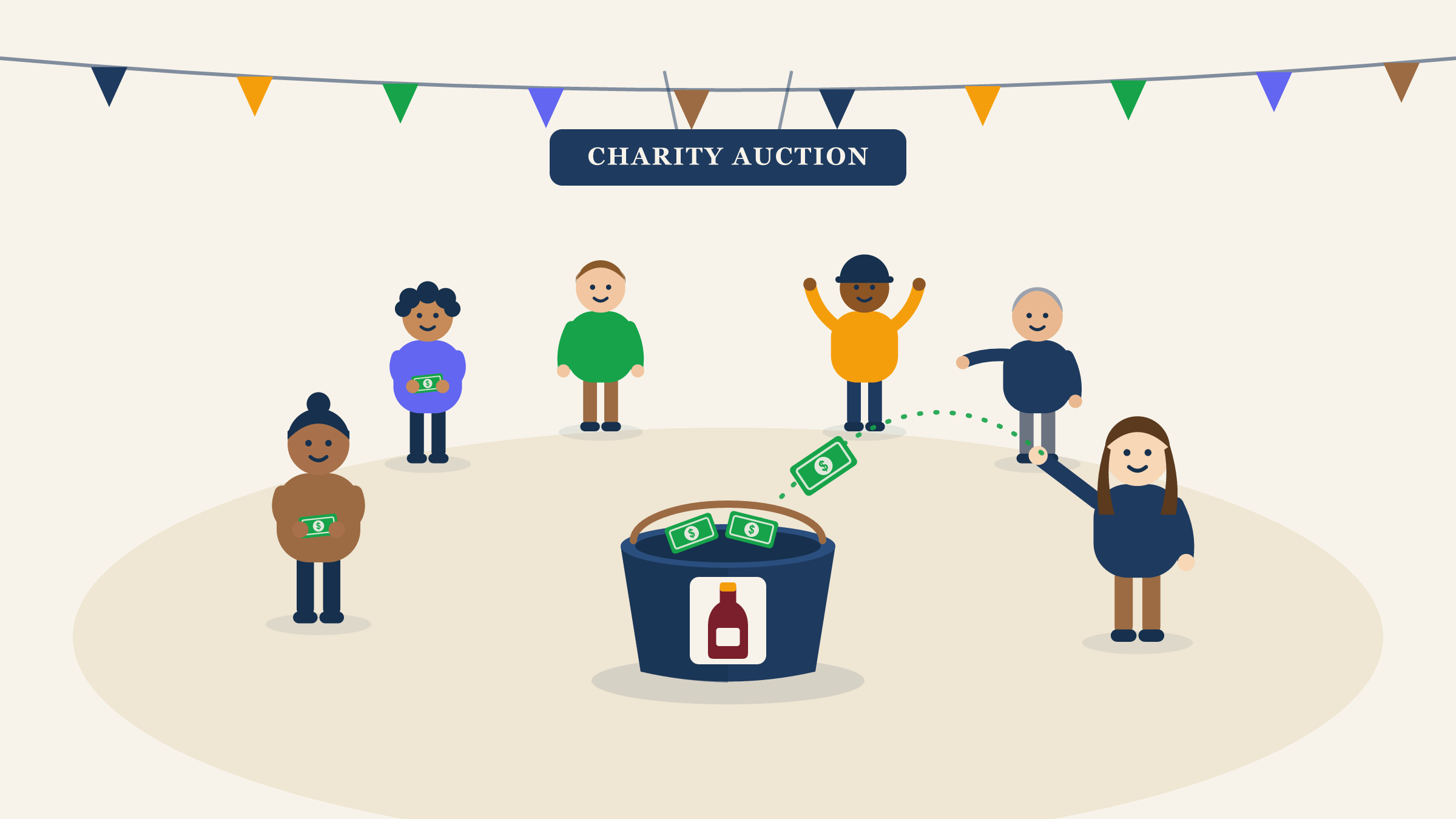
Ok, now all ten of you have put a dollar into the bucket. The person running the auction—let’s call them Capy—randomly chooses one of you. Capy chooses you. Now, if you want to stay in the bidding for this prize, you put another dollar in the bucket. Just like the prior dollar, that dollar is now gone. It is the price of staying in.
Now, you are all in a circle around the bucket and it’s the turn of the person to your left. They have the same choice you had: stay in for $1 or exit the bidding. Play proceeds, one person at a time.
As you can imagine, dollars are accumulating in the bucket.
Eventually, bidders will choose to exit.
The winner is the last person to put a dollar in the bucket.
Imagine that all ten people stay in three rounds. That’s $30, what the wine is worth. Then people fold, in the 4th, 5th, 6th round, whatever. I’ve made a little animation of the action on this page, at the top right.
This kind of auction is a little like a lottery. It’s an “all pay” auction because everyone has paid (something) for the prize, even though only one person wins the prize.6 In fact, in this scenario, if the person was the last one standing after six rounds of play, they spent $6 for the $30 bottle of wine.
Now, the other people have spent some money, putting their dollars in the bucket, but they didn’t get the wine.
Are they sad? I don’t think so.
After all, they are at a fundraising event. They are there to spend money to support the cause.
I might be wrong. Then again, I might not be. As it happens, Jeff and colleagues have continued to work on this topic, and they published a banger of a paper just last year, linked above. They wanted to see how well different auction mechanisms worked, and they were able to gather data both in the controlled environment of the lab and, impressively, in the field, at 95 Rotary club meetings across eleven states.
They were able to get data from 1,700 Rotarians, an accomplishment in itself. (Not because they are Rotarians. Just in general that’s a lot of field data.)
In the lab, they ran a horse race among ten different auction mechanisms: English auctions, Dutch auctions, silent auctions, and so forth. Then they took four of the formats (plus a hybrid) on the road to the Rotarians: the English auction, the raffle, a sealed-bid all-pay auction, and, yes, the bucket auction.
Out of those ten different kinds of auctions, the kind that raised the most money was… drumroll… the bucket auction. As they had seen in prior work (with less data and fewer different auction competitions), Carpenter and colleagues found that the bucket auction raised about three times as much as the English and silent auctions. Yes, this held both in the lab and among our Rotarian friends. In fact, the bucket exceeded expectations, delivering a very robust haul.
Now, it’s true that bucket auctions had more variation. They could do great or they could fizzle. It was a big effect. The revenue variance of the all-pay formats was an order of magnitude larger than that of the familiar winner-pay formats.
But more or less, they were the winner. (See Fig. 3 of the paper for the revenue race, and Fig. 6 for the variance.)
I want to take a moment to clarify that Jeff doesn’t think the reason that non-profits use silent auctions instead of bucket auctions is the reason I suggested above, that it’s the way they did it last year. Instead, he points to risk aversion. In the paper, the choice of auction format is framed the way an economist would frame the choice of asset. A non-profit that counts on its annual event to make payroll cares about the worst case, not just the average case.
There is a second, related strand: bidders know how silent auctions work, so they are more likely to participate. Unfamiliar formats risk people sitting out entirely, which shrinks the take no matter how clever the mechanism is. Still, I have to say, connecting up to the gas station story above, when I talk to people about why they use the formats they use, they just never say that “well, our organization has relatively little tolerance for high variability in auction revenue.” They say what I say they said.
Now, finally, let’s talk about me and my side-quest.
I wanted to give charities a way to run a bucket auction.
In general, most platforms that non-profits use run silent auctions. The reason for this is straightforward: that’s where the demand is. Charities are used to this format. It’s what they used last year.
Thus was born, as I call it, CapyBidder. (The website is here and you can make an account on the app here.)

Because of advances in artificial intelligence, I was able to write software that runs a bucket auction.
As of this writing, it is fully functional. It runs as a web app and it runs on both iOS (Apple) and Android devices. So you could build an auction with real prizes and people could bid using their phones.
Where is CapyBidder now?
Well, I’ve run a bunch of tests, and I have made some discoveries, some good and some bad.
On the plus side, testers find the auction fun. I have a nifty countdown dial that shows how much time you have left to bid on the prize you’re registered for. You can see how many other people are left in for each prize. The action feels tense, but in a good way.
The big hurdle I’ve run into is that I haven’t been able to find the right way to explain how it works. When I run my tests—so far only for fake money, nothing real at stake—people are confused that they have bid on an item, didn’t win it, and still see that they owe (fake) money. My sense is that people have in their mind the usual way that auctions are run. You bid and if you win you get the thing and pay for it. Of course, the bucket auction is more like a lottery. You bid, but you don’t necessarily win.
So now I think there are five possible reasons that non-profits don’t use bucket auctions.
Risk aversion. Jeff might be right. It’s risky.
Momentum. Or maybe status quo bias. No one wants to change what they did last year. We’re still around this year, so whatever we did must be working.
Software. Until the advent of CapyBidder, to the best of my knowledge there was no bucket auction software designed for non-profits.
Irritation. Bidders who don’t win the prize pay into the pot but don’t get anything.
Confusion. It’s just too hard to explain a bucket auction, so no one wants to use it.
Do you know a non-profit—preferably a small one—that might want to try out a new way to run an auction? CapyBidder is free in beta.
Do you have ideas about how to explain how the thing works? Drop me a line. I’m open to new ideas.
I’ve set up a little test auction called Coins for Camels, if you want to check out the interface. (You have to make an account to see the auctions.) Got ideas to improve it? Send them along.
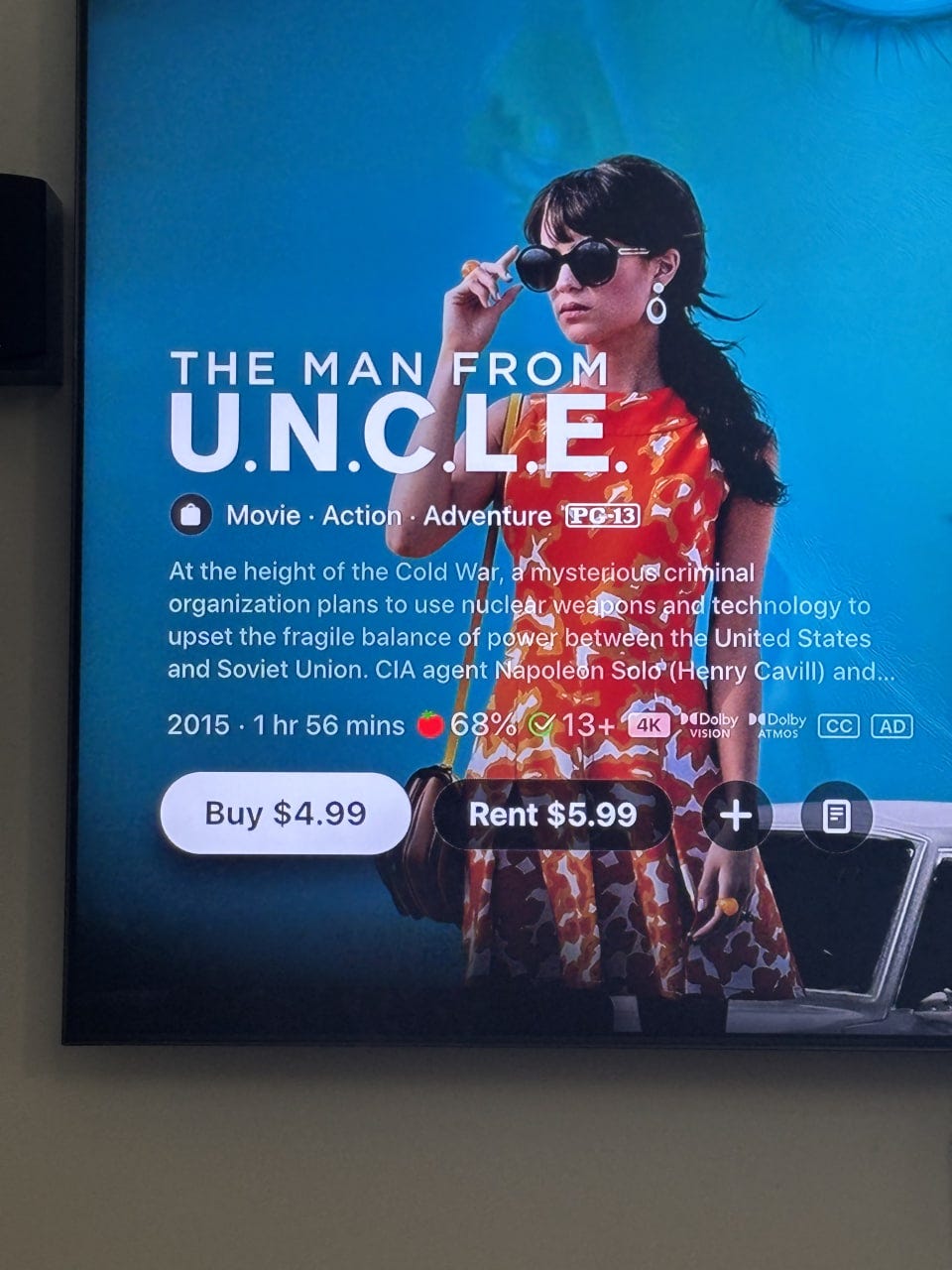
As you saw in my prior posts, I’m curious about why people use different kinds of allocation mechanisms. Why does Taylor Swift sell her tickets at a price that is so much lower than what people will pay, allowing third parties to swoop in and make a bundle? Why is there always a line at that one cookie place in downtown Philadelphia… shouldn’t they just raise their prices? And just to add this little nugget, why does Amazon want me to pay not to be able to rewatch a movie?7
From my point of view, it sure seems like charities are using auctions that don’t raise as much money as they could.
Bucket auctions hold real promise for doing better than what they did last year.
Unless you care about the technical stuff, you can skip this footnote. The reason the winner pays the second price is subtle. In a Vickrey auction, your bid does exactly one thing: it determines whether you win. It never determines what you pay—that number is set by somebody else’s bid. Suppose the signed picture of Mark Ruffalo is worth $100 to you, and the next-highest bidder wrote down $50. Bid your true value, $100, and you win, pay $50, and walk away $50 happier. Could you do better with a different bid? Bidding more than $100 changes nothing here—you still win, still pay $50—but it courts disaster: if a rival had written down $130, you’d win and pay $130 for a picture worth $100 to you. Bidding less than $100 can’t lower your price either, since you don’t set it; all it can do is cost you the picture when you’d have gotten it at a bargain (bid $40 and the $50 bidder wins, taking your $50 of surplus with them). Bidding your true value is never worse than any alternative and sometimes strictly better, so it’s a dominant strategy. That’s the sense in which the Vickrey auction is truth-revealing. (In a first-price auction, by contrast, your bid is your price, so you shade it below your true value and hope.)
This isn’t hypothetical. The FCC handed out cellular licenses by lottery in the 1980s; speculators flipped the licenses and made prodigious moolah. This is the same thing that happens with underpriced concert tickets: third parties benefit. Congress switched to auctions in 1993. When I was at the University of Arizona, the crew there at the Economic Science Laboratory was developing mechanisms for auctions of similar complexity, such as takeoff and landing rights at airports.
Carpenter et al. (2025) made the same observation, putting it this way: “Anecdotal observations suggest that winner-pay formats dominate charity events and all-pay mechanisms (other than the raffle) appear to be mostly absent from the fundraising landscape.”
It probably didn’t have 17 parameters. But it had a bunch.
Economists will recognize this as a “war of attrition.”
Goods donated to non-profit auctions, rented movies, and sold movies have in common that the marginal cost to the seller is roughly zero. I think this is one reason they all have weird pricing. The world of selling/renting movies is complicated and, candidly, beyond my ken. My guess is that in cases such as this, there’s no opportunity for arbitrage to discipline this seeming market irrationality, but I don’t really know. (That is, I can’t buy the movie and resell it for a price just below the rental price. The right to watch a movie isn’t transferable in this way.) Maybe someone at Amazon is monitoring for such cases so they can reduce the rental price? But I don’t know the shape of the relationship between Amazon and whoever owns the IP to rent, so maybe that’s not even an option? In any case, non-profits often think of donated goods as zero cost, and that makes them, I think, care less about what they sell it for at an auction.
Comments
Nothing yet. Say the first thing.
Sign in to join the conversation.