
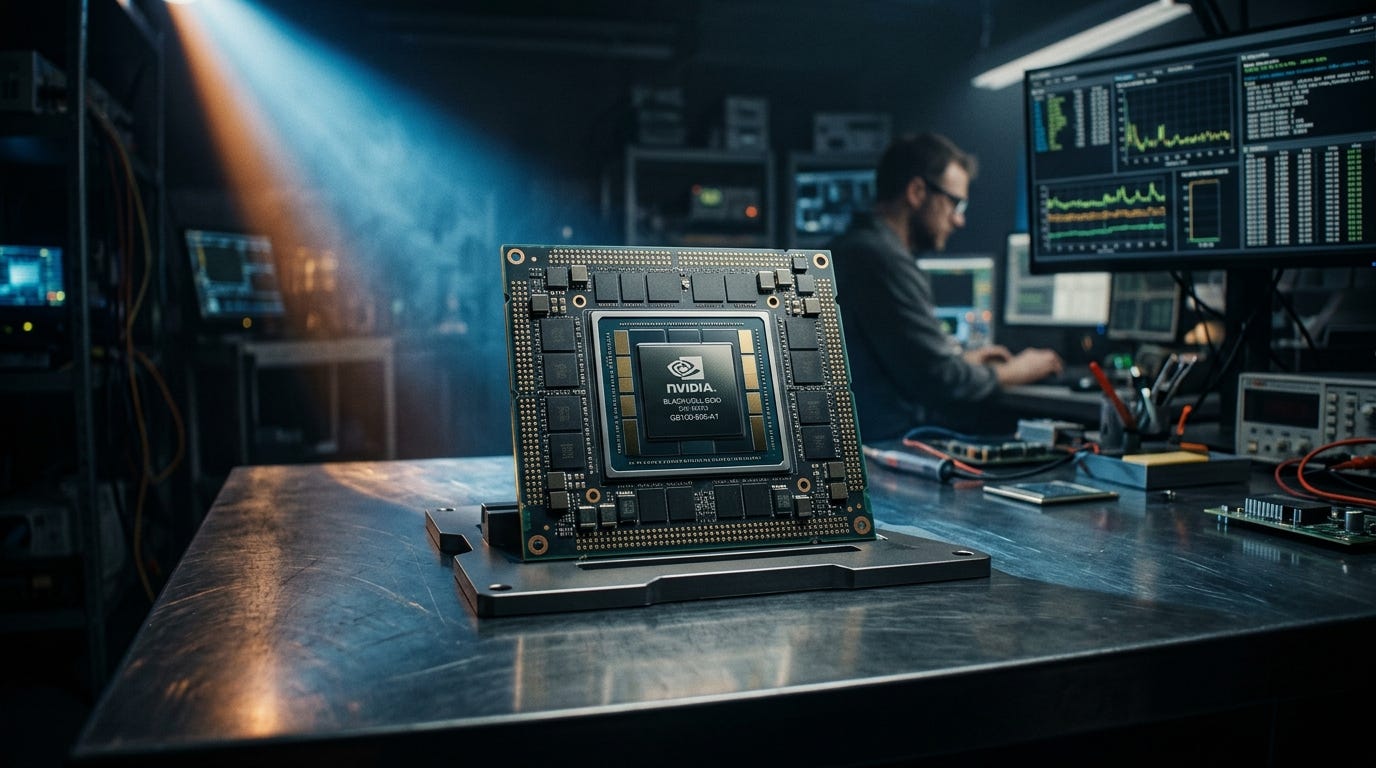
In 2007, banks bundled mortgages. In 2026, Wall Street is bundling GPUs.
That’s a bit crude. But it’s not fully wrong. Yesterday, Nvidia signed MOUs with Apollo, BlackRock, Blackstone, Brookfield, Goldman Sachs, and KKR. The goal: raise over $500 billion in outside capital for AI builds.
No final deals. No set terms. No firm pledges. No timeline. Six MOUs and a press release.
Let’s look under the hood.
Venture capitalists call a private company worth over $1 billion a unicorn. $10 billion and it’s a decacorn. $100 billion is a hectocorn. But what do you call a private company worth over a trillion dollars? Anthropic is there, right now. The first of its kind. It’s worth more than every American airline — It’s even bigger than the U.S. defense budget … Anthropic’s annualized revenue grew by 80 times in the first quarter. They’ve already filed the paperwork for an IPO … Some estimates say they are going public as early as October. Now, here’s what’s really exciting. You can take a stake in this IPO … Right now. Today. Before it goes public. For a chance to see gains on day one.
(sponsored)
Here’s what we know from filings and press notes.
Nvidia signed six MOUs. These are not binding deals. The partners are the biggest asset firms on Earth. Each firm picks its own tools to raise capital. Apollo and Blackstone lean toward private debt. BlackRock has deep skills in infrastructure funds. Goldman and KKR bring project finance and ABS know-how.
The capital flow looks like this:
Wall Street Capital Pools → Compute Finance Platforms → Nvidia Clients (AI Labs, Firms, Clouds) → Nvidia Hardware + Data Center Builds
The clients are the ones who borrow. Nvidia gains from the ecosystem. The banks earn fees and interest.
Here’s what we don’t know:
• How much each firm will put in — not shared
• Debt vs. equity vs. hybrid mix — not shared
• Interest rates or what “good rates” means — not shared
• When capital gets deployed — not shared
• When final deals get signed — not shared
That’s a lot of blanks for a $500 billion headline.
One detail leaked via The Information and Reuters. Nvidia may back up to 25% of deals. That could mean $125 billion in payment pledges. Jensen Huang confirmed this option on X.
Also, Nvidia is said to be working on a $350 billion plan to help OpenAI buy chips. On top of that, up to $250 billion in backing for OpenAI’s lease costs at SoftBank’s Ohio data center.
Those numbers add up fast. And pledges are not free money. They are risks on the books.
(sponsored)
Nvidia’s press release uses a key phrase: turning compute into “an investable asset class.” Huang told CNBC his chips are “an investable asset.” Let’s test that claim.
For something to work as a funded asset class, it needs:
• Steady cash flows
• Clear loss-of-value curves
• Active resale markets
• Standard ways to set a price
Here’s how GPUs score:
Steady cash flows? Sort of. Cloud-based billing models exist. But AI workload demand is choppy. A top lab’s compute needs can shift each quarter.
Clear loss of value? This is the hard part. GPU models change every 18–24 months. A Blackwell chip funded today competes with what ships in 2028. Nvidia’s product pace is fast.
Active resale markets? Not yet. There’s no standard exchange for used GPUs at large scale. Resale prices are murky.
Standard pricing? No. Every data center has different power costs, cooling setups, and usage rates.
Now compare this to commercial real estate — the analogy Nvidia itself invites:
Commercial Real Estate → 30-year useful life → Set appraisal norms → Deep resale market → Steady rental income
GPU Builds → 3–5 year useful life → No pricing consensus → No resale market at scale → Usage-linked revenue with demand swings
The analogy is hopeful. Not wrong in spirit. But the gap in maturity is huge.
Here’s what is real: BlackRock just closed a $14 billion deal with Meta. BlackRock funds will hold 80% of a 1-gigawatt data center campus in El Paso. Meta puts in $2.3 billion in land and building. BlackRock adds $4.9 billion in cash. $12.5 billion in debt funds the build. Meta is the sole tenant. Target go-live: 2028.
That’s a real deal. Named tenant. Clear terms. Set capacity. It proves compute-as-infrastructure can work. The Nvidia MOU setup is still several steps behind this level of detail.
Last time Jensen Huang made a public statement about this technology — optical stocks surged the same day. That was the confirmation. Not the discovery. The people who knew before he said it were already in.
Jason Bodner is naming what Huang will confirm next — free.Read it before Huang says it
(sponsored)
Markets are honest when press releases aren’t. Here’s what happened right after the news:
• Nvidia (NVDA): −2.86%
• Apollo Global (APO): +3.59%
• Blackstone (BX): +3.30%
• Brookfield (BAM): +0.45%
• KKR: +1.18%
Read that again. The chip maker fell. The fee earners rallied.
The market’s read is clear:
Nvidia Hardware Sales (core business) → Now Partly Tied to Outside Financing → Margin Risk + Pledge Costs
vs.
Wall Street Platforms → New Fee Stream → Asset Fees on $500B Pool → Low Balance Sheet Risk
The banks found a new fee market. Nvidia found a new risk line.
This doesn’t mean the deal hurts Nvidia. Demand at this scale could fuel hardware sales for years. But the stock drop hints that investors weigh the pledge risk. It also signals that buyers may need help paying.
When your clients need $500 billion in outside credit to buy your product, that’s either huge demand or a sign the price has outrun budgets. Likely both.
Let’s get concrete. Maybe you hold NVDA. Maybe you own one of the six finance firms. Maybe you’re sizing up AI infrastructure. Here’s a framework.
The Capital Flow Chain to Track:
Big Capital (Pensions, Insurance, Sovereign Wealth) → Wall Street Platforms (Apollo, BlackRock, Blackstone, Brookfield, GS, KKR) → Finance Tools (Private Debt, ABS, Project Finance) → Nvidia Clients (Hyperscalers, AI Labs, Firms) → Hardware + Data Center Buys → Nvidia Revenue + Software Adoption
Every link has a risk point. Let’s walk through them.
Risk Node 1: Demand Staying Power
The whole setup assumes AI compute demand grows nonstop for the loan period. What if a major AI lab scales back? What if a new design cuts GPU needs per task? Usage rates drop. Usage-linked revenue only works when usage stays high. No one says what happens to loan terms if usage falls below a set level.
Risk Node 2: Nvidia’s Pledge Risk
Huang confirmed the option to back up to 25% of deals. On $500 billion, that’s $125 billion in potential costs. For context, Nvidia’s total assets per its latest 10-Q were about $112 billion. A pledge this large, even if partly used, would reshape the balance sheet. Watch the next 10-Q for how these risks show up in the notes.
Risk Node 3: GPU Value Loss vs. Loan Length
This is the mismatch no one in the press release talks about. Say a finance platform makes 7–10 year loans. But the GPU part loses value in 3–5 years. That’s a gap. The building keeps its worth. The chips inside don’t. Whoever builds the ABS layers must price this in. We haven’t seen those terms yet.
Risk Node 4: One-Vendor Risk
Six firms. One chip maker. If Nvidia’s edge shifts — say AMD or custom chips gain real share — the backing weakens. This is single-vendor risk dressed up as broad capital deployment.
Utility Block: Your Due Diligence Checklist
Before you change any holding based on this news, check:
• Has any firm shared binding pledges? (Today: No)
• Has Nvidia filed 10-Q or 8-K updates with pledge details? (Watch for this)
• What is the average loan length vs. GPU refresh cycle? (Not shared)
• Are usage contracts fixed or flexible? (Not shared)
• Is there a resale market for these finance tools? (Not yet)
If you can’t answer these five items, you’re trading on a press release. Not on facts. That’s fine for a day trade. It’s not fine for a real position.
Kira’s Read:
This is a big structural move. Nvidia is shifting from a chip seller to a platform that creates its own finance ecosystem. That’s a moat play. It’s also a complexity play. And complexity cuts both ways.
The BlackRock-Meta deal in El Paso is the model to watch. Named tenant. Clear terms. Set capacity. Set timeline. When the Nvidia MOU setup yields deals at that level of detail, the “investable asset class” idea gets real.
Until then, we have six MOUs, a half-trillion-dollar wish, and a stock that dropped 2.86% on the news.
I’m not changing my NVDA position on this. I’m adding these five checklist items to my tracker. Then I’ll wait for the next 10-Q. That’s the document that matters. Not the press release.
No posts
Comments
Nothing yet. Say the first thing.
Sign in to join the conversation.