
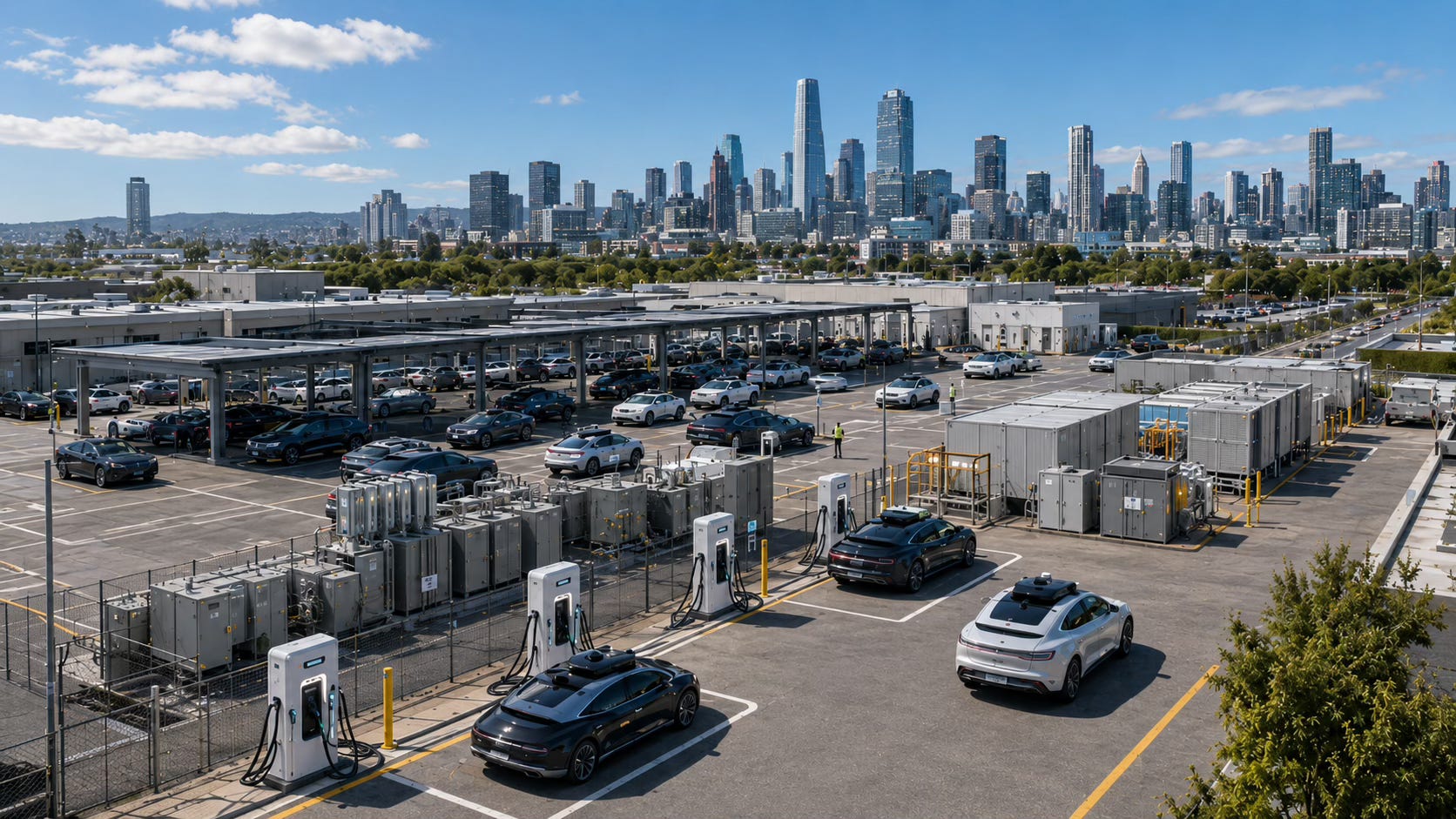
It’s September 15th, 2030. I’m headed to a meeting in Midtown Manhattan. I step out of a robotaxi at 56th and Lexington. I pause and watch the vehicle drive off down the street and think to myself:
Where is that vehicle headed?
The robotaxi may appear to eliminate parking, but actually it relocates it. Fleets of autonomous vehicles to ferry passengers need charging, maintenance, cleaning, staging, and places to wait between rides.
Why might that matter for real estate?
Autonomous vehicles are digital products operating on top of a very physical support network.
An Uber or a robotaxi may feel like a digital service. Tap an app, a vehicle appears, you get in, and it disappears after dropping you off.
But the vehicle itself remains primarily a physical construct.
It needs electricity. It gets dirty. Tires wear out. Kids get their markers out and draw on the upholstery. Sensors fail. Vehicles need inspections, repairs, staging, and places to wait between rides.
To execute the AV fleet business plan at scale, these requirements demand a network of real estate and infrastructure.
Today we see an early version of that network emerging. Waymo, for example, appears to use a combination of larger service facilities and smaller distributed charging and staging locations.
Its larger facilities can handle functions like charging, cleaning, inspection, maintenance, and more specialized work. Smaller locations closer to areas of demand can support charging, staging, cleaning, and light service.
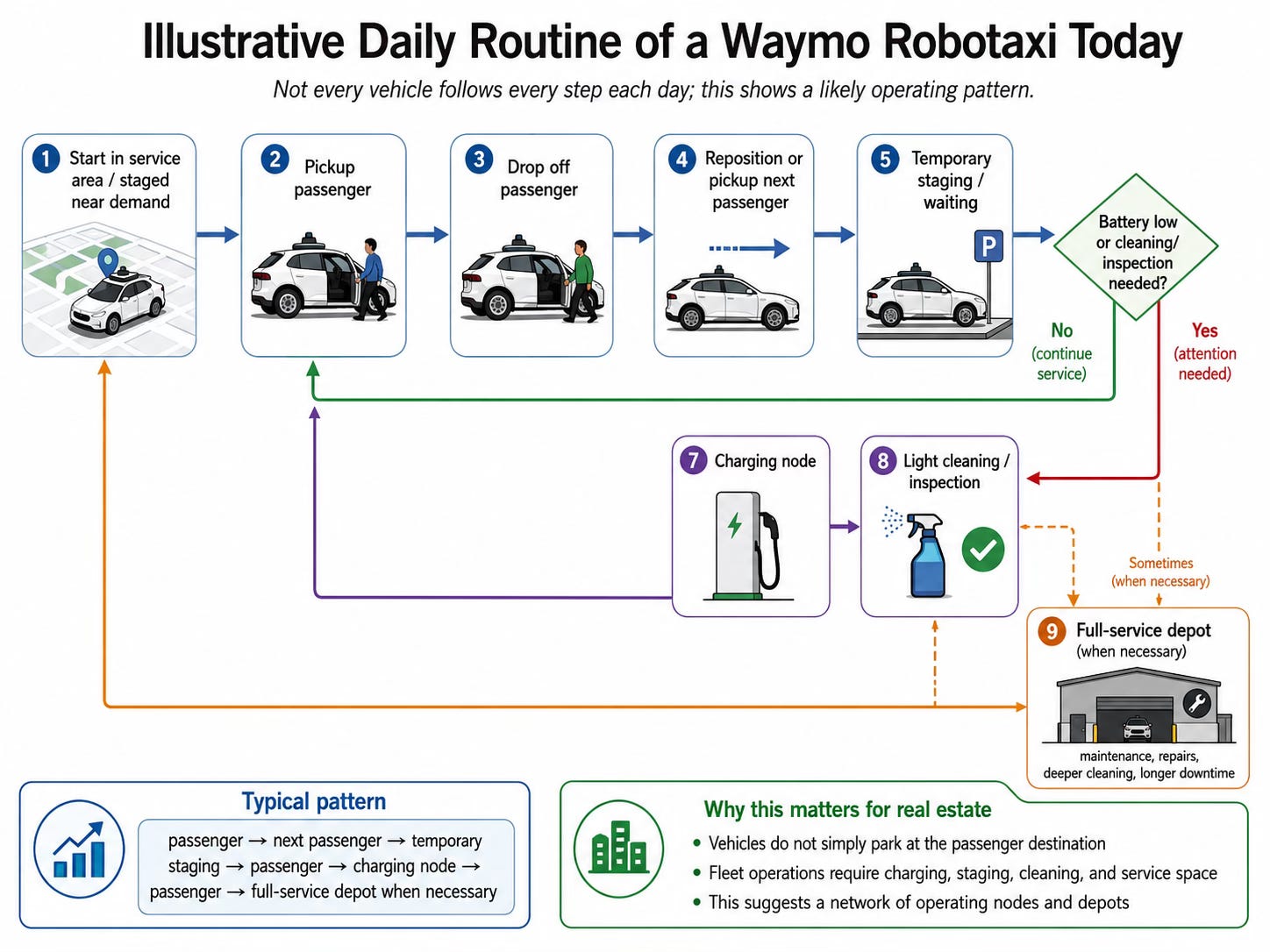
Different autonomous fleet operators may organize their networks differently, and these systems will continue to evolve. But the underlying physical requirements are unlikely to disappear.
Today, autonomous vehicle fleets remain relatively small compared with the total number of trips taking place in major cities.
But what happens if autonomous vehicles become one of the most common ways people move around cities?
A network supporting thousands of vehicles is one thing. A network supporting millions of vehicles something entirely different.
An exponential increase in consumer demand requires charging infrastructure, staging areas, electrical capacity, maintenance facilities, and strategically located fleet support nodes.
The interesting question is: what are the physical and capital requirements for that network to grow by 10x, 100x, or even 1,000x?
We do not have to imagine what it would look like to have 1,000,000 robotaxis in our cities, we have a model for reference today, Waymo in San Francisco.
Today there are roughly 1,000 Waymo robotaxis on the road in San Francisco.
There are multiple locations for storage and maintenance throughout the city. The main maintenance depot appears to be at Toland Street on approximately 2.75 acres. It has a 30,000 SF building with parking for around 120 robotaxis. Their second primary location is at 14th Street. It appears to have parking for around 100 vehicles. And there are a few other satellite locations with parking around San Francisco including a garage in the SOMA district. This equates to parking for around 400-700 vehicles.
Some numbers we have found online:
Power: At the 14th Street location, they are installing 5 MW of charging capacity for around 100 vehicles.
So if you need 5 MW available for 100 vehicles, you need to have 50 MW for 1,000 vehicles.
Parking Space: For 1,000 vehicles, Waymo has about 50% dedicated parking spaces or 500 spaces. Multiply 500 spaces by 300 SF (includes parking & circulation) = 150,000 SF of demand across the 1,000 vehicles. And 150,000 SF / 43,560 SF/Acre = 3.44 acres of parking
Remember, this is a speculative exercise to think through the footprint of one observable vendor. It is not the verified footprint of Waymo in San Francisco.
For fun, let’s extrapolate this to 1,000,000 robotaxis in service in a city:
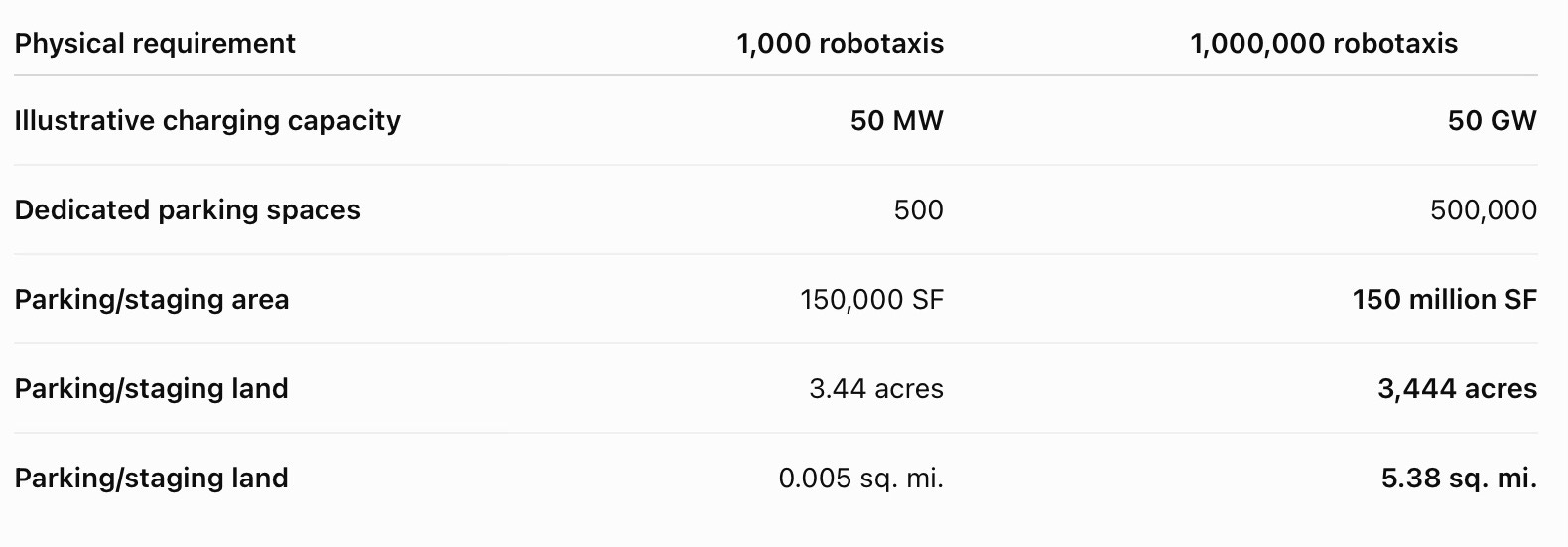
Assumptions: The parking calculation assumes dedicated capacity for 50% of the fleet and approximately 300 SF per vehicle, including circulation. The power calculation is a simple linear extrapolation from the 5 MW of planned charging capacity at Waymo’s 14th Street facility, assuming approximately 100 vehicles per facility. These are illustrative planning estimates, not Waymo-disclosed systemwide requirements.
The scaling of autonomous vehicle infrastructure won’t be linear. Regardless of how it scales, the implications for real estate investors and our cities is massive.
Parking today lives at your destination.
Your home. Your office. The restaurant you visit. The store where you shop. The airport. The stadium.
But an AV fleet vehicle does not need to remain parked where the passenger gets out.
That fundamentally changes the historic relationship between transportation and real estate.
For thousands of years, the thing that moved you around typically needed to remain relatively close to you when the trip ended. Horses needed stables. Personal vehicles needed garages and parking spaces.
Autonomous fleet vehicles break that connection.
What happens to real estate when you no longer need to park “your car” somewhere?
A transfer of spatial urban infrastructure takes place.
Vehicles still need to park, wait, charge, be cleaned, maintained, and repaired. But those functions no longer need to happen where you are.
That could mean less demand for parking at:
Offices
Retail
Residential buildings
Airports
Concert venues
Stadiums and other major destinations
And more demand for:
Fleet staging
Charging and service
Highly accessible industrial land
Garages that can support fleet operations
Locations with substantial electrical capacity
Parking demand may not collapse all at once. It could shift slowly, beginning in markets where autonomous fleets reach meaningful adoption first.
If parking moves away from the destination, buildings begin to change too.
For developers focused on creating great places to live, work, and play, the emphasis may shift away from vehicle storage and toward vehicle throughput.
Instead of designing large garages to hold hundreds of cars for eight hours, developers may need to think more carefully about how autonomous vehicles enter a property, drop people off, pick them up, and leave quickly.
A building that once needed 50 linear feet of curb frontage might instead need a 3,000-square-foot mobility zone designed to handle a steady flow of vehicles.
The geometry of the building starts to respond to a different transportation system. It also frees up the geometry of the building to be optimized for other factors such as energy generation, human comfort and productivity, etc.
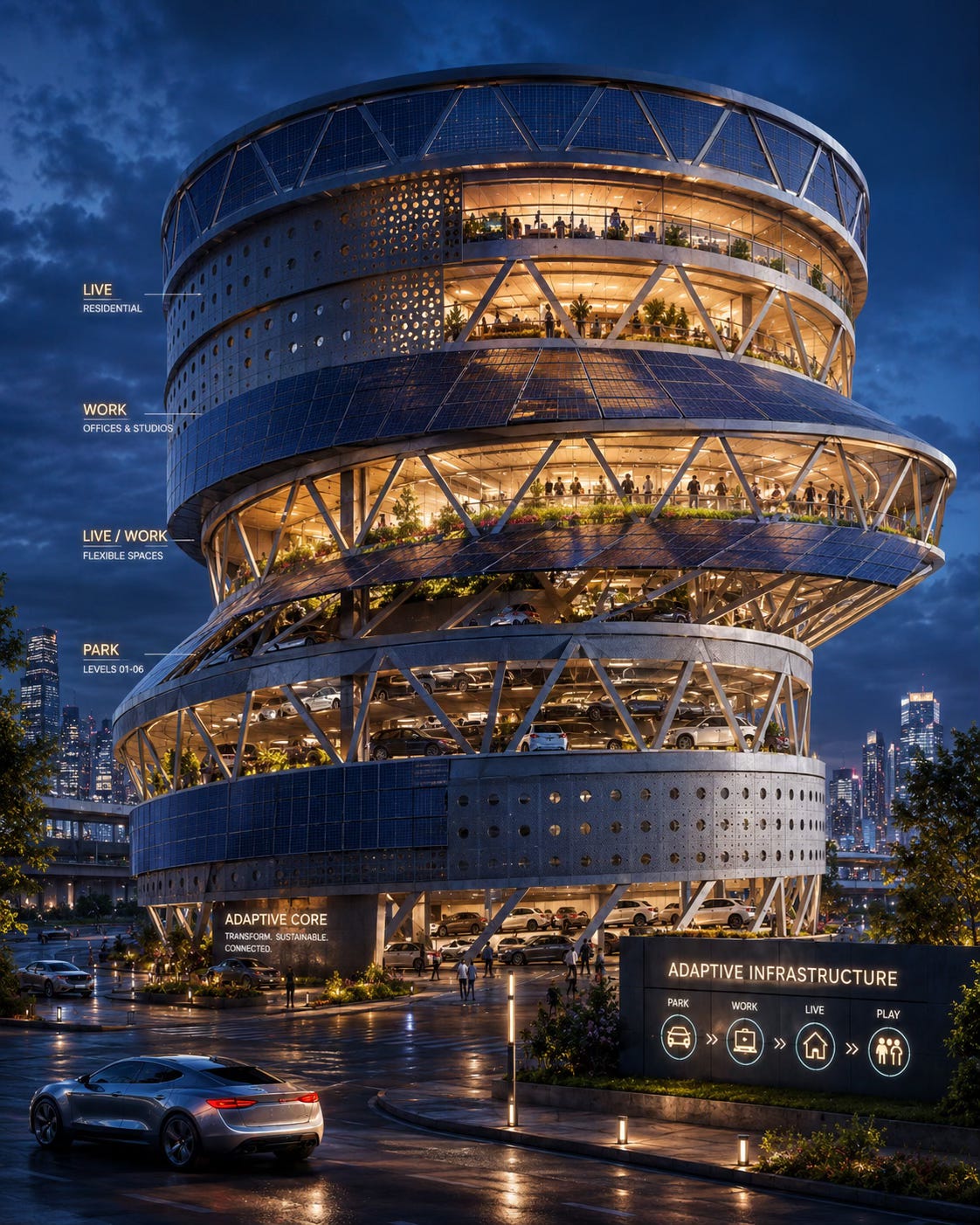
Garages that are able transform over time may become more economically attractive than single-purpose parking structures. To facilitate this transition one could imagine designing parking floors with sufficient ceiling heights, structural capacity, natural light, and regular floor plates that allow owners to convert to residential, office, retail, or other uses as parking demand changes.
I explored this idea years ago at MIT. The image below is from a project I designed where we explored the ideas of a transformable parking structure meant to be flexible to change as parking demand and building use evolved over time.
At the urban scale, the question becomes even more interesting when we look at the enormous stock of parking infrastructure that already exists in American cities.
Some existing garages may become fleet management locations.
Others may become obsolete and be redeveloped.
Surface parking lots may disappear altogether in particularly valuable locations.
The result could be a denser city with more space devoted to people and productive uses rather than storing privately owned vehicles.
More people, more activity, and perhaps more density of good ideas.
But who knows. Maybe that’s the architect in me speaking. This is a question I have been interested in for a long time.
Below is a diagram from my MIT thesis exploring the relationship between transportation technology and urban form.
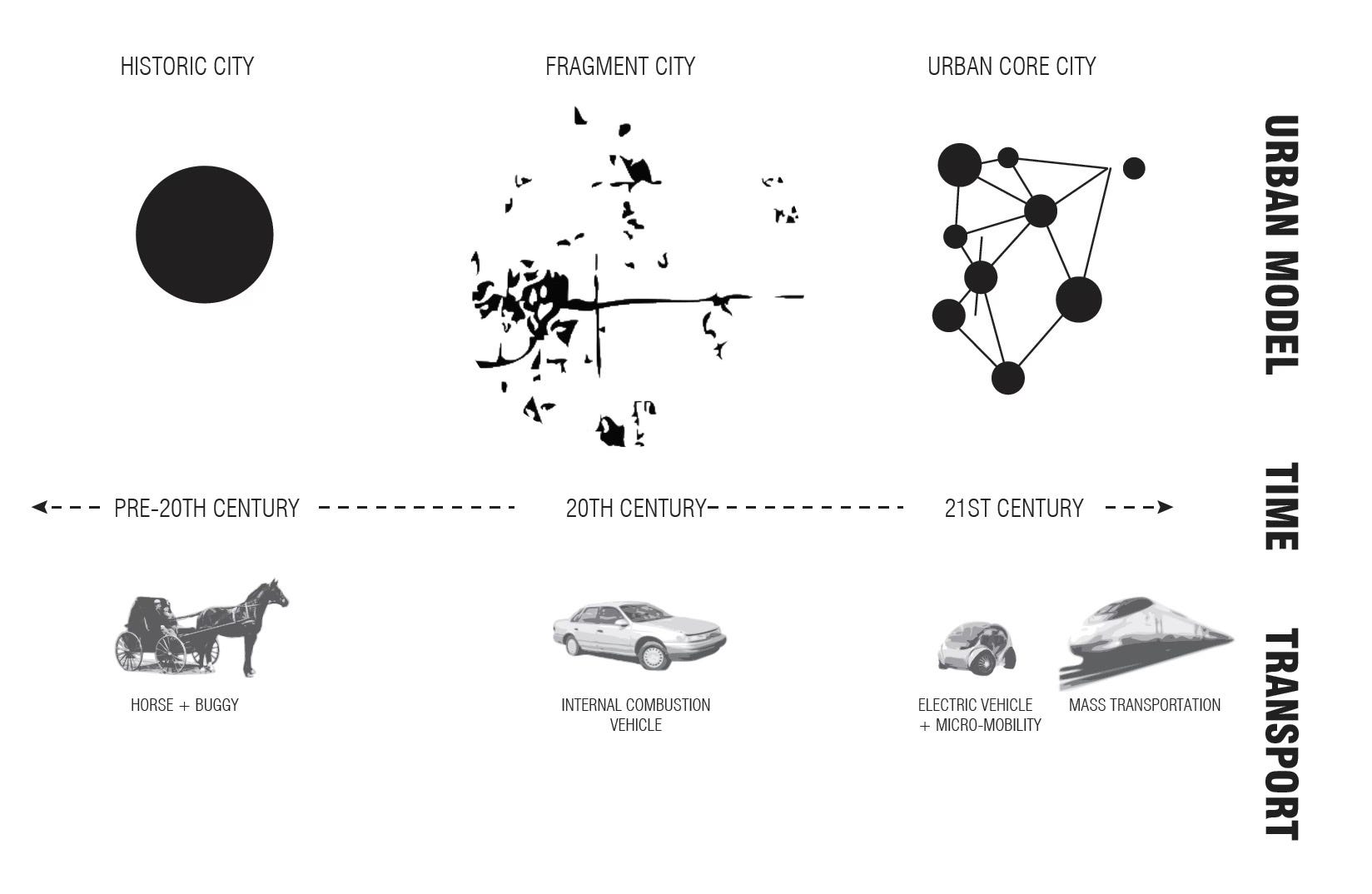
If infrastructure for 1-million AVs requires 1,000’s of acres, a distributed network of locations, and 50+ gigawatts of power availability, what does that mean for investors?
The simple answer, it means a whole lot.
Property owners should think in terms of:
Location
Power
Zoning
Access to major arteries
Separation from sensitive uses
Existing automotive/parking/industrial infrastructure
Redevelopment optionality
If you own existing parking infrastructure that could become much more valuable, but for those looking to acquire facilities with this thesis in-mind, the most important characteristics are likely to be a good location with access to major vehicular arteries, friendly/flexible zoning, access to large amounts of power, and a variety of uses.
That is the kind of infrastructure you want to own long-term.
At the same time, some existing parking assets may have value for exactly the opposite reason. If autonomous transportation eventually reduces parking requirements at offices, apartments, retail centers, and other destinations, a large surface lot or parking structure may represent future development capacity rather than simply a place to store cars.
That creates two potential forms of optionality: parking assets that can become fleet infrastructure, and parking assets that can become something else entirely.
Car dealerships, gas stations, surface parking lots, older garages, and underutilized industrial properties are obvious places to start looking. But the traditional rules of real estate still apply. Location matters. So does access to power, existing entitlements, surrounding land uses, and the ability for a property to evolve over time.
This is a working thesis, but I believe well-located parking infrastructure in urban locations will become increasingly valuable as autonomous fleets scale because of their embedded optionality.
That robotaxi that disappeared around the corner, where did it go?
It went somewhere, I'm not really sure where though. And that is as important as the fact that it didn’t stay at my location.
The parking lot may disappear from next to the office building, but the physical requirements of the transportation system do not disappear with it. They move somewhere else.
And as we have seen, when we have 1 million AVs in a city at scale, autonomous mobility becomes an enormous land, power, infrastructure, and real estate problem.
Which of course is also the opportunity.
The next installment in this series will explore the other side of the question: if autonomous vehicles make transportation easier and cheaper, does the city become more valuable and dense, or do we simply enable another wave of outward expansion and sprawl?
Cheers,
John
Thanks for reading The LineUp! This post is public so feel free to share it.
Comments
Nothing yet. Say the first thing.
Sign in to join the conversation.