
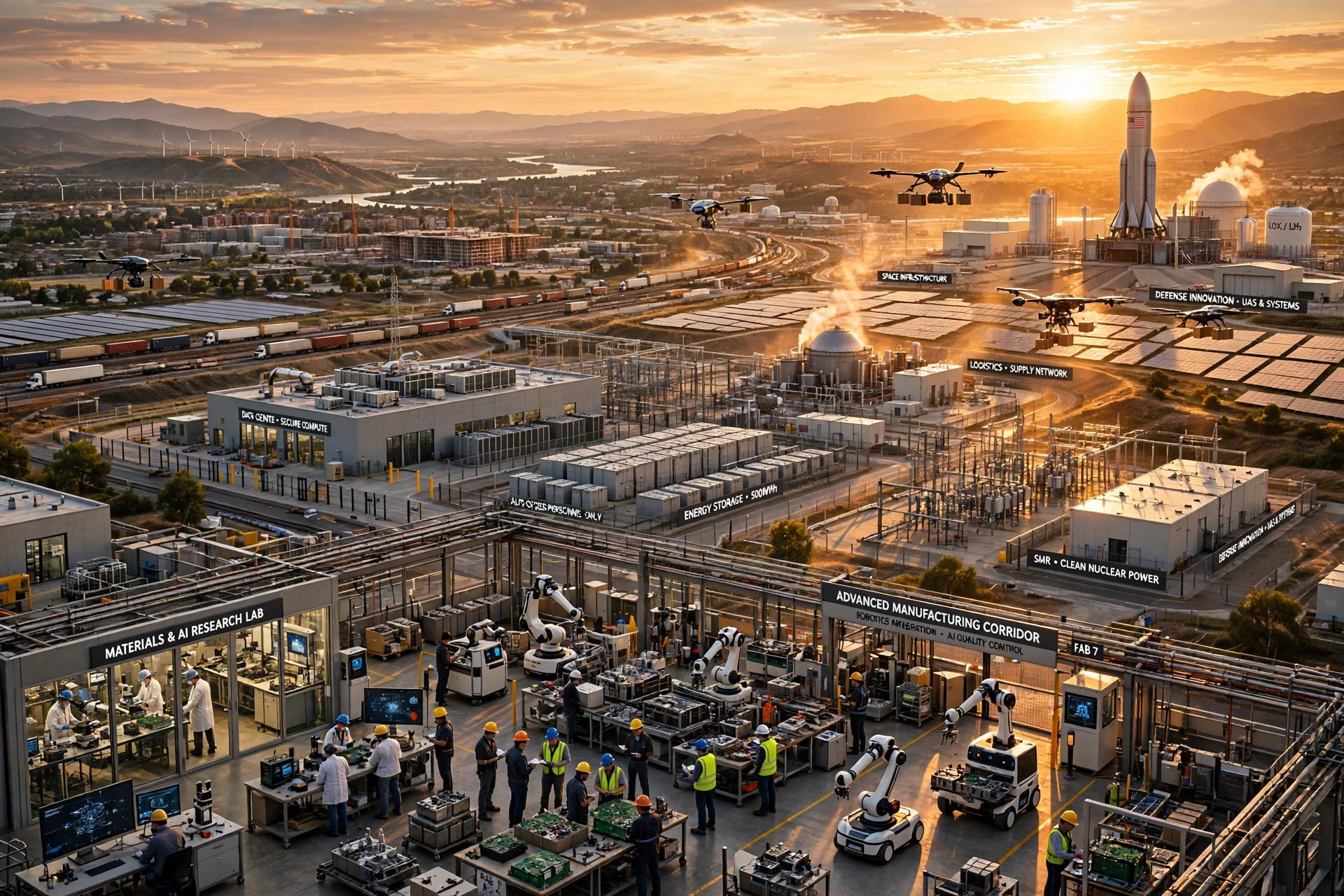
Over the past several months, I have been thinking more deeply about the physical consequences of the changes underway across artificial intelligence, robotics, advanced manufacturing, space, defense, and energy.
These sectors are often discussed as separate investment themes. I increasingly believe they are part of the same larger transformation: the emergence of a new physical economy and a new map of American growth.
The essay below sets out the conviction guiding our research and investment work at Pugh Capital Partners.
I believe America is entering a new industrial and technological era that will reshape its economy, its cities, and its physical geography.
Artificial intelligence, robotics, advanced manufacturing, space, defense, and energy are converging. Unlike the digital economy of the past several decades, this next economy will not live primarily on screens or in the cloud.
It will be built in the physical world.
It will require factories, laboratories, secure facilities, data centers, energy systems, logistics networks, testing environments, and communities of builders, engineers, entrepreneurs, and skilled workers.
Cities have always been shaped by the defining technologies and infrastructure of their time. Ports created commercial centers. Railroads created industrial cities. Automobiles created suburbs. Aviation created new gateways. Software and venture capital created global technology hubs.
The next era will create a new economic map.
The impact of AI is only beginning to be felt. Governments are investing at historic levels in space, defense, energy, and domestic manufacturing. The world’s largest technology companies are committing extraordinary amounts of capital to AI, computing, power, and physical systems.
Capital is already moving. Industry is reorganizing. New centers of growth are beginning to form.
As intelligence moves into machines, robotics changes the economics of production, space becomes increasingly commercial, defense becomes increasingly autonomous, and energy becomes more strategic, new manufacturing and innovation corridors will emerge across America.
The strongest will be places where research, production, capital, infrastructure, talent, and entrepreneurship reinforce one another.
Real estate will be one of the essential foundations of this transformation.
The companies building the future need places to design, manufacture, test, operate, and expand. They need land, buildings, power, suppliers, housing, and infrastructure. These requirements create scarcity, and scarcity creates opportunity.
One of the defining investment opportunities of our generation will be found at the intersection of innovation, manufacturing, and place.
This conviction is also shaping the research-led investment strategy we are building at Pugh Capital Partners.
Drawing on decades of experience across real estate, development, technology, and finance, we study the ecosystems where innovation, manufacturing, capital, infrastructure, and talent are beginning to converge.
Our aim is to develop differentiated conviction in a select number of emerging corridors, then invest in the physical assets that will enable their growth.
In the weeks ahead, I will share some of the research, signals, and emerging corridors that are shaping this view.
More to come.
Cheers,
John
Thanks for reading The Lineup! This post is public so feel free to share it.
Comments
Nothing yet. Say the first thing.
Sign in to join the conversation.