
“The old roster is dying, and the new roster struggles to be born; now is the time of monsters.”
It’s the offseason. I hate it every year, but this year has been more acute than most. Having tasted the thrill of a division title and deep playoff run; having seen my family, community, and the region come together over Mariners baseball, I have no desire to return to the world of contract years, AAV, and trade rumors. But Dan Wilson called for Eduard Bazardo with Andres Munoz just hanging out in the bullpen.
The world, clearly, does not particularly care what I want.
The offseason plan is an annual exercise enjoyed by many bloggers and fans. It’s a chance to flex knowledge of the game’s inner-workings, an intellectual conversation and, crucially, a chance to argue with people over the value of various teenage prospects (what the sport is really all about). The Light Bat also enjoys the offseason plan, albeit with our own unique perspective*.
Last winter, The Light Bat’s offseason plan observed the team’s annual tradition of making itself worse in-between seasons and advocated simply not doing anything. Depending on how you feel about qualifying Donovan Solano as “something”, the team followed the plan nearly to the letter, won their first division title in 24 seasons, and made it further into the playoffs than they ever had before. It’s possible this humble missive knows a thing or two about what it’s talking about.
This year we are presenting a far different and, depending on your view, ambitious goal. Please keep in mind the CAVEATS: The Light Bat does not play by the rules arbitrarily laid down by Mariner ownership, nor the broader conventions under which MLB teams operate. As collectively bargained baseball franchises have more freedom and opportunity to build rosters however they see fit than any major sports organization in America. All that and a federally-backed trade monopoly! (No wonder they absolutely have to have a salary cap eh?)
If you’re interested in reading a thoughtful, thorough, and more traditional examination of what the Mariners’ offseason may look like, I’m happy to once again steer you towards Jonathan Jick’s Words from the Wharf.
Ok, that’s the preamble. Let’s create a Mariners.
*No matter how much on-field success they achieve, the ownership and management structure of the Mariners disqualifies them from being discussed in an overly serious or technical manner. This has always been true and, given that structure is unlikely to ever change appreciably, always will be.
This is the moment the Mariners and their fans have been waiting for. The team is coming off one of the greatest seasons in franchise history, and possesses a bevy of talent both in the minor and major league levels. With Julio Rodriguez and Cal Raleigh the Mariners have arguably the best centerfielder and, undeniably, the best catcher in the game, in their prime, contractually locked-in at reasonable rates. Additionally, even coming off a relatively down year, the team’s deep stable of starting pitching talent affords their run prevention a preposterously high floor.
There have arguably been other, better opportunities for the team to push its chips all-in, but not significantly. This is the chance for the team to go on the kind of free agency bonanza we’ve always wanted them to. There are a bevy of available players, right this very moment, that fit the Mariners’ current roster holes and/or simply make the team better as it continues its quest to become the final MLB team to make a World Series.
As of now, per Spotrac, the Mariners’ payroll is 15th in baseball at approximately $167 million. The highest payroll in the game belongs to the two-time defending champion Dodgers, at approximately $350 million. Quick math shows something like a $183 million dollar gap between the two franchises. That gives us some serious wiggle room.
Of course, we are not totally unrealistic. We are not going to do something so extreme, so pie-in-the-sky that the end result saddles poor John Stanton and friends footing the bill for MLB’s largest payroll.
We’re going to leave them third.
NOTE: For this portion of the exercise I am not attempting to guess what kind of contract structure a free agent may gain on the open market. The numbers are taken directly from Fangraphs’ crowdsourcing estimates, which are as good of a guess as any.
While the much-celebrated re-signing of Josh Naylor was an excellent start at attempting to cobble together a 2026 roster as good as the one 2025 ended with, this is a move that clearly indicates the Mariners will actually exceed the past season’s standard. Tucker is the premiere free agent of this class, a fabulous (and fabulously-consistent) hitter who - standing next to Julio Rodriguez - would give the Mariners two-thirds of one of the league’s most potent outfields for years to come.
We are in Beef Country now, lads. The DH position in Seattle has been a comically-deficient position ever since the organization made zero efforts to retain Nelson Cruz after 2018. Schwarber is the Gospel of Three True Outcomes made manifest. He does absolutely nothing positive on a baseball field outside of drawing walks and smashing baseballs extremely long distances. Fortunately the structure of the sport makes those two things among the most valuable outcomes available, and he does them as well as anyone.
NOTE: As a show of my good faith in this exercise, I am reducing Schwarber’s overall expenditure by exactly one (1) million USD to allow John Stanton the budget for reinforcing the windows of the Hit It Here Cafe.
This one should be obvious. The Mariners’ 3B position presently consists of Colt McColt - a preciously talented but utterly unproven 20-year old - and Ben Williamson, whose power supply couldn’t heat an Easy Bake Oven for five minutes. Bregman is a proven asset on both sides of the ball, and instantly makes the team significantly better. Many will lament this move due to Bregman’s association with the Hated 2017 Astros. For those of you in this camp I remind you scripture directs us to leave childish things behind when we cease to be a child.*
*If you are a child reading this, please enjoy hating Alex Bregman in good conscience
This one will be controversial for a few reasons. The first is that Bichette should probably move off of shortstop, if not immediately than very soon. The other is, if he does plays shortstop, he does so by replacing eternal incumbent J.P. Crawford. Of course, Bichette could simply slide over to second base. Additionally, Crawford should also probably move off of shortstop, if not immediately than very soon. Unlike Bichette he doesn’t really hit. Either way, it’s the kind of problem good rosters have.
Admittedly, we’re starting to crowd the roster a bit. Before signing Schwarber this move would have easily slid Randy Arozarena to DH, which is where he primarily belongs moving forward. It would take some creative playing time management to juggle Bellinger’s addition, at least for 2026. But, as with Bichette, having too many good players is a wonderful problem to have and, whether by future trade or injury, these things have a way of working themselves out in the end.
While it’s likely the Mariners’ rotation bounces back from an injury-addled 2025, it remains highly unlikely the group ever approaches the highs of 2023-2024 again. Valdez lengthens the already-long list of quality 2-3 starters in the Mariners’ arsenal, provides redundancy for injury, and gives top prospect Kade Anderson plenty of leash to get acclimated to professional baseball. He’s a bit of an ornery SOB, but I’m confident he will not try to purposely cross up Cal Raleigh to try and hit him in the beans. Cal would not take kindly to that. And hey! A left-handed starting pitcher. Is that legal? dot meme.
Schwarber (DH)
Julio (CF)
Tucker (RF)
Raleigh (C)
Naylor (1B)
Bregman (3B)
Bichette (2B)
Bellinger (LF)
Crawford (SS)
Woo
Gilbert
Valdez
Kirby
Castillo
Miller
-Munoz
-Brash
-Who cares
Right around $341 million for 2026, just behind the Mets for third place in MLB.
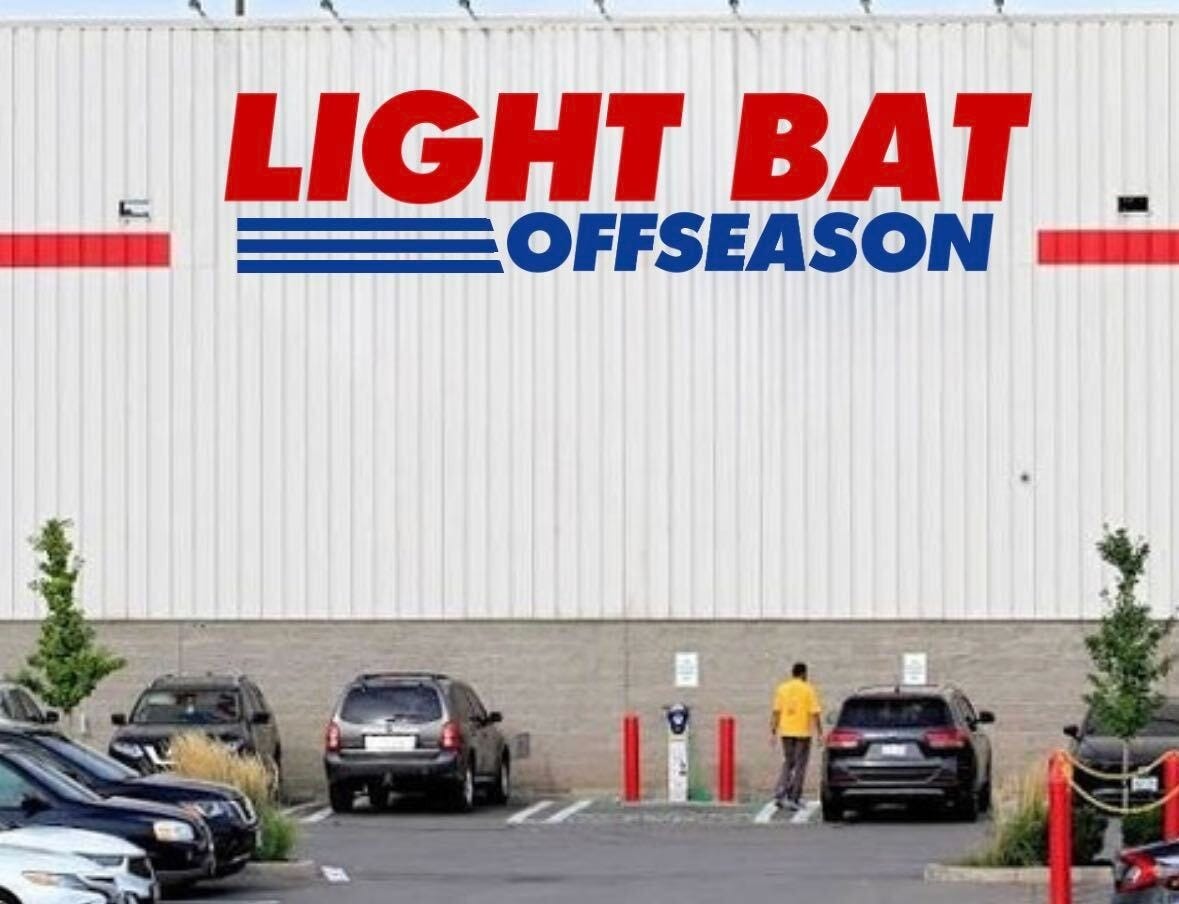
I call this the Costco Plan because it’s buying way, way more than the Mariners technically need, but doing so at a tremendous value. The total financial outlay for these players is $176 million dollars in 2026. Fangraphs has them projected to produce a total of 22 fWAR over the next season. That is a cost of right around $8 mil/win, a fabulous ratio in modern baseball.
By comparison, previous Mariner offseasons saw the team spend around $30 million dollars in 2025 for Mitch Haniger and Mitch Garver. Those players combined to produce exactly 0.0 fWAR last season, which puts the ratio of $/win in the infinite. These are the kinds of numbers that draw concern at Q4 earnings reports from shareholders. Given their prolonged track record of being unable to identify and/or acquire lower level talent at value, this proposition seems the clearest and most secure path forward
A quick reminder here, once you’ve unrolled your eyes at all the above: Seattle is one of the very wealthiest cities in the country per capita; richer than New York City, Boston, and Washington DC among others. The Mariners’ long-standing track record of performing like a mid-market team does not change the reality that this region has more than enough affluence to support a Top 5 MLB payroll, regardless of what anyone with a financial stake in the team may say.
If you are concerned about how these various contracts look in, say, 3-5 years let me once again refer to history. The Robinson Cano contract - which scared Mariner ownership so badly they are only now letting themselves sort of pretend like they might try to do something sort of like it again someday - was in place here from 2014-2018. Over that time he produced like a Top-3 MLB second baseman, even factoring in his 80-game suspension in 2018. After that, he was traded for a Top-5 MLB prospect and the vast portion of his remaining contract was taken on by another team. The deal produced literally nothing negative for the organization, either in the immediate or long term.
The risks of a bad ending to a large contract always exist, and I will not say they do not. They are, however, often vastly exaggerated by the ownership class and its various mouthpieces as justification for not doing them.
By my back-of-napkin, early-AM math this plan results in the Mariners having something like a 105-win true talent roster. No doubt, given the mindset of the Stanton/Dipoto Regime, it would be viewed as neither financially feasible nor necessary from a talent perspective. Their goal is well-established: Be consistently good enough to contend for one of baseball’s ever-increasing playoff spots for as little money as possible.
The goal for myself, and I would at least hope some other fans, is for the Mariners to build as good of a baseball team as is possible, every single year. MLB’s current salary structure allows for similarly-inclined ownership to do any number of things to achieve those ends that may, on the surface, be considered outlandish or over-the-top.
This plan begins to do something like that, and it does so without pushing the Mariners beyond the previously-established boundaries of what other teams have shown is financially possible. It has the added benefit of leaving the Mariners’ legitimately exciting and deep farm system entirely untouched. Should the team feel compelled midseason to add a player like Tarik Skubal, fill out the bullpen, or otherwise touch up holes that emerge through injury or underperformance, they will be well-stocked to do just that.
The goal of sports is to win every single game, every single day, for all of eternity. It is an impossible goal, but a fantastic philosophical starting point. It’s where I’m coming from with the 2026 Seattle Mariners, and every Mariners team to come.
Goms
No posts
Comments
Nothing yet. Say the first thing.
Sign in to join the conversation.