
The last post looked at child development gross motor milestones. Remember the framework of 2-4-6-9-12, head up-roll-sit-crawl-walk?
This post will touch on emotional and fine motor milestones. For emotional milestones, I think it helps to understand what is going on in the baby’s brain.
Towards the end of the 4-7-month period, the baby will discover that objects continue to exist even when they are out of her sight – a principle called object permanence.
From Caring for Your Baby and Young Child Birth to Age 5, “In her first few months of life, she assumed that the world consisted of only things that she could see. When you left her room, she assumed you vanished; when you returned, you were a whole new person to her. In much the same way, when you hid a toy under a cloth or a box, she thought it was gone for good and wouldn’t bother looking for it. But sometime after four months, she’ll begin to realize that the world is more permanent than she thought.” (Reference 1)
By playing games like peek-a-boo, she will continue to learn about object permanence.
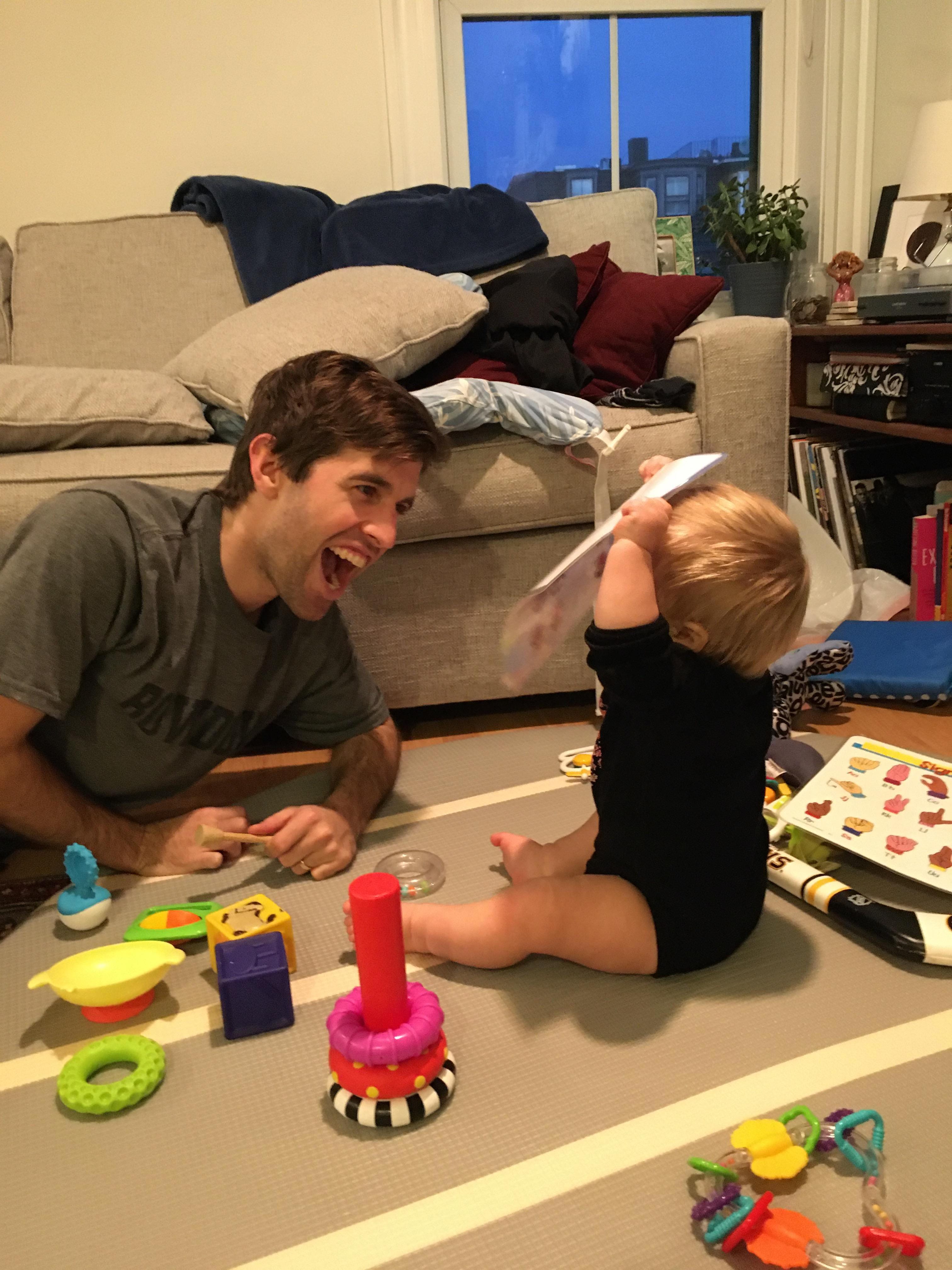
By about eight months, object permanence is developed, so when you hide a toy under a scarf, she will know the toy is under the scarf and will search for it.
As the baby hits eight months, along with object permanence, she can tell the difference between familiar and unfamiliar. Thus, she becomes anxious around strangers. Stranger anxiety is usually one of the first emotional milestones a baby reaches.
Separation anxiety is another normal stage of emotional development that starts as babies acquire object permanence. The baby gets anxious or upset with the thought or the reality of being separated from the caregiver.
In this stage, the baby may become incredibly clingy to the main caregiver. For the following examples, let’s say the main caregiver is the mother. If the mother leaves the room, the baby gets upset and, if possible, follows. If the mother goes to the bathroom, the baby may crawl right behind her and wait outside the door. If the mother heads out of the house to run an errand, the baby starts crying.
During my pediatric training, a child development specialist shared that he thought that every baby should show separation anxiety because that indicated that the baby had strong attachment with someone.
Separation anxiety peaks between 10-18 months and then eases up by two years.
4 months
Can easily bring objects to her mouth
Transfers an object from one hand to another
6 months
Can begin to self-feed
Uses raking grasp (uses fingers and thumb in a mitten or claw-like grip or raking motion)
9 months
Develops pincer grasp (uses index finger and thumb to pick up things)

1-2 Years
Scribbles spontaneously
Turns over container to pour out contents
Builds tower of 4 blocks or more
References
American Academy of Pediatrics. Caring for Your Baby and Young Child: Birth to Age 5. Edited by: Steven Shelov, Tanya Remer Altmann. Bantam Books. 2014
En el último post se analizaron los hitos de la motricidad gruesa en el desarrollo infantil. ¿Recuerdas el marco de 2-4-6-9-12, rodar-sentarse-gatear-caminar?
En este post se abordarán los hitos emocionales y de la motricidad fina. En cuanto a los hitos emocionales, creo que es útil entender lo que ocurre en el cerebro del bebé.
Hacia el final del período de 4 a 7 meses, el bebé descubrirá que los objetos siguen existiendo incluso cuando están fuera de su vista, un principio llamado permanencia del objeto.
Según Caring for Your Baby and Young Child Birth to Age 5 (Cuidando a tu bebé y niño pequeño: del nacimiento a los 5 años), “En sus primeros meses de vida, asumía que el mundo sólo estaba hecho de cosas que podía ver. Cuando salías de su habitación, asumía que te habías desvanecido; cuando volvías, eras una persona completamente nueva para ella. De la misma manera, cuando escondías un juguete bajo una tela o una caja, ella pensaba que había desaparecido para siempre y no se molestaba en buscarlo. Pero en algún momento, después de los cuatro meses, empezará a darse cuenta de que el mundo es más permanente de lo que pensaba”. (Referencia 1)
Jugando a juegos como el cucú-tras, seguirá aprendiendo sobre la permanencia de los objetos.
Alrededor de los ocho meses, la permanencia del objeto está desarrollada, así que cuando escondes un juguete debajo de una bufanda, ella sabrá que el juguete está debajo de la bufanda y lo buscará.
Cuando la bebé llega a los ocho meses, además de la permanencia del objeto, puede distinguir entre lo familiar y lo desconocido. Por lo tanto, se pone ansiosa ante los extraños. La ansiedad ante extraños suele ser uno de los primeros hitos emocionales que alcanza el bebé.
La ansiedad por separación es otra etapa normal del desarrollo emocional que comienza cuando los bebés adquieren la permanencia del objeto. El bebé se pone ansioso o se molesta con la idea o la realidad de estar separado de su cuidador.
En esta etapa, el bebé puede volverse increíblemente pegado al cuidador principal. Para los siguientes ejemplos, digamos que el cuidador principal es la madre. Si la madre sale de la habitación, el bebé se altera y, si es posible, le sigue. Si la madre va al baño, el bebé puede gatear tras ella y esperar fuera de la puerta. Si la madre sale de casa para hacer un recado, el bebé se pone a llorar.
Durante mi formación en pediatría, un especialista en desarrollo infantil me dijo que creía que todos los bebés debían mostrar ansiedad por separación porque eso indicaba que el bebé tenía un fuerte apego a alguien.
La ansiedad por separación alcanza su punto álgido entre los 10 y los 18 meses y luego disminuye hacia los dos años.
4 meses
Puede llevarse objetos a la boca con facilidad
Transfiere un objeto de una mano a otra
6 meses
Puede empezar a alimentarse por sí mismo
Utiliza el agarre de rastrillo (utiliza los dedos y el pulgar en forma de manopla o garra o con un movimiento de rastrillo)
9 meses
Desarrolla el agarre de pinza (utiliza el dedo índice y el pulgar para coger objetos)
1-2 años
Garabatea espontáneamente
Da la vuelta a un recipiente para sacar su contenido
Construye una torre de 4 bloques o más
Referencias
American Academy of Pediatrics. Caring for Your Baby and Young Child: Birth to Age 5 [Cuidando a tu bebé y niño pequeño: del nacimiento a los 5 años]. Editado por: Steven Shelov, Tanya Remer Altmann. Bantam Books. 2014
No posts
Comments
Nothing yet. Say the first thing.
Sign in to join the conversation.