
Welcome to The Kids StreamerSphere, a regular newsletter where we look at the latest news, deals, and performance data for kids content within the context of global streaming. If you would like to support my work, please become a paid subscriber.
Thanks to all paid subscribers who came out yesterday for the Netflix earnings primer webinar. The discussion got me thinking about some of the challenges facing them ahead of earnings tomorrow, ultimately resulting in this bonus edition of the newsletter. You’ll still get my full reaction from earnings on Friday. So here you go…
It’s the morning after the night before, and Netflix has a headache. From a corporate perspective, they partied hard with that Warner Bros. acquisition. Looking down the barrel of an $82 billion deal isn’t for the faint-hearted. At the very end, Netflix came to its senses and sensibly got an Uber home, so why has it woken up with this banging head?
Like with all hangovers, this is Netflix’s own fault. They pivoted the strategy behind their corporate storytelling to focus on content engagement over subscriber growth. They kind of had to because they were reaching a ceiling on the latter. But they did this in their typical disruptifying way, by flipping the script on a sacrosanct industry status quo. They opted to openly disclose their engagement metrics. Like publicly. Like to everyone. And smart people paid attention, and now those metrics say that Netflix might have an IP problem. The very IP problem some say would have been solved by the acquisition of Warner Bros. And that might be true to a certain extent but it’s a very Hollywood answer to the question.
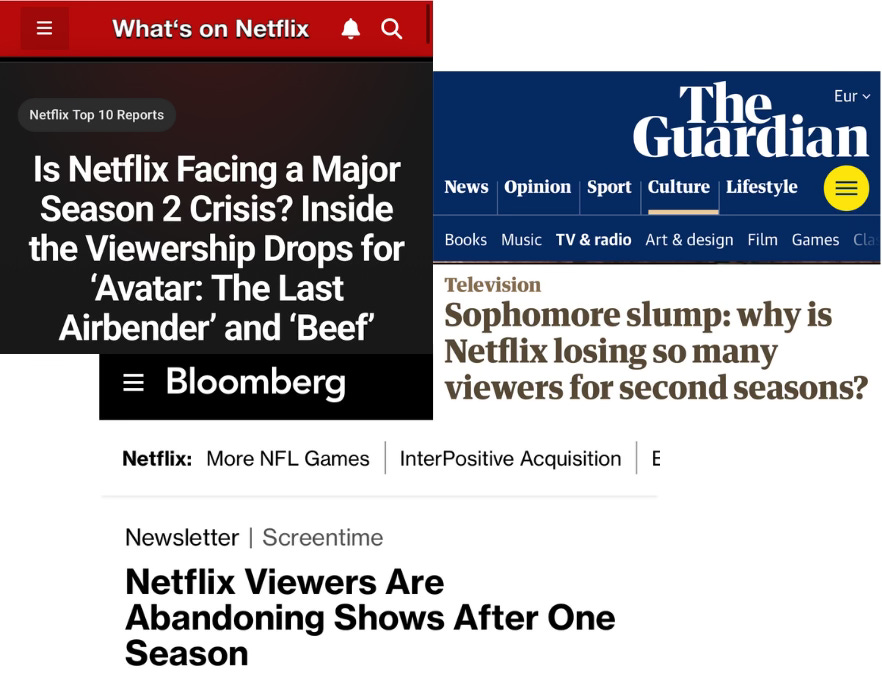
“Season 2 Crisis”, “Sophomore Slump”, call it what you like. This is this week’s Netflix narrative, and it’s not a great one to be bringing into their Q2 2026 earnings round and the drop of their next data dump. The truth is in the numbers. Netflix knows that; they disclosed them. But is it just an IP problem? People are also pointing fingers at the binge release model, the limited episode volume of a streaming “season” and extended gaps between seasons. These bear some of the burden, but ultimately this is also because discovery in premium streaming is broken and the kids segment has been fighting against all of these factors for years.
In kids TV, a hit isn’t typically built in 28 days. Back in “the old days” it was 28 months if you were lucky. In the middle of that was a machine of programming strategy. Launch the series in a dedicated slot with lower volumes. Build to a weekday and then a full-week slot. Marathons at the weekend. Doubles, sometimes triples. Different time slots and dayparts. A toolbox of content discovery options and alternatives thrown out with the bathwater in premium streaming.
This is water we’ve been trying to push uphill for kids TV since the dawn of the streaming wars. How to be discoverable. To stay “above the fold” when there are 18,000 titles to contend with. Corporate media thought the almighty algorithm would save all, and so did Netflix. But all they’ve ended up with is platforms that are populated rather than programmed. YouTube, on the other hand, has always had the best of both worlds. That invasively instinctive algorithm powered by Google’s mighty data stack, but overlaid with programming, which people often forget. Each successful channel on YouTube is actively programmed. The person or team behind it is fully accountable for their own audience; it’s what they live or die by. And that’s why YouTube has never had an “IP problem”.
Which is exactly why the most interesting thing Netflix has done in the last year isn’t a season 2 of a marquee premium series, it’s poaching the discovery problem’s own solution. Ms. Rachel, Mark Rober, Danny Go, Salish & Jordan Matter. Four creators who’ve already done the hard, unglamorous work of building an audience, now sitting inside Netflix’s walled garden. But the hangover is that Netflix aren’t cracking discovery with this; they’re renting folks who already have. But renting doesn’t tend to be a long term strategy.
Hangovers are infinitely survivable. But that type of bad habit behaviour might be telling Netflix something important. Rather than go full Hollywood and use Warner Bros. or an ever increasing commissioning budget to expensively paper over some pipeline cracks, they should do what they do best and disrupt. Truly unlock discovery. Figure it out. Fix it.
We can see early signs of this in kids, through the introduction of playlists and the expansion of the Trending Top 10. But the creator-to-Netflix pipeline is still another bandage over the real problem in premium streaming: discovery. Solve discovery within your own platform and you have far less need to spend heavily buying, or indeed renting, somebody else’s IP.
No posts
Comments
Nothing yet. Say the first thing.
Sign in to join the conversation.