
Welcome to The Kids StreamerSphere, a regular newsletter where we look at the latest news, deals, and performance data for kids content within the context of global streaming. If you would like to support my work, please become a paid subscriber.
If your company would like to get news out, please reach out to me to talk about sponsorship.
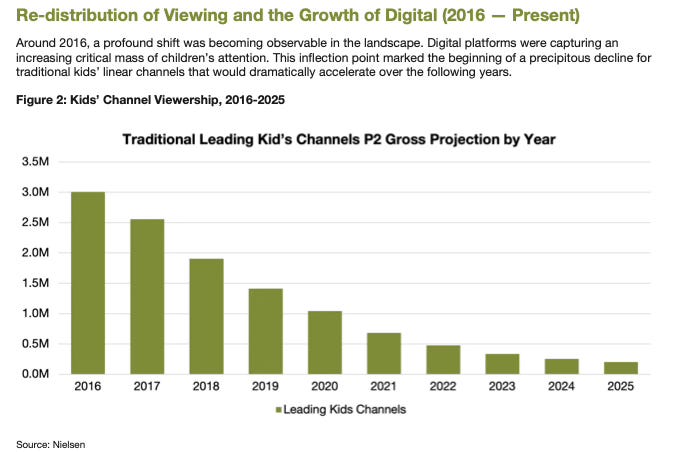
Reports of linear television’s demise HAVE NOT been greatly exaggerated. If you ever needed a chart to sum that up, here it is. US kids channels’ TV viewership over the past decade. It’s grim. It’s definitive. This was lifted directly from a paper I worked on with the Coalition for Innovative Media Measurement. We’ve spent the last year looking at the realistic state of play of today’s kids media landscape.
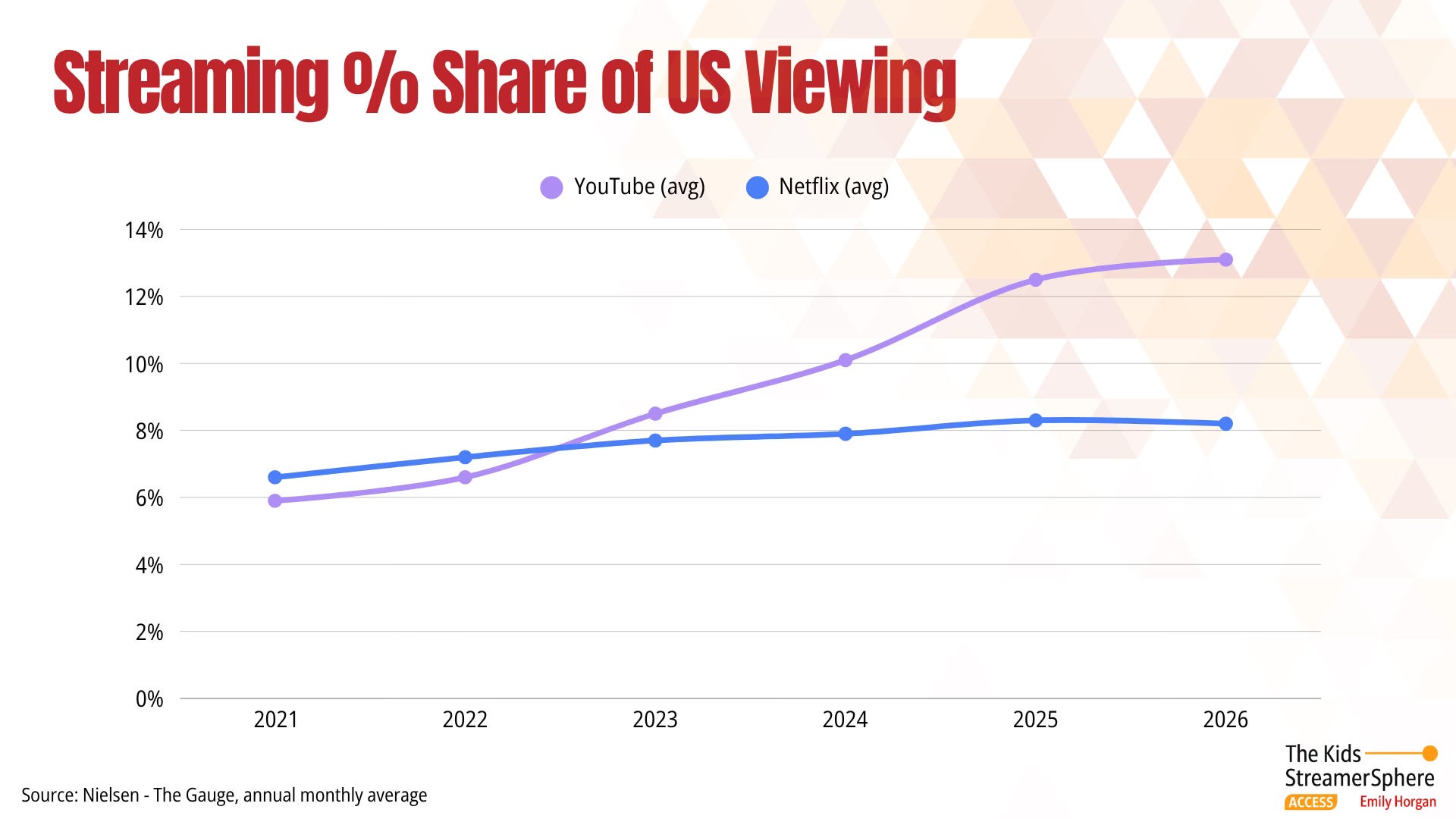
If linear is dead, then where have the kids gone? We know that the slack has been taken up to some extent by premium streaming, but YouTube has been the dominant player. The real winner who’s eating linear’s lunch. Streaming wars are over, YouTube has won, and all that. There are many ways to demonstrate this. Here it is through Nielsen’s The Gauge data.
And yet. If you look at where kids actually spend their time versus where the money follows, the math doesn’t math, as we looked at in this newsletter a few weeks ago.
Per Moonbug:
“Twenty-five percent of all screen time in North America is focused on kids and family content, but it represents only 4 percent of ad investment.”
That’s a YouTube-specific number. Kids and family content killing it in streaming, and yet the business model fails and our segment of the industry remains in crisis. Should YouTube care though? The catastrophic stalling in revenue for kids content hasn’t as much as dented their growth.
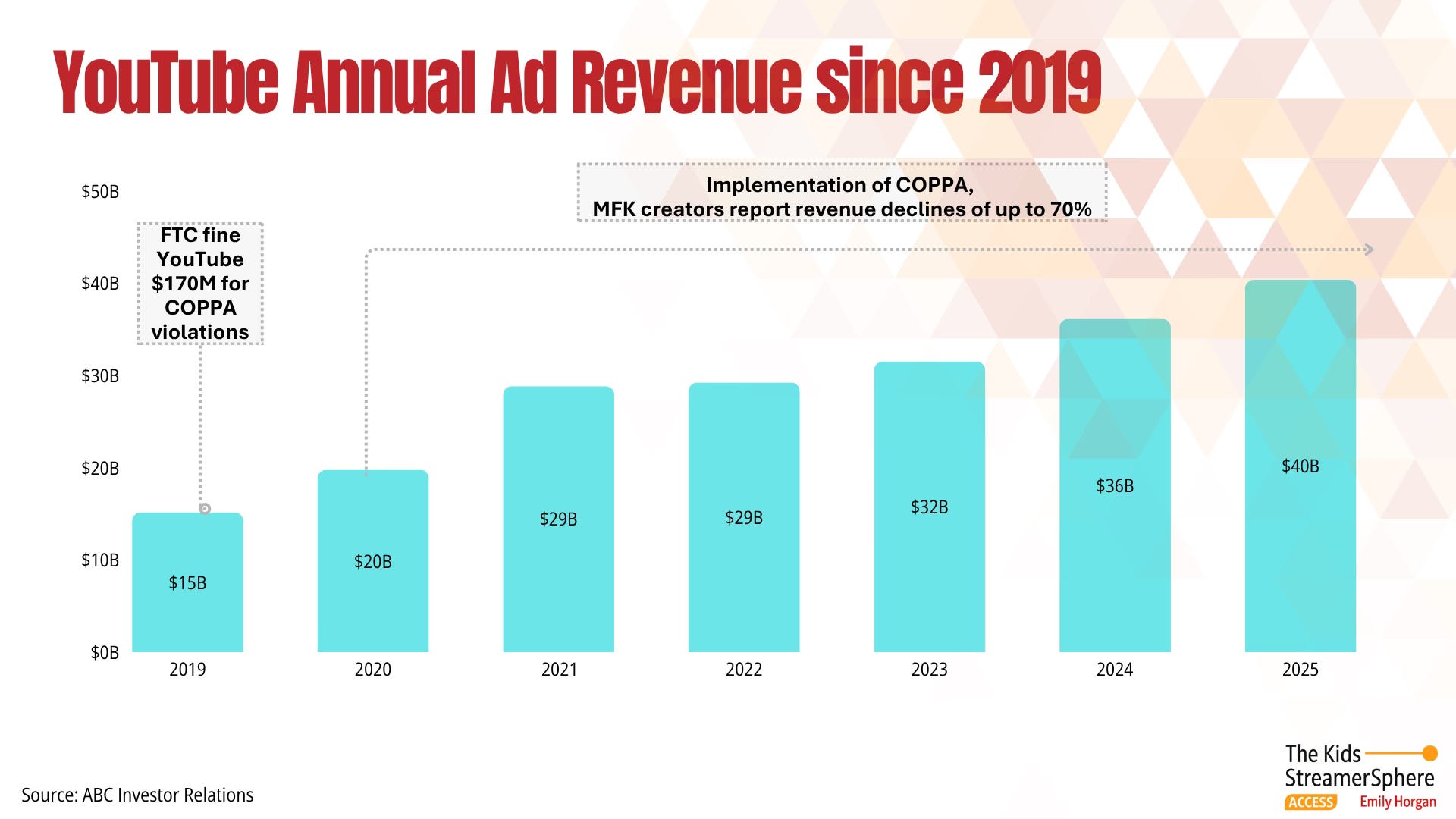
There’s a whole matrix of reasons behind that engagement and ad revenue mismatch. We covered this in the CIMM project. Together we produced a paper that looks at the shortcomings of current measurement systems and how these are impacting kids media as a whole.
For me, it was an education on the vast machinations of the digital ad-buying ecosystem and the complex policy and legal crosscurrents that govern it. My motivation for getting involved was the hope that fixing advertising monetization would bring a solution to the kids media industry to help get more great kids content funded. CIMM and their members want better measurement, and that isn’t an abstract fix. It’s something that could actually make a difference to the bottom line of kids and family producers.
COPPA sits right at the center of this. It’s vital legislation. Keeping children’s data safe online isn’t up for debate. In practice, though, even the idea of COPPA has made a lot of advertisers switch off from kids content altogether before they’ve properly understood what’s actually permitted.
You can read more about the project here, here or here:

The key thing that stood out for me in all the research and discussion was the lack of data accuracy generally. One study shared by Truthset showed that datasets trying to flag “households with children” are less than 50% accurate on average. You’d be better off flipping a coin.
CIMM and their members are now actively collaborating to find a way through this. Studios, platforms, measurement companies and agencies. Folks like Moonbug, Precisify, Kidoodle, Warner Bros. Discovery and WildBrain. I’m reassured by the people involved and the momentum their collaboration represents.
And I’m glad that the intended outcome of the process is to actually solve the problem rather than simply point it out. Will the linear heyday ever return? Unlikely. But we’re at market failure in kids media and this is one thing that might actually make a difference.
If your company wants to get involved with CIMM, give me a shout and I can make the intro.
No posts
Comments
Nothing yet. Say the first thing.
Sign in to join the conversation.