
Picture this: I am a first-time parent to an extremely active two-and-a-half-year old, fresh out of COVID times. We are visiting my parents, and they suggest we all go to their home church together. My gut says, this cannot go well. I’d been in enough churches to know why. Growing up, kids were expected to sit still in the pew, and if they couldn’t, someone would take them out of the sanctuary.
I sometimes hear of people searching for their “church home.” But church cannot feel like home if children are only expected to sit quietly inside it.
When parents avoid particular spaces, it typically isn’t because they don’t trust their child. It’s often because they want to protect their child - to keep their spirit, their authenticity, their joy, intact. Parents can sense, often with great accuracy, when a space isn’t built for their child.
Fitting in requires changing yourself to match a space. Belonging is being safe and fully yourself, needed and welcomed for what you bring. Come as you are. I worried that at church, we’d have to work to fit in. I worried I’d be asking my toddler to be someone she wasn’t yet capable of being.
Neela’s story
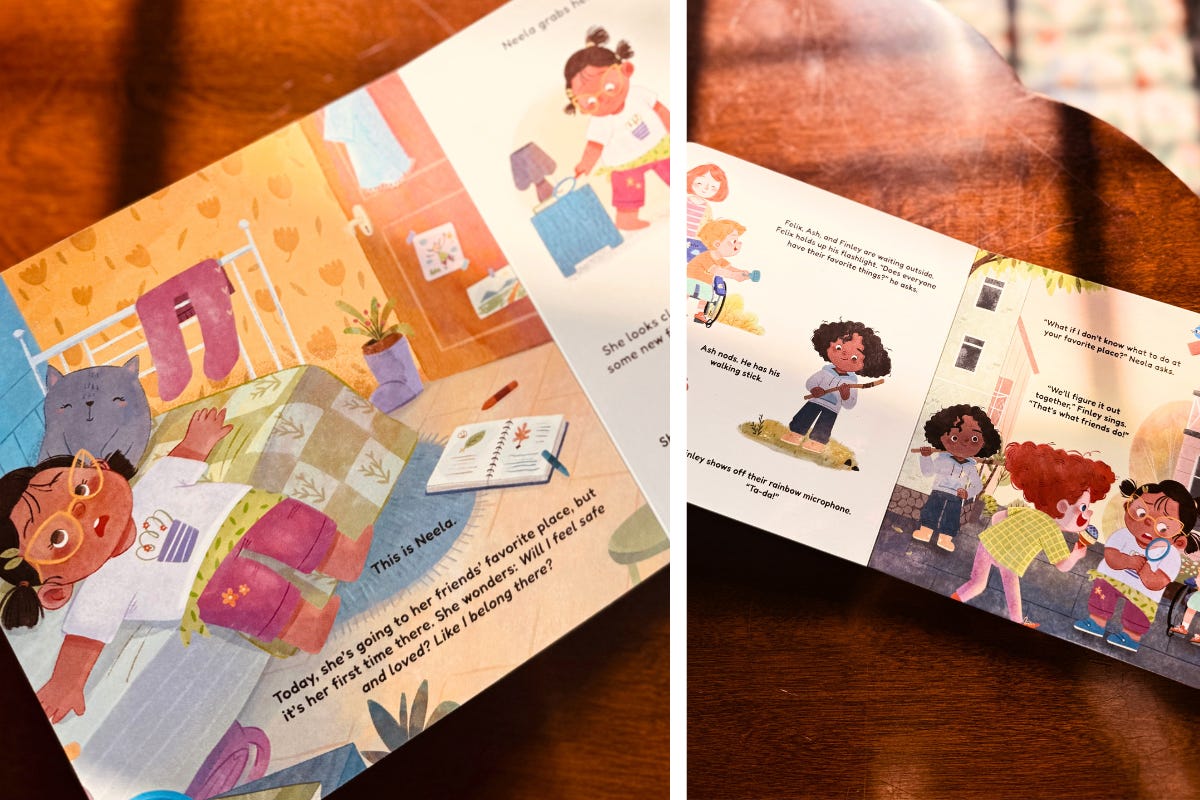
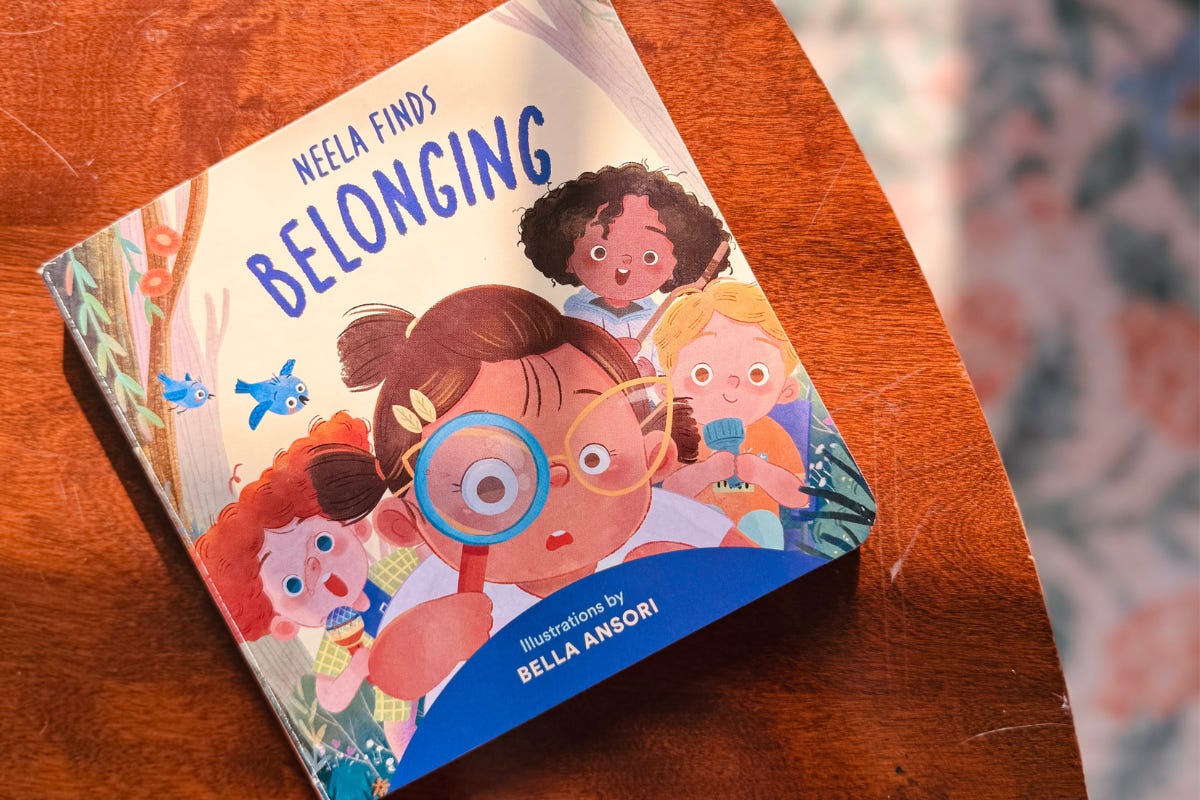
The board book Neela Finds Belonging centers on an experience of a child named Neela. In the story, Neela, Felix, Ash, and Finley, four good friends with varying appearances and personalities, are about to depart to visit one of the friend’s favorite places. Neela is feeling anxious about it. It’s her first time there, and she wonders, “Will I feel safe and loved? Like I belong there?”
Note: This post is sponsored by Karis Parenting, the book’s publisher.
Before heading out, Neela and her friends each grab their favorite things. Neela’s is a magnifying glass.
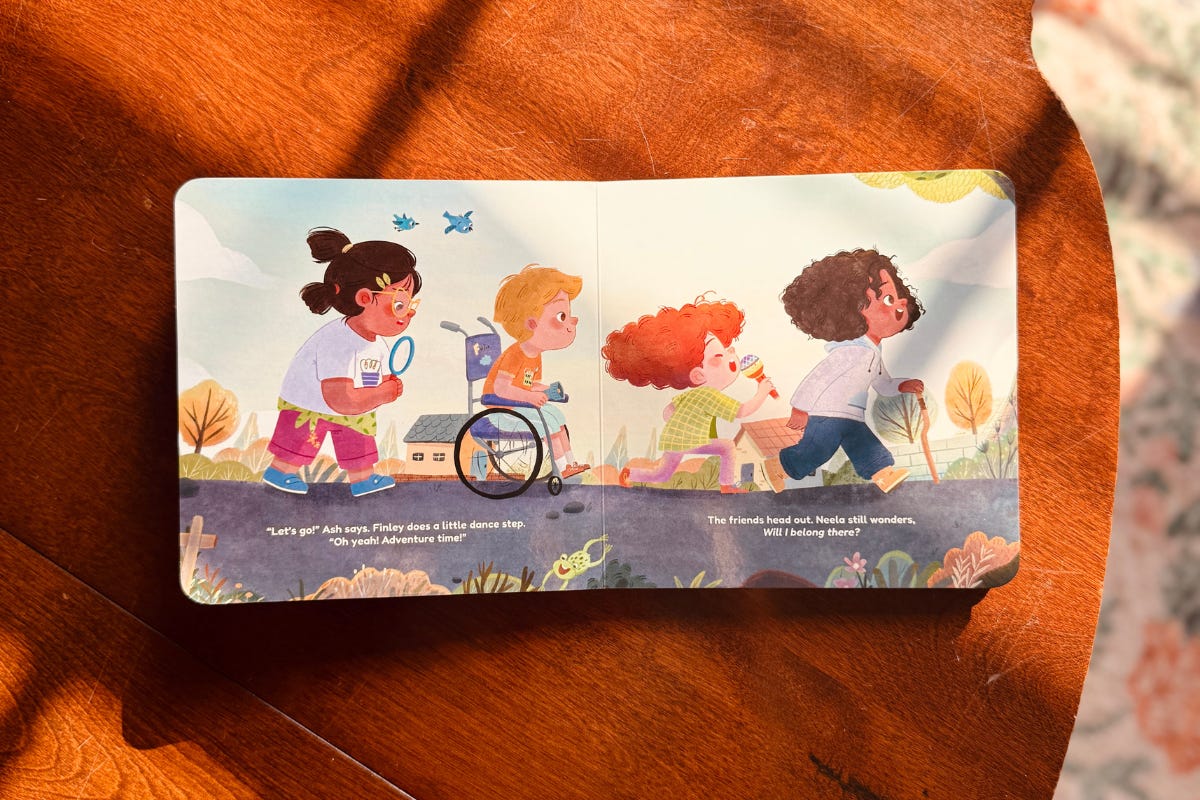
The journey to her friend’s favorite place is framed as a fun adventure story, reminiscent of Going on a Bear Hunt. The friends use their favorite things as tools to help them face challenges along the way, and they help one another.
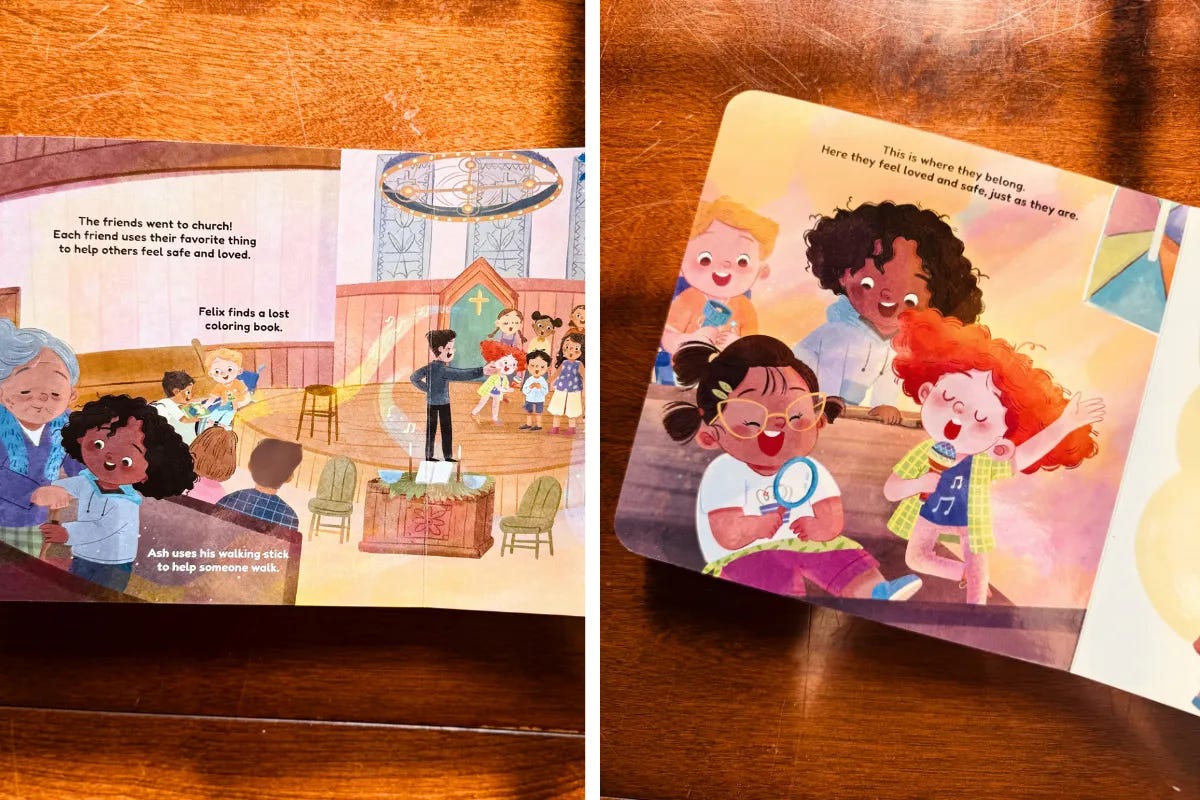
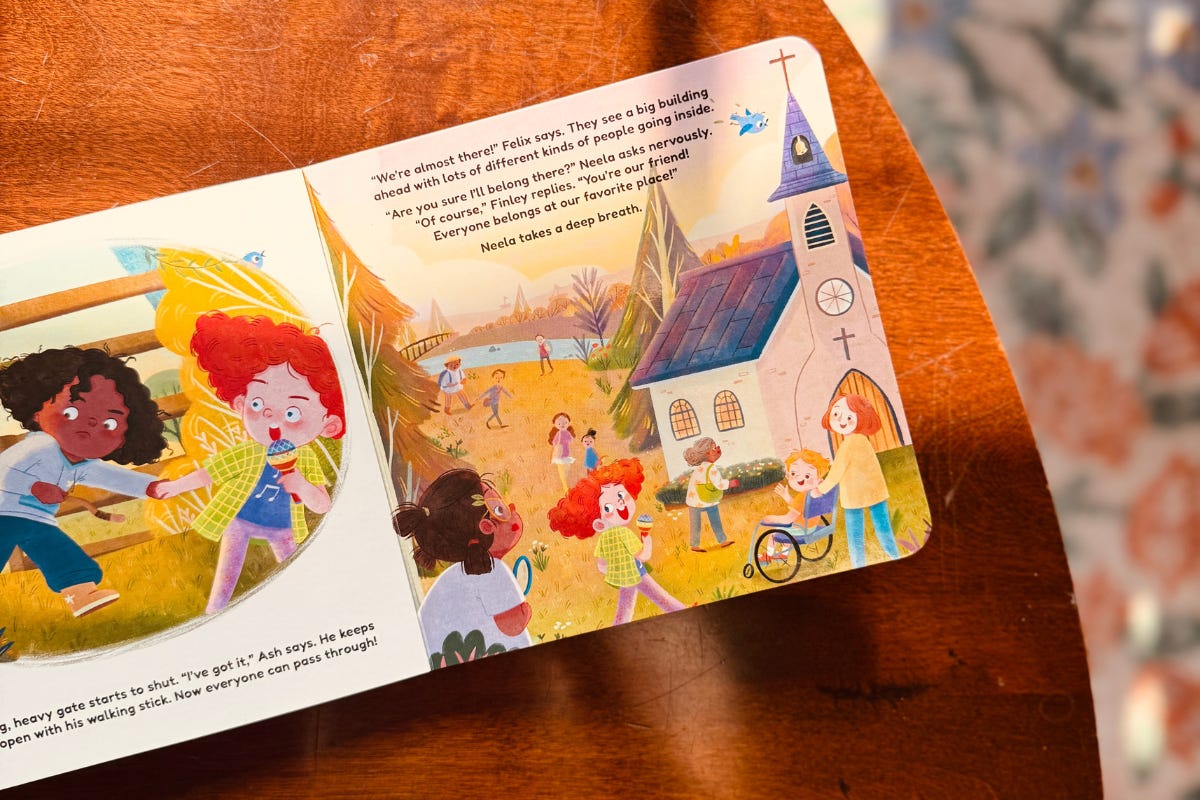
When they finally arrive at their destination, it’s revealed: the favorite place is a church! Each friend uses their favorite thing to help other church-goers feel safe and loved. And there, at church, Neela finds comfort and belonging.
And much to my surprise and delight, so have we, at my parents’ church.
What the book shows, and what we’ve found
In the story, Neela and her friends aren’t simply handed belonging at the door. They create belonging, using what they brought, aligned with their own unique strengths, to help someone else. Felix uses his flashlight to help a child find his lost coloring book. Ash uses his walking stick to help an elderly woman walk. Finley uses their microphone in the choir. Neela uses her magnifying glass to help someone find their spot.
One point related to this: the adults in this story don’t ask the kids to leave their favorite things at home. So often, kids are told to leave the toy in the car, the stuffed animal on the bed, the thing that makes them feel steady, before they walk into a space that isn’t built around them anyway.
Neela’s friends get to bring theirs. And it isn’t just tolerated. It’s what makes them useful, what allows them to help! Belonging, in this story, is built by kids who are given something real to do, with the very things that make them feel safe.
We’ve had a similar experience at my parents’ church. My daughter, now six, has always enjoyed displaying things in particular places. She loves setting up her dollhouse, arranging beads in a design. Lately, she has been invited to participate in serving the church community meal. And she’s given a real job there - she helps set the tables! She’s doing the same thing Neela’s friends do: building her place there, one action at a time
Of course, she’s still a kid and can get silly. Last weekend, she began pulling ice cubes out of the water pitcher with her bare hands. But nobody gave her a nasty look, and I quickly swapped the pitcher for a fresh one. No harm, no foul.
In Neela Finds Belonging, everyone has a place - no matter their identity. A boy in a wheelchair leads the way to church (modeling bodily autonomy as he directs a friend to push him). A nonbinary child is part of the friend group (Finley uses they/them pronouns). An elderly woman gets steadied by a walking stick and a helpful young friend. A child sings in the choir. And Neela herself exists in a bigger body (That said, the story isn’t about her size. It’s simply one part of her identity).
At the community meal, my daughter sets placemats next to my aunt, who has Down syndrome, alongside elderly congregation members and neighbors experiencing food insecurity. Different ages, different abilities, different backgrounds - all together.
And it’s truly fun for her, as church is fun for Neela and her friends. Neela’s church isn’t a place you sit still and get through. It’s illustrated as a place full of life and joy where kids feel like they matter. Our church is similar - it has scavenger hunts, popsicles, bingo, live music my girls dance to without anyone telling them to sit down. They’ve designed it with kids in mind.
Via Karis: Body
This book comes from Karis Parenting’s Via Karis framework - five spiritual practices: Water, Word, Table, Body, and Creation. Neela Finds Belonging aligns with Body. It echoes 1 Corinthians 12, where the church is described as one body made of many different parts. In this story, it’s children with different strengths and tools. It’s a wheelchair, a walking stick, a magnifying glass, a flashlight, a microphone. None of them do the same job, but all of them are needed. Differences are a strength instead of a barrier, and love shows up as practical care for someone else.
It’s worth noticing, too, that the book doesn’t start big. It starts with four close friends, and only widens from there to include a wider circle of adults. Even among people you already know and trust, truly feeling like you belong can be hard to come by. Belonging takes time and effort - showing up again, and again, and being shown up for.
A Final Reflection
If you’re in a similar place - hesitant, unsure, wondering if church could ever hold your kids as they are - I get it. I’ve been there.
I hope you find what we found. I hope you find what Neela found. A place that doesn’t just say you belong, but gives your kids something real to do - so they can build that belonging themselves.
You can buy your copy of Neela Finds Belonging here.
What is Karis Parenting?
Karis Parenting, a ministry of the First Baptist Church of Asheville, makes beautiful, expert-backed tools that make it easy for kids and families to explore and deepen faith. Find out more at KarisParenting.com.
Related reading:
Comments
Nothing yet. Say the first thing.
Sign in to join the conversation.