
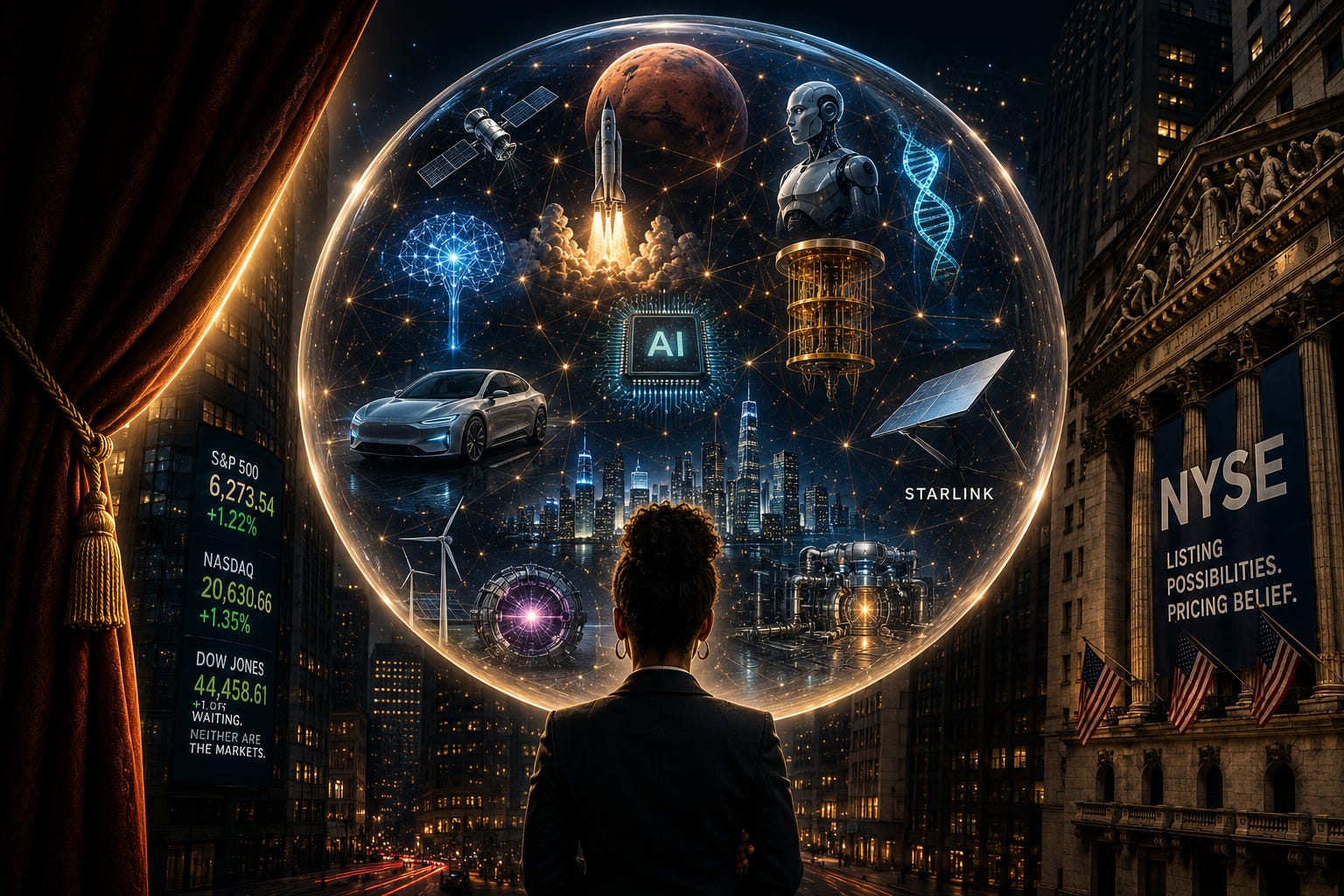
“SpaceX is behaving like Bitcoin.”
When I heard a guest on Bloomberg Radio make this comment recently, it immediately caught my attention. At first blush, the comparison sounded absurd. Bitcoin is a decentralized digital asset. SpaceX builds rockets and launches satellites. Then I looked at the numbers.
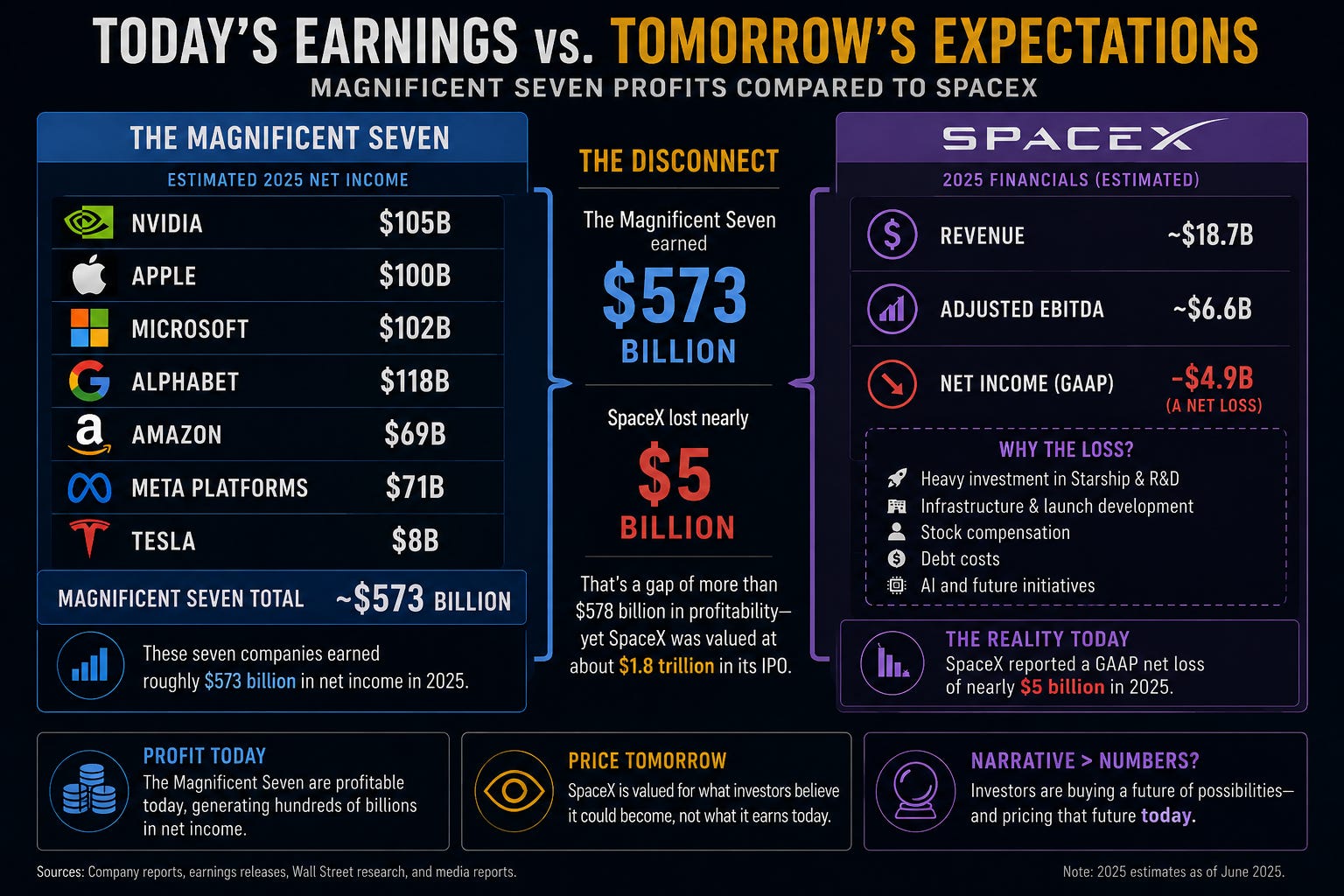
SpaceX generated approximately $18.7 billion in revenue during 2025 while reporting a GAAP net loss of roughly $4.9 billion. During the same period, the group of stocks known as the Magnificent Seven—Apple, Microsoft, Nvidia, Alphabet, Amazon, Meta, and Tesla—collectively earned roughly $573 billion.
Even Tesla, the smallest earner of the group, probably generated more profit than SpaceX’s entire adjusted EBITDA (earnings before interest, taxes, depreciation and amortization). And yet, the SpaceX IPO was valued at about $1.8 trillion. When viewed through that lens, the Bitcoin comparison begins to make sense.
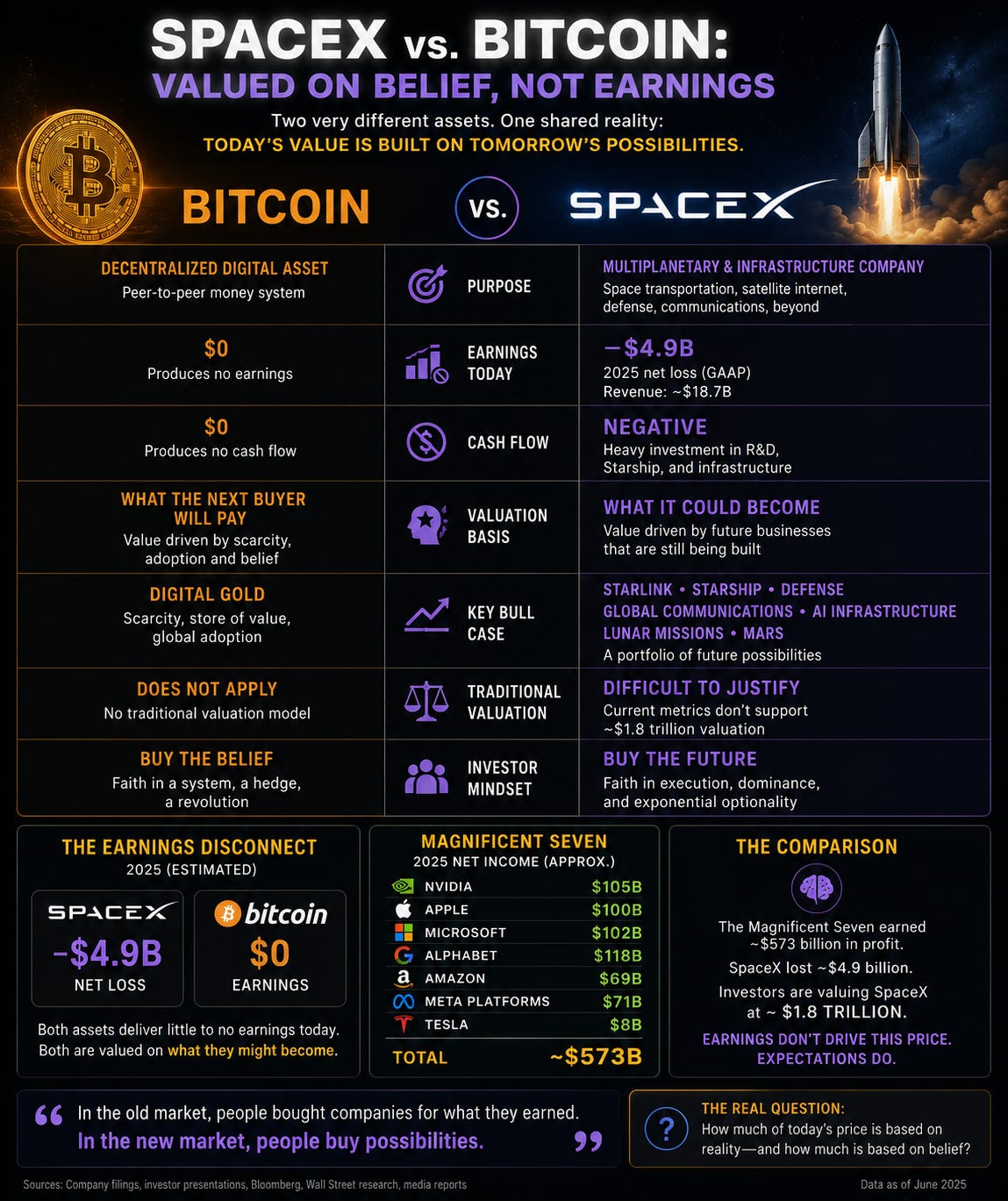
Bitcoin has no intrinsic value. It produces no earnings or cash flow. Its value rests largely on scarcity, adoption, and a collective belief about the future. Obviously, SpaceX is different from Bitcoin. It has real customers, real revenue, and arguably the dominant position in commercial space.
But here’s the thing: investors aren’t valuing SpaceX for what it earns today; they’re valuing what they think it can become. They’re betting on the company’s prospects for the future—Starlink, AI infrastructure, defense, global communications, lunar logistics. Mars.
In other words, investors are buying a portfolio of future possibilities.
That realization reminded me of an essay I wrote several years ago titled “Dragons, Conspiracies, and the Suspension of Disbelief.” The premise was simple: all of us possess an extraordinary ability to believe in things that cannot yet be proven if the story is compelling enough. We use this ability whenever we watch a superhero movie or a professional wrestling match. We willingly suspend logic for the sake of the story.
Suspension of disbelief is what makes the story seem real.
We see the same phenomenon in the stock market. The question for investors isn’t whether a company’s story is true today. It’s whether it could become true tomorrow. Companies, in turn, ask investors to assign value to that possibility today. If enough investors believe in the same future, that belief becomes a component of the company’s market value.
Once upon a time, Amazon was dismissed as little more than an online bookstore with impossible ambitions. Tesla wasn’t valued solely as a car company. Investors increasingly saw an AI company, a robotics company, an autonomous driving company, an energy company, and a software company wrapped into one. Both are examples of how the debate shifted away from earnings toward optionality.
In 2021, Tesla reinforced the crypto narrative by purchasing $1.5 billion in Bitcoin, highlighting its long-term potential. However, less than two years later, the company sold approximately 75% of those holdings to bolster its balance sheet amid economic uncertainty. Today, those remaining assets would be worth billions more.
Meanwhile, SpaceX’s IPO disclosures revealed that the company still holds a substantial Bitcoin position. Five years ago, investors debated whether Tesla was really a car company. Today, they’re debating whether SpaceX is really a rocket company.
Historically, investors bought companies because of what they earned. Then they bought companies because of how quickly those earnings might grow. Today, investors increasingly buy companies because of the future they imagine.
Markets have always discounted future cash flows. What’s changed is that they increasingly assign value to future narratives. That’s not inherently irrational.
Every transformative company begins as a possibility before it becomes a business. Tesla didn’t become one of the world’s most valuable companies because it sold electric vehicles. Investors assigned a certain amount of value to the possibility that it would become much more than an automaker. AI. Robotics. Autonomous driving. Energy. Software.
Whether those expectations are ultimately fulfilled is almost beside the point. The market priced the possibility long before it could price the reality.
That’s the conversation we’re having now about SpaceX. Investors are pricing what the company might become. The question is whether those possibilities will eventually become profitable businesses—or cautionary tales.
SpaceX may well transform communications, defense, transportation, and space exploration—or not. That uncertainty is precisely what investors are pricing.
Last month, Bloomberg reported that short interest in SpaceX has climbed sharply ahead of a massive share unlock, which makes restricted shares held by insiders eligible to be sold for the first time:
SpaceX has set the stage for one of the largest share unlocks in capital markets history, with as much as $116 billion worth of stock becoming eligible for sale for the first time next month.
Restrictions preventing some insiders from selling as many as 911.5 million shares will lift on August 6, two days after the rocket, satellite and artificial intelligence company reports quarterly results for the first time. That’s just the start, with billions of shares set to be freshly eligible for trading by the end of the year.
This week will be the biggest test of the company’s valuation since its IPO. Ordinarily, a flood of new shares and growing skepticism would pressure a richly valued stock. Yet the central narrative remains remarkably resilient.
That’s because the debate isn’t really about today’s earnings anymore. It’s about tomorrow. Perhaps that’s what the Bloomberg guest meant when they compared SpaceX to Bitcoin. SpaceX isn't behaving like Bitcoin because rockets resemble cryptocurrencies. It's behaving like Bitcoin because both derive a significant portion of their value from collective belief about the future.
The question is whether we’ve reached a point where narratives have become as valuable as evidence. If so, the most valuable asset in today’s market may no longer be earnings.
It may be belief.

Comments
Nothing yet. Say the first thing.
Sign in to join the conversation.