
A Note About Supporting The Journeyman
Most of the work I publish here remains available to everyone. That is intentional. I believe serious analysis should be accessible, particularly at a moment when so much of the public conversation is shaped by institutions, platforms, and personalities with interests that are not always disclosed.
But free does not mean without cost.
The Journeyman requires research, production, technology, and, most importantly, time. It also requires independence. I do not have a large corporation underwriting this publication or an editorial department assigning stories. The work exists because readers believe it is worth sustaining.
My rates remain as they were six years ago, even as Substack’s current standard pricing has risen to $8 per month or $80 per year. I have also frequently offered discounts on top of that already lower price. I have elected to end this practice.
A paid subscription is not simply a purchase of additional content. It is a vote for the continued existence of independent analysis—with receipts.
If you regularly read, share, or rely on this work, I hope you will consider becoming a paid subscriber at the regular price. The free readership gives The Journeyman reach. Paid subscribers allow the work to continue.
President Trump is leveraging his Truth Social platform in an unprecedented way: the company is selling financial firms high-speed access to his posts. In response, Democrats are calling for an investigation into Truth Social’s new data service, suggesting it may constitute insider trading. It probably isn’t.
As a progressive, I understand the instinct to be skeptical. A company owned by a sitting president, known for disregarding norms, is distributing market-moving information through a private platform while he and his family stand to benefit financially.
However, as someone who has worked in and studied electronic markets, I believe the API itself is not illegal. Trump Media appears to be selling something Wall Street has offered for decades: speed.
In electronic markets, geography becomes time—and time becomes money.
I have previously written about building trading desks that used quantitative strategies. High-frequency trading was my specialty. After leaving Wall Street, I launched Hillcrest Strategies, an independent consultancy.
I worked as a consulting market-structure analyst and financial-technology subject-matter expert for TABB Group, an institutional research firm focused on global capital markets. My work covered algorithmic trading, direct market access, exchange infrastructure, order-management systems, and the increasingly valuable race to decrease latency.
In 2014, I co-authored Electronic Trading Outlook for Brazil: Trading Faster, Trading Smarter with Alexander Tabb. The client was ATS Brasil, a joint venture between Americas Trading Group and NYSE Euronext that had applied for regulatory approval to establish a second stock exchange in Brazil.
The proposed exchange intended to compete with what was then BM&FBovespa (now B3 S.A.–Brasil, Bolsa, Balcão), the country’s sole exchange operator. My work included direct briefings with representatives of the Brazilian venture and Brazilian market professionals about the marketplace and its electronic-trading infrastructure.
The completed report examined many of the same forces at the center of the Truth API controversy: algorithms, direct market access, matching engines, co-location, trading costs, exchange competition and the commercial value of lowering latency. We examined BM&FBovespa’s Puma electronic-trading platform and its four levels of direct market access. At the fastest level, DMA-4, sophisticated firms could place their servers inside the exchange’s data center for quantitative trading.
In other words, I have both traded in and studied this industry, including how exchanges sell speed. For this reason, I am not convinced that Truth Social’s API alone constitutes insider trading or is illegal.
The key question is not whether Truth API subscribers receive Trump’s posts before regular users, but whether they receive the information before Trump publishes it.
Trading firms routinely pay exchanges for direct data feeds, place servers near exchange matching engines, purchase faster communications networks, and subscribe to machine-readable news services. The trading infrastructure I built featured custom algorithms and high-frequency connectivity, costing $10,000 per trader each month. The goal is always to receive information and act before those with slower technology can respond.
Truth Social did not originate the business of selling speed. The speed race is the world Michael Lewis described in Flash Boys. Firms spent millions of dollars to shave milliseconds—and eventually microseconds—from the time required to receive market data or execute an order.
In 2007, Dow Jones introduced its Elementized News Feed, an ultra-low-latency service that transmitted breaking corporate and economic news in machine-readable fields. An algorithm did not have to wait for a portfolio manager to read a story or even decipher a headline. The feed could identify the company, event, and relevant number, allowing a trading model to process the information and place an order within milliseconds.
Reuters developed NewsScope Real-Time for much the same purpose. Bloomberg created event-driven trading products. Dow Jones partnered with RavenPack to add sentiment, relevance and company identifiers to its reporting. The news was intended for publication. What institutional customers purchased was a faster, cleaner and more actionable method of receiving it.
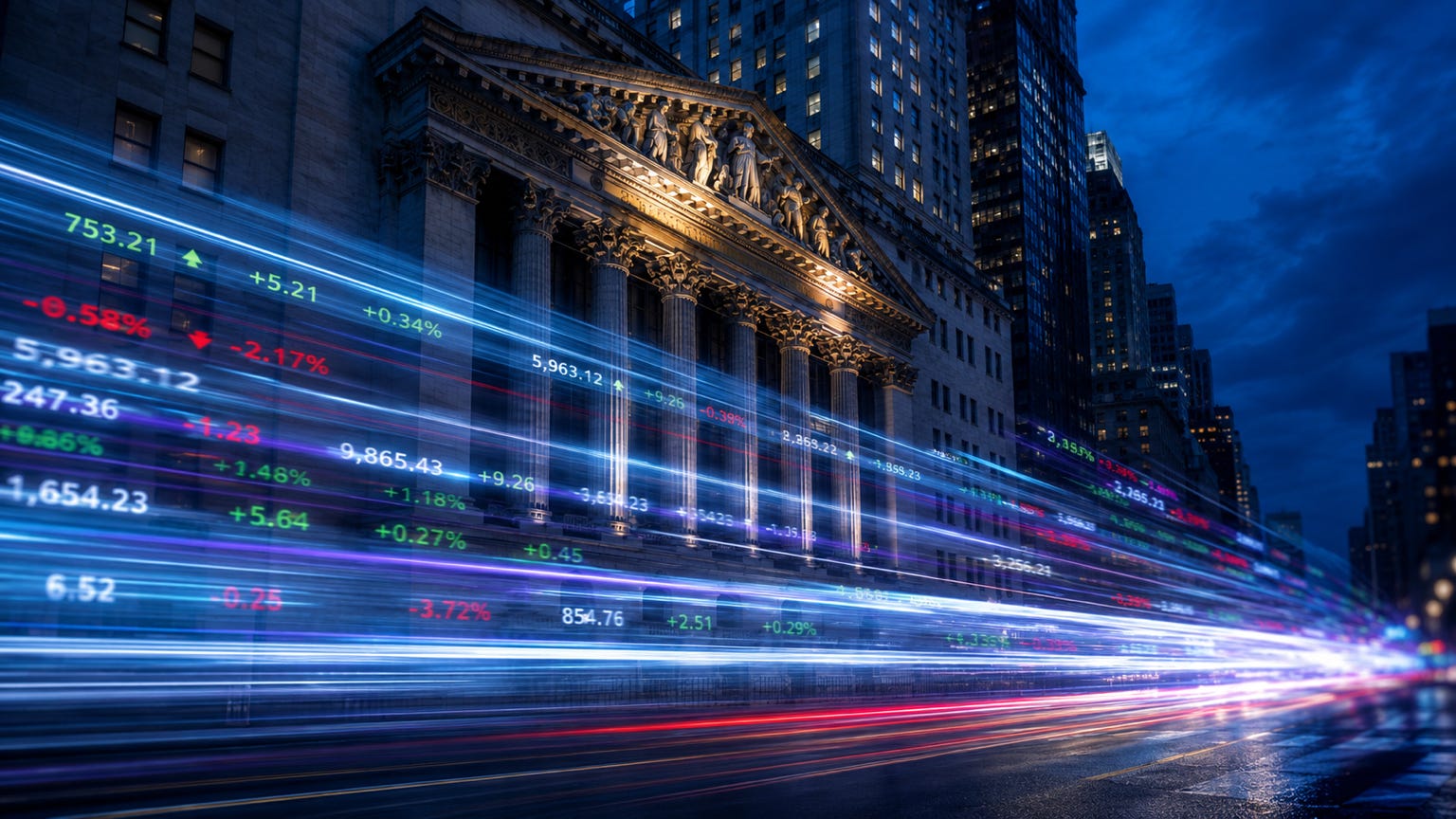
The exchanges built an even larger business around the same principle. Despite the television images of traders working on the floor in lower Manhattan, the technological heart of the New York Stock Exchange is approximately 34 miles away in Mahwah, New Jersey. The NYSE’s primary matching engines—the computers that match buy and sell orders—operate inside a massive data center there.
Trading firms pay to place their servers in the same facility, reducing the distance orders must travel. The NYSE markets co-location in Mahwah as the most direct route to its market data and trading venues. Electronic trading shifted the market from the physical floor to data centers, making low latency and proximity valuable products.
In electronic markets, geography becomes time—and time becomes money.
Truth API applies this commercial model to political information. Trump Media is not selling proximity to a matching engine, but rather a faster technological route to market-moving messages.
Trump Media says Truth API will deliver posts from Truth Social’s most influential accounts—including Trump’s—to paying customers faster than ordinary users receive push notifications. An algorithmic trading desk—like the one I ran—could ingest a Trump post, interpret it, and execute a trade before someone reading Truth Social on a phone even knows the post exists.
This is an advantage, and potentially a significant one. However, having an advantage is not inherently illegal.
Insider trading generally involves trading on material, nonpublic information obtained or disclosed through a breach of a duty of trust or confidentiality. A Trump announcement about tariffs, military action, an Iran ceasefire or a particular company could certainly be material. His posts have repeatedly moved stocks, bonds, currencies and oil prices.
If Trump has already posted and the message has entered Truth Social’s publication system, Trump Media can argue the information is public, even if paying customers receive it milliseconds earlier.
Securities law does not guarantee every investor access to identical technology, processing power, or simultaneous delivery to every screen. It has never prohibited financial institutions from paying for faster access to public market data.
The key question is not whether Truth API subscribers receive Trump’s posts before regular users, but whether they access the information before Trump publishes it.
If the API transmits published posts through a faster channel, it resembles a standard premium data feed. However, if Trump Media provides selected customers with unpublished drafts, transmits content privately before publication, or delays public posts while favored traders establish positions, that would be a fundamentally different arrangement.
This is why the feed itself is likely legal, but actions taken immediately before information enters the feed may not be.
There have been arrangements that moved much closer to that boundary.
For years, Thomson Reuters provided certain high-speed clients with the University of Michigan’s consumer-sentiment data two seconds before its other paying clients—and more than five minutes before the wider public release.
Two seconds is an eternity to an algorithm. These clients were not simply receiving already-published information through a faster delivery system; they were purchasing a brief period of exclusive access to information that had not yet been publicly released. The controversial arrangement ended in 2013.
Truth API is comparable to Dow Jones if it transmits Trump’s posts only after publication. It becomes more like Thomson Reuters if subscribers receive content before public release. This factual distinction should guide the analysis, not personal opinions about Trump, automated trading, or Wall Street’s advantages.
The recent Kalshi teleprompter episode offers a much clearer illustration.
Trump’s longtime teleprompter operator was placed on unpaid leave following reports that he used advance knowledge of Trump’s prepared remarks to bet on what words the president would say. According to news reports, the operator allegedly made more than $100,000 from contracts tied to Trump’s speeches. Kalshi froze the account and referred the matter to federal regulators.
Those allegations have not been adjudicated. If true, they describe conduct fundamentally different from purchasing a faster API. The operator allegedly possessed information that was specific, valuable, unavailable to the public, and obtained through his White House responsibilities.
He was not merely faster at reading Trump’s speech. He allegedly knew portions of the speech before Trump delivered it and placed bets based on that knowledge. That is what most people mean when they hear “inside information.”
Similar questions arise from the extraordinary trading activity observed shortly before several market-moving Trump announcements.
In March, more than $800 million in U.S. and international oil futures reportedly changed hands within minutes before Trump announced that he was postponing strikes on Iran’s energy infrastructure. In April, traders reportedly placed an approximately $950 million bet on falling oil prices hours before Trump announced a two-week ceasefire with Iran.
Trump is simultaneously the government decision-maker, the source of the market signal, and a financial beneficiary of the infrastructure distributing that signal.
There have also been instances in which stock and oil futures began moving sharply just before Trump released information capable of reversing the market. None of these episodes proves insider trading. Large traders make large speculative bets, and occasionally those bets will be spectacularly well timed. But repeated bursts of trading immediately before previously undisclosed presidential decisions deserve considerably more scrutiny than a company openly selling faster delivery of published social-media posts.
Investigators should identify the traders, determine the precise timing of policy decisions, reconstruct who had advance knowledge, and compare that timeline with the orders. That is where evidence of actual insider trading—if any exists—is most likely to be found.
None of this makes the Truth API arrangement acceptable. A sitting president is generating market-moving information through a private platform while his family benefits financially from selling faster access.
Trump is simultaneously the government decision-maker, the source of the market signal, and a financial beneficiary of the infrastructure distributing that signal.
No ordinary news organization, market-data vendor or stock exchange combines all three roles.
This represents an extraordinary conflict of interest. It creates harmful incentives and clear opportunities for corruption. It requires aggressive oversight, disclosure of Truth API’s customers, preservation of transmission records, and a clear separation between official presidential communications and private monetization.
Congress should consider requiring market-moving government announcements to pass through an official public channel before—or at the same time—they appear on a president’s privately owned platform.
Democrats weaken their argument by using “insider trading” as a catchall for conduct they view as unfair, exclusionary, or corrupt. Wall Street has always charged for speed. Unequal access to public information is not equivalent to trading on material nonpublic information.
Truth Social may be selling latency, but the more serious question is whether someone with advance knowledge of Trump’s decisions is trading before the latency race even begins.

Comments
Nothing yet. Say the first thing.
Sign in to join the conversation.