
I don’t know what I was thinking.
Looking back at the material I’m about to share here, I’ve gotta say that I’m a little embarrassed by my actions. At the same time, I’ve gotta admire the sheer amount of chutzpah I had in proposing this at all. So we might as well get into it and I’ll try to provide a little context along the way.
What you’re about to see is a significant portion of a… well, I guess you could call it a “presentation” that I made to the upper editorial echelons of Wildstorm Productions in, I believe, mid-2001. At that point, they had only been owned by DC Comics for about three or four years. Regardless of that, my enthusiasm was definitely misplaced. But I was young and naïve and overly excited about working somewhere that was, in its own way, on the cutting edge of superhero comicbooks.
I had already been doing what I felt was some of my best work at Wildstorm, starting with the MR. MAJESTIC series and carrying on into Volume 2 of WILDCATS. But I also felt like some of the other books in the line, most notably The Authority (first by Warren Ellis and Bryan Hitch, then Mark Millar and Frank Quitely) and Planetary (by Warren Ellis and John Cassaday) were as good as it gets. Alan Moore’s ABC imprint had also just launched, so there was just a lot of cool stuff happening.
But it also seemed… a little scattershot. Having gotten to know the editors at Wildstorm, I could see there was skill and dedication, but no overarching vision for the company. At least, not one that I could see. Editors were just trying to get their books out on schedule, too deep in the trenches to see the bigger picture. Hey, it happens more than you might imagine.
To take a step back… it used to be my strong opinion that Jim Lee sold Wildstorm maybe a year or two too early. I honestly believed, had he waited, the sheer quality of what Wildstorm was putting out might’ve catapulted them to the front of the pack at a point where Marvel and DC were both somewhat vulnerable (Marvel being mired in bankruptcy and DC basically hanging on to one significant hit in Grant Morrison’s JLA). Again, my naïveté was in full force.
What I later learned… was that Jim Lee had to sell, was extremely motivated to sell, was looking for a buyer to take over the financial burden of maintaining the Wildstorm offices, which were located basically on the ocean in scenic La Jolla, California. Believe me when I tell you, it was the most beautiful location for a comicbook studio that I’ve ever seen. But that real estate doesn’t come cheap. I can only imagine how insane the overhead was, and what a relief it must’ve been for Jim to finally relieve himself of that particular millstone (especially during the post-speculator bust we all experienced in the mid-90’s). In fact, there are accounts that claim that Jim Lee tried to get Marvel to buy him out first (with designs even then to running the whole show). Not to mention, there’s every indication that Jim simply didn’t want to own -- and run -- his own company. To me, he seems to be more of a corporate animal, comfortably suckling on that particular teat.
Because, in actuality, DC didn’t so much buy Wildstorm as they bought Jim Lee. Wildstorm just happened to come with the dinner. They really wanted Jim at DC Comics -- he was the valuable asset -- and the immediate result was the twelve-issue Batman: Hush series that Jim drew, published a few years later. It was DC’s biggest hit in years and set the publisher on a course to start clawing back significant market share… arguably to the point where they just recently surpassed Marvel in that particular area. And, of course, Jim’s name is atop DC Comics’ current chain of command (again, no doubt part of his long game from the very beginning).
But back to early 2001… I’d been e-mailing back and forth with Kick-Ass creator, Mark Millar, the previous year (before he’d been recruited by Marvel to help launch their Ultimate line), since we were the two young gun Wildstorm writers at that time. We were conspiring to take better advantage of what we both recognized as untapped potential. Millar believed, as I did, that Wildstorm could be the hottest imprint in the industry. We just needed to recruit a few more like-minded creators (mainly writers, since this was fully in the “writer-driven” era of mainstream comics) and, essentially, take over the whole f**king thing. Over the course of a handful of e-mails, we obnoxiously played god and attempted to manifest a brighter future for Wildstorm.
I should mention here that it seems that both Millar (along with Frank Quitely) and I were separately offered contracted positions at Wildstorm. My offer was much more casual, floated as a possibility by then Wildstorm President, John Nee, at a lunch meeting (at the long lost All-American Burger on Sunset Blvd), so I don’t know how serious it really was. Although part of the conversation involved actually moving to La Jolla. Of course, there was no way I was moving out of Los Angeles. I heard that the Millar/Quitely talks got much farther along, but I can’t imagine that was ever going to happen, either. But it spoke more to the idea that Wildstorm was actively looking for some sort of pathway going forward.
Then DC proper started messing with The Authority. Censoring Millar’s scripts. Censoring Quitely’s art. Imposing creative restrictions. Pretty soon, both creators were gone, having moved on to greener pastures at Marvel Comics.
(Of course, so did I… but my motivations were much different. Regardless, I ended up migrating back to Marvel and started doing significant work at DC Comics proper)
But I wasn’t ready to give up the ghost just yet. Up to that point, I hadn’t had the same censorship issues with the mothership (although that would change in later years), so I was still willing to push ahead with a potential new vision of a more creatively cutting-edge version of the Wildstorm imprint, to finally cast aside any whiff of the 90’s and fully embrace the Twenty-First Century in a manner that no other publisher seemed to be willing to. At least, not then.
Around that time, in my personal life, I was extricating myself from a three-year romantic relationship that, at the time, felt like the height of Twentysomething drama. But in the immediate aftermath, we attempted to remain friends, the kind that could depend on each other if and whenever necessary. She was a great gal who had just begun what turned out to be a long career in advertising. Even at a young age, she was highly skilled at graphic design and fashioning ad campaigns. Plus, she had the heavy duty computer/scanner set-up that was needed to put this particular pitch together. I was -- and remain -- grateful to her and the time she dedicated to this crazy idea of mine…
… because this was much more than simply pitching a new series, this was about a complete rebranding the imprint and re-imaging the kind of content a reader would find there. That meant pitching multiple titles, both new and old, to give an overall sense of the vibe I was going for. Because, when it came down to it, a vibe was what I was pitching, more than anything.
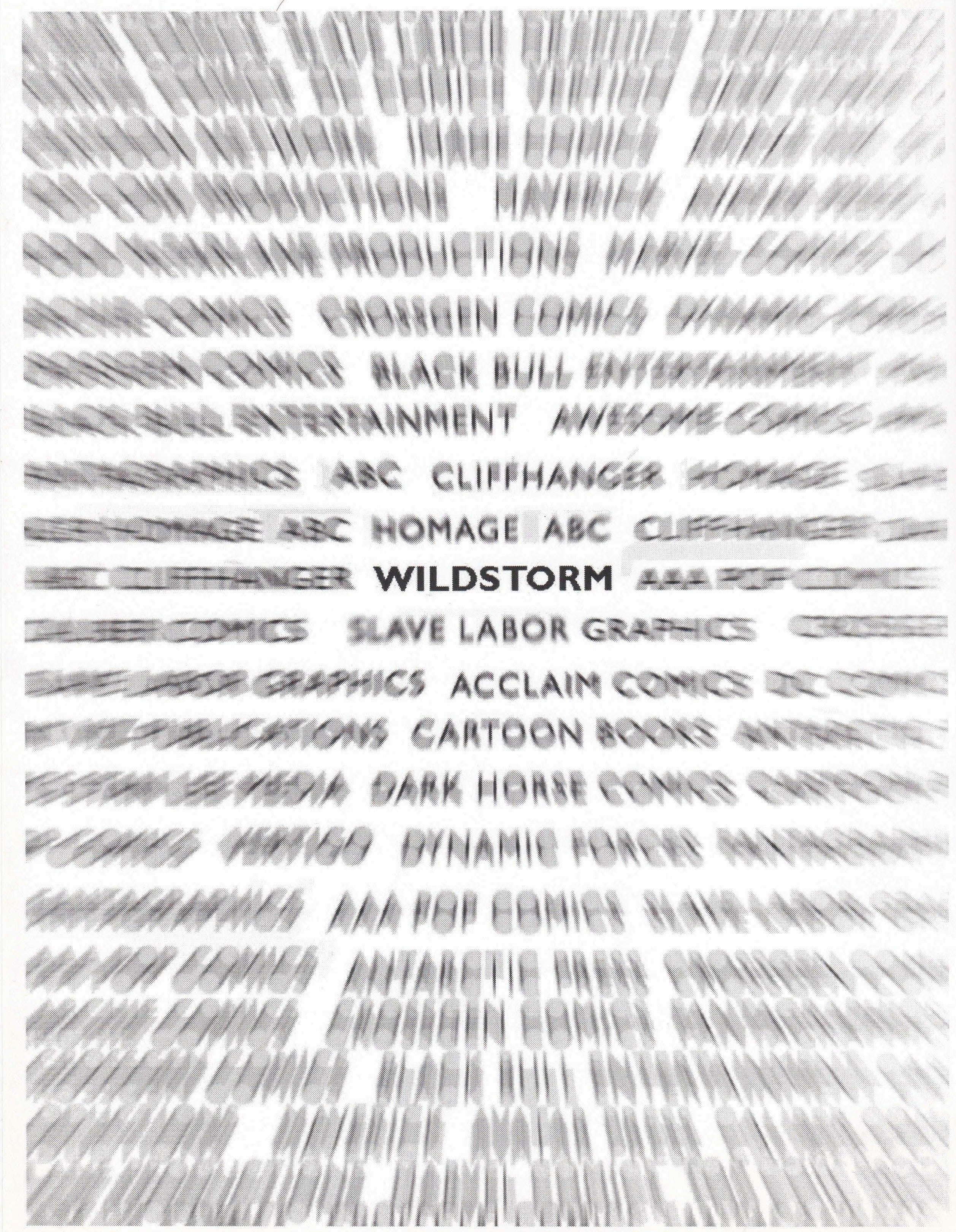
The first thing I did was to differentiate the imprints within the great imprint. Wildstorm -- as an overall shingle -- already contained Homage, Cliffhanger and Moore’s ABC line. Nothing to sneeze at, no doubt about it. But the “main” imprint -- the books that only displayed the “WS” bullet -- didn’t seem to have its own identity. It was defined more by what it wasn’t rather than what it was (or could be, in this case).
This initial graphic exploration illustrated how I was attempting to position Wildstorm, in relation to the rest of the industry at that moment in time…
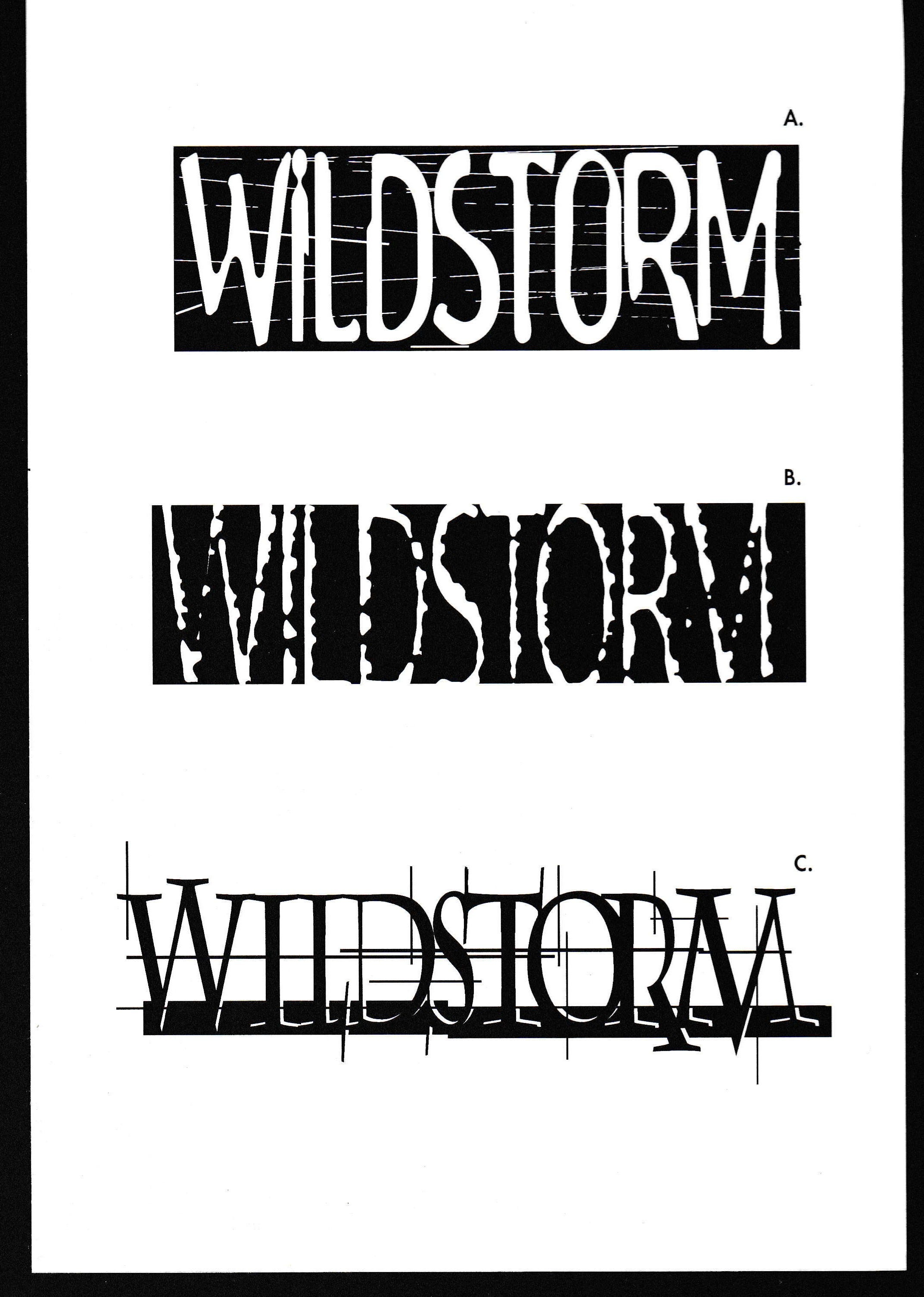
As part of this whole initiative, we even explored different logo treatments that would signal a potential “new” Wildstorm. Looking at them now, I don’t know how highly I rate any of them… they’re clearly very much of their time (by that, I mean “dated”)… but there was definitely some thought and effort put into them…
I set up a meeting with the top brass at Wildstorm editorial and schlepped it down to La Jolla to make my presentation in person (like it was a big deal or something). Wildstorm President John Nee was at that meeting, then-head editor Scott Dunbier was at that meeting… and I feel like Jim Lee himself was also at that meeting (although I couldn’t swear by that). I had a few pieces of art to show, presented mounted on matte boards, very much like if I were pitching a bona fide advertising campaign. Although I’m sure I prepped them beforehand, I don’t think any of them were expecting what I was serving up. And however seriously they were -- or weren’t -- taking me, I’ll never know. But, in that particular moment, they were at least willing to listen.
Next time, we’ll take a look at the actual pitches I submitted…
Joe Casey
USA
No posts
Comments
Nothing yet. Say the first thing.
Sign in to join the conversation.