
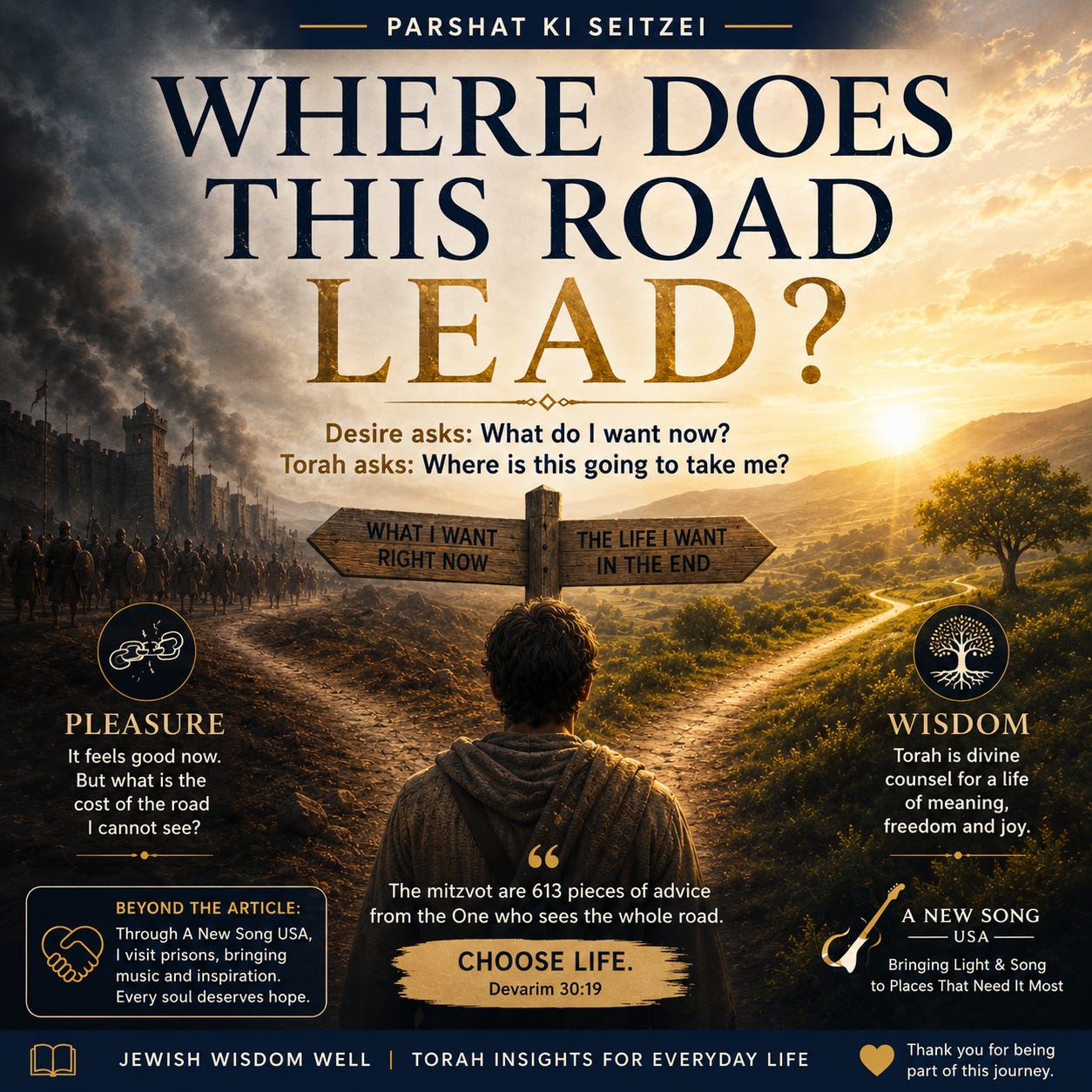
What if the Torah's prohibitions are not simply restrictions, but divine advice about how to live? In this week's Parshat Ki Seitzei, we encounter the unusual case of the yefat to'ar, the beautiful captive woman—a situation in which the Torah recognizes the extraordinary power of human desire under the extreme conditions of war. Yet the Torah immediately shows us that getting what we desire does not necessarily lead to happiness. This raises a deeper question: when we are tempted by something we want right now, can we trust that our desire knows where the road leads—or should we listen to the One who sees the entire journey?
Parshat Ki Seitzei begins with one of the Torah’s most startling passages.
The Torah describes a soldier who goes to war, sees a beautiful captive woman, desires her, and wants to take her as a wife. The Torah then gives him a very specific procedure through which this relationship can eventually take place.
At first glance, this is difficult to understand.
Why would the Torah permit something that would otherwise be forbidden simply because a person’s desire is so strong?
Every day we face temptations. A person may want to eat something forbidden. He may want to take something that doesn’t belong to him. He may feel an attraction that he knows he should not pursue.
The Torah does not normally say, “Your desire is strong, so go ahead.”
Quite the opposite.
The Torah expects a person to exercise self-control.
So why is this case different?
The answer begins with the extraordinary circumstances of war.
The Talmud in Kiddushin explains the passage with the words:
“לא דיברה תורה אלא כנגד יצר הרע” — “The Torah spoke only in response to the evil inclination.”
Rashi explains that if the Torah had not created a permitted path, the soldier might take the woman in a forbidden way.
This does not mean that the Torah has suddenly decided that desire is a legitimate excuse for violating God’s commandments.
Rather, the Torah is recognizing something very specific about human nature.
This is not an ordinary temptation.
The person is in the middle of war. He is surrounded by violence, danger, physical exertion and heightened emotion. He is not standing in ordinary circumstances, living an ordinary day, and casually deciding whether to give in to a desire.
This is an extreme situation.
And Torah, which normally demands mastery over our desires, recognizes that this particular circumstance creates an extraordinarily powerful challenge.
There is a fascinating lesson here.
The Torah expects us to control ourselves. But the Torah also understands us.
It does not pretend that human beings are machines.
And yet, there is another part of this passage that may be even more remarkable.
The Torah gives the soldier a way to obtain what he desires—but then it immediately begins showing us where that desire will possibly lead.
Rashi points out that the sections following the captive woman are deliberately placed together. He explains that the man will eventually come to hate this woman, and eventually a rebellious son will emerge from the relationship.
In other words, the Torah is not simply showing us how to satisfy a desire.
It is showing us the trajectory of a desire.
And that brings me to an idea from the Zohar that has always struck me deeply.
The Zohar describes the 613 mitzvot as “תרי”ג עיטין” — 613 counsels or pieces of advice. The mitzvot are not merely a collection of arbitrary restrictions. They are divine guidance—G-d showing us how to navigate life.
That changes the way we can look at a prohibition.
Suppose a person wants to steal.
In that moment, his choice may look very simple:
“I can take this money, and then I will have the money.”
But the Torah says: Do not steal.
Why?
The Torah is not merely taking something pleasurable away from him.
It may be protecting his future.
I have the experience of visiting people in prisons through my work with A New Song USA, bringing music and Torah-inspired programs to incarcerated men and women.
In those visits, I have sometimes heard something that is both heartbreaking and revealing.
A person will tell me that he is actually glad he was caught.
Not because he wanted to go to prison.
But because he had become trapped in a cycle that he could no longer escape.
He kept stealing.
He kept making destructive choices.
And eventually getting caught forced the cycle to stop.
Think about the choice that person faced at the beginning.
He did not necessarily see:
“I am choosing prison.”
He saw:
“I am choosing the money.”
The problem was that he could see the immediate gratification much more clearly than he could see the end of the road.
And that is one of the great purposes of Torah.
Hashem sees the entire road.
We often see only the next step.
A prohibition can therefore be understood as something much deeper than a restriction.
It can be a warning:
“Don’t go down this road.”
There will be consequences
Sometimes they are immediate.
Sometimes they take years.
Sometimes they affect our relationships.
Sometimes they affect our character.
Sometimes they affect our freedom.
And sometimes we may never fully recognize the consequences in this world.
But the underlying principle remains:
The Torah knows something about the road that we may not yet be able to see.
That is why the episode of the captive woman is so fascinating.
Even when the Torah makes an extraordinary concession because of the extraordinary power of the temptation, it does not present that desire as the path to happiness.
The permission is not an endorsement.
It is an accommodation to human weakness.
And then the Torah shows us the possible consequences.
Perhaps this is why we should think twice when we encounter a mitzvah or a prohibition that seems to us like an obstacle to happiness.
We tend to think:
“If only G-D would let me do this, I would be happy.”
But perhaps the Torah is saying:
“If you could see the whole road the way I see it, you would understand why I am telling you not to go there.”
We often confuse pleasure with happiness.
Pleasure asks:
“What do I want right now?”
Wisdom asks:
“What kind of life will this choice create?”
And Torah gives us something even greater than wisdom.
It gives us the counsel of the One who sees the entire picture.
The Torah doesn’t merely tell us what we are not allowed to do.
It teaches us how to live.
And sometimes the greatest freedom is not the freedom to follow every desire.
It is the freedom to recognize where that desire is taking us—and to choose a different road.
Choose life.
-The Jewish Wisdom Well
No posts
Comments
Nothing yet. Say the first thing.
Sign in to join the conversation.