
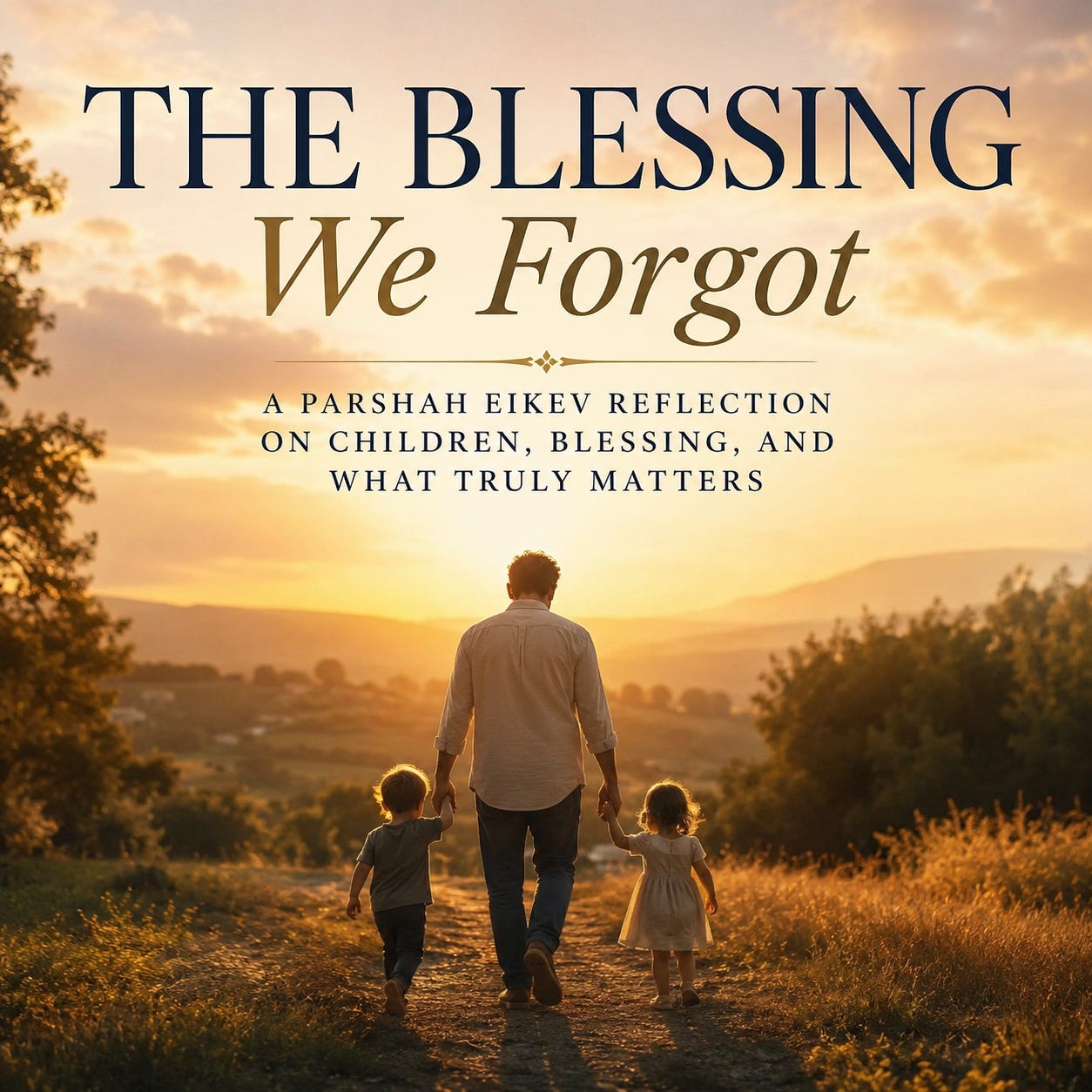
When we think about blessings, we usually think of health, financial security, success, or peace of mind. Yet in this week's parashah, Eikev, the Torah does something unexpected. After promising that Israel will be blessed, it immediately speaks about the blessing of children. Why would the Torah emphasize this blessing above so many others? In a world that often sees children as an inconvenience or a burden, perhaps the Torah is reminding us that the greatest blessings are not the ones that make life easier—they are the ones that teach us how to love, give, and grow beyond ourselves. And for those who cannot have children, this timeless lesson remains just as meaningful, revealing that the deepest blessing is found whenever we help another soul flourish.
In this week’s parashah, Eikev, the Torah makes a remarkable statement:
“Blessed shall you be above all peoples; there shall not be among you an infertile man or woman, nor among your cattle.” (Deuteronomy 7:14)
At first glance, the verse is surprising.
The Torah could have described blessing in countless ways. It could have spoken about wealth, success, health, security, abundant harvests, or long life. Instead, after declaring that we will be blessed above all nations, it immediately points to one blessing in particular: the ability to bring children into the world.
That should make us stop and think.
Our generation often sees children very differently. Many people worry that children will take away their freedom. They fear the financial cost, the sleepless nights, the sacrifices, and the responsibilities. Children are sometimes spoken about almost as though they are a burden to be managed rather than a blessing to be cherished.
The Torah presents the exact opposite perspective.
Yes, children require sacrifice. They demand our time, our patience, our energy, and our resources. But perhaps that is precisely why they are such a blessing. The greatest blessings are rarely the ones that simply make life easier. They are the ones that make us greater.
A child teaches us to stop living only for ourselves.
The selfish heart asks, “What will I lose?” A giving heart asks, “What can I give?”
Parenthood stretches the human soul. It teaches patience, compassion, responsibility, forgiveness, and unconditional love. It transforms our priorities and reminds us that the deepest joy comes not from acquiring more for ourselves, but from giving ourselves to someone else.
Perhaps that is why the Torah singles out this blessing. It is not merely celebrating the birth of children. It is celebrating the birth of a giver.
There is also an important sensitivity that must be acknowledged.
Many wonderful people long to have children and carry that pain every day. This verse is not meant to deepen that pain or suggest that their lives are somehow lacking. Every human being is precious before Hashem, and many people who never become biological parents fill the world with extraordinary life.
Some become teachers who shape generations. Some become mentors who guide young people through life’s greatest struggles. Some become rabbis, educators, counselors, foster parents, or adoptive parents. Others simply become the person who believes in someone when no one else does.
The lesson of this verse is larger than biology.
The Torah is teaching us that the greatest blessing is not simply having a child. It is becoming the kind of person whose greatest joy is helping another human being grow.
Every one of us is capable of that.
Whether through our own children or through the countless lives we influence, Hashem gives each of us opportunities to become a source of life, hope, and growth.
Maybe that is the deepest message of Eikev.
The greatest blessing is not what we accumulate.
It is what we give away.
And the more we give ourselves to others, the more blessed we truly become.
-The Jewish Wisdom Well
No posts
Comments
Nothing yet. Say the first thing.
Sign in to join the conversation.