
A few weeks ago, I trekked to the Dolomites—probably the most jaw-dropping place I’ve ever been—to ride what is widely regarded as one of the hardest and yet most beautiful gran fondos* on Earth with the mission of A: finishing the event in one piece and B: writing about it for the dear homies at Escape Collective.
I’ve pasted a few of the opening grafs** below but, as Escape Collective is 100% reader funded, everything they publish is paywalled. That said, in the few very short years since their launch, EC has been able to lock in some of the best cycling journalists in the world and so, if you have any interest in bike racing or cycling in general, a subscription is well worth the $20 a month or so. And that’s not to mention that it goes almost directly to paying writers, a final destination that is all-too-foreign in today’s media landscape.
So read on, enjoy, and subscribe if you’re so inclined!
Thanks and safe and happy travels.
- mvm
*a “fondo” is a mass-start cycling event where anyone can enter but there’s some very real racing at the pointy end. Think NYC or Boston Marathon, only on bikes.
**journalism has a bunch of weird shorthand such as “graf,” which is what we nyyyerds call paragraphs. We also spell it “lede,” not “lead,” and write TKTK when we don’t know a fact but will confirm it later. It means “to come” and is spelled with a “K” in these instances because the letters T and K rarely appear in succession in the English language, making it easier for editors to spot. Anyway, that’s your journalism lesson for today. That and, to quote the great John Bennett, “Only shitty writers need transitions.”
The slow roll of tires on tarmac. Chains grinding faithfully against cassettes. Birdsong, at least while you’re still below the treeline. Breath, in and out, in and out. Yours. Theirs. Ours. Maybe, if you’re lucky, a little hush of wind across the back of your neck.
Despite being in the thick of one of the world’s biggest, most prestigious, and most difficult fondos, surrounded on all sides by fanatical cyclists, some who’ve traveled the world to be there, that’s about all you hear as you climb the wall-like roads of the Dolomites.
You stand up sometimes — if for no other reason than to give your ass and your quads a tiny respite — and count your pedal strokes. You set a target number in your mind, rather than a location up the road, and, standing up, you tick them out in the silence of your brain. “1, 2, 3, 4, 5,” and on and on until you reach whatever that predestined number was. You sit back down, hoping the grade has mellowed out a bit in the twenty-five or fifty or one-hundred times you’ve turned your pedals. It hasn’t.
You focus on the little names and the little national flags printed on the numbers of the riders in front of you. As the fondo reserves half of its 8,000 entries for Italians, most of them are lyrical in the way that only Italian is lyrical. “Catarcione,” “Tagliapietra,” “Della Pergola.” Others are almost funny. You focus on the man named “Zucchini” and the woman named “Panini.” But you have neither breath nor will to laugh. You wonder if anyone behind you is doing the same, focusing on the little name printed on the little number stuck to the back of your jersey, asking themselves how a “Venutolo-Mantovani” ended up in the United States. You wonder if there even is anyone behind you or whether or not you are it, Lanterne Rouge, D.F.L. Dead fucking last. You see a German name like “Wolfgang” beside a little Italian flag and presume he must be from around here, in this rare part of Italy that is almost as much German and Swiss as it is Italian, in Alta Badia, in the Sella Ronda, in South Tyrol.
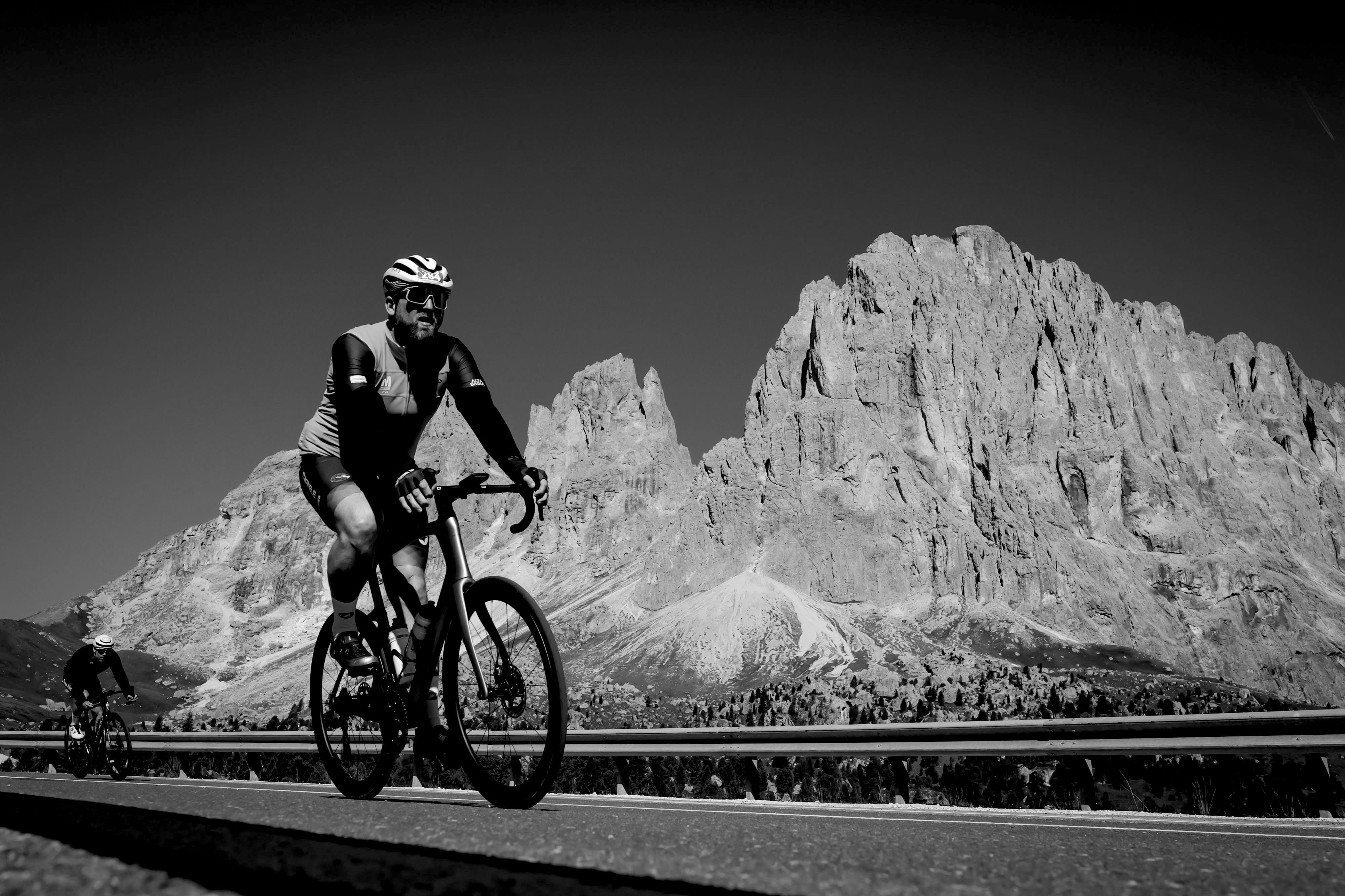
You don’t have a god but you pray anyway, asking some higher power — the universe perhaps — for strength and salvation. You remind yourself of all of your dead and all of your irreparably damaged and you tell yourself that you have legs that can pedal and lungs that can breathe and you remind yourself how lucky you are to be here, miserable as it may be. You curse yourself for ever having set out to do this in the first place. You bless yourself for having the will to try something so daunting, something so Herculean.
Big mountains will do this to you. The Passo Giau — the sixth of the Maratona dles Dolomites’ seven monstrous climbs — did it to me.
10 kilometers. 9.5% average gradient. Maximum pitches of 15%. More than half of the climb above the treeline, where the brutal sun amplifies your pain by a magnitude of thousands.
But let’s not get ahead of ourselves here. Because, chances are, if you’re a member of the Escape Collective community, you’re probably familiar with the Maratona. Maybe you’ve even ridden it yourself. But in case you haven’t, here it is.
First held in July 1987 and featuring just 166 riders — members of the Societá Ciclistica Alta Badia-Raiffeisen celebrating the cycling club’s first decade — the Maratona dles Dolomites has grown in popularity and, perhaps more importantly, lore. It’s a lore that is due in large part to the fact that so many riders may never even get the chance to experience it. Because, of the 30,000 bike riders who apply to ride the Maratona every year, only 8,000 are selected. Therefore, it’s not only the beauty and brutality of the ride that puts it near the top of most serious cyclists’ bucket lists. It’s the exclusivity. Sure, you can make your way to Corvara, the tiny ski town in the Alta Badia region of South Tyrol, and ride the route. Go for it. But you can’t do it on closed roads with beautifully stocked rest areas waiting for you at the summit of each climb. You can’t do it with thousands of spectators lining the roads, cheering your efforts as they ring cowbells and bang pots and pans. You can’t do it alongside thousands of other lunatics who revel in the absurdly challenging.
“Type two fun,” they call it; the kind of shit you remember as being a blast but, deep in the throes of it, is anything but fun. What it is, is the kind of fun that keeps us present, that keeps us focused on that next street sign or that next corner, the next pull at the front of the paceline or each and every rotation we count of our pedals.
To keep reading, visit the story at escapecollective.com.
No posts
Comments
Nothing yet. Say the first thing.
Sign in to join the conversation.