
You land after a long flight. At baggage claim, your bag never shows up. You report it and ask a simple question: “Can you find it and tell me what happens next?”
Behind the scenes, it is a mix of predictable steps and messy work. Someone checks tracking systems, waits for replies, asks you for missing details, and keeps you updated. I found the missing-baggage example below in an early blog post by Camunda’s CEO Jakob Freund, and it is a good way to picture agentic orchestration.
This article is a non-technical introduction to agentic orchestration with Camunda. I keep it simple on purpose: no code, no deep platform details, and as little jargon as possible. The goal is to explain the basic idea and why BPM and AI fit together.
Business Process Management (BPM) is running work as a defined process. A process engine executes it step by step and keeps it moving.
Many organizations already use a BPM suite to manage and automate processes. In Camunda, agentic orchestration lets you add AI without replacing that foundation.
Where you put the AI matters. If it sits outside the process, you lose end-to-end visibility. With agentic orchestration, AI work happens inside the process, so the case history stays complete.
BPM is great at the things you want to be linear and reliable:
Traceability per case (an “instance”).
Waiting, timers, and escalation (like a 48-hour handoff).
Built-in human review via user tasks.
A Large Language Model (LLM) is good at working with unstructured information, like free text or documents. It is also useful when a system needs to interpret a situation and decide what to do next.
In the baggage example, the passenger might write a short description or provide pictures instead of using a form. The LLM can:
Extract key details.
Classify information.
Find the next best action through reasoning.
Draft a clear status update.
But the LLM should only act inside guardrails.
So the question is not “BPM or GenAI?”. The question is how to combine them without losing the advantages of BPM.
This is where both parts come together. The BPM engine runs the reliable path, provides guardrails, and keeps the case history. The LLM chooses the next approved task until a solution is reached, or until the process adds a human to the loop.
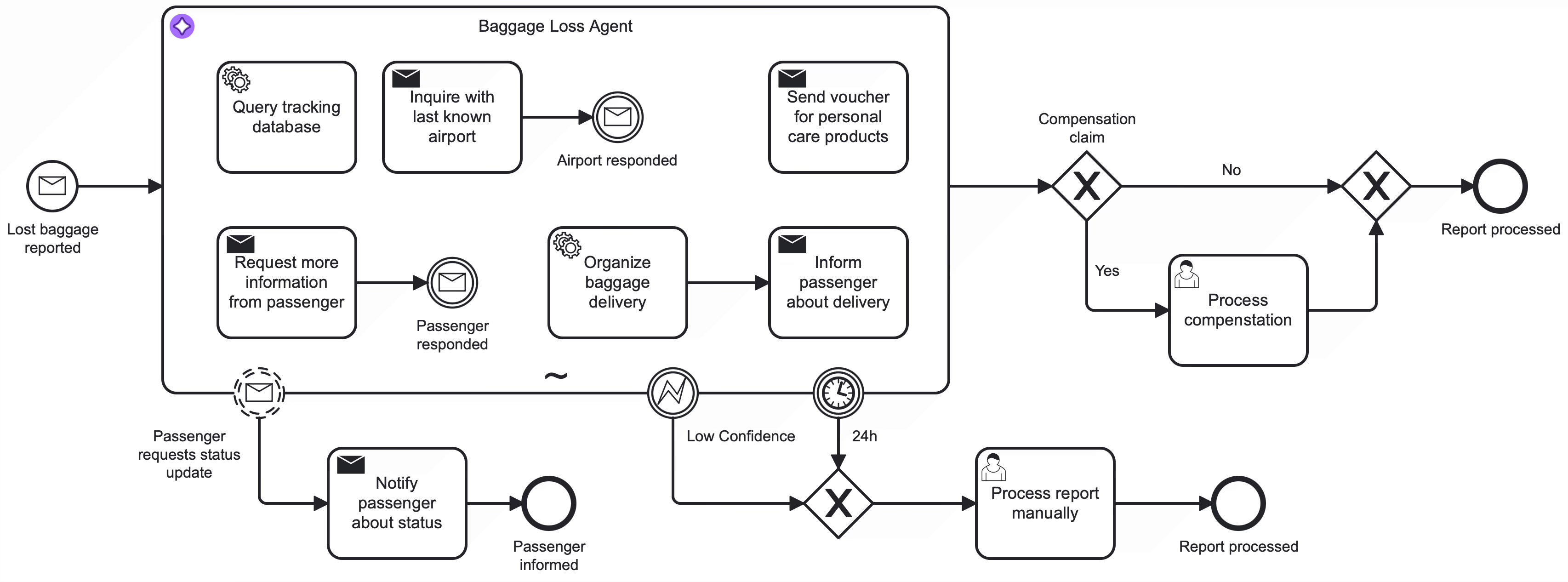
Most cases should still run straight through. The AI loop is for exceptions where a human would normally try a few steps to get unstuck.
For missing baggage, the AI loop has a clear goal: reach a stable outcome with safe escalation. The engine exposes a toolbox of approved tasks and blocks everything else:
Query tracking database
Ask last known airport for confirmation
Request more data from passenger
Issue voucher
Organize delivery
Send status update
The loop is simple:
The LLM picks the next best task from the toolbox.
The engine validates and runs it, stores the result, and pauses if it must wait.
The loop ends when the goal is reached, or escalates when it is not safe.
The engine logs each task call and result, so the work stays visible.
While the AI loop runs, the passenger might ask for updates. In our example, you can send a status message without interrupting the main work. In BPMN, a process diagram language, this is a non-interrupting message boundary event.
You also define clear “stop and ask a human” rules, like:
Low-confidence: the LLM cannot match the bag safely, or the data conflicts.
24-hour timer: too much time has passed without progress.
In both cases, BPM creates a user task for a human to review and decide. A reviewer sees what the AI tried, decides what to do next, and the case continues or ends.
When the AI loop finishes, BPM makes the outcome explicit:
If the bag is found and delivery is arranged, the case ends.
If the bag is not found, BPM routes into a compensation decision and claim handling, or escalates for approval.
If the basic idea makes sense, do not jump to model choice yet. The first question is whether the problem really needs agentic orchestration at all.
That is where I go next. I stay with the baggage example and look at what should stay a normal workflow, what fits DMN, and where an agentic step is worth the extra effort.
No posts
Comments
Nothing yet. Say the first thing.
Sign in to join the conversation.