
The Intelligent Friend - The newsletter that explores how AI affects our daily life, with insights from scientific research.
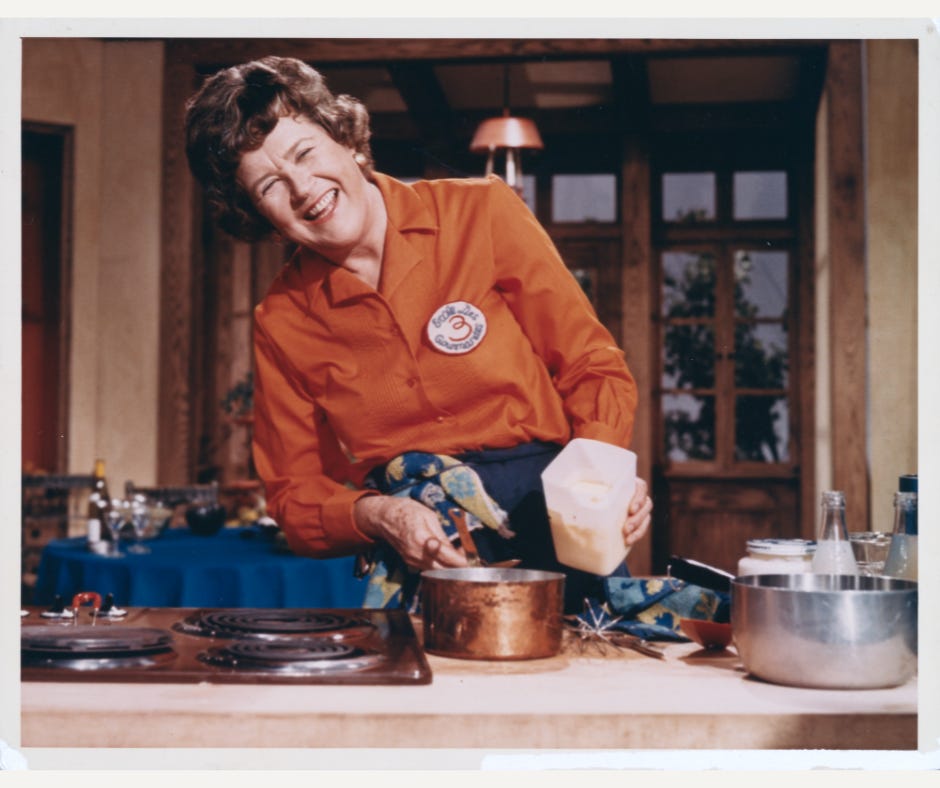
“It’s a square. It’s a triangle. Pull it, stretch it, roll it up, form it into a crescent shape — and it’s a French croissant.” Her hands move with economy and vigor as she says the words. That is how an episode from the ninth season of The French Chef opens, “French Croissants”, with Julia Child at the counter. Over the next minutes she walks you through every step: measuring ingredients with care, working the dough, and baking croissants you can make at home. There are small pearls of kitchen wisdom along the way. “And then we want two-thirds cup of tepid milk” she says in a firm, almost corrective voice. “And tepid simply means you’ve taken the chill off it”.
Watching, you’ll likely feel the itch to cook. And if you know this program —and this genre — you’ve probably watched many others: today’s tv competitions, YouTube tutorials by independent creators, practical guides that promise to help you knead, shape, and create.
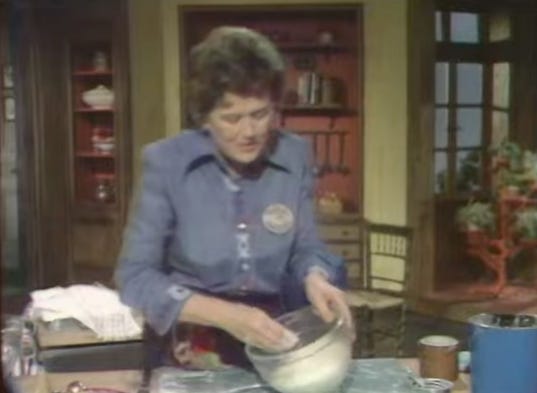
Julia Child wears an indigo shirt, precisely pressed, with a patch on the left breast. As she demonstrates the steps toward a perfect French croissant, she radiates confidence, though not the brittle kind that pretends to certainty. She thinks aloud. She adjusts. She proceeds iteratively. What she offers is not only a sequence of instructions, but a way of approaching the work. At exactly 5:51, she begins to knead with her hands. Throughout the process, excluding the oven, she never turns to a machine.
Watching this video — or another one on kneading bread or preparing pizza at home — you might make the very same choice. Kneading, for you, could be precisely what makes the process authentic, what convinces you that you truly made the dough yourself. Your best friend, who simply wants a pizza on the table as quickly as possible, might see it differently. While the machine does the work1, he could be reading emails, and once the dough is ready, move on to the other steps
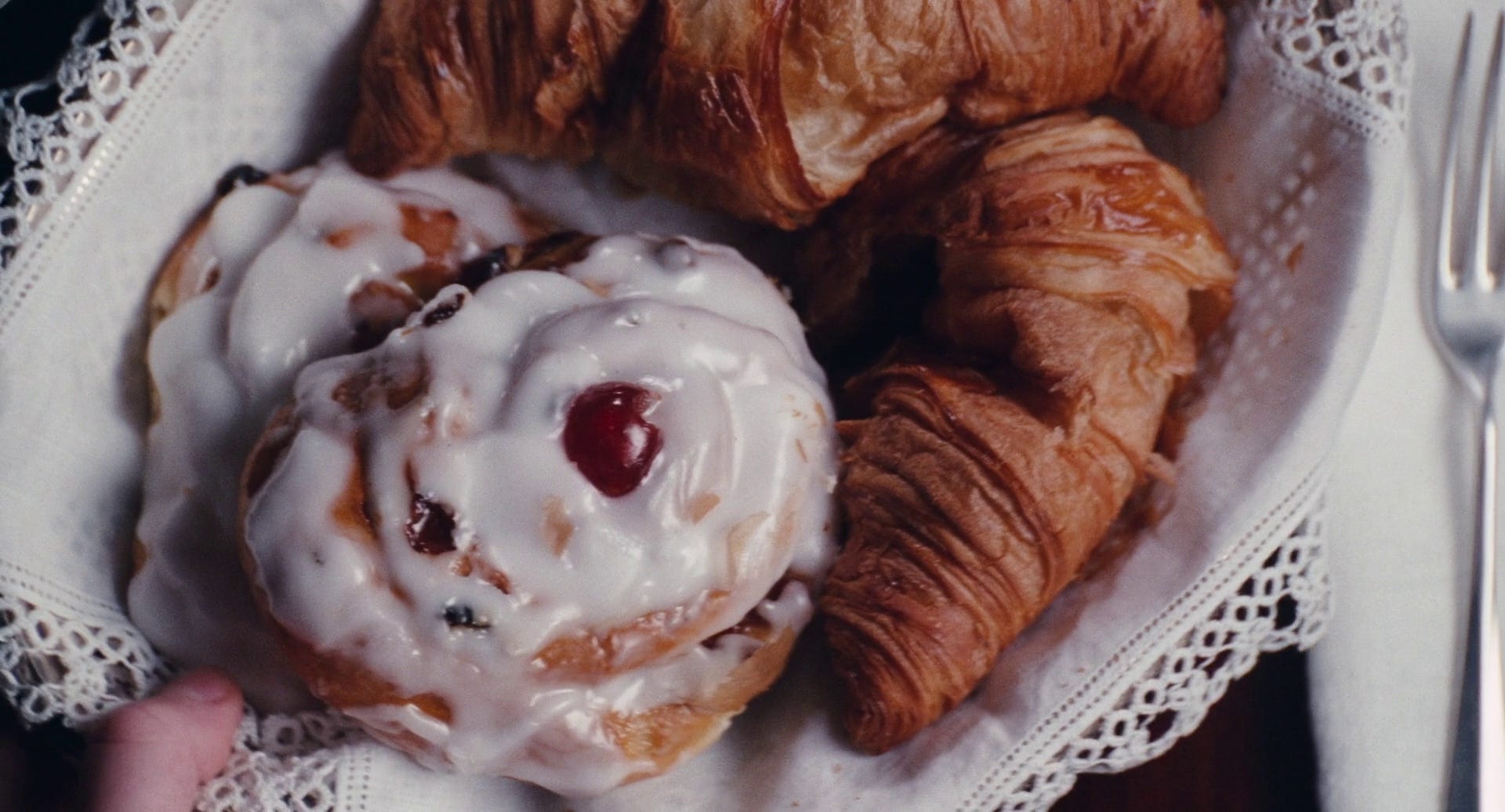
Who’s right? Of course, both. The difference lies in how much weight you give to baking (or cooking, looking at another example). In this example, for you, unlike your friend (or vice versa), cooking is central to how you define yourself. You may own stacks of cookbooks (here one I’m evaluating to buy, anyway), follow food creators, never miss an episode of MasterChef. At gatherings, you proudly share your latest experiments in the kitchen, and you love browsing for unusual ingredients. In other words, cooking matters for your identity.

And so you hesitate to use a machine for kneading. Automating this step feels like a threat to your identity as a passionate cook, or as a baker (depending on what we are considering). You are automating the very thing that carries meaning for you. Research clearly indicates that when automation threatens a process or activity that is tied to our sense of identity, we resist it. And this is not true for baking alone. In their study, Leung and colleagues (2018) demonstrate this effect across a wide range of activities and categories.
We all know someone who is passionate about cars. The kind of friend who recoils at the very thought of an electric vehicle. For him, driving conjures a particular imagery: long stretches of open road, leather gloves, or simply the solitude of a long journey behind the wheel. And in that world, only manual transmission counts.

Speaking with him, you might find the stance almost anachronistic. Faced with the ease of an automatic, why cling to the manual? Yet he would be just as sharp in turning the question back on you, invoking the bread machine as his counterexample. He resists the automation of manual shifting just as you resist the automation of baking — because for him, driving is more than transportation. It is important for his identity.

In their first study, Leung and colleagues asked a large group of drivers about their cars, their expertise, and their preferences. According to results, people who identified more strongly with being a “driver” were significantly more likely to own a manual transmission.
Let us return to Julia Child. Near the end of the episode, she offers yet more pearls of kitchen wisdom to ensure the croissants rise properly in the oven: “Be sure that, when they’re risen, you feel it”. Earlier, at minute 10:31, she remarks on the dough: “Remember that it’s not the amount of time that it takes to rise — it’s how it looks.” The episode is dense with instructions of this kind. “And at this point, you want to wrap it up and refrigerate for about half an hour or so”.
The video shows Child’s meticulous exactitude and her almost theatrical capacity to entertain through a kind of domestic storytelling. However, watching carefully, what binds these utterances together is the underlying exertion — the labour, attention, and energy — that the watcher is asked to invest at each stage. By the time the video ends, the satisfaction we feel is tied to the effort we have expended.
But what if we used a machine to carry out the process from start to finish? We would not feel that we had done the work ourselves. We would not, in truth, think we had made the croissants. To put it in more scientific terms, we would be unable to attribute the outcome internally. And without the perception of internal attribution — and without the sense of control over the steps — we cannot fully own the result. Automation strips this away.
One of the studies by Leung and colleagues (2018) makes the point elegantly. Participants were asked to imagine borrowing equipment to bake bread. The researchers tested whether the strength of identification predicted preference for automation differently depending on how much skill was “removed” by the machine. The pattern is straightforward: those who see baking as part of who they are tend to resist a machine that does everything, but are far less resistant to a simple dough mixer, which still leaves space for their effort.
Finally, it is worth underlining, however, that this resistance emerges only when consumption is tied to identity motives. As the authors themselves note, “a keen cyclist may decide to buy another bike to commute to work to avoid slow traffic or save money”.
With today’s issue, we have arrived at a double insight. First, we have seen how, in a landscape of ever more advanced technological options, automation can intrude upon the choices that speak most closely to our identity.
The greater the share of effort replaced, the greater the perceived threat to our identity motives. Second, in the spirit of Julia Child, we have discovered a recipe and a video that may brighten a Sunday morning with the perfect French croissant. Surprise family and friends or simply accompany it with a pleasurable afternoon tea.
Did you find this issue interesting? I’d be enthusiast to hear your opinion. If you have one second, tell what you think in the comments!
Sincerely thank you for reading this issue. See you in the next one,
-Riccardo
About this, there is a very interesting article by Whillains et al. (2020) published on Harvard Business Review: https://hbr.org/2020/10/robots-save-us-time-but-do-they-make-us-happier
Comments
Nothing yet. Say the first thing.
Sign in to join the conversation.