
⚡ 01 Legora reportedly chases $10bn-plus, nearly double its April valuation
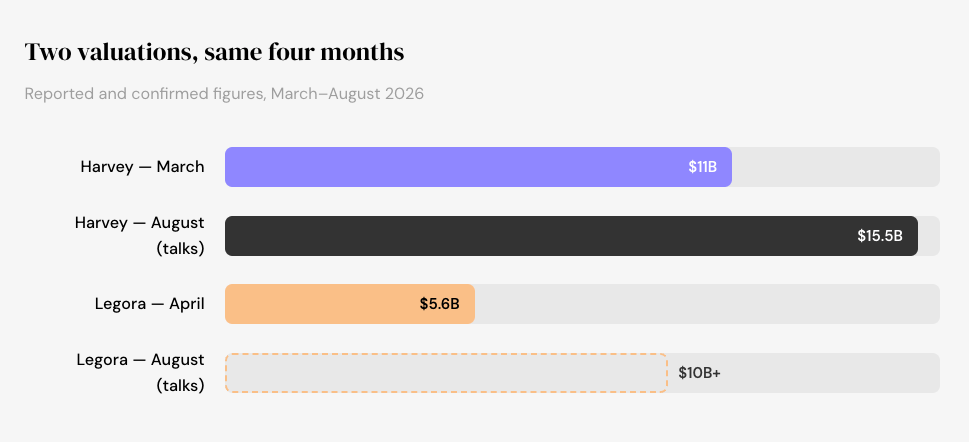
Legora is said to be in talks to raise at more than $10bn, up from the $5.6bn mark this briefing tracked in April. Harvey, which closed $200M at $11bn in March, was separately reported on August 7 to be in talks for $500M at $15.5bn, as its revenue passed $350M. Neither round has closed.
⚡ 02 Relativity gives lawyers a conversational interface over the whole matter
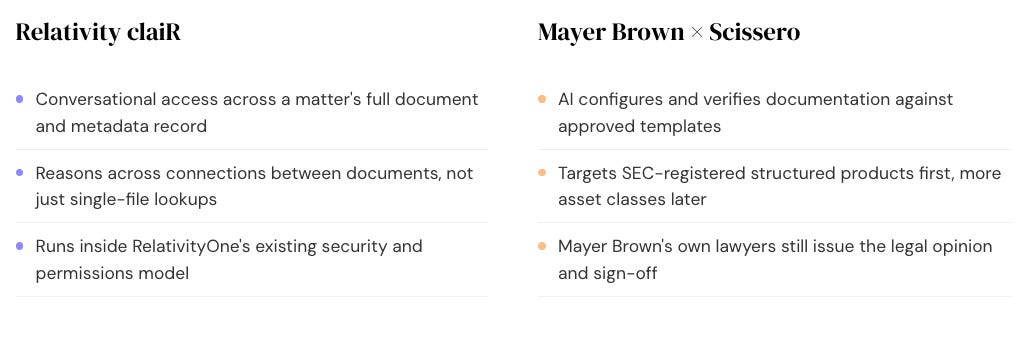
claiR extends Relativity’s aiR Assist from indexed document sets to the full depth of a matter, metadata and all, inside RelativityOne’s existing permissions. It is live in early access with A&O Shearman, Foley & Lardner and K&L Gates. General availability is expected in early 2027.
⚡ 03 Mayer Brown puts its own name behind an AI verification layer
The firm and Scissero launched a service that configures structured-products documentation on an automation platform and verifies it against approved templates, before Mayer Brown’s own lawyers sign off. It starts with US SEC-registered products.
⚡ 04 Harbor launches an AI implementation arm built only for law
Harbor Deploy embeds forward-deployed engineers and delivery leads inside law firms and legal departments, arguing that the deployment businesses OpenAI, Anthropic and Microsoft built this year were not designed for a profession where confidentiality and duty to the client are not negotiable.
🏗 05 The UK holds the launch webinar for its first AI regulatory sandbox, built for law
The Advisory AI Growth Lab, which opened applications on August 3, will give around a dozen legal services providers up to nine months of coordinated access to the SRA, the Legal Services Board, the Council for Licensed Conveyancers and the ICO. Applications close September 27.
Receive one hand-written article and our weekly briefing by subscribing below.
Harvey is reportedly in talks to raise $500M at a $15.5bn valuation, five months after its last round closed. Days later, Legora was reported to be chasing a valuation above $10bn, up from the $5.6bn it hit in April. Between them, the two platforms are discussing adding more than $9bn in paper value in under four months, a pace that says more about investor appetite than about anything a legal team can act on yet.
Harvey’s talks, first reported on August 7, follow a quarter in which the company says its revenue passed $350M, up from roughly $300M in May and $100M a year earlier. Neither round has closed, and neither company has confirmed the figures on the record. This is talks, reported by outlets covering the deal, not a signed term sheet. If it lands, it would be Harvey’s second valuation step-up this year, from $11bn in March to $15.5bn now.
Legora’s trajectory has moved on a similar clock. The company crossed $100M in ARR in April, roughly 18 months after launch, the fastest any enterprise software company has reportedly hit that mark, per Bessemer’s own tracking. A valuation above $10bn would nearly double the $5.6bn mark it reached the same month, when NVIDIA’s venture arm joined its Series D extension. Both companies are still, fundamentally, selling software that sits next to a lawyer and makes the lawyer faster. Neither round changes who decides what that lawyer still has to check.
The question worth asking. This capital is chasing model and workflow depth: faster drafting, more integrations, a bigger agent library. It is not chasing the question of who owns the routing decision once the software works as advertised. A $15.5bn valuation prices in every enterprise legal team eventually buying this kind of tool. It says nothing about who decides which piece of a matter an agent is trusted to touch, or who checks the output before it reaches the business. That is still, for now, an expensive in-house lawyer’s job. The same job all this capital is implicitly betting will eventually cost less.
On back-to-back days, two very different companies shipped products that expand what AI can reach inside a legal matter, and drew the same boundary around what it is allowed to decide alone.
Relativity’s claiR lets a lawyer ask natural-language questions across the full depth of a matter, not just the indexed document set aiR Assist already covered, but metadata and the connections between documents too, without the data leaving RelativityOne’s existing permissions. It is running in early access at A&O Shearman, Foley & Lardner and K&L Gates, with general availability expected in early 2027 at no added cost within RelativityOne’s integrated pricing. The lawyer still has to ask the question and read the answer. claiR widens the aperture, it does not remove the reader.
Mayer Brown’s arrangement with Scissero draws the line in a different place but lands in the same spot. Client documents get configured on an automation platform, then verified by Scissero’s AI against approved templates and parameters, the kind of matching work a junior associate would otherwise do line by line on a structured-products issuance. What does not change is who signs: Mayer Brown’s own lawyers still provide the legal opinion the client is actually paying for. The service starts with US SEC-registered products and is expected to extend to exempt offerings, European products and defined-outcome products later.
The same week, Aloi raised $7M to build a “Judgment Graph” that captures how a firm’s own lawyers reasoned through past matters. That is a bet that the valuable thing to automate is not the sign-off itself, but making the firm’s accumulated judgement reusable by whoever handles the next similar case.
The question worth asking. Both products widen what AI can see inside a matter and leave the sign-off exactly where it was. If the boundary never moves, the software gets cheaper and faster while the expensive part of the process stays fixed. What would actually have to change for that boundary to move, and who inside your team has the authority to move it?
OpenAI, Anthropic and Microsoft each spent 2026 building businesses that embed their own engineers inside client organisations, to get enterprise AI from pilot into daily use. On August 10, Harbor built the same thing for one industry only.
Harbor Deploy embeds forward-deployed engineers and delivery leads directly inside law firms and corporate legal departments, under what Harbor Labs managing director Justin Hectus calls an “Advise, Implement, Manage” model. The pitch is specific to law: general-purpose deployment teams, Harbor argues, are not built for a client relationship where confidentiality, professional judgement and duty to the client are non-negotiable constraints rather than compliance line items. It is the first offering of its kind built exclusively for legal, arriving into a deployment market the frontier labs effectively created this year by proving that shipping a capable model is not the same as getting it used.
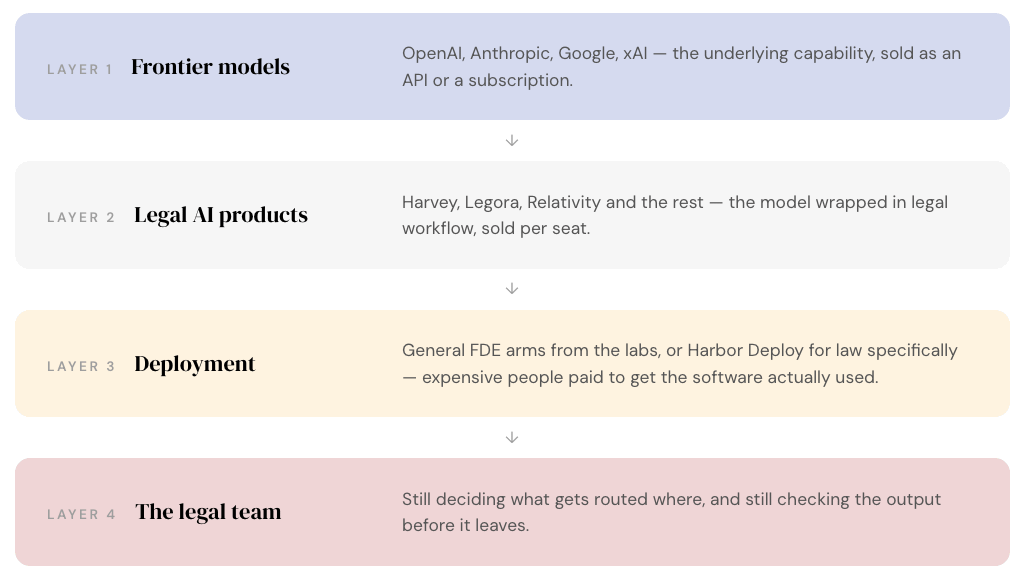
The question worth asking. Getting AI into daily use still means paying skilled people, now embedded on-site instead of billing by the hour, to do the last-mile work of making an agent trustworthy for one task at a time. That is a legitimate business. It is also, structurally, another expensive resource solving a routing problem, just with a headcount answer instead of a software one. Once the agent is deployed, who is actually checking its output before it reaches the client: the forward-deployed engineer, or someone at the client with the authority to escalate?
A regulatory sandbox is usually a fintech instrument. This one launched with legal services and conveyancing as the sole pilot sector, and an explicit goal of making legal work “faster and more affordable.”
The Advisory AI Growth Lab opened applications on August 3 and held its launch webinar on August 10. Around a dozen participants, covering legal services providers, legal tech firms and conveyancing companies, will get up to nine months of coordinated, free access to the Solicitors Regulation Authority, the Legal Services Board, the Council for Licensed Conveyancers and the Information Commissioner’s Office, to work out how existing rules on client confidentiality and data protection actually apply to the AI they are already building. No grant funding is attached for participants. Applications close September 27.

The government’s own framing is unusually direct for a regulatory announcement: the goal is to “improve access to justice for the public by enabling high-quality, faster and more affordable legal services.” That is a government acknowledging, in its own policy language, the exact mismatch this briefing keeps coming back to. Inexpensive work is currently done by expensive resources, priced out of reach for anyone who is not already paying for it, and the bottleneck is not whether the technology works.
The question worth asking. If regulators already agree the problem is cost and access, not capability, what is actually stopping wider adoption today? Not the models. The routing infrastructure, meaning who decides what gets automated, on what terms, with what escalation path when it is wrong, is precisely what a nine-month advisory programme can clarify permission for, but cannot build.
Capital is chasing depth, not ownership. Harvey and Legora’s funding talks price in more software: faster drafting, deeper integrations, a wider agent library. Between them the two platforms are discussing more than $9bn in fresh paper value in under four months. Neither round touches who supervises what the software produces, or who carries the risk when it is wrong.
Deployment is now its own market. Harbor followed the frontier labs into embedded engineering. The shape of the offer is telling: expensive people, now on-site rather than billing by the hour, still needed to get inexpensive tasks moving. When the answer to an adoption problem is headcount, the adoption problem is structural, not technical.
Every vendor keeps the human at the end. claiR and the Mayer Brown and Scissero service both expand what AI touches while leaving the sign-off exactly where it was. That is a deliberate, defensible choice. It is also the clearest signal in the week that nobody in the market has yet built the thing that would let the boundary move safely.
Regulators are quietly agreeing with the thesis. The UK built its first AI sandbox around legal services because the work is priced out of reach, not because the technology is not ready. When the policy language names cost and access as the problem rather than capability, that is a regulator conceding the bottleneck sits in how work is routed and supervised, not in the models.
Take the week’s threads together and they point the same direction. More capable models, a new deployment layer, and two products that each widen what AI can reach inside a matter. None of it changes who currently decides what gets automated and who checks it before it goes out. That is still an associate, a partner, or a newly embedded forward-deployed engineer: expensive people, doing the routing work by hand, because the infrastructure to do it otherwise does not exist yet at most legal teams.
That is the gap Flank is built to close. Outsourcing routine legal work to supervised agents means the routing decision, meaning what goes to an agent, on what terms, with what escalation path, is built once, into the system, rather than re-made by a person every time a matter crosses a desk. The agent knows the templates and the terms. A human still reviews the output before it leaves. Nothing shipped this week replaces that model. Most of it, read carefully, is still waiting for someone to build it.
✳️
No posts
Comments
Nothing yet. Say the first thing.
Sign in to join the conversation.