
⚡ 01 Harvey acquires Benchmark, its third deal of 2026, to deepen its push into asset management
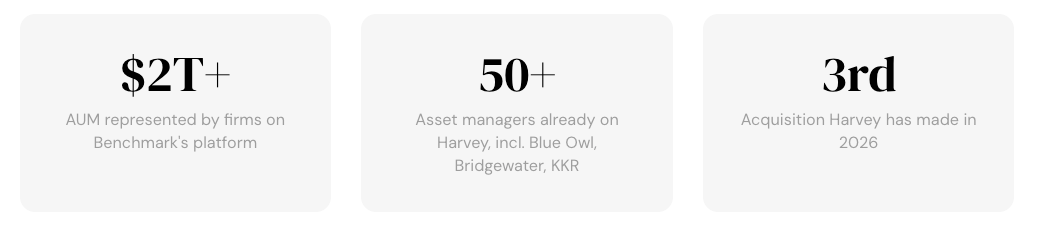
Harvey acquired Benchmark on July 16, a “decision infrastructure” platform used by firms representing more than $2 trillion in assets under management. Benchmark’s co-founders join Harvey’s product and engineering team. Harvey already serves 50-plus asset managers, including Blue Owl Capital, Bridgewater Associates and KKR.
⚖️ 02 The Arizona Court of Appeals rules that citing AI-fabricated cases is sanctionable, even without a lawyer involved
A self-represented litigant in a probate dispute admitted using generative AI without checking the results: two of eight cited cases did not exist. The court held that both attorneys and self-represented litigants can face contempt, dismissal, fines or fee-shifting, regardless of intent.
🏗 03 China’s new AI agent rules take effect, forcing ByteDance and Alibaba to shut down companion agents
The Interim Measures for the Administration of AI Anthropomorphic Interaction Services, issued jointly by five central government bodies, require anti-addiction systems, usage warnings and instant-exit mechanisms for any AI built to sustain an ongoing relationship with a user. Rather than retrofit the feature, Doubao and Qwen simply switched it off.
⚡ 04 Meta’s Louisiana data centre investment reaches $50B, up from $10B less than two years ago
The Richland Parish campus expands to nearly 10 million square feet and 5 gigawatts of capacity, becoming one of the largest data centres ever built. Meta’s own commitment has risen from $10B (2024) to $27B (October) to more than $50B now.
🏗 05 Illinois signs the first US law requiring independent third-party safety audits of frontier AI
Governor JB Pritzker signed SB 315, the Artificial Intelligence Safety Measures Act, with broad bipartisan support. It applies to the largest AI developers, requires public disclosure of safety practices and “catastrophic risk” frameworks, and creates whistleblower protections. Takes effect January 1, 2027.
Share the latest news with your colleague:
Harvey has spent three years building the deepest brand in legal AI. On July 16 it announced the acquisition of Benchmark, a “decision infrastructure” platform that pulls a private investment firm’s scattered deal memos, financial models, emails and legal documents into one searchable system, used today by firms representing more than $2 trillion in assets under management. Benchmark’s co-founders, Alec Dunn and Connor Janson, join Harvey’s product and engineering organisation. Terms weren’t disclosed, but the strategic logic is not subtle: Harvey already works with more than 50 asset managers, including Blue Owl Capital, Bridgewater Associates and KKR, and this is its third acquisition this year alone.
What Benchmark does for a private-markets analyst is structurally the same job a legal AI copilot does for a lawyer: it makes an expert faster at reading, screening and summarising the material already sitting on their desk. It does not remove the deal-memo drafting or portfolio-monitoring task from anyone’s queue. Harvey’s own product suite tells the same story at scale. Agent Builder, its self-serve tool for constructing custom multi-step agents, still hands the configuration work to the buyer’s own team, and its per-seat pricing (roughly $1,000 to $1,200 a month per user) sits squarely in software-budget territory. Three acquisitions in a year builds a wider surface of tools. It doesn’t, on its own, change who does the underlying work.
The Flank read. Harvey is executing the textbook response to inexpensive work being done by expensive resources: it is buying more tools to hand to the expensive resource. That’s a reasonable growth strategy for a $200M-ARR software company, and Benchmark’s underlying product is a genuine improvement for the analysts who use it. But it is still the assistant model, applied to a new desk. The lawyer, or the analyst, opens the tool, gets a faster answer, and does the work themselves. The bottleneck doesn’t move. It gets a better interface. Flank’s bet is different in kind, not degree: agents that execute the workflow end-to-end, under a supervision model built as core product rather than assembled from acquisitions. The acquisition that matters isn’t a new tool for the desk. It’s the work leaving the desk entirely.
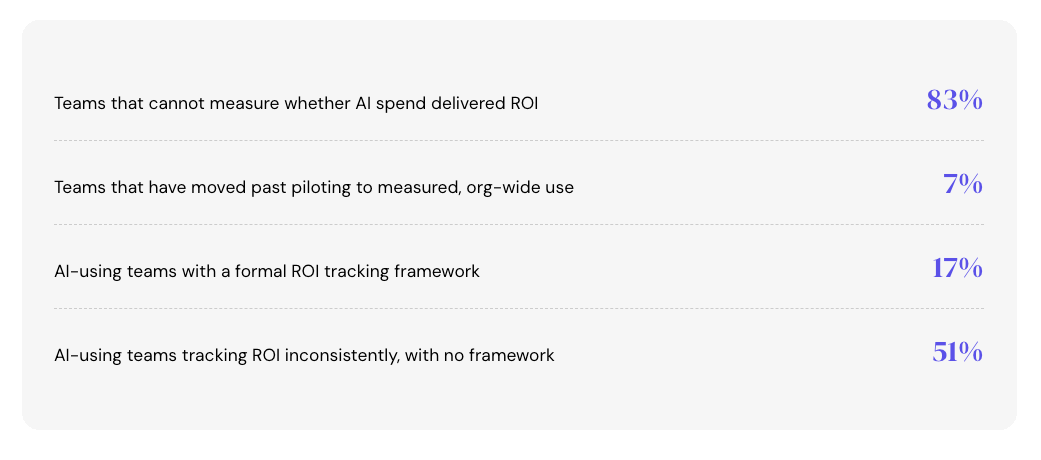
Two stories this week describe the same adoption curve from opposite ends. Axiom’s 2026 In-House Legal AI Report, based on a survey of 528 legal leaders across six countries conducted by InsightDynamo, found that 83% of in-house teams cannot say whether last year’s AI spending actually paid off, and that just 7% have moved past piloting into organisation-wide, measured use. Only 17% of AI-using teams track ROI against a formal framework at all: 51% track it inconsistently, without one. Where AI is delivering measurable value, it concentrates in a narrow band of high-volume, document-heavy tasks: legal research, contract review, document summarisation. That is exactly the templated, repeatable work this briefing keeps returning to.
The same week, the Arizona Court of Appeals ruled on a probate dispute over the estate of a woman who died in 2023, in which a self-represented litigant admitted using generative AI without verifying the results: six of eight cited cases were deficient, two didn’t exist at all. Writing for a unanimous panel, Judge Brian Furuya rejected any suggestion that lack of intent should excuse it: “To accept a defense of lack of ill intent would legitimize reckless indifference to the truth and accuracy of court filings.” The ruling extends a body of sanctions case law this briefing has tracked for months (New York, Oregon, Mississippi, the Ninth Circuit) to a new category of user entirely: the self-represented litigant, the exact population MIT and USC found producing AI-generated writing in 18% of federal filings.
The Flank read. Put the two stories together and they describe the same missing layer from opposite directions. Axiom’s numbers are the demand-side version of a pattern this briefing has cited before in different clothing: teams adopt AI fast, and the spend keeps rising, but the organisation still can’t show the work costs less or gets done better, because nobody built the measurement and supervision infrastructure alongside the tool. The Arizona ruling is what happens at the other end of that same gap, when there is no verification step between an AI’s output and a court filing. Both are the same argument: access to AI is not the constraint any more, and hasn’t been for a while. The constraint is a governed system that turns access into a measured, supervised outcome. That is exactly why Flank prices itself on the outcome delivered, not the licence sold, and why every agent workflow runs through human review before anything leaves the system. The 7% who’ve scaled AI and the courts sanctioning the 93% who haven’t verified it are describing the same missing infrastructure.
Illinois and China regulate almost nothing else the same way. This week they converged on one idea: that an AI system acting with some autonomy, whether a frontier model reasoning about catastrophic risk or a companion agent sustaining a relationship with a user, needs a check that isn’t the vendor marking its own homework. On July 6, Governor JB Pritzker signed Illinois SB 315, the Artificial Intelligence Safety Measures Act, making Illinois the first US state to require regular independent third-party safety audits of the largest AI systems, with penalties up to $1M for a first violation. On July 15, China’s Interim Measures for the Administration of AI Anthropomorphic Interaction Services took effect, forcing ByteDance’s Doubao and Alibaba’s Qwen to shut down personalised companion agents used by hundreds of millions rather than retrofit the anti-addiction and instant-exit mechanisms the rules now require.
Illinois SB 315 targets the largest frontier AI developers with more than $500M in revenue, requiring independent third-party safety audits and whistleblower protections, effective January 1, 2027. China’s measures, issued by five agencies, target AI agents built to sustain an ongoing relationship with a user, requiring mandatory anti-addiction systems, usage warnings and instant-exit mechanisms, effective July 15, 2026.
Neither rule was written with enterprise legal AI in mind. One targets catastrophic-risk disclosure at the frontier-model layer, the other targets consumer companion products. But both share a premise that is directly relevant to how legal departments will be asked to procure AI going forward: that autonomy without independent verification is the thing regulators are now moving to close off, wherever they find it. Gartner has already said the general counsel should be asserting AI governance leadership inside their own organisations. ModelOp’s tracking shows AI governance-platform adoption jumping from 14% to 50% of enterprises in a year. The direction of travel, in two very different legal systems in the same week, points the same way.
The Flank read. This is the environment Flank’s model was built for, not a threat to it. Supervision that’s assembled after the fact, through a partnership with a governance vendor bolted onto someone else’s product, is a different claim from supervision that’s native to the product from day one. Harvey’s governance today runs through partnerships: Intapp for ethical walls, Aderant for billing. Flank’s supervision is the core product: tenured legal professionals reviewing every agent workflow before it reaches the business, under whichever of three models the client chooses (their own lawyers, a partner firm, or Flank’s own supervision team). As “was this independently audited” becomes a procurement question rather than a nice-to-have, the vendors who can answer it structurally, not contractually, are the ones left standing.
Every legal AI product this briefing covers is a wrapper around someone else’s model, and every one of those models runs on someone else’s chips. TSMC reported record Q2 2026 results on July 16: net profit up 77.4% year-on-year, revenue of $40.2B, gross margin at 67.7%, and its high-performance-computing segment, the AI-accelerator business, now 66% of total revenue, up 20% in a single quarter. CEO C.C. Wei used the moment to announce a further $100B investment in Arizona, bringing TSMC’s total committed spend in the state to $265B. The same week, the US Commerce Department reclassified the UAE into its highest trust tier for chip exports, clearing licence-free sales of Nvidia and AMD’s most advanced accelerators and accelerating the $30B, 5-gigawatt Stargate UAE compute campus in Abu Dhabi.
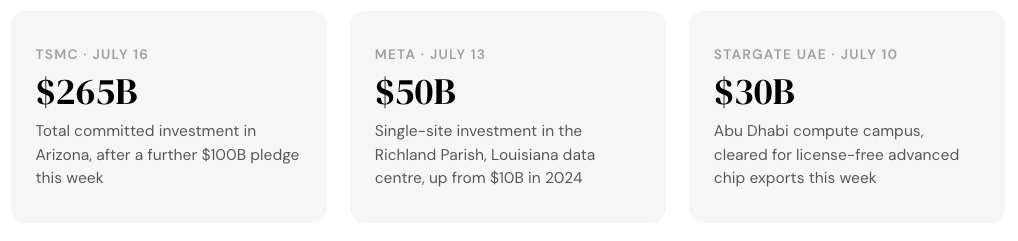
None of this capital is being deployed cautiously. TSMC’s own numbers show why: 66% of its revenue now comes from the chips that power AI, and its gross margin is climbing because it holds roughly three-quarters of the global advanced foundry market. Every legal AI vendor’s cost base, and every enterprise buyer’s exposure to that cost base, sits downstream of a supply chain this concentrated.
The structural question for enterprise legal teams. The volatility at the model layer (Gemini’s rebuild, Grok’s aggressive pricing, GPT-5.6’s release) sits on top of an infrastructure layer that is consolidating around a handful of chip and compute suppliers, not diversifying. If the model your legal AI vendor licenses today is replaced, re-priced, or capacity-constrained by decisions made in Taipei, Washington or Abu Dhabi, does your contract, or your workflow, survive that switch? A vendor-neutral supervision layer is worth more the more concentrated the layer underneath it becomes.
Last week’s briefing covered Harvey’s own disclosure that its token processing had grown 14x in six months, with a single large contract review capable of generating a $20,000 compute bill. This week, xAI shipped Grok 4.5, pricing it at $2 per million input tokens and $6 per million output tokens, by some estimates three to four times cheaper than Claude Opus 4.8, while claiming roughly double the token efficiency of comparable models on agentic coding tasks. It scores 83.3% on Terminal-Bench 2.1 and 64.7% on SWE-Bench Pro, putting it in genuine contention with the frontier rather than trailing it. Google, meanwhile, is expected to ship its own rebuilt Gemini 3.5 Pro today, closing the loop on the architectural scrap-and-rebuild that wiped $225B off Alphabet’s market cap two weeks ago. As of publication, though, Google has not confirmed the specifications circulating in developer previews, including a reported 2-million-token context window and a “Deep Think” reasoning mode gated to a $250-a-month tier.
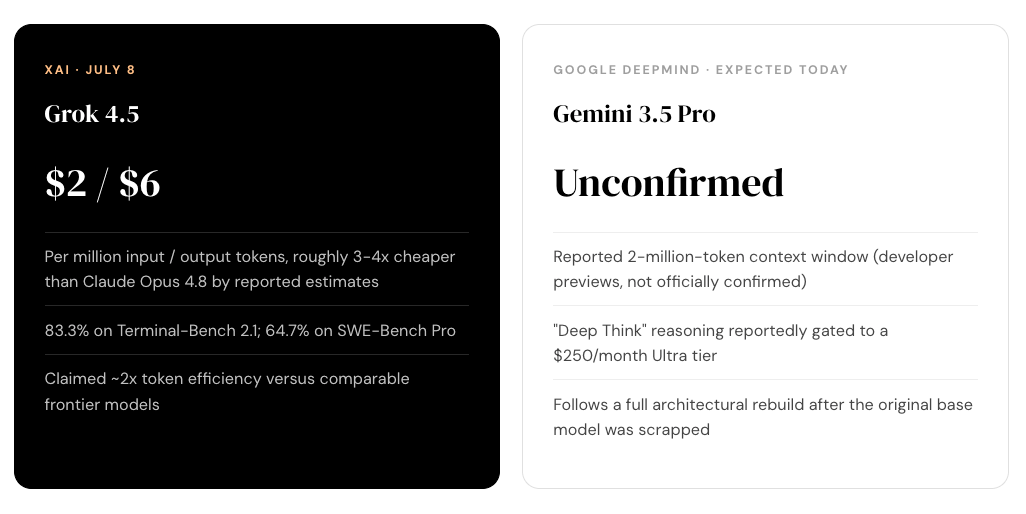
The structural question for enterprise legal teams. If a frontier lab can price a competitive model at a fraction of what another lab charges for comparable capability, the marginal cost of the intelligence underneath your legal AI tools is falling faster than most vendor contracts reflect. Does your legal AI vendor’s pricing move when the frontier model underneath it gets cheaper, or does the saving stay in the vendor’s margin while your renewal quote holds flat? A flat SaaS fee has no mechanism to pass that through. A model that prices on outcomes, not licences, has every incentive to.
A software vendor buying its way into a new vertical, a survey confirming most legal AI spend still can’t prove its worth, two governments writing independent audits into law, and hundreds of billions of dollars committed to the chips and data centres underneath all of it: none of these stories mention each other, and all of them are describing the same market. Intelligence is getting cheaper and more available by the week. Oversight of that intelligence is becoming a legal obligation, not a competitive nicety. And almost nobody buying AI for legal work today can show, with real numbers, that the work now costs less or gets done better than it did before.
Tools consolidate, but the work stays on the same desk. Harvey’s third acquisition this year widens its product surface without changing who does the underlying work: the assistant model, applied to a new desk.
Intelligence gets cheaper, and there’s no mechanism forcing that saving through to you. Grok 4.5’s aggressive pricing and Gemini 3.5 Pro’s imminent rebuild both point toward falling marginal costs at the frontier, with no mechanism forcing that saving through to the enterprise buyer on a flat SaaS contract.
Oversight becomes law. Illinois and China, independently, in the same week, moved to require independent verification of AI systems operating with autonomy. It previews what legal AI procurement will soon demand.
The ROI still isn’t there. 83% of in-house teams can’t prove their AI spend worked. Courts keep sanctioning the output of AI nobody checked. Access was never the hard part.
Every thread in this week’s briefing is a variation on the same mismatch: inexpensive work is being done by expensive resources, and cheaper, more capable, more heavily audited AI does not, on its own, close that gap. Falling frontier-model prices and hundreds of billions in new compute make intelligence more abundant. New audit laws in Illinois and Beijing make unverified autonomy more legally exposed. Neither one touches the actual constraint Axiom’s survey just put a number on: 83% of legal teams still can’t show the work costs less, because access to a tool was never the same claim as the work done and proved it.
Harvey’s answer is to keep buying tools. Ours is structural: tools are a commodity, outcomes are not. Flank competes for the budget line where routine legal work already sits, not only a new software line, but the ten-to-fifty-times-larger services spend on outside counsel, ALSPs and internal headcount doing templated, repeatable work. Agents execute it under your playbooks, a human reviews every output before it leaves the system, and you don’t pay until the first workflow is live in production. As audits get written into law and frontier pricing keeps shifting under every vendor’s feet, that’s the one part of this week’s news that doesn’t change: insource the work to supervised agents, and the ROI question Axiom’s survey couldn’t answer stops being the open question it is for everyone else.
✳️
No posts
Comments
Nothing yet. Say the first thing.
Sign in to join the conversation.