
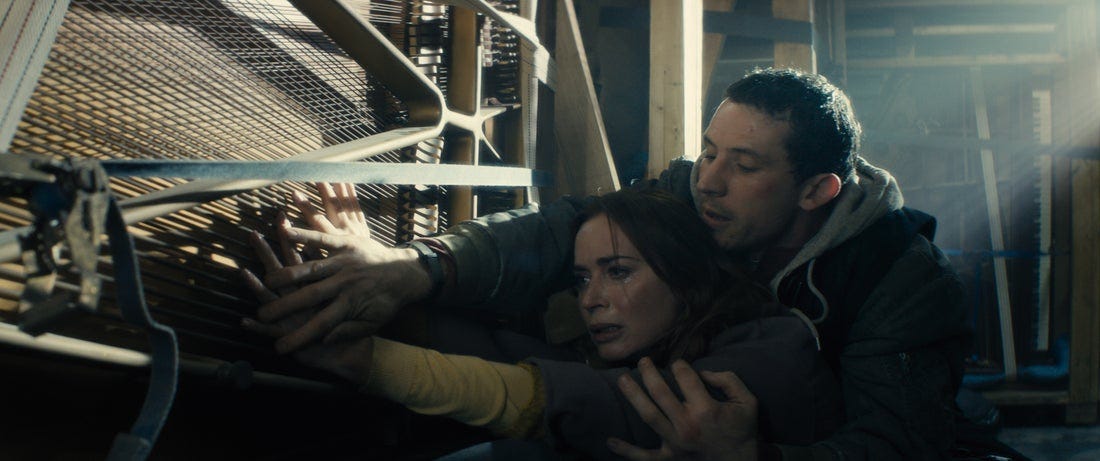
Early in Steven Spielberg’s alien action thriller Disclosure Day, Kansas City Weatherwoman Margaret Fairchild (Emily Blunt), shaken after an encounter with a supernatural CGI bird, speeds to work to Gwen Stefani’s 2006 hit “The Sweet Escape”. It’s a song choice that’s as indicative of the film’s bizarro tonal melange as it is surprisingly on the nose. Disclosure Day is unabashedly messy, chock full of abrupt generic shifts and absurdist leaps of logic (I lost count of how many times characters say “why am I doing this?”), a stream of ideas stitched together by the magic of the movies, its fraying seams on full display. Grafting an escapist fantasy of Americana onto our spiritually corrupt present, the film clings to the nostalgic fantasy of a world that “made sense”, where monoculture never dissipated, everyone still watches local news, the truth could change minds, and we surrendered to wonder, probably in the form of Spielberg movies scored by John Williams.
So yes, times in Disclosure Day indeed are “a little crazy” (impending nuclear war with North Korea, DEFCON 2), and although she doesn’t know it yet, Margaret’s story, and that of her fellow “experiencer” Daniel Kellner (Josh O’Connor), is hurtling towards a literal recreation of her world. In an abandoned midwestern warehouse, a rogue defense-tech contractor (and blatant directorial stand-in), Hugo Wakefield (Colman Domingo), has erected a meticulous reconstruction of her childhood home, curating the perfect conditions for Margaret and Daniel to re-experience a shared foundational trauma: an alien abduction.
Margaret and Daniel’s childhood encounter with the beyond, a meta-cinematic one that turns Margaret into an empathy machine and Daniel into a formalist wizkid, makes them particularly useful to the project of disclosure, the leak of confidential videos confirming the existence of extraterrestrial beings. Daniel, who is on the lam with his girlfriend Jane (Eve Hewson), is in possession of the leaked files. Their flimsy relationship, more an excuse for Jane, a devout Christian and former novitiate, to have a spiritual crisis, at least provides one of the film’s most thrilling setpieces, a body-swap murder attempt in a rural safehouse. A few states over, Margaret’s alien powers are activated on-air. The clip of her speaking in alien-tongue on the morning news catches the eyes of both Wakefield and the FBI, sending her on an impromptu search to find Daniel. When the pair finally converge, Spielberg also grants us one of the year’s most thrilling action sequences as the pair perform a bravura stunt jumping from a totaled vehicle onto the side of a train car.
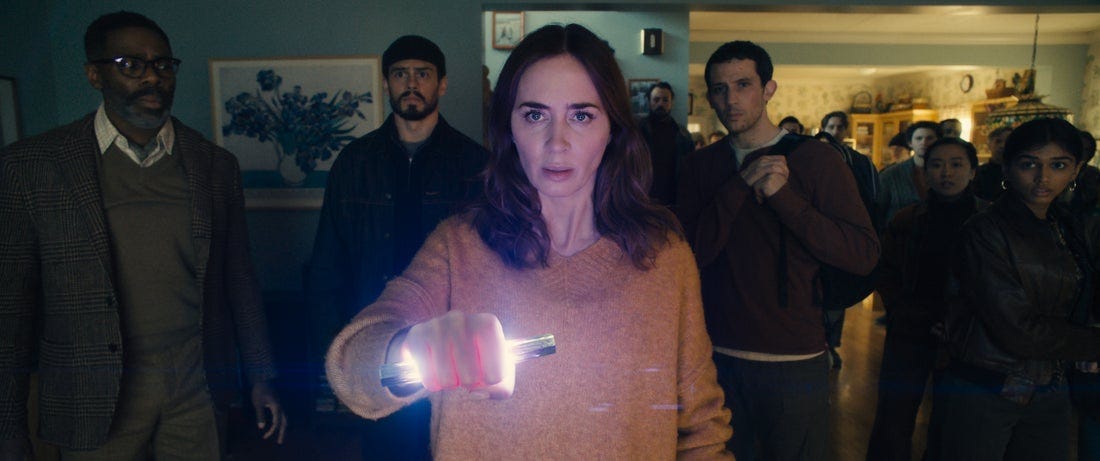
Pursued by the military industrial complex on their extended collision-course, Margaret and Daniel find themselves in a dual-pronged chase without beginning or end. There’s something charming and occasionally exhausting about the haphazard way Spielberg and screenwriter David Koepp fling their characters from one scenario to the next without concern for continuity or credulity (see: Margaret and David miraculously escaping a military complex via her ability to morph into images of their adversaries’ loved ones, a inexplicably random crop circle), but it’s also this messiness that gives the film its live-wire excitement. Emily Blunt’s fantastically heightened performance, which spontaneously shifts from bubbly midwestern affability to abnegating empath is perfectly suited to this film’s gleeful, deeply-felt rampage.
With its in medias res opening and cliffhanger ending, the palpable absence before and after Disclosure Day applies to the film’s general disposition towards the unknown. We never learn about the mechanics regarding the array of alien powers (telepathy, body possession, electricity generation, Solaris-esque impersonation), nor is it even clear how the ultimate disclosure is meant to happen until it’s directly in front of us. Spielberg and Kaminski frequently deploy conspiratorial camerawork, swirling the camera from extreme close-up, to medium shot, to overhead long shot, a progressive pulling of the curtain that reaches the edges of the flimsy diegesis. Much of the film, its tension between reality and fantasy, its sweaty, desperate layering of temporalities, could be described by the confrontational dynamic between Janusz Kaminski’s sterile digital photography, all blue-tones, flared lenses, and De Palma-esque glasswork, and the classically Spielbergian emanations of light, undulating amber signifiers of childlike wonder. As much as Disclosure Day is about how the unknown will change the world for the better, it’s also defined by its creator’s unwillingness to face the present, with its corrupt image economy and even more uncertain future. It’s never less than obvious that the film’s central revelations, which pointedly play on Abu Ghraib, but also recall everything from Wikileaks to the Epstein files, won’t stir an empathy epidemic, nor does such a liberal platitude towards empathy actually inspire much hope for structural change. Therein lies the film’s tragedy.
That central tragedy throws into question the film’s insistence on the necessity of disclosure, which feels less about truth than child-like cinematic wonder. To that effect, the most troubling sequence in the film constitutes a directorial self-indictment. Whisked into a set-version of Margaret’s childhood home, she and Daniel are coerced by Wakefield into a film-within-a-film, reliving their adolescent trauma to advance the disclosure agenda. Lured into the forest by a variety of woodland creatures, the children’s repressed memory is portrayed as a thinly veiled instance of sexual assault (the film’s most resonant comparison is actually Araki’s Mysterious Skin). Here, as in the brief snippet of the torture video Daniel shows Jane, the cinematic metaphor of the alien is used not as empathy machine, but as avoidance. The spectre of these real-world tragedies hangs over the film’s final movement, a faux-triumphant vision of collective salvation by cinema. The film’s final plea to listen is genuinely despondent. To quote a more timely song, nothing’s going to save us, not music, not fashion, and certainly not film.
Disclosure Day is distributed by Universal and in theaters now.
Comments
Nothing yet. Say the first thing.
Sign in to join the conversation.