
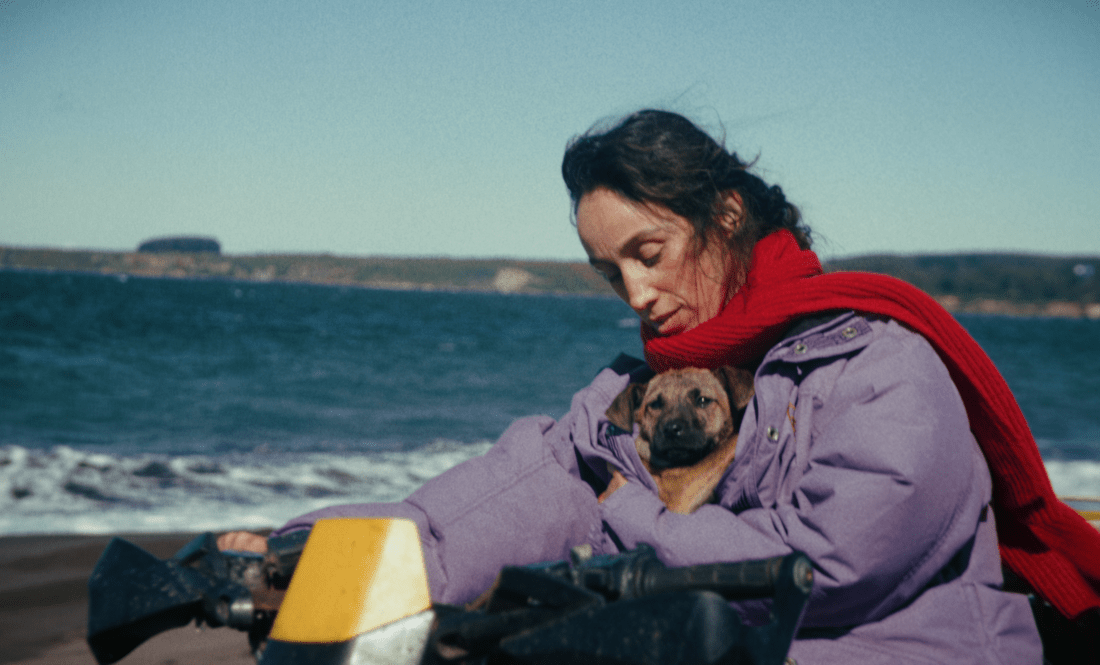
A brittle character study cum landscape film disguised as a drama about a woman and her dog, Dominga Sotomayor’s La Perra is both perfectly judged and ravishingly beautiful. Set on a remote island in the South of Chile, the film is situated within a community of seaweed harvesters, one of whom, Silvia, has her regimented lifestyle disrupted when she rescues an abandoned puppy that washes up on the coastline. The approach and milieu evoke everything from Epstein’s Finis Terrae to Rossellini and Antonioni, the emotions stirred by the woman’s mercurial relationship with the animal articulated through the turbulent landscape of rocky, windswept cliffs and crashing waves.
By eschewing character psychology, Sotomayor’s film sidesteps nearly all of the pitfalls of its potentially saccharine premise. Her matter-of-fact approach to narrative gives e.g. Silvia’s brief separation from her husband with the same weight as any process-oriented scene of seaweed harvesting. Despite their complex bond, there are few scenes of Silvia talking to the dog, and even fewer that manipulatively anthropomorphize Yuri. Even in the rare instances where Sotomayor takes Yuri’s point of view, such as an indelible digression where she runs into a group of wild horses, the dog is treated as alien and unknowable.
La Perra hinges on Yuri’s disappearance. An initial search mission takes Silvia into a cave. There, her sobs dissolve into an image of a tremulous stream dripping onto the cliffside. The flashback precipitated by Yuri’s disappearance is only obliquely related to the narrative, depicting not Silvia’s evident but unspoken struggles to have a child of her own, but instead a childhood trauma that expands our understanding of the island, its relation to the outside world, and Silvia’s tenuous place in the community. When Yuri returns with pups of her own, Silvia’s unrequited love rapidly curdles, her smoldering emotions intensified by Oyarzún’s recessive performance. Despite its stony surface, La Perra is seductively open-ended, a sensory bath of rural life and natural phenomena that progressively accumulates emotional force until the ocean itself catches fire.
La Perra premiered at the Cannes Film Festival on May 18th.
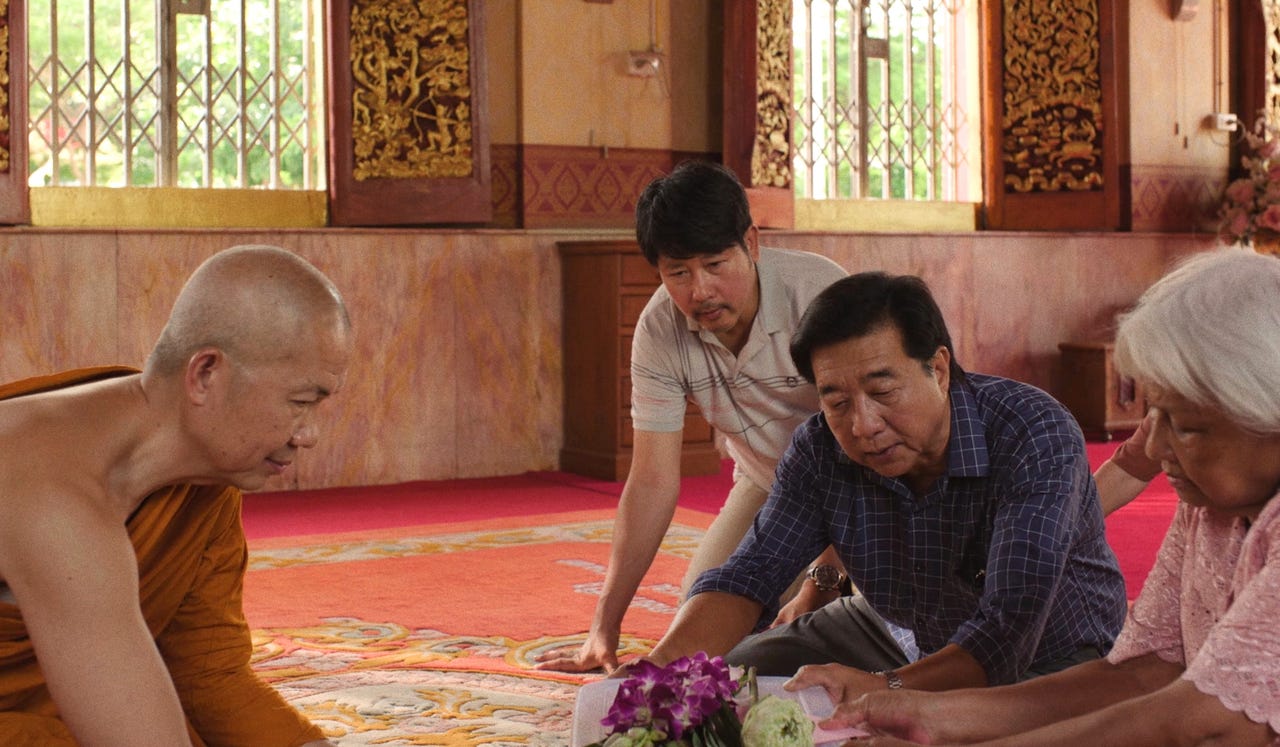
Like his documentary Railway Sleepers, Sampot Chidgasornpongse’s first narrative feature, 9 Temples to Heaven, initially takes a panoramic look at contemporary Thailand through a predefined structure. Told that the family matriarch may pass away before her upcoming birthday if she doesn’t make merit at nine temples over the course of a day, three generations of the Sirikritichai family converge for an extended pilgrimage.
The first half of 9 Temples broadly adheres to realism, the journey from temple to temple a pretense for the characters to tour a wide expanse of Thai architecture and discuss a broad range of issues. The feeling that the characters are mouthpieces for their specific generational backgrounds is often clunky, and improves as it becomes more observational and sensual. Spirituality is central as Sakol, whose boss convinced him to gather the family for this pilgrimage, inevitably clashes with his agnostic son, Tor, who refuses to take part in the Buddhist ceremonies. Since Grandma has little desire to visit the temples herself, Tor spends the film convincing the family to go home. When Sakol compares an incomplete journey to Grandma refusing to take her medicine, Chidgasornpongse expands the issue of spirituality to one of East vs. West, ancient vs modern.
These tensions surface in the merit ceremonies, where some temples have been refashioned to appeal to a modern audiences and nearly all leverage spirituality as a means to earn donations. At the second temple, a monk stresses the importance of mindfulness, warning against the temptations of a wandering mind while the camera glides upwards to marvel at the architecture. As if calling out the film itself, the monk asks if the group has drifted off, citing their behavior as the reason to pay for his new summer camps. These longueurs subvert the realist veneer, knocked loose by another of the grandchildren who breaks the fourth wall after confessing that private meditation clarified this world’s unreality.
From there, time and space begin to stretch. An extended shot of the sun being smothered by dark clouds invokes Syndromes and a Century and in the scrambled day/night cycles, there are sensual pleasures abound. Chidgasornpongse spends ample time watching glittering doorways, gold leaf fluttering in the wind, and farm animals passing through the night, the richness of the ambient noise and the stretching of time displaying Chidgasornpongse’s experience as Apichatpong’s longtime Assistant Director. At key moments, he pauses on close-ups of hands, stopping the film in its tracks to pinpoint moments of familial support. The film is ultimately unresolved about its spiritual quandaries (how could it not be?), but Chidgasornpongse’s aims are ultimately character-based, introducing us to this familial cross-section of Thailand and the intersecting forces governing their lives.
9 Temples to Heaven premiered at the Cannes Film Festival on May 19th.
Comments
Nothing yet. Say the first thing.
Sign in to join the conversation.