
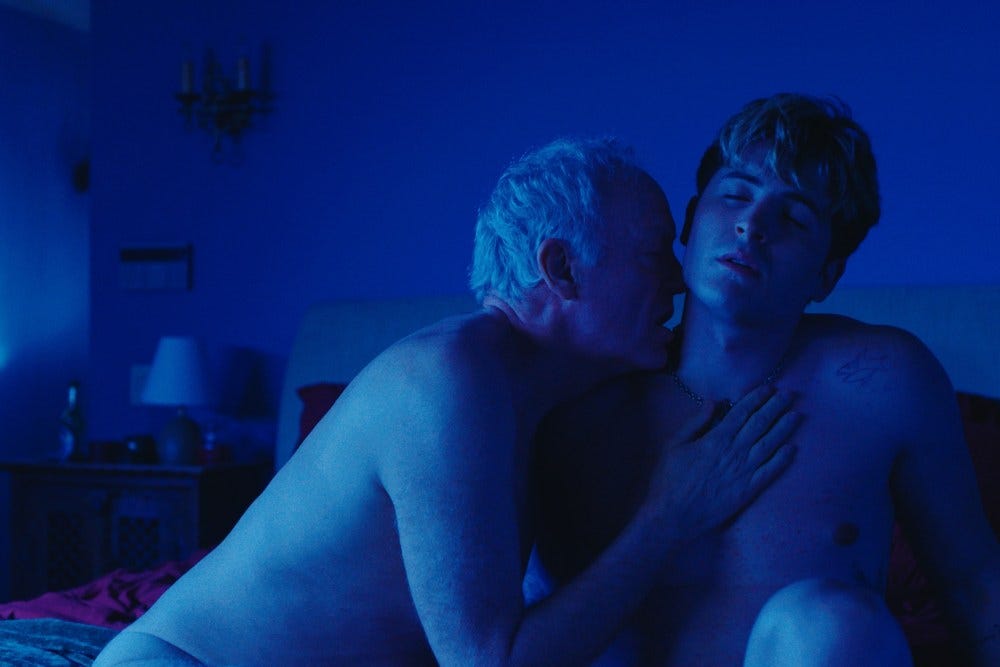
Though Elliot Tuttle is just 23 years old, his debut feature Blue Film feels like a gay film from a bygone era. This despairing chamber piece has the tortured heart of say, an early Tsai Ming-Liang film. It’s this anachronism that has found Blue Film an audience in an era where films like Pillion contort more “provocative” edges of gay subcultures into feel-good conventionality. Blue Film is a flawed, but interesting proposition, refreshing for its unfashionable negativity, but also one that exists purely in cinematic terms, a bit too out of touch and a bit too abstract to resonate.
This is ultimately a rather familiar American indie, a one-night-only conversation between two men of different generations. Aaron Eagle (Kieron Moore) is a 20-something cam boy, a cartoonishly masc findom who opens the film flexing his biceps and flaunting his ass for tokens on a stuttering livestream feed. We first see him from the perspective of his counterpart, a masked voyeur (Reed Birney) who initially might be an audience surrogate. This man has paid Aaron 50,000 dollars to spend the night with him, a transaction that takes a dark turn when he’s revealed to be Aaron’s former middle school English teacher, Hank Grant. Grant was fired from his job for assaulting another boy years later. After a stint in prison and a conversion to Christianity, he’s traveled from the pair’s hometown of Bedford, Maine to solicit his former student.
The ensuing conversation is a predictably thorny affair. Supported by two strong performances from Birney and Moore, it’s primarily interesting to see their fluctuations in vulnerability, when and how social performance kicks in as a defense mechanism. Underneath the myriad questions of nature vs. nurture, the pair’s differing attitudes towards sex, Blue Film’s central provocation is that these two characters’ perversions are borne of the same totalizing despair at the heart of gay culture. In a way, the title is very literal. Concentrating the world into this transient mid-century home, both characters are bathed in blue lighting. In addition to Aaron and Hank’s personal demons, the single-location setting is haunted by the memory of AIDS (see: Derek Jarman’s Blue).
If I have a primary qualm with Blue Film’s concept then, it’s that it does sort of feel old-fashioned. While watching, I had a consistent sense that our contemporary definition of queerness and queer cinema had moved past this sort of representation. The most contemporary aspect of the film involves the dialogue between an older and younger generation, and in that respect, there’s a problem with the character of Aaron Eagle, whose life outside of his online persona is never less than theoretical, and even in his more vulnerable moments, never registers as a believable portrait of a WeHo gay. His character (and the film overall) is suffocated by self-seriousness. It’s hard to imagine a gay guy who calls his audience his “faggots” like they’re a fandom would do so as earnestly as Aaron. Tuttle has frequently invoked Breillat’s Anatomy of Hell as one of Blue Film’s reference points, and whatever one may think of that film, it’s not just provocative in form and content, it’s also funny.
There actually is a really strange moment at the end of Blue Film, one that needs to be seen to be believed. After their night together, Aaron and Hank say their goodbyes on the steps leading into the AirBnb. There, completely unacknowledged, Hank recites multiple lines of Lana Del Rey’s “The Grants” as if it were regular dialogue. It’s one of the more random moments I’ve seen in recent memory. That the film refuses to have fun with it is indicative of its shortcomings.
Blue Film is distributed by Obscured Pictures and is available on VOD.
Comments
Nothing yet. Say the first thing.
Sign in to join the conversation.