
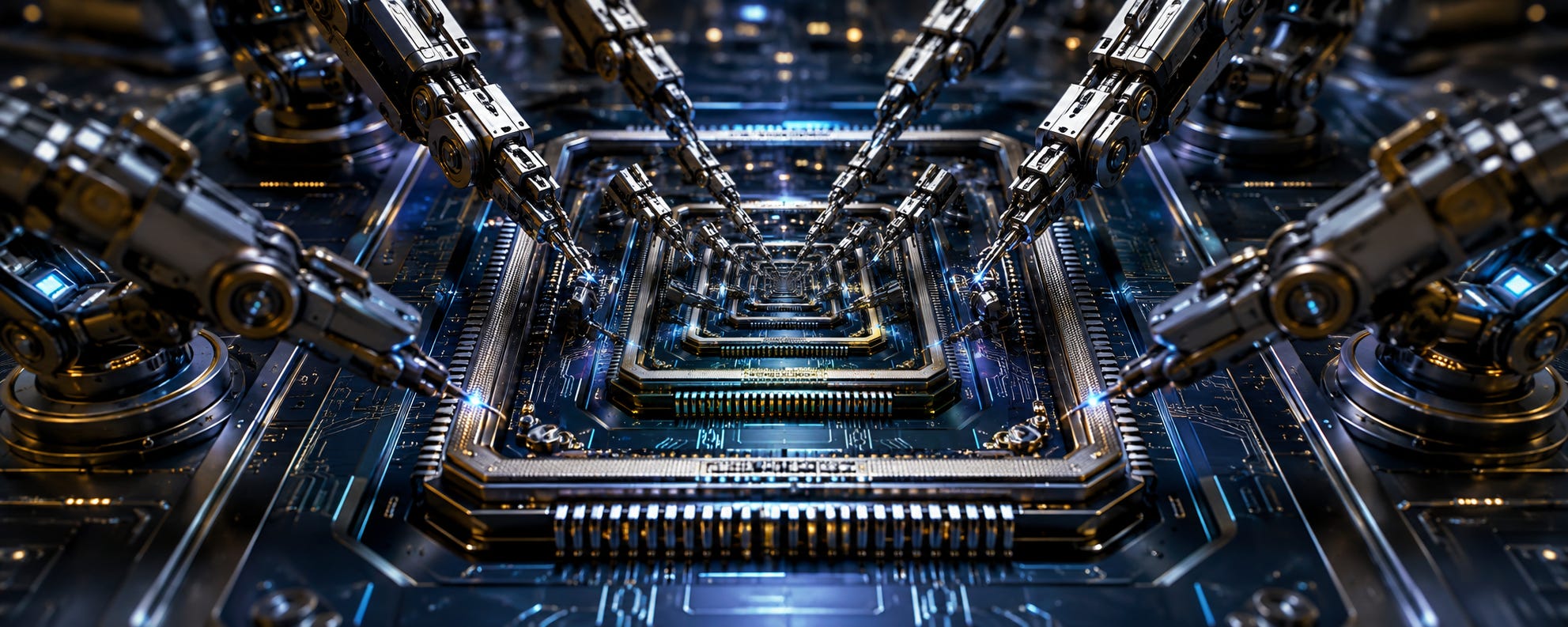
The Singularity has learned to write its own software, but the silicon it runs on has still needed a human design team, until now.
Chips began as the work of a few hands. Jack Kilby built the first integrated circuit in 1958. Federico Faggin led a handful of engineers to the Intel 4004 in 1971. In 1980, Mead and Conway wrote the rules down so any graduate student could design one, and in 1987 Morris Chang founded TSMC so anyone with a design could have it made. Manufacturing was democratized. Design was not. Only 14% of chip projects now reach first-silicon success, and three-quarters run late. A chip takes years and hundreds of millions of dollars, so new silicon has re-concentrated inside a few giants.
The deeper problem is a mismatch of clocks. An architecture freezes years before volume silicon, while the AI workloads it must serve change in months. Designers hedge with generality and pay twice, once for the hedge and again when the workload maps poorly onto frozen logic. With Moore’s Law stalling, specialization is one of the last great sources of performance per watt, but it is only worth capturing if the design cycle runs at the cadence of the workload.
Today, Architect Labs, a company I advise and one 021T Capital backs, is unveiling Redwood, the first AI accelerator designed, verified, and deployed end-to-end by an AI system. Two human architects wrote a high-level specification. From it, the system generated the performance model, RTL, UVM verification environments, formal proofs, firmware, drivers, and compute kernels, with no human intervention below the specification and no pre-existing or open-source IP. In under two weeks it closed every block at 95% code and functional coverage. The first RTL drop to an AMD Versal FPGA had zero bugs. A third week brought Qwen3 inference online, which the company demonstrated live at this summer’s Design Automation Conference.
AI has been inside the chip flow for years, so the word “first” has to be placed carefully. Google’s AlphaChip has placed TPU floorplans since 2020, one step inside a human flow. In 2023, NYU researchers taped out an 8-bit microprocessor designed by conversing with a chatbot, an engineer at the keyboard. EDA vendors promise 10x on individual tasks. Those were firsts of assistance. Redwood is a first of authorship. The whole stack came from one specification, and a modern model runs on the result. The one qualifier is that Redwood lives today on an FPGA, and its silicon numbers are projections calibrated from FPGA measurements. Projected onto Samsung 8 nm, the process class of NVIDIA’s Jetson Orin Nano, Redwood Nano runs the same model at 49 tokens per second against Jetson’s measured 28, at 1.3 W against 2.6 W, a 3.4x gain in performance per watt on 2.88 square millimeters.
The speed matters more than the score. Any change to the specification is regenerated, reverified, and redeployed to hardware in under 48 hours. A traditional chip program freezes its architecture early and defers every later idea to the next generation. Redwood never froze. At its peak, the design absorbed 115 merged changes in a single day. And the design did not stop with the humans. Qwen running on Redwood was exposed as an endpoint inside the AI system that built it, and the model found timing and kernel optimizations for its own operations. In 1965, I. J. Good imagined a machine designing better machines and called the result an intelligence explosion. He was thinking of software. The loop now reaches silicon.
Chang’s fabless industry let companies design chips without owning a fab, and NVIDIA, Broadcom, and Apple silicon were born of that split. Architect Labs CEO Ebrahim Hussain calls the next split the designless industry. A company brings its workload, and the chip is derived from it, the way a fabless company brings a design and wafers come back. The design team that used to be the gate becomes a specification. Architect Labs is already working this way with Fortune 500 partners, compressing programs that ran for months into weeks.
Custom silicon has been one of the scarcest goods in technology. The Z80 that ran a generation of home computers is credited to two designers, Faggin and Masatoshi Shima, who drew its circuits by hand in 1975. Arm’s IPO prospectus puts the design cost of a 2 nm chip at roughly $725 million, a sum only giants can spend. Redwood was specified by two people and designed by a machine. Every workload that matters deserves its own chip. Now it can have one.
The Singularity is now designing its own silicon. Learn more at architectlabs.com.
(Disclosure: I advise Architect Labs and hold a financial interest in 021T Capital, which has backed it. Informational only, not investment advice, nor an offer or solicitation of any security. Technical and performance figures are company-reported and unverified, and the silicon results are projections. Forward-looking statements involve risk.)
Comments
Nothing yet. Say the first thing.
Sign in to join the conversation.