
Most people assume feelings arrive after something happens.
An event occurs, the brain reacts, and emotion follows.
Neuroscience tells a different story.
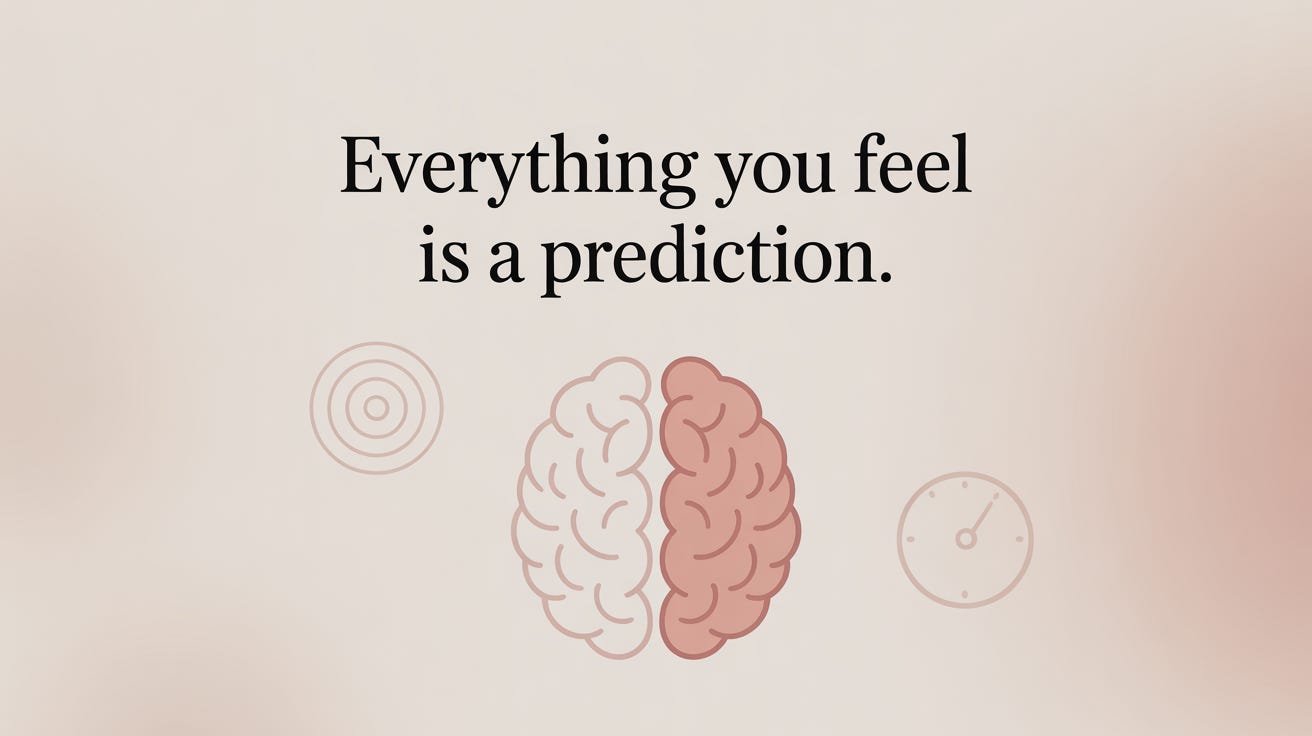
Much of what you feel is not a reaction at all.
It is a prediction made in advance.
Your brain is constantly forecasting what will happen next, what it will mean, and how your body should prepare. By the time you consciously notice a feeling, the prediction has already shaped it.
This is not a flaw in the system.
It is how the brain stays efficient and alive.
Your brain receives far more sensory data than it could ever process in real time. Vision, sound, touch, internal signals from organs, and signals about posture and movement all arrive at once.
Processing everything from scratch would be too slow.
Instead, the brain works like a forecasting engine. It uses past experience to predict what is most likely happening, then checks incoming information to see if the prediction was close enough.
Most of the time, it is.
When the prediction matches the input, the brain saves energy.
When it does not, the brain updates the model.
This means perception is not passive.
It is an active construction.
Emotions follow the same principle.
When your brain predicts a challenging conversation, it prepares your body in advance. Heart rate may rise. Muscles may tense. Breathing may change. Hormones may shift.
You experience this preparation as a feeling.
Anxiety, excitement, calm, or irritation are not reactions that arrive after the fact. They are forecasts about what the brain believes you are about to need.
The brain is not asking whether the situation is actually dangerous or demanding.
It is asking what usually happens in situations like this.
Prediction comes first.
Conscious interpretation comes later.
This predictive system explains why emotions can feel immediate and uncontrollable.
By the time you notice a feeling, the body has already been adjusted to support the prediction. Trying to think your way out of it can feel impossible because the signal did not start in conscious thought.
It started in physiology.
This is also why telling yourself to calm down rarely works when your nervous system is already activated. The brain has already decided what state is needed.
Predictions are shaped by learning.
What you have experienced before teaches the brain what to expect next.
If your nervous system learned threat, urgency, or instability over long periods, it may continue to predict danger even when circumstances have changed.
This is how chronic stress develops.
The brain keeps preparing the body for problems that are no longer present.
Feelings begin to feel disconnected from reality, yet they persist.
The brain is not broken.
It is using an outdated model.
Because feelings are predictions, regulation matters more than reasoning.
When the nervous system experiences safety, steadiness, and predictable rhythms, the brain updates its expectations. Over time, it learns that it no longer needs to prepare the body so aggressively.
This is why consistent sleep, regular movement, stable routines, and reduced sensory overload improve emotional clarity.
You are not teaching the mind new thoughts.
You are teaching the brain new expectations.
Mental clarity improves when predictions become quieter.
A regulated nervous system does not need to prepare for constant threat. This frees cognitive resources. Attention sharpens. Emotional swings soften. Decisions feel less urgent and more deliberate.
Clarity is not something you force.
It emerges when prediction pressure decreases.
This is also why pushing through fatigue often backfires. The brain interprets constant pushing as evidence that threat is ongoing. It doubles down on protective predictions.
Rest, when done consistently, teaches the opposite lesson.
If feelings are predictions, then change happens through repetition, not insight alone.
Small, stable signals teach the brain more than occasional breakthroughs. Calm moments matter even when they feel boring. Predictability matters even when it feels slow.
You are not trying to eliminate emotion.
You are teaching the brain what it no longer needs to predict.
Over time, feelings follow.
No posts
Comments
Nothing yet. Say the first thing.
Sign in to join the conversation.