

There has been a steady undercurrent of discussion about Diversity, Equity, and Inclusion (DEI) efforts in academia; including a recent (and, in my opinion, quite good) Atlantic cover article on quitting the tenure track by Tyler Austin Harper; a New York Times guest essay on the “woke right”, and a Compact essay on the plight of white men. DEI efforts remain popular, albeit politically polarizing, with 64% of Americans reporting that it is important for organizations to promote racial and ethnic diversity in some form. Where the consequences of DEI become most concrete is in hiring. It is therefore useful to ask whether DEI initiatives are accomplishing what they set out to achieve in faculty hiring1.
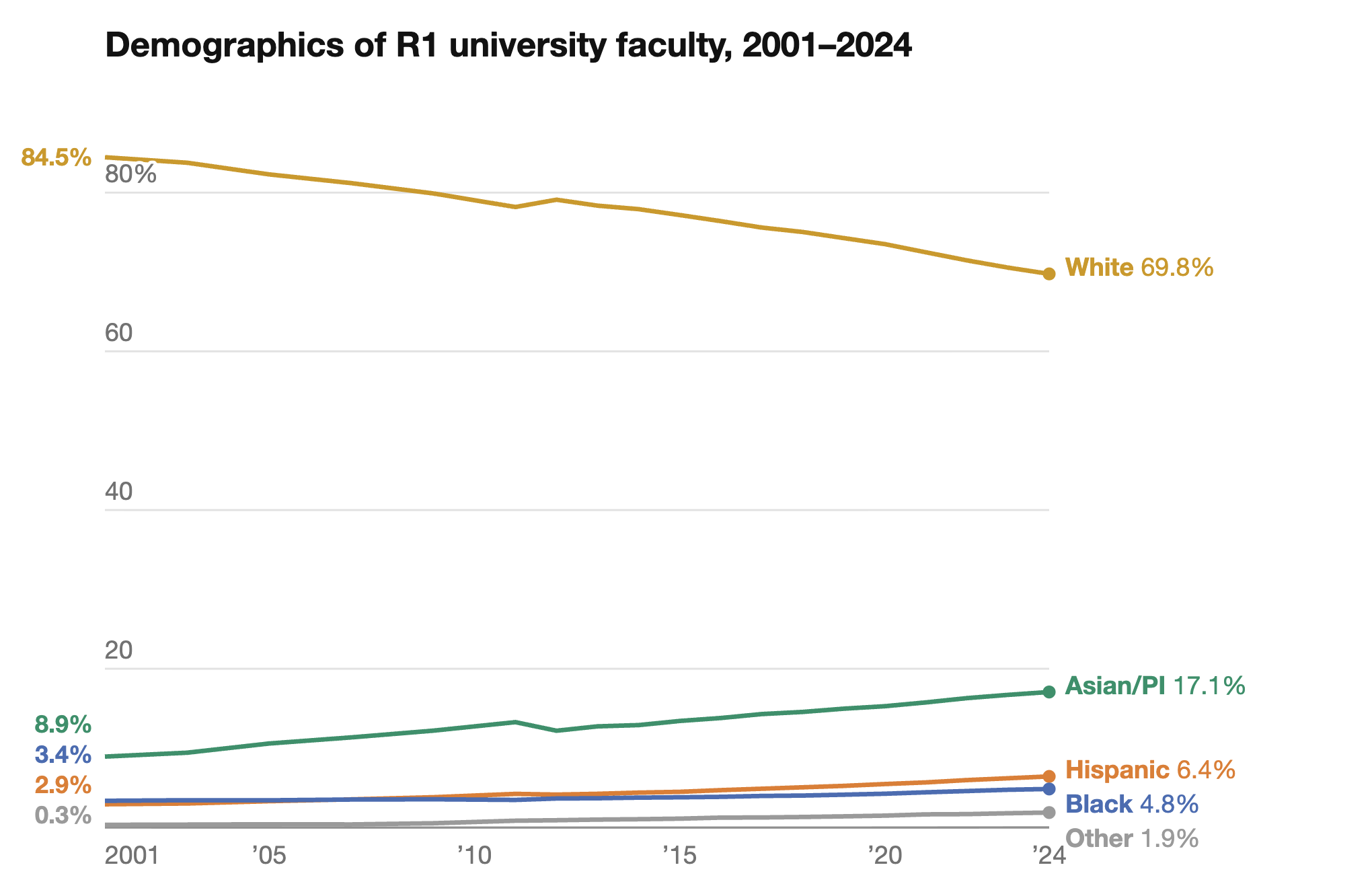
The articles cited above are mostly experiential, so let’s start by simply looking at the long-run diversity trends in university faculty at top-tier research institutions (R1s)2. First, the fraction of R1 university faculty that are black has hardly changed at all, from 3.4% to 4.8% in the span of two decades.
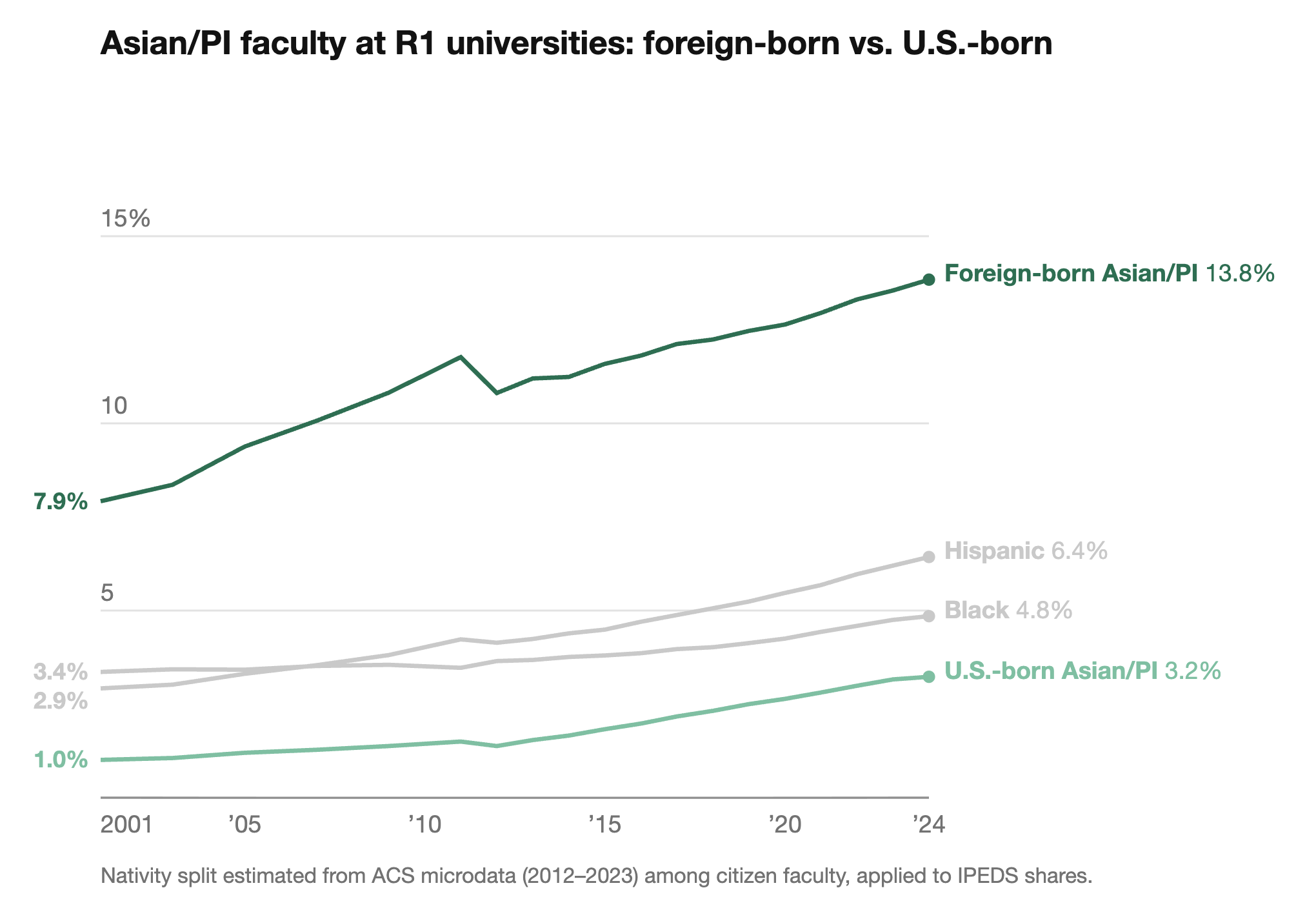
If we focus on the Asian/PI trend and do some back-of-the-envelope estimation3, most of those gains have come from immigrants: foreign-born faculty make up >80% of the overall Asian/PI faculty pool.
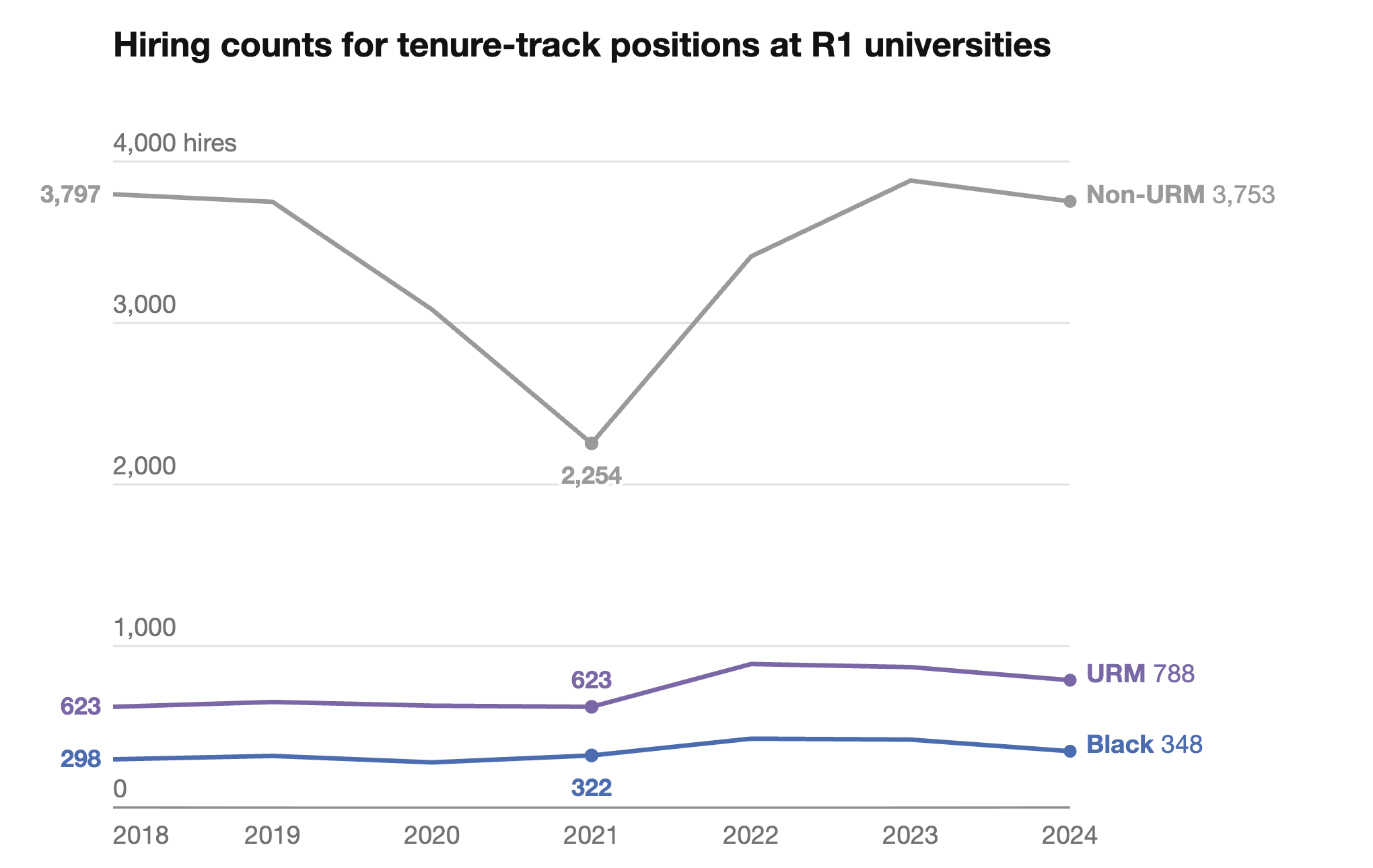
So what of all of the talk about DEI hiring? If we zoom in on the “DEI era” from 2020 to 2024 we can see that, indeed, there was a substantial shift in the incoming faculty mix: the hiring of non-minority faculty dropped dramatically during the pandemic, while black/minority hiring remained essentially flat. The former was likely a consequence of pandemic-induced hiring freezes and the latter a consequence of continued hiring in specific diversity/URM-enriched research areas (for example, Stanford’s cluster hire on the impact of race in America, or the NIH-FIRST diversity program). To put these numbers in perspective, in the counterfactual where the URM proportion of new hires is kept fixed at 2019 levels, R1s would have seen ~160 fewer minority faculty hires per year (or about 1 per campus per year).
A different way to look at hiring is to ask what proportion of recently graduated PhDs are hired as faculty across different groups. We can get a rough estimate by comparing the number of new hires in each year to the average number of graduating PhDs in the previous 4 years, and this reveals several interesting trends:
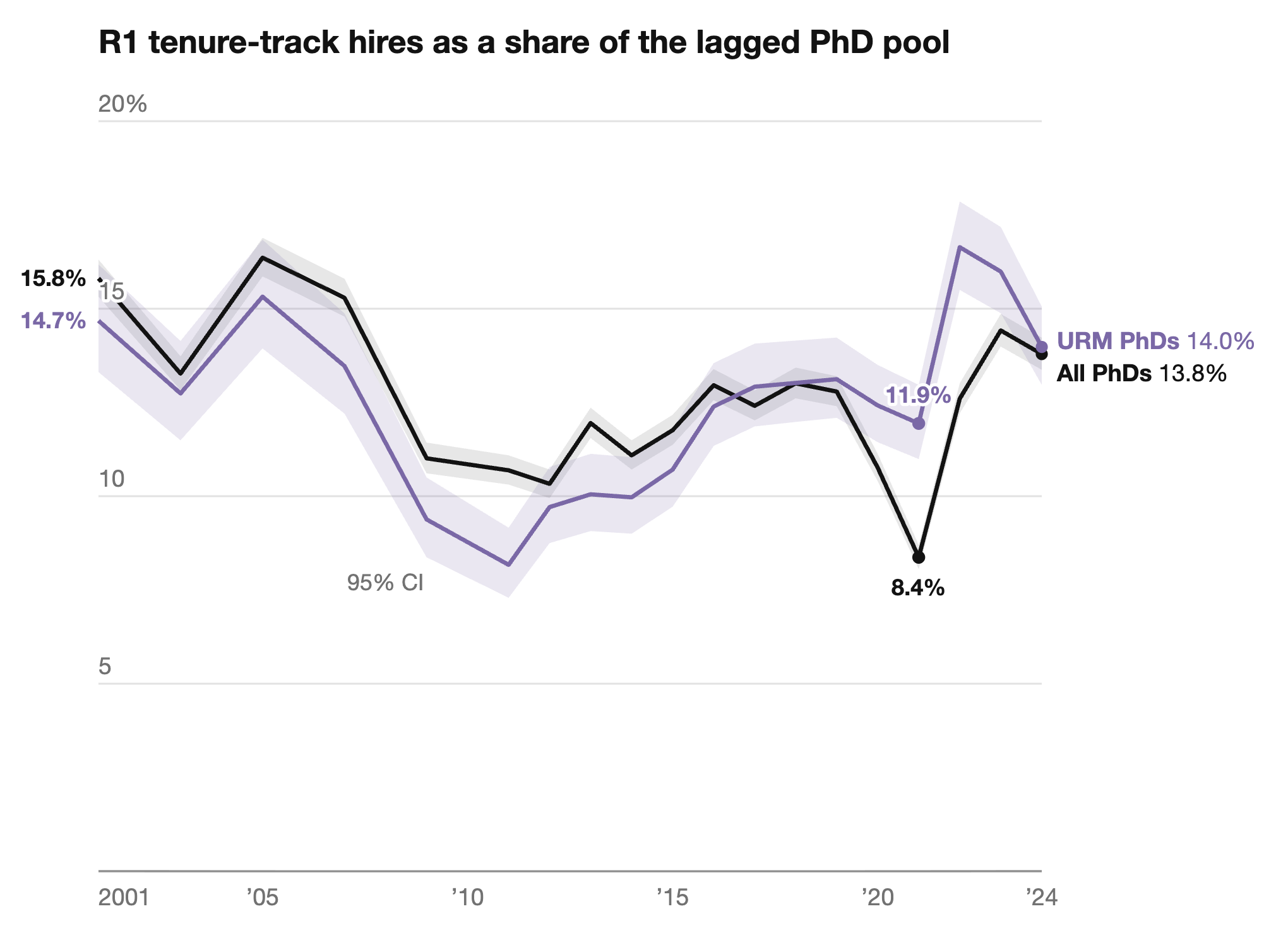
The biggest is that faculty hiring took a nosedive after the 2008 financial crisis and has still not recovered: a lower fraction of recent PhDs was hired in 2024 (13.8%) than in 2001 (15.8%). In the pandemic period, we again see the decrease in the proportion of all graduating PhDs being hired and a slight increase in the proportion of minority PhDs being hired during the same time. But this phenomenon was extremely short-lived and by 2024 the proportion of minority PhDs being hired into R1s was statistically indistinguishable from the proportion for all PhDs.
Whatever DEI policies were in place, their consequences were a brief change in hiring that quickly returned to historic trends. Put more bluntly, if a goal of DEI was to fundamentally impact the long-term academic faculty hiring landscape, then DEI initiatives failed to achieve this goal.
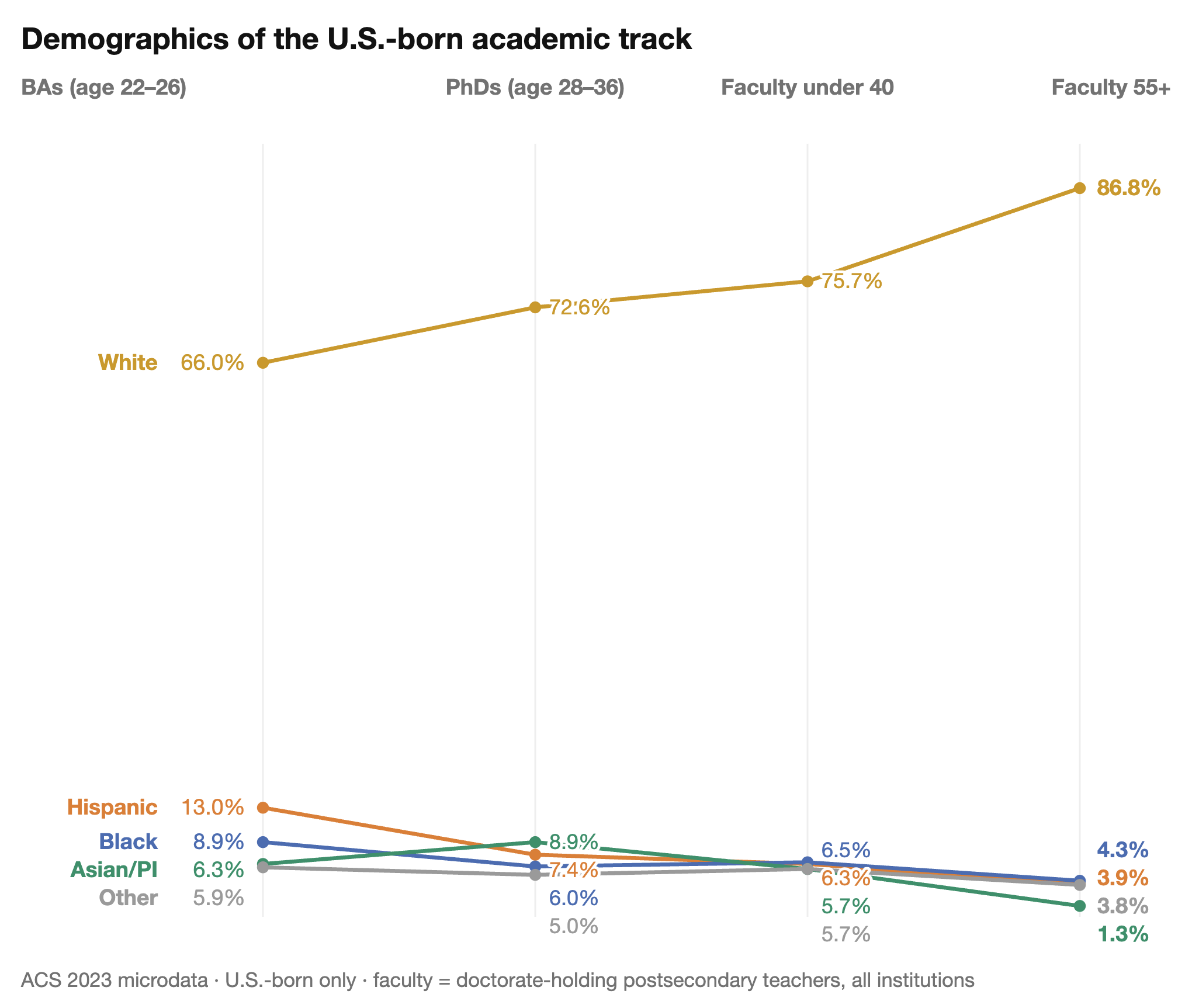
So how can diversity efforts in academia actually increase the number of minority faculty, especially without the backdrop of a pandemic-level hiring freeze? One place to look is at the senior faculty diversity mix. Across the academic track4, white academics become increasingly overrepresented: 66% of graduating BAs, 73% of graduating PhDs, 76% of young faculty, and 87% of older faculty. Older faculty almost certainly benefited from well-established patterns of discriminatory hiring in the 1990’s and earlier, in addition to fundamentally different academic pipelines. That means faculty diversity can be influenced by changing hiring policies, but it can also be influenced by changing retiring policies.
With this in mind, we can consider several hypothetical policies for improving black faculty recruitment. To understand their potential impact, we will simulate their implementation from 2001-2024 and then contrast with the actual number of minority faculty today.
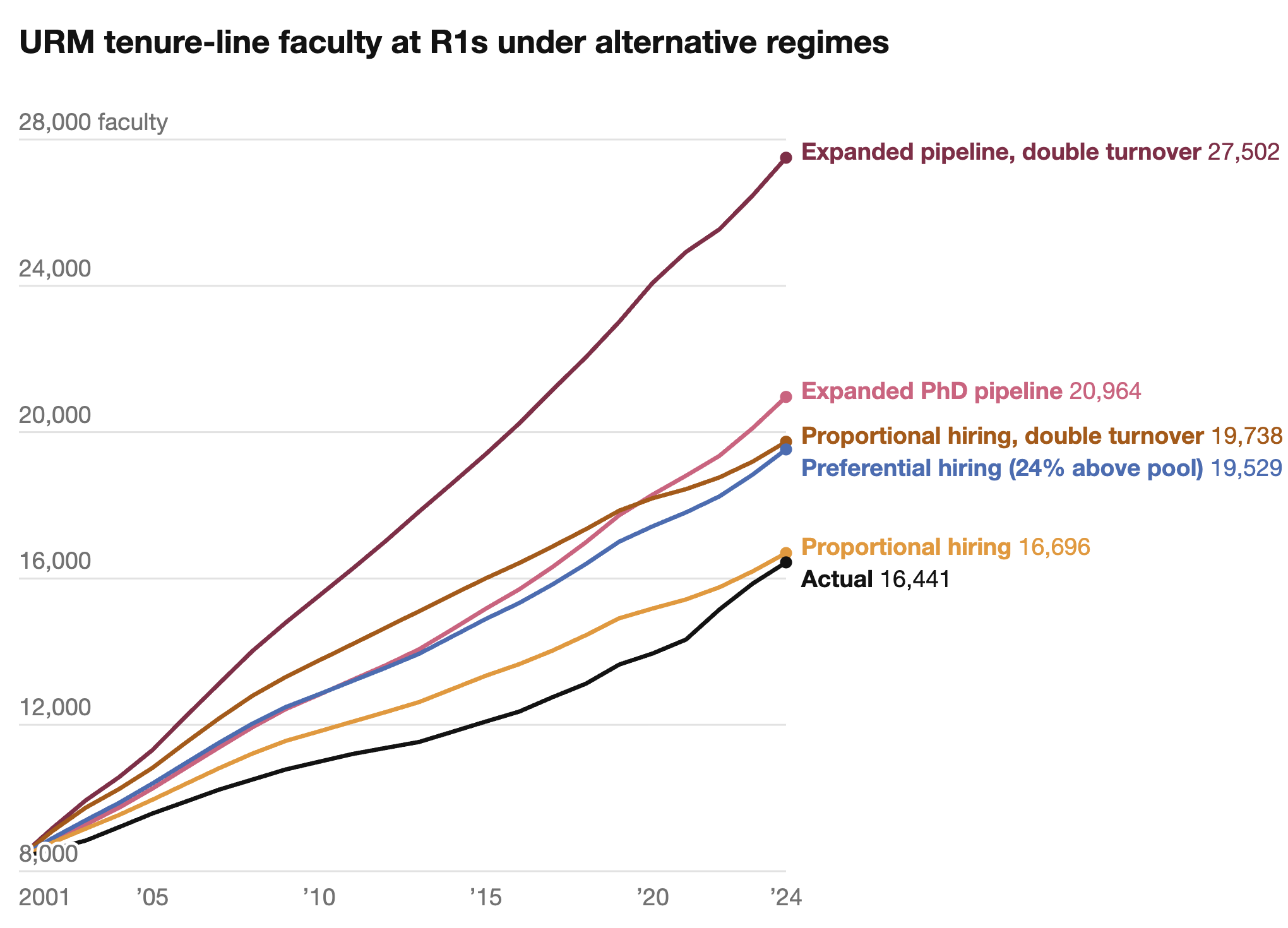
First, if faculty hiring was simply proportional — meaning the fraction of incoming faculty matched the fraction of graduating PhDs in previous years — this alone would have slightly exceeded the number of minority faculty employed today (gold). In other words, the preferential hiring of the DEI era did not even fully compensate for the disparate hiring of the preceding two decades.
If we further augment this neutral hiring policy by retiring senior faculty at 2x the observed rate and hiring new faculty to fill their slots. These accelerated retirements (together with proportional hiring) would increase the total number of minority faculty by an additional ~3,300 to ~20,000 (darker gold). What does 2x turnover look like? It is roughly equivalent to a 20 year service cap, where faculty would retire from their tenure track positions in their mid-50’s instead of their late 60’s.
Alternatively, we can imagine a “DEI” policy with the preferential hiring rates observed through the pandemic (24% more minority hires than expected from the graduating pool). This is likely an overestimate of what could be sustained for multiple years5, let alone several decades, given that academia did not maintain it even during a favorable cultural climate, but let’s see what happens. This permanent DEI policy would have produced a nearly identical number of minority faculty (blue) as proportional hiring with accelerated retirement. In other words, two decades of the most preferential hiring policy in recent history would be as impactful as merely hiring proportionally from the graduate pool and then incentivizing senior faculty to retire faster.
Finally, we can dream a little bigger and imagine a policy where the academic pipeline is expanded at an earlier level: PhD programs take in an equal proportion of graduating minority BAs, and then tenure track R1s take in an equal proportion of graduating minority PhDs. This policy would have lead to a total of ~21,000 minority faculty in 2024, greater than any other intervention we’ve considered. If we also impose accelerated retirement, that number increases to ~27,500 minority faculty in 2024 — about 70% higher than the actual amount. This hypothetical, still relying on purely proportional hiring at every level, dwarfs the other policies considered.
During the pandemic, faculty hiring dropped dramatically but DEI policies kept minority hiring flat/slightly elevated — leading to ~1 additional faculty hired per institution per year relative to the counterfactual. Just a few years later, this trend had ended. I think these numbers offer some useful perspective. It is not to say that we should accept any policy just because it directly impacts a small number of people. But the claims of a “lost generation” of white male hires6, or of a massive boost to minority applicants are simply unsupported by the data. And that cuts both ways: many universities emphasized DEI in their branding and PR, but the material impact appears to be quite small. This is all consistent with the experiences described in Harper’s article: the campus is embroiled in DEI-related infighting, but the two “diversity candidates” are ultimately not hired, and Harper — a self-perceived diversity hire — ends up leaving academia in disgust.
Where do we go from here? I think the policy hypotheticals break down the often amorphous concept of DEI hiring into useful parts. One direction is to reboot preferential hiring through cluster and area hires. Last time this was attempted it failed as durable policy, and greatly increased political polarization over academia. And while DEI efforts that emphasize fairness in hiring are very popular, using race in admissions is not. Another direction is to work towards parity in hiring at earlier stages in the pipeline (BA→PhD), through structured interviews, diverse hiring/admissions committees, training grants, networking events and bootcamps, etc. In parallel to both, we can incentivize early retirement.
I imagine at this point some readers balk at the idea of a 20 year cap for tenure track faculty. The reason I raise these hypotheticals is to make the trade-offs clear. There are only so many tenure lines: if we want more diversity in a zero-sum hiring market, then either we turn away potential junior faculty, or we push out senior faculty. To have a large impact, the former requires preferential hiring that puts the burden on academics in the most precarious point of their career. The latter can be done with neutral hiring but it requires the people at the top to make the sacrifices.
All analyses were carried out with Opus 5 and checked manually. The underlying data was primarily derived from the IPEDS database collected by the Department of Education, which tracks the demographic breakdown of standing faculty and newly hired faculty. Every word of this article was written by the human author.
I focus on R1s because they are typically associated with major DEI efforts; have relatively homogenous recruitment/tenure policies and systematic data reporting; reflect a sizable fraction (~30%) of academic faculty; and avoid sectoral differences (e.g. Historically Black Colleges and Universities with specific diversity missions).
The IPEDS analysis excludes nonresident aliens but does not have data on nativity. Instead we extract citizen Asian/PI doctorate-holding faculty from the ACS, identify the foreign born percentage (88.7% in 2012, 83.3% in 2019, 81.1% in 2023), and then interpolate between these measurements (held flat before 2012). Note that green-card holders are included in the IPEDS analysis but not the ACS, so the foreign-born estimate is conservative.
I’m switching to the ACS data here and focusing on the US-born population to avoid the complexity of different immigrant populations entering the academic track at different points.
Not to mention that hiring based on specific topic areas — like the Stanford cluster hire on race in America — has an inherent ceiling based on the number of faculty working in that area.
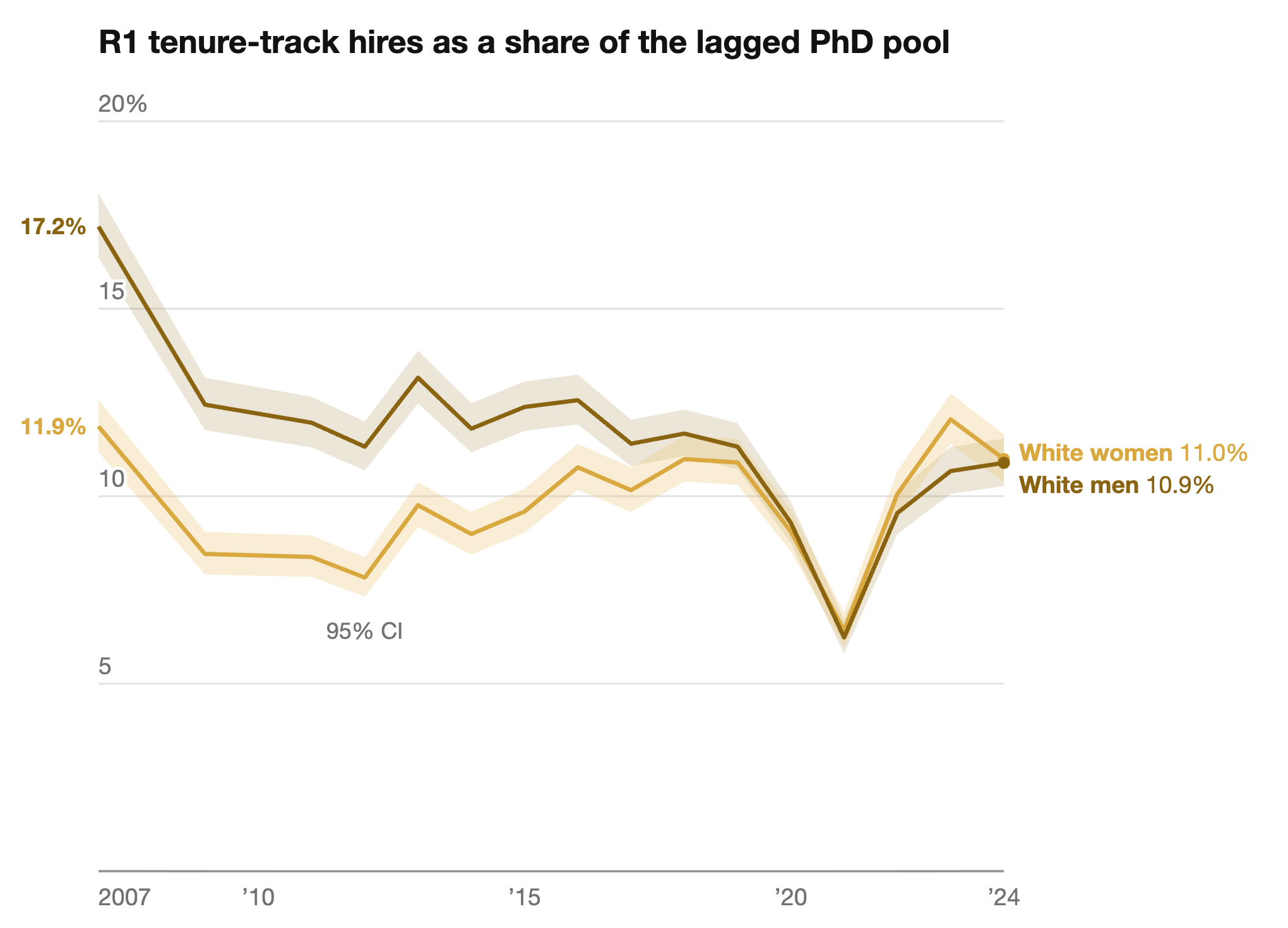
Update: Jacob Savage graciously popped into the comments to ask about the plight of white male faculty specifically. Good question. White male hiring as a share of graduating PhDs has now converged to the same rate as that of white women. Savage’s broader thesis does not appear to hold up in other sectors either.
n
Comments
Nothing yet. Say the first thing.
Sign in to join the conversation.