
This is a strategy thesis on how to grow FMCG in the India of today and tomorrow. Join here.
TL;DR — The same financial instruments can build a demand engine like it did at Coca-Cola, or distract you from real demand creation like it did to Nestlé under Mark Schneider. The difference is in the lens - do you see like an operator, or like a money allocator?
In the 1800s USA, nine out of ten railroad builders were financiers who used government subsidies to build their railroads. Their only goal was money, so they resorted to all kinds of subterfuge to inflate their subsidies.
The government paid by the mile, so they built the longest path to everywhere. Not just this, they destroyed each other’s tracks at night, delayed construction, and even built parallel tracks!1
Then there was James J. Hill. He did the most ‘financially unsavvy’ thing by refusing all subsidies, raised his own money and built the Great Northern railway slowly, deliberately, with high-quality materials. He even reinvested the profits into the business.
Unlike his peers, he didn't just lay track and move on. He laid them where farms and small towns already existed. And where they didn't, he paid immigrants to settle. He even gave them cattle for free, so they could land on their feet. He did this because he knew that when areas next to his railroads prospered, they would use his trains for trade, which would fund his next build.
He was building demand flywheels before flywheels were a thing. :-)
When the dust settled, all the savvy financial engineers were penniless and James J. Hill was the only person in American history to build a railroad and not go bankrupt.
James J. Hill understood railroads as a business to operate, while his rivals looked at railroads as a financial instrument.
Carlota Perez2 describes phases in every technology cycle, when demand takes time to catch up to the goodies that new technology builds.
(It took railroads 50-70 years to fully replaced horse drawn carriages.)
In the meantime, leaders have to do something right? This is where they hit a fork in the road. They can either create demand - a slow, painful, frustrating process that humbles you. Or they can resort to financial wheeling and dealing - lots of action, quick ‘results’, and ink slinging by journalists that boosts egos.
Nine out of ten choose the latter.
D2C founders race from one funding round to the next while their operating teams discount to ‘buy’ sales. If a D2C founder fails, VCs call it ‘failing fast’ and anoint them trail blazers.
Comparatively, a legacy FMCG CEO has more at stake → 100+ years’ legacy, thousands (if not millions) of livelihoods, career track records and pay checks. Given that the companies they lead already have a solid base, they are under tremendous pressure to ‘show’ success, fast.3
But pressure is good. It can turn carbon into diamonds if the CEO has an operator’s mindset. Or it can contract the business if the CEO’s focus is on financial engineering the P&L.
Today, I compare the strategic choices of Nestlé under Schneider and The Coca Cola Company (TCCC) between 2016-2025. Both faced the same context →
a slow but definite global shift towards healthier food and beverages.
pressure to be more sustainable, especially w.r.t. water and plastic.
covid and the subsequent commodity inflation.
In such a tough environment, both relied on financial engineering to protect their balance sheet. But my reading is that Nestlé under Schneider increasingly viewed the business through the lens of shareholders. Whereas The Coca Cola Company (TCCC) never took their eyes off the consumer.
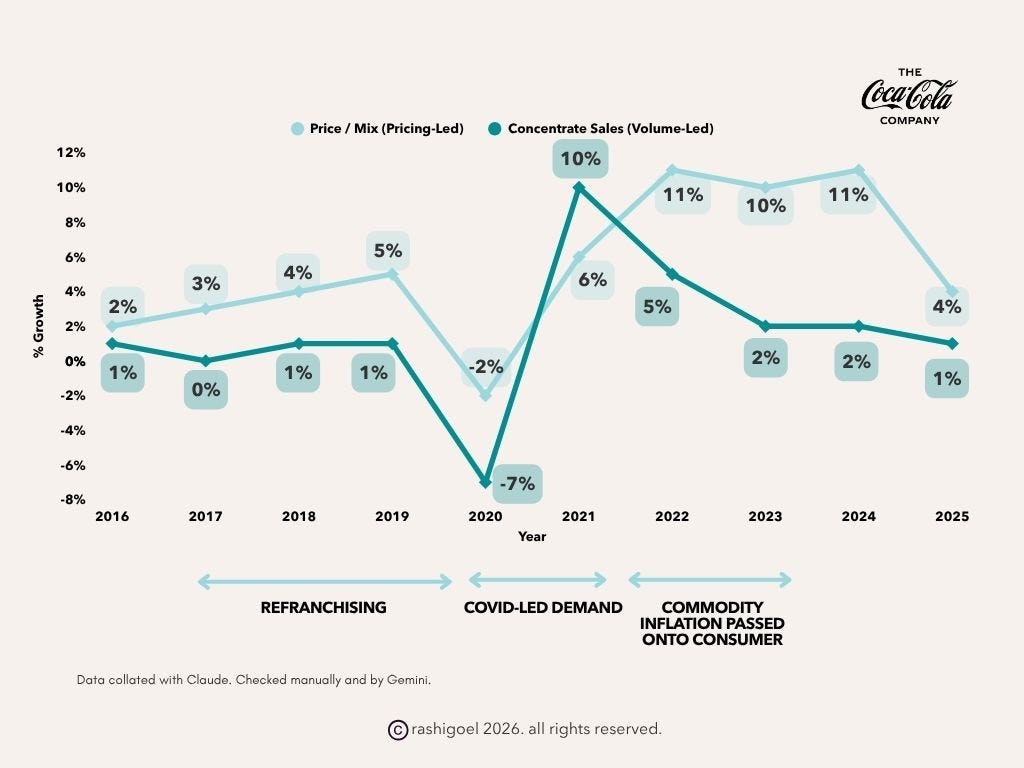
Between 2016-18, TCCC franchised almost all of its company-owned bottling operations. Which means they shifted all the capital and labor intensive operations of manufacturing, trucking, distribution and retailer relationships to bottlers.
They became a high-margin, asset-light beast and freed bandwidth for razor sharp focus on growing their already formidable brand equity, product innovation, and selling concentrate. Their operating margins grew from 22% to 35%+.
Its portfolio adjustment was minor and business as usual (BAU). It reduced investment in laggards like TaB and Odwalla, and bought premium dairy/sport hydration/coffee brands - Fairlife, Bodyarmor, and Costa Coffee.
We pay Rs.20 for a Coke Can in a restaurant, but Rs.120/- for the same can at the airport. No one has mastered the craft of blending consumer psychology with distribution like TCCC has. They have a team whose only job is to maximise revenue by architecting different pack-price-place combinations.
When TCCC had to raise prices during the post-covid commodity inflation, volumes slowed, but never turned negative. A homage to the power of their brands.
In 2017, TCCC’s net revenue was $35.4 Bn, which rose to $47.9 Bn in 2025.
Nestlé S.A. on the other hand, is a different story. It ran in the same place for 8 years - it was CHF 89.8 Bn in 2017, and CHF 89.5 Bn in 2025.
Nestlé S.A stuck to its traditional business model of owning and running hundreds of factories to produce its complex portfolio (from Purina pet food to Nespresso capsules).
This is not the problem at all because like all legacy FMCG, Nestlé is great at efficiency programs. Schneider grew profit margin from 16.4% (2017) to 17.7% (2020), one year ahead of schedule.
In service of Nestlé’s vision to be a nutrition, health and wellness company, Schneider (rightly) sold non-strategic laggards like US confectionary, Galderma, and Ice Cream, and invested in businesses of the future.
I’m afraid, these bets didn’t pay off.
They cost CHF 1.84 Bn in net revenue, and the new portfolio looks like a failed VC fund - not even one bet clocked a 10-20X return, which would have redeemed the rest.
The one deal that worked was Starbucks (that too just 2X revenue). Demand for Starbucks already existed. All Nestlé had to do was produce and distribute Starbucks products into the in-home channels.
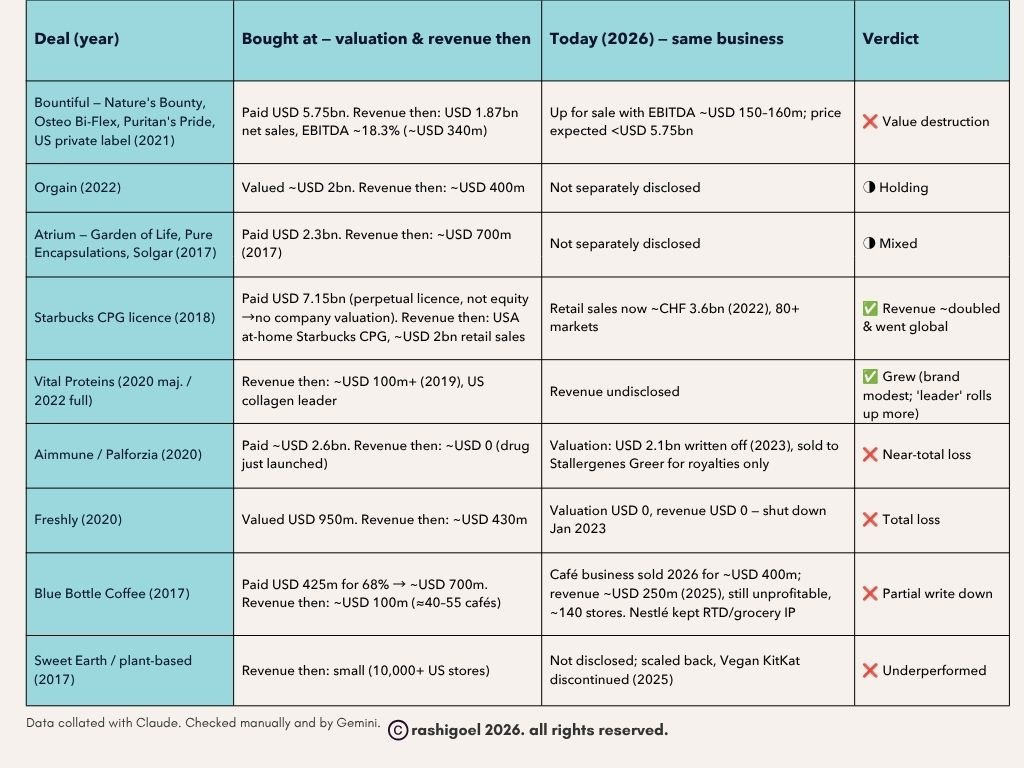
I asked Claude to collate a few acquisitions, and when I read the 2019 annual report, I could see that there were many many many more that kept the leadership busy.
Since 2017, we have completed or announced more than 50 transactions (acquisitions and divestitures) with annual sales equivalent to 12% of Group sales. Net acquisitions had a negative impact of 0.8%, largely related to the divestment of Nestlé Skin Health and Gerber Life Insurance.
Annual report 2019
(Who was focusing on the core business?)
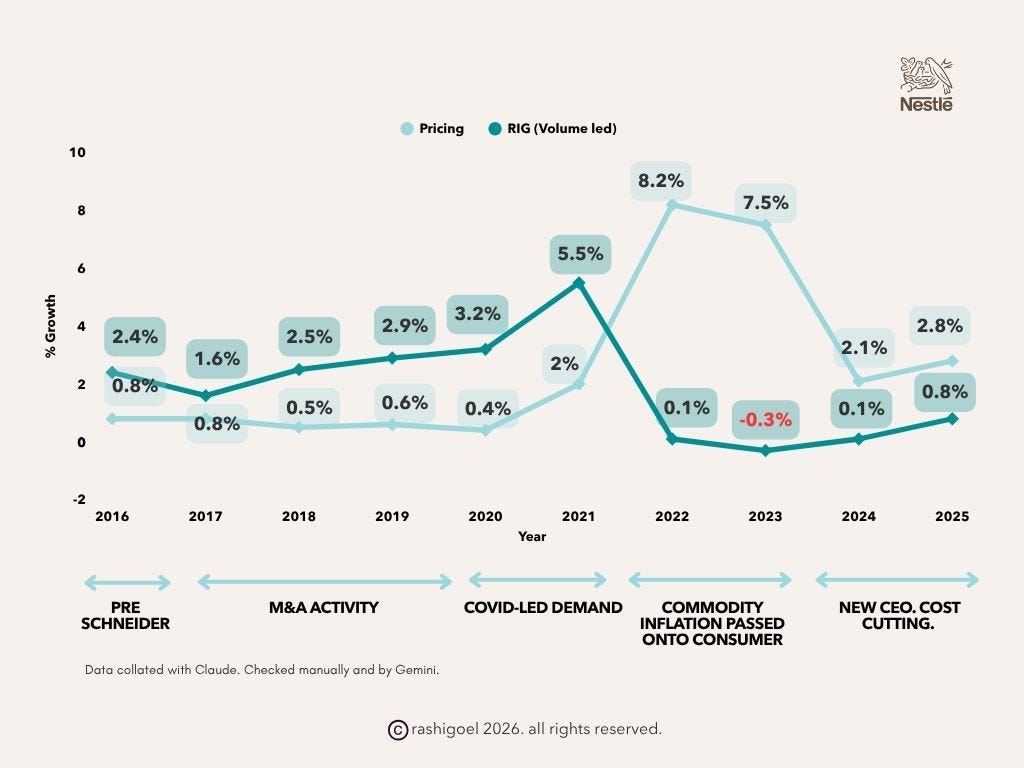
Nestlé under Schneider was so busy engineering the balance sheet, that it got distracted from the real job of demand creation and volumes tanked to -0.3% on a price hike.
This is the only report card that matters → you know your brands get an ‘F’ when consumers walk the minute you raise prices.
Schneider was the first outsider to run Nestlé in over a century. For seven years the board - seasoned veterans who know the company inside out - supported all kinds of financeering, egged on by activist investor Third Point’s Dan Loeb.
Here’s what surprises me. The one thing this board was uniquely qualified to spot → that in all the financieering busyness, the real demand engine of new products, renovation, and advertising (work that compounds into demand, just like Hill’s immigrant settlements around his railroads) was being overlooked → is the one thing they missed.
They didn’t act until August 2024, when they ousted Schneider. Here is what Reuters had to say. (I have highlighted sections that point to organic growth slowdown).
Nestle shares hit a record high in January 2022 as the group enjoyed a pandemic-driven boom, but they have been on a downward slide since May 2023 after a series of mishaps, earnings misses and guidance downgrades.
The decision to axe Schneider was reached after Nestle’s board became increasingly concerned about weak sales growth - with sales volumes increasing by just 0.1% in the first half of 2024, opens new tab, one of the sources said.
There were also worries about slowing product development, with new and revamped products taking longer to be devised and rolled out, with the accompanying marketing campaigns.
“The virtuous circle of introducing products, which generated cash for new products, was slowing down. That was a real concern,” the source said.
Nestle’s price-to-earnings ratio, used to gauge the relative value of a company’s stock, is 17.7, down from more than 25 in June 2022. That is higher than the consumer goods industry average of 10, but below rival Unilever’s 18.5.
Financial engineering can capture demand, repackage it, even starve it. It cannot create it.
But financial moves look like momentum and we get so blinded by the bright lights and news flashes, that we forget. We forget that in an operator’s hands, financeering points towards demand, that’s when growth compounds. But in an allocator’s hands financeering distracts from demand.
Just for kicks, I asked Gemini to count mentions of ‘consumer/s’ and ‘shareholder/s’ in Nestlé’s annual reports. It seems that consumer centricity has increased with a CEO change.
In 2019 (Schneider), the ratio of ‘consumer’ to ‘shareholder’ was 2.5. In 2025 (Navratil), it was 4.3.
Strategy Activator Workshops — done with you.
A proven approach that we tailor to your context. At the end of the process you will know your insight-led growth strategy. Received great feedback from Harpic, Tata Salt and Tata Sampann. Click here to share your interest and I will get back to you.
DIY Strategy Products
I am building self-serve products you can use to develop your growth strategy. Join the early list for first access.
https://www.quora.com/What-is-James-J-Hill-famous-for-and-what-is-his-legacy
The Wall Street gives only 2 couple of years to these CEOs to ‘perform’. Then heads start rolling.
Comments
Nothing yet. Say the first thing.
Sign in to join the conversation.