
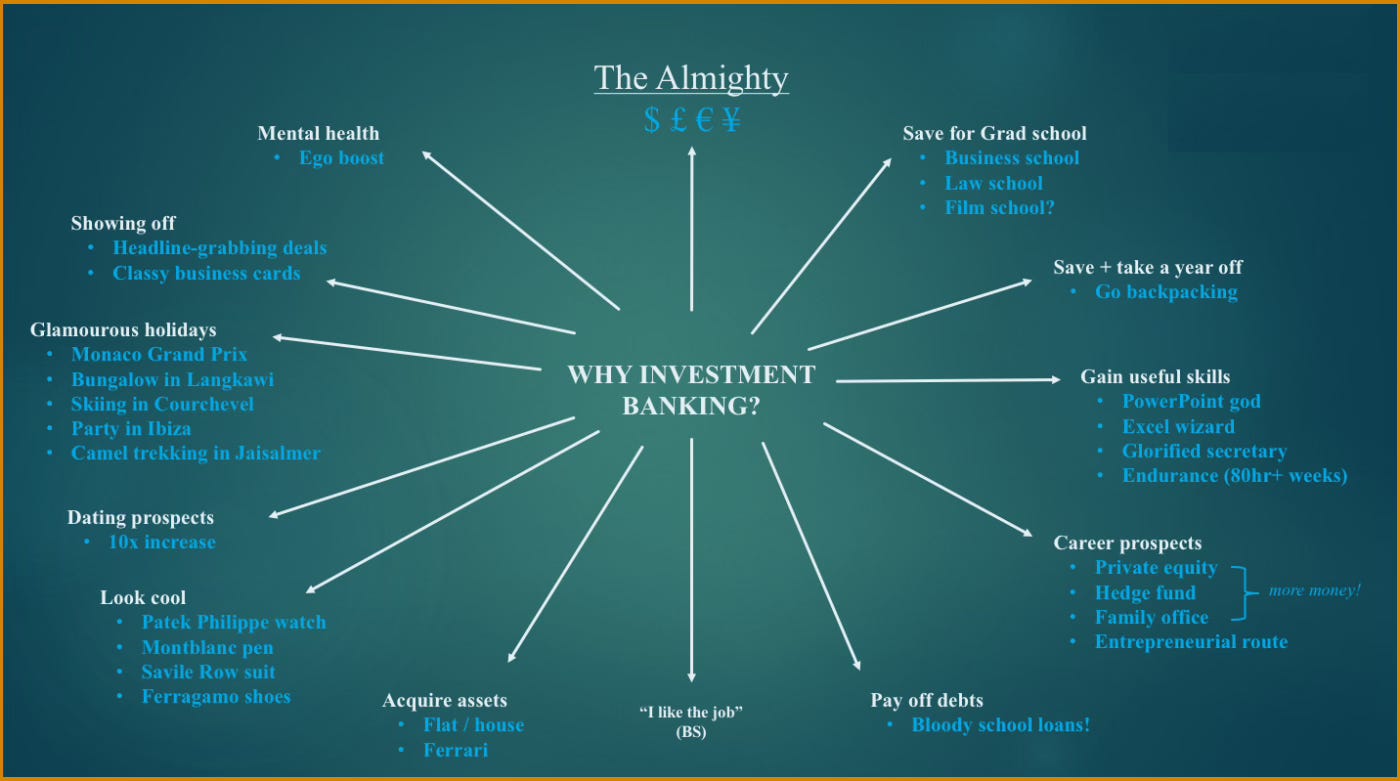
There are different reasons why individuals become investment bankers (ibankers). Why they yearn to practice the sacred art of investment banking (ibanking). Though some people enter this esoteric world of high finance by pure chance, and with little effort, they are anomalies. In the vast majority of cases deep-seated motivations propel the uninitiated to persevere until the gates of entry to that prestigious world open before them and they finally break in.
Most of those motivations can be grouped into categories. They explain why so many bankers agree to work unusually long hours, put up with abnormally high levels of stress and sacrifice so much personal and leisure time. Take a look at the faces of people who have been in the business for over 10 years, especially in a front office role. Many wear their sacrifice on their face. Sadly, few of them realise this.
Those of you currently in the business, next time you attend the Monday morning meeting just take a nice, long look around the room at the seniors bankers present. Is it not unusual that many of them are probably 10 years younger than they look? I know it took me less than a year at the bank to give birth to most of the grey hairs I presently sport.
So why do so many people accept, amongst other things, the premature ageing that comes with the territory?
Different reasons. Let us consider some of them.
Hypnosis: dangling a shiny pendulum
For many there’s a psychological attraction. After being mesmerized by the words and countenance of recent graduates in polished suits at campus recruiting events dreamy-eyed candidates are propelled to put forth an application. I recall one banking workshop where the speaker, a young banker, left his key chain on the panel table before getting up to speak at a podium. Every one of us noticed the Ferrari emblem of the prancing horse. When the workshop came to an end, my friend Noah nearly trampled two girls as he ran up to speak to the banker. Never mind that the speaker has had stress-induced diarrhoea for the past month, working round the clock to make a deal happen, and has been literally pissing out his ass every morning at work.
Benjamins (US) / dosh (UK) / fric (French) / dinero (Spanish) / foulous (Arabic) / qián (Chinese)
Let there be no doubt that chief amongst the reasons is the motivation to earn a lot of money. See, for many bankers, and banker-wannabes, it’s a given that the entrepreneurial route is the path which ultimately leads to the greatest riches. However, entrepreneurship is beset with pitfalls and risks. Therefore, given the very calculating nature of bankers, the optimal choice is a career which is less risky than entrepreneurship yet at the same time relatively more lucrative than other roles.
If you consider it safe to be employed and risky to be an entrepreneur, then investment banking can be considered one of the best safe bets in terms of compensation.
There are bankers who spring out of bed at 6am every weekday to get ready for work as if called into a meeting by God. The raison d’être for this group is to toil through all the days of the year until one very particular day in the year. Bonus day.
Whether it is earned in €, $, £ or ¥, on a good bonus day it will feel as if God came down to earth and kissed him or her on the forehead.
On bonus day you may notice for the first time that some of your colleagues actually have teeth. Year-round glares turn into ear-to-ear smiles. Many of them will have gotten engaged, married, become parents or taken off on week-long holidays to the Seychelles. However, you will not see them wear as big a smile as the one they’ll walk into work with that day in anticipation of the handout. The stress, grey hairs, hair loss, stomach ulcers, eczema, skin rashes, to name a few undesirable aspects of the job, are justified by the paper handed to them which contains their bonus for the year. If it is a great handout then the day after the beneficiary will glow like a prophet.
Let’s hope it’s a good year.
The lifestyle: la dolce vita
From fine Asian restaurants serving mouth-watering black cod with miso and expensive French wine to luxury hotels nestled on hilltops in remote exotic islands, the list of activities enjoyed by bankers can be out of reach to some people in relatively lower-paying industries. Whether the bankers truly appreciate the $100 main or £275 bottle of red wine served at Chez Quelqu’un or rather enjoy the status associated with eating there when the restaurant next door offers more delectable food at a third the price, does not matter here. It’s the lifestyle the job affords that some gravitate towards.
Some chaps and chapettes want the opportunity to hang out with a Barbour quilted jacket-wearing crowd. Makes them feel special.
For others the right lifestyle includes being able to send their kids to a school which will prep them for entry into Eton College (UK), Philips Exeter Academy (US) or Le Rosey (Switzerland).
Many enjoy being able to do the rich person’s routine such as attending niche art exhibits where they’re served champagne, engage in inane small talk and pretend that they’ve done the rounds in art circuits since birth. Reminds me of an ex-colleague who’d always take half an hour to peruse art reviews online, jot down a few key phrases and throw them around at the events like he did a post-doc at École des Beaux-Arts in Paris.
Let’s not forget the fine food:
“Yes, to start with I’ll take the caviar appetizer, followed by the veal fillet, cooked in aubergines, with confit of veal breast, with pepper and lemon, and…oh…as it appears divine I’d also like the artichoke and black truffle soup with the layered brioche and mushroom. Merci.”
Status: symbol of financial success
For some it’s the prestige that comes with the job which matters most. Many bankers love knowing that their friends refer to them as a “high flying financier”. All of a sudden people around think of you as a financial whiz. Relatives and friends will call you and question you on how to get mortgages, successfully refinance loans, invest in gold, buy into a tech start-up or even how to tip in restaurants. Your opinion on all things monetary suddenly matters very much. That is, even if all you do in your day-to-day job is to give loans to handful of South African corporates and that in reality you’re as knowledgeable on mortgages or commodities as a tourist guide in Giza (Egypt) is about Norwegian forestry.
I’ve know some ibankers who’ll complain about the job on daily basis and carry their utter disdain for their work life on their foreheads. But when you run into them at a rooftop lounge on a Friday evening surrounded by an attractive young crowd of non-finance people you’ll hear them describe what they do as if they’re Thomas Crown.
True love
Some people know they want to work in finance from a young age. True, it’s rare; but when you meet them in a bank you’ll recognize it right away. More often than not they’re very sharp. Everyone in the team will either love or hate them. There is no in between. At a junior level (i.e. Analyst / Associate) they are typically the guys who make far fewer mistakes in presentations and models, digest information and data the quickest and generally appear to feel most at home in the building. It is almost a given that they’ve breezed through their finance studies in university. Some of them probably could have joined a bank straight from high school rather than attend university.
When these worshippers of finance walk across the trading floor or past the Head of M&A’s office they’ll fight hard to keep a stupid smile from manifesting itself. They cannot help it. The trading floor is like a playground for them. The Head of M&A’s office like a throne. And if they receive a nod of acknowledgement from the man or woman inside that office they may rush to the bathroom, lock themselves in a stall and cry out of joy for the job they consider a blessing. They probably hear Vivaldi’s Four Seasons (Spring) in their heads when they walk around the bank on a busy Monday morning, a difficult day for most humans. Or perhaps Beethoven’s Ode to Joy – the part where the entire ensemble comes together in joyous harmony.
For these special souls, the enjoyment they derive from reading the Financial Times on a Friday morning is tantamount to a sustained mini ejaculation.
I once spotted one of them in the bathroom. Thomas, who attended the UK’s leading boarding schools and spoke as if he were an earl, was an Equity Capital Markets (ECM) Associate and we occasionally worked on deals together. He was probably headed over to chat to a Sales guy and decided to make a pit stop beforehand. He surely thought he was the only person inside the toilets. I was slightly out of his range of vision at the urinals. Anyway, he’d finished washing his hands and was now staring at himself in the mirror:
“Star ECM associate ladies and gentlemen. Rain maker!” he said.
This caught my attention and I quickly noticed he wasn’t on his phone. His smile reminded me of the smile on a friend’s face the day he became a father. Thomas went on chatting to himself.
“Walkin’ down the trading floor. Smile at the FX guys, “hey Cyrus how’s cable*”, wave to the EM traders, ‘yo Ravi how the Abu Dhabi bonds doing? Has the sheikh farted again?”
(*note: cable is the exchange rate between the US Dollar and British Pound)
He suddenly bit both lips and looked down. He was overwhelmed by it all. I nearly burst out with laughter.
Great expectations
For some, a career in finance is expected of them from a young age. That was certainly the case with Guillaume, a Swiss M&A analyst I met in London during training.
“Most of our family and friends are in finance. My father is a private banker. My older brother is a hedge fund analyst. The pay maintains the lifestyle we like. The lifestyle our friends also have. Bien sur.”
He tells me this as he brandishes a ring with his family crest on it as if he were a 17th century musqueteer. Has anyone told him there are under 30-year old techies who have made more in 5 years than his ancestry combined? And they wear flip-flops and shorts to work.
Tour of duty: Operations In & Out
The people in this group are those who’ve planned the mission from Day 1. They have given themselves two or three years to immerse themselves in that world, work like a horse, learn as much as possible about finance, hone their PowerPoint presentation and Excel skills, add some eyebrow-raising bullet points in the resume / cv and get out before it’s too late. Once the tour of duty comes to an end they tend to head back to university for graduate studies, launch a start-up, spend a year backpacking around Latin America flirting with locals and smoking indigenous herbs, set about writing an eBook or move into an Ashram in Uttar Pradesh and massage each other thinking it will lead to enlightenment.
Sadly, only some of the people who swear an oath to the tour of duty on that very first day fulfill their mission. Everybody in finance reading this knows exactly what I’m talking about. To those in the business: how many times have you told yourself, ‘just one more year…just one more bonus’? To those who have friends in the business: how many times have you heard them insist they’ll soon leave their job? Most end up MIA (missing in action). Once behind enemy lines and captured people slowly forget the original plan, which is easily overshadowed by the perks of the job inside the golden cage. That is precisely what happened to Carlos, a friend of a friend.
He was on a two year plan. So he said. Six years later – though you’d think it more like 15 years looking at his face and what’s left of his hair – he still insists departure is imminent. A few months ago I ran into him in a lounge in New York. Rihanna’s What’s My Name started to play and he began to dance. You could call it that, if you had downed half a bottle of vodka and were looking through a kaleidoscope. I’m fairly certain in some part of the world he’d get violently beaten with a dead monkey and have his head shaved with a rock for looking that bad. He used to dance with a modicum of style I was told. But after sitting on a chair crunched over a computer 12+ hours per day modelling on Excel for six years … things happens.
The people
One attraction of working in an investment bank is that you’re sure to work alongside some bright minds. The reason for that is very simple: investment banking promises enormous wealth and an exciting career and, therefore, it attracts some of the sharpest, most intelligent and driven individuals in academia and the workplace.
I can’t deny that I’ve met some impressive people in the bank. Having said that, I’ve also met a great deal of legendary imbeciles.
Nonetheless, some ibankers join and stay in the business because of the people.
Chance, circumstance or the alignment of the stars
Some stumble into the business by sheer chance, much like one accidentally steps in dogshit. It just happens. They’re at the right place, at the right time, and opportunity presents itself.
It just so happens that nerds (intelligent but single-minded persons obsessed with a nonsocial hobby or pursuit) are most likely to have this happen to them. Why? They’re natural chess masters, have an engineering degree from a top-ranked global university and, most important of all, give off the exact impression a managing director wants to see in a potential recruit: “I’m a geek, will work like a dog, make few mistakes and rip open my scrotum doing the splits on two chairs like Van Damn if you ask me to.” Hired!
Comments
Nothing yet. Say the first thing.
Sign in to join the conversation.