

For a while now, I’ve been privately questioning the role of the ‘author’ vs the life of a ‘writer’.
~Writer: in their own private corner, writing!
~Author: out in the world, selling!
I inhabit both roles, as one must in any creative career—but I feel, especially as I get older, a much closer kinship with the writer side. I find the Public Author-facing role increasingly itchy and uncomfortable. I’d like to be able to toggle more easily between the two, but for some reason I feel the need to regain an inner stability as a writer first and foremost, rather than putting too much energy into sculpting or reinforcing an outward-facing brand as an author. All of which is to say: I’ve pulled back from defining myself as an author in my work. I’d rather live and identify as the writer, because that is how I spend the bulk of my days anyway.
It has come as a surprise to me that I’m craving so much private writing time because all through my twenties, I did so much Public Author-ing. I said yes to any and every event and panel going. I did talks on stage. I attended book festivals and was even a guest curator at various major literary festivals in my twenties. I went into Amazon HQ to talk about one of my books. I fielded questions from the audience. I wore a quirky blazer. I was an Author™ and proud. I did what I felt I had to do in order for my writing to be read.
Over the past few years, I’ve been recoiling a little at what it takes to be an Author™—say it with me—in this economy. I have pulled back from doing events and interviews, saying yes to very few opportunities. Ignored aggressive comments to “use my platform” for whatever cause said person wants me to retweet that day. I have made some very special writer friends, some of whom I retreat with every year, where we sit around and discuss the intricacies of being a writer trying to communicate something meaningful—and then how to bring that work into the world without losing your spirit.
It’s an amazing job being a writer and I’m so incredibly lucky; and it’s also a confusing one—it always is when you are mixing art with commerce. You are mixing business and pleasure. You are mixing Private and Public selves. You are monetizing and commodifying yourself. You are given so much, and yet, you are stripped bare if you’re not careful. You are expected—and encouraged—to spend so much of your time taking opportunities that circle around the writing, rather than doing the writing itself.
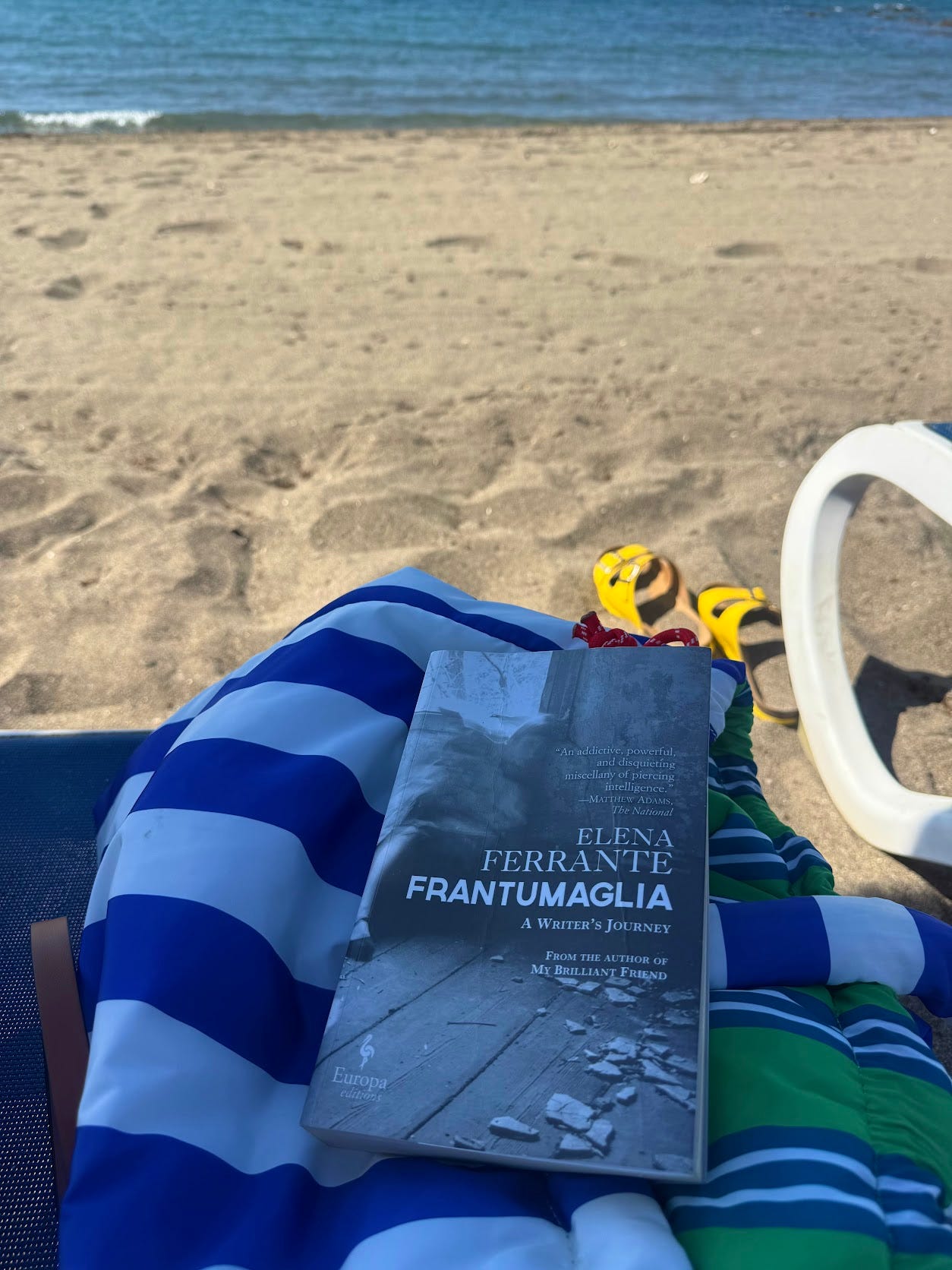
I’ve just returned from a week’s holiday in Spain with my rather large family. It was expectedly chaotic: a full villa of 18 people spanning four generations. My parents; my younger sister and her husband, both in their thirties, with a toddler and a three-month-old baby; my older siblings, in their fifties; and their children, aged between nine and nineteen. There was always someone to talk to or someone to play with, so I read very little. A rarity for me—I only got through one book.
The book was Elena Ferrante’s Frantumaglia. Originally published in 2003, the edition I read includes additional material and now spans almost 400 pages, collecting interviews, emails, letters and responses to readers’ questions from 1991–2016. I knew, while reading it, that it was going to be a meaningful book for me.
The word Frantumaglia translates as "a jumble of fragments" and the subtitle says “A Writer’s Journey”. Elena Ferrante is the beloved author of many novels including famous The Neapolitan Quartet, and The Lost Daughter (adapted by Maggie Gyllenhaal and starring Olivia Colman.) She has also never revealed her identity. She is a writer, without being a public author.
There were many times while reading the book, where I found myself curious, excited, and rather envious. She says in one interview: “Anonymity lets me concentrate exclusively on writing.” She says she enjoys a life “without surveillance or urgency.” One of her most famous quotes, which appears on page 15 of the book is: “I believe that books, once written, have no need of their authors.” She believes “authors, as authors, live in their books. It’s where they appear most truthfully.”
What’s clear in Frantumaglia is that Ferrante focuses on living her normal life and writing in private and not much else. She says on p.117: “I publish only when it seems to me that the book can find its way on its own.” One of my favourite lines in the book is: “Writing puts me in a good mood, publishing doesn’t.”
Ferrante doesn’t give away much to do with her personal life or who she is. I imagine her to be an older, stern-yet-warm Italian woman. Though you do get a taste of how she treats her writing: as a vocation, but not her ‘job’. She makes money in other ways; a day job as a translator I think. She doesn’t ‘need’ to publish, and she outright refuses to be a part of the author world. She has never stepped foot into the world of literary festivals or panels or bookshops or events or even a film premiere based on one of her books and she has never accepted an award in person (of which she has won many). When asked what it meant to her to be nominated for the prestigious Strega prize she replied: “Nothing.”
It is clear that the decision not to be a ‘known author’ in the traditional sense is to really have a clear distinction. She wants the books to be famous, not her.
She writes:
“For more than twenty years I’ve let go of the anxiety of success and the anguish of lack of success. I write as I like and if I want to.” p.117
“I simply decided once and for all [..] to liberate myself from the anxiety of notoriety and the urge to be part of that circle of successful people, those who believe they have won who-knows-what.” p.339
Anonymity gives Ferrante total creative freedom. Because she isn’t known, the media cannot gossip or judge (although they’ve tried to unmask her identity for years). Ferrante doesn’t have to field endless questions about her fiction ‘being based’ on her life. She can put whatever she wants inside her books without anyone judging her personally:
“…writing with the knowledge that I don’t have to appear produces a space of absolute creative freedom. It’s a corner of my own that I intend to defend, now that I’ve tried it. If I were deprived of it, I would feel abruptly impoverished.” p.62
Many authors I know are sick of the self-promotion trail and long for their books to speak for themselves. In this internet age—an age in which art often feels less valued than we wish it were—it’s becoming harder to imagine navigating the literary world in that way.
There is also freedom in the fact that, because she is anonymous, no one really expects anything of her—either in person or on the page. She could simply let her pseudonym disappear and never publish again if she wanted to. She does not have to maintain appearances or keep her audience happy online. She has total freedom over what she chooses to publish and when:
“Eventually, in all serenity, I will tell you if the novel can be read or not, if it can be published or should be added to my writing exercises […] I believe that, for those who love to write, time spent writing is never wasted.” p.74
“No one obliges me to publish. [..] And if I never again write a book that comes out the way I want, I won’t publish anymore.” p.123
Frantumaglia also allowed me to reflect on the toll ‘author life’ can take on a writer who isn’t necessarily built for it. It made me think about how much it demands of you—especially if you’re introverted by nature—and how the author exists separately from the book they have just written. Many authors experience burnout around publication because they are thrust into public spaces in a way that doesn’t feel natural. I resonated with this paragraph below, how I often long to part ways with my books once I’m finished with them:
“But when one stops writing one becomes oneself again, the person one usually is, in terms of occupations, thoughts, language. Thus I am now me again, I am here, I go about my ordinary business, I have nothing to do with the book, or, to be exact, I entered it, but I can no longer enter it. Nor, on the other hand, can the book re-enter me. So what’s left is to protect myself from its effects, and that is what I try to do. I wrote my book to free myself from it, not to be its prisoner.” p.59, Frantumaglia
In a 2015 interview with The Paris Review, Ferrante seems quite scathing about the industry needing the author to be already popular in order to publish them. This seems only to have gotten worse in the age of Instagram with amount of followers translating into book deals. She comments on how the publishing houses started becoming obsessed with “external credentials as proof of its quality” instead of “simply through texts”. She writes here about the decision to remain anonymous around publication:
“…I was frightened by the possibility of having to come out of my shell—timidity prevailed, the desire for intangibility. Later, it was hostility toward the media, which pays scant attention to the books themselves, and tends to assign importance to a work especially if the author already has a solid reputation. It’s surprising, for example, how the most widely admired Italian writers and poets are also well-known academics or are employed in high-level editorial jobs or in other prestigious fields. It’s as if literature were not capable of demonstrating its seriousness of intention simply through texts but needed to provide “external” credentials as proof of its quality.
In a similar category—if we leave the university or the editorial office—are the literary contributions of politicians, journalists, singers, actors, directors, television producers, etc. Here, too, the works do not have intrinsic authorization for their existence but need an entry pass generated by work done in other fields. “I’m a success in this or that field, I’ve acquired an audience, and therefore I wrote and published a novel.” The media place great importance on this nexus. It’s not the book that counts but the aura of its author. If the aura is already there, and the media reinforce it, the editorial world is happy to open its doors and the market is very happy to welcome you. If it’s not there but the book miraculously sells, the media invent the author, engaging a mechanism by which the writer sells not only his work but himself, his image.” p.271
How much self-promotion is too much? How do you let the book find its readers, without the author attached? Why must we be constantly forced to ‘sell our image’ in return for publicity? Do we have to? Was I more likely to get my first book deal in 2015 because I was visible on Twitter? Probably. Why must the author be so visible? Ferrante writes:
“Increasingly, the promotional activity of authors tends, instead, to cancel out the works and the need to read them. In many cases the name of the writer, his image, his opinions are better known than his works, and that goes not only for contemporary writers but unfortunately, by now, also for classics.” p.84
There is a sense, even, that Ferrante finds “sending one’s person along with the book” somewhat embarrassing:
“I’m happy when my books establish an intense and lasting relationship with readers. It seems to be proof that I’ve given the books what’s necessary and they truly have no more need of me. If now I were to accompany them throughout the world, I would feel like those mothers who follow their children around even when the children are adults, and who on every occasion speak in their place or embarrass them by singing their praises.” p.291
It reminds me of advice an older author friend once gave me: “Do not feel you need to babysit your books and follow them around once they are published.”
In a world where we are increasingly forced to ‘market our own books’, and where publishing houses and their PR departments are dwindling, how possible would it be these days to be an author without a face?
A dear friend who is a very successful literary agent said to me once that many of her authors wish that one or more of their books would become so successful that they never have to go on social media again.
Perhaps this connects back to the fact that most books find their audience through word of mouth—which has nothing to do with the author.
It strikes me that the main relationship Ferrante cares about is the one with her readers. The readers who consume her books, who don’t need to know anything about her life or person to enjoy her work and have a relationship with the books. She wants to write her truth, centre the writing, be seen on the page and then ‘go about her daily life’. Perhaps Ferrante really is living the writer’s dream.
Comments
Nothing yet. Say the first thing.
Sign in to join the conversation.