
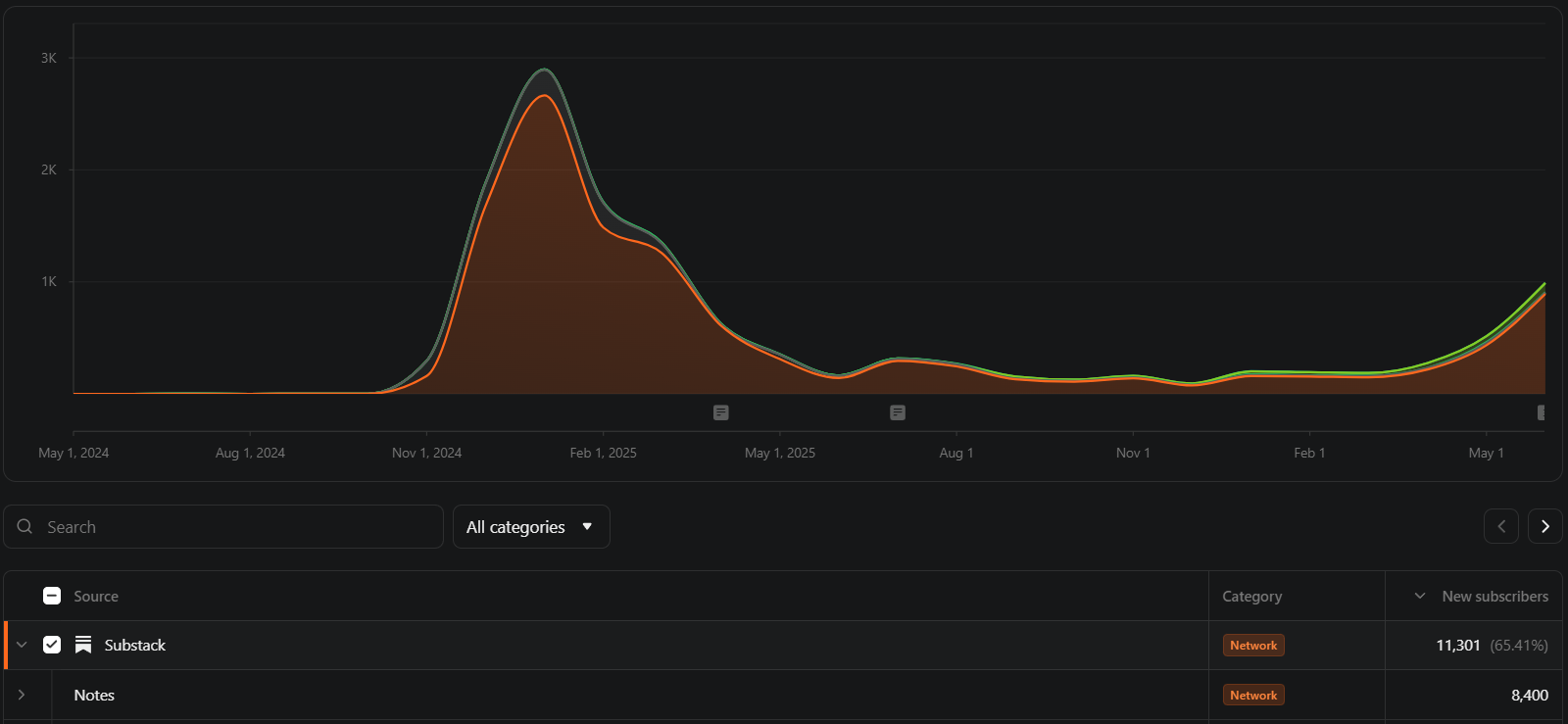
Last week I pulled up my subscriber source report for The Human Project, mostly out of boredom, and just sat there staring at one number.
65.41%.
That’s the exact share of my till-June subscribers, 11,301 of them, that Substack itself is responsible for.
And when I clicked into that number, 8,400 of those subscribers came from one single tab: Notes.
Not paid ads. Not a viral Twitter thread. Not some lucky feature.
Just Notes, posted with wildly inconsistent effort over about 20 months.
I want to be upfront about something.
This isn’t going to be one of those “post consistently and be authentic” articles.
You’ve read fifty of those already, and none of them showed you an actual graph with actual ups and downs and actual reasons behind them.
This one’s different.
I’m going to walk you through my real subscriber chart, month by month, including the part where I basically abandoned the whole thing for a year.
Because that gap tells you more than any success story could.
I started The Human Project in October 2024.
First few weeks, nothing much happened, which is normal and nobody talks about that either.
Then I made a decision.
I told myself if I wanted to actually understand how the Notes algorithm worked, I needed enough data points to see a pattern, not just a few lucky posts.
So starting late October 2024, I posted 4 Notes a day, every day, without fail.
By January 2025, that turned into the biggest spike on my entire chart, close to 3,000 new subscribers in a single month.
If you saw the graph, that’s the tall mountain right around the Feb 1, 2025 marker.
Then it fell off a cliff.
Not because Notes stopped working.
Because I got busy.
Around January 2025, I picked up several ghostwriting clients for LinkedIn and newsletters, and my own newsletter became the thing I worked on last, if at all.
Some days zero Notes. Some days one, maybe two, whenever I found ten free minutes.
That inconsistency shows up brutally clear on the chart.
From February 2025 all the way to December 2025, the line is basically flat. A small bump here and there, nothing close to that January peak.
I’m telling you this because most articles about growth only show you the peak. Nobody shows you the eleven flat months in between, and that flat stretch is honestly the more useful part of the story.
At the start of this year, I made a resolution.
Not the usual gym-membership kind.
I decided to cut down my ghostwriting client load and give Substack another real shot.
So in January 2026, I started posting Notes again, mostly just whatever felt interesting that day.
No format, no research, just posting.
That month brought in 202 new subscribers. February, 194. March, 196.
Basically flat again.
Same as the previous year’s dead months, just at a smaller scale since my base was different by then.
Somewhere in March 2026, I got frustrated enough to do something different.
I went back through every single one of my own Notes that had performed well, going all the way back to that January 2025 spike, and pulled every single one into a doc.
Then I did the same thing with other writers’ viral Notes, people way bigger than me, just to see if the patterns held across different accounts too.
I laid all of it out side by side.
Around 300 Notes total between mine and others’. And patterns that I’d been vaguely sensing for over a year suddenly became obvious once they were all in one place.
I started posting in that exact format from late March onward. Here’s what happened next, straight off my own dashboard.
April 2026: 276 new subscribers. May: 515. June: 990.
That’s not a fluke month.
That’s four months in a row of the number roughly doubling, right after I switched to a format built entirely from studying what already worked instead of guessing.
Here’s the mistake I made for over a year before I actually looked at my own data properly.
I assumed every Note had roughly equal odds of doing something.
It doesn’t, not even close.
Once I laid out my own history, a small number of Notes were doing almost all the heavy lifting, and the rest were basically invisible.
That’s true whether you’re posting 4 times a day as I did in that first stretch, or once a day like most people manage.
Most Notes fail because they read like a headline instead of something a real person would actually say out loud.
Go check your last 10 Notes right now.
I’d bet at least 7 of them sound like you’re trying to sound impressive instead of trying to say something true.
From what I saw across those viral Notes of mine, the algorithm rewards early engagement in the first 20 to 40 minutes more than almost anything else.
If your opening line doesn’t stop a scroll in half a second, the Note is basically done before the hour’s up, no matter how good the rest of it is.
This is exactly why “just be consistent” advice failed me for a full year.
I was consistent, technically. Consistently posting things that weren’t built on anything.
Once I understood that, I stopped guessing every morning and turned what I’d found into a proper system for myself, since rebuilding that research from scratch every time I wanted to post felt exhausting.
A few other writers asked if they could see how I did it, so I eventually cleaned it up into something usable.
That became Substack Notes OS, built directly from those 300 viral Notes and my own 20 months of data, including the flat months. (+ the 300 raw viral notes, just in case you want to get your hands dirty as well)
If mornings spent staring at a blank Notes box sound familiar, this is basically the shortcut through the year I spent figuring it out slowly.
Okay, back to the actual mechanics, since the templates only make sense once you understand what they’re built on.
Going back through my own good months and the other viral Notes I studied, three types of openers kept showing up, over and over, regardless of whose account it was.
Something slightly embarrassing to say out loud.
Not shocking, just honestly not the polished version most people post.
One of my better performing Notes from this year started with something close to: “I ghostwrote for other people’s newsletters for a year and completely neglected my own.”
That’s not a clever hook.
It’s just true, and apparently a lot of writers relate to neglecting their own thing while helping everyone else with theirs.
Vague claims get scrolled past.
Specific, slightly odd numbers make people pause because it reads like you actually checked something real.
“I posted 4 Notes a day for 3 months straight, here’s what I learned” performs completely differently than “here’s what I learned about posting Notes.”
Not controversy for its own sake.
Just a gentle “actually, I think this common advice is wrong” angle.
This one needs care though, more on that below.
Here’s the unglamorous version of what changed after March 2026.
Every morning, before checking email or client work, I write three Notes, not one.
The first is usually stiff.
The second is decent.
The third is where the honest, unguarded sentence shows up.
I only post the strongest of the three.
I write these in a separate doc first, never directly into the Notes box.
Typing straight into the posting box makes you self-conscious, and self-conscious writing is exactly the safe, forgettable kind that goes nowhere.
Then, every few days, I check what actually landed against what didn’t and write down why in a simple tracker, the same habit that helped me spot my own patterns back in March.
Over time, that tracker became more valuable than any single Note, because it’s built on my audience’s actual behavior, not somebody else’s generic advice from a different niche entirely.
I know that tracking system sounds simple, almost too simple.
But this exact loop is the difference between the flat 11 months on my chart and the four months where subscribers nearly doubled each time.
I ended up building this tracking and templating process properly inside Notion, with the full dataset of those 300 viral Notes, a Content Calendar, and a Remix Vault that resurfaces my own best-performing Notes when I’m out of ideas.
That’s the core of Substack Notes OS.
If the “write three, post the best one” habit sounds useful, but rebuilding the tracker and research from scratch feels like a lot, that’s exactly the gap it fills.
I need to mention this because it’s rarely talked about.
During 2025, on the few days I did post, I leaned hard into the “mild disagreement” style because it had worked well in January.
I criticized a popular newsletter growth tactic once; it did fine, so I kept doing versions of it.
Then I posted one on a more sensitive topic, worded a bit carelessly, and it didn’t just flop. A handful of people unsubscribed off the back of it.
The lesson: your growth engine and your reputation live on the same platform, and my flat months weren’t only about low volume; some of it was low trust too.
A Note that gets engagement but damages trust is a net loss, even if the surface numbers look okay.
Now anything remotely touchy gets a quick gut check before it goes up: would I be fine with my most respected reader seeing this?
If there’s hesitation, it stays in the doc.
People assume the growth from April to June happened because I suddenly posted way more often.
That’s not really true.
My posting frequency in those months wasn’t wildly different from January or February.
What changed was the format, built from actually studying what worked instead of guessing.
202, 194, 196: From Jan to Mar
then 276, 515, 990, from Apr to Jun
Same effort roughly, completely different output, because the input finally had research behind it instead of just habit.
That’s the part I wish someone had told me back in October 2024, before I burned through 4 Notes a day for months without knowing why some worked, and most didn’t.
If you’re starting from wherever you are on Notes right now, here’s what I’d actually do.
Write three Notes tomorrow morning before checking anything else.
Post the one that feels most honestly you, even if it feels slightly too plain.
Track what happens for two weeks before judging anything, and be honest with yourself about which ones actually landed versus which ones you just liked writing.
That’s genuinely it.
Not a 90-day content calendar.
Just that loop, done with actual attention to your own results, the way I eventually did after wasting most of 2025 not doing it.
I didn’t figure any of this out from a course or someone else’s masterclass.
I figured it out from a graph that embarrassed me a little when I finally looked at it properly, 11 flat months sitting right there in black and white.
Your chart won’t look exactly like mine.
But the process of finding your own pattern in it works the same for everyone.
No posts
Comments
Nothing yet. Say the first thing.
Sign in to join the conversation.