
This is The Human Player, a section focused on bodies and technology. While listening to Is Reality Real? With David Hoffman on Star Talk, I was called back to my 2016 article Thanatophobia: Everything to Fear but Fear Itself, written on Catapult.co. In the original piece, I focused on the existential dread of non-existence. Today, I add a little more, considering what happens when my system finally crashes?
Death, therefore, the most awful of evils, is nothing to us, seeing that, when we are, death is not come, and, when death is come, we are not.
-Epicurus
During a psychology class in high school, my teacher said fear could easily be conquered by accepting the acronym False Evidence Appearing Real. As a teenager this made sense to me. When I thought of common phobias—spiders, heights, darkness, snakes—there really wasn't much to worry about, especially if you live a basic life. The snakes and spiders you encounter in most areas can't harm you. The dark and a fear of heights are just an experience—nothing really happens externally. It's all mental, so they are all rightfully defined as irrational.
I conditioned myself to have no fears over those years. I grew up as most kids in Brooklyn did in the nineties—whether Black, white, Hispanic, or Asian, we were always up to something. Drugs, guns, threats, and police violence—before the internet made us realize it wasn’t isolated—were part of everyday life. None of that scared me.
But randomly, in my mid-twenties, I began to get anxiety attacks. I remember the first night vividly. I was watching Cowboy Bebop—a 26-episode show I loved, a show I’d already watched ten times. As the final episode concluded, the protagonist dies. I watched him die for the eleventh time. But this time, his death hit differently. Something inside of me was triggered.
What happens next? What about the other characters? They were all still alive, so what happens with their life?
The show ended. Everything was over, and my only option was to watch the series from the beginning. Watch a life the protagonist had already played out, unable to deviate from it in order for him to live again—in order for me to pull from every character’s past to create an ongoing future that would fill in the voids.
I panicked. My eyes were wide. I saw the white light that would disconnect me from life.
It was 2 in the morning. I was in my twenties, living with my mother, who was sleeping in the next room and woke up at 4:45 to get to work. I quickly grabbed my pillow and yelled into it. I grabbed both ends, sunk my teeth in like a dog, and attempted to pull, shred, and tear it apart from every angle. My chest was on fire. I couldn’t catch a single molecule of oxygen. This is where I’d die. Weak. Pathetic. Breathless.
My mother wouldn’t know until she came back from work at 4 p.m.
Throughout the whole attack, I kept repeating: I won’t exist one day.
I won’t exist one day.
I won’t exist one day.
That awareness was something that had never clicked before. Lack of existence—what did that really mean?
spent nearly twenty years clinically depressed. I remember going online when I was thirteen, back when we had WebTV. I searched “why am I sad all the time” on MSN. It wasn’t even just me who was sad—everyone I grew up with was sad, and we all showed it differently. Something was wrong with all of us, and initially I accepted it because if we’re all sad, then life felt fair.
I saw the word “depression” for the first time and I was intrigued, and quickly relieved that there was a word for someone like me. There weren’t many resources on the internet in 1998, but I remember reading a webpage that mentioned “clinical depression.”
“If your depression lasts longer than three weeks you should go see a physician.” Three weeks? It had been about three years.
I also remember reading that you weren’t allowed to call it clinical depression because it wasn’t diagnosed. You know how you’re not really dead until someone looks at the time and calls it?
Seeking professional help was out of the question. In the Haitian community, mental conditions are something you should just snap out of. They think you’re sad about something and you’ll get over it in a few days. So I repressed every emotion, unless it was the byproduct of alcohol. But once anyone noticed I seemed “down,” anger became my default. Anger is more acceptable than sadness for men—especially Black men. I was angry from then on, and I accepted that fate for the next eight years.
In 2009, before the first anxiety attack and during my college senior year, I asked a sociology professor if our lives are inherently for other people. I was losing what little sanity and hope I was holding onto. I went to him because I didn’t want to feel alone with the thought. I knew it was valid. I played out as many life scenarios as I could and they all ended back at someone else reaping the benefit of my existence.
Only he who does nothing for his life’s sake can truly be said to value his life.
—Lao Tzu, Tao Te Ching
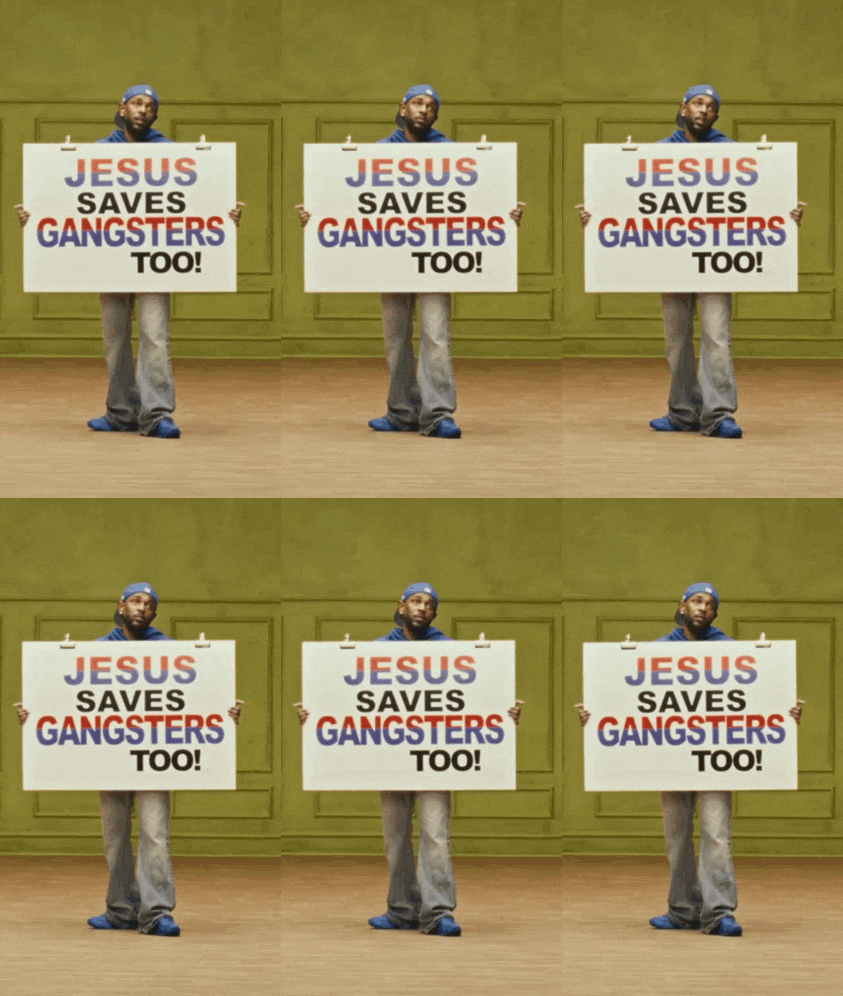
I became a born-again Christian in August 2001. My depression became less of an issue because of faith. The allure of god, being able to cast my troubles away, accepting there was a bigger plan—the end goal of heaven warmed the bitterness in my heart and put a joy in my life I hadn’t known since I was six. But the more religion, philosophy, and sociology courses I took at CUNY Hunter, the less the idea of god as I knew god made sense. My lack of faith kept growing.
We live, work, and experience all these amazing and terrible things, and then we die. And all we become is a memory in the lives of the people who knew us and are still alive. Then they eventually die, and we cease to exist in any form — unless we have historical notoriety. When I explained this to my professor, he chuckled. “But if you’re dead, why does it matter?”
He didn’t get it. Or he did, but didn’t say what I needed to hear.
Losing God meant losing the love and comfort that had anchored me to this life experience. The questioning and uncertainty sparked the initial panic attack. And once the light was matched, the fire forged on.
Every night, on cue, the attacks would replay like rewatching the same scene from a movie over and over again. Same routine. Same thrashing. Same pillow wrestling. Same desire to release.
I suppressed the rage every single night—the same way I had always muffled the sadness. But every night, through muffled tears and yells into a pillow, I finally felt free to express my pain in the darkness of my bedroom.
I was alone.
Who would I be yelling to that could do anything for me? Who would care to understand? Who could truly say something that would comfort me?
The attacks slowly began to spread out. Sometimes they occurred every night for a week, then disappeared for a month. The fear was still there, but my body didn’t react the same way. When they came back, there was nothing to do but accept them. During the periods when they didn’t exist, I could comfortably indulge in my depression, which felt more manageable. And once the panic subsided, I finally had the freedom to go to sleep. I couldn’t sleep without it.

“In my experience, I've found that grief and loss are the common denominators of most mental health issues. We, as a society, don’t know how to cope with grief and loss. We end up not dealing with these issues while creating mental health issues such as anorexia, addictions, and abuse,” notes Kriss A. Kevorkian, Ph.D., MSW, one of a few people to hold a doctorate in thanatology — the study and science of death, dying, and bereavement.
Between 2010 and 2013, liquor became part of my daily ritual. I found solace in a daily bottle of rum, whiskey, or cognac, mixed with frequent bar-hopping and a beloved flask. I knew that staying up late would lead to panic attacks, so when I was alone I drank to numb my brain. When I was with friends, I drank to entertain. Both scenarios ensured I passed out the moment I was home — too tired to panic.
At this point I was living with a good friend in a Brooklyn condo. The attacks never happened outside of my apartment. The feeling of solitude and darkness can’t exist in the bright lights of New York City. But one night, sitting on the Brooklyn-bound Q train — not too drunk but not too sober — nonexistence came into my mind again.
What’s the point of doing anything? Existence is pointless. Even if you exist in some capacity after your human death, it won’t be like this. Dust to dust, yea. Everything is part of the same universe but a human is not a dog, not a tree, not a bench.
My chest became heavy again. I was too prideful to let anyone see me panic, so I sat there stoically as tears rolled down my cheek while the train crossed the Manhattan Bridge.
I slowly began to develop a death wish — not out of fear, but out of curiosity. I wanted to know what was next and I didn’t want to wait. My greatest fear had become my deepest desire. Not to end the pain, but to meet it head-on. To say: Fuck you. I exist. Now what?
Nothing. Now nothing.
I tried talking to friends and family about my fears, but everyone offered the same standard replies:
“But whatever you create and give the world adds onto your legacy and that will live on.”
“If you have kids, you’ll live through them.”
I stopped bringing it up. I coped by reconnecting with my panic attacks—familiar, consistent, always showing up. I was powerless when they happened, but I had conditioned myself to know that eventually, I’d catch that first breath. And then another.
For a brief moment, as I gasped for air, I was dead. But then, with a single inhale, I brought myself back to life. I’ve always been an arrogant piece of shit.
I slowly began to develop a death wish — not out of fear, but out of curiosity. I wanted to know what was next and I didn’t want to wait. My greatest fear had become my deepest desire. Not to end the pain, but to meet it head-on. To say: I exist. Now what?
Nothing. Now nothing.
I tried talking to friends and family about my fears, but everyone offered the same standard replies:
“Whatever you create and give the world adds to your legacy — that will live on.”
“If you have kids, you’ll live through them.”
I stopped bringing it up. I coped by reconnecting with my panic attacks — familiar, consistent, always showing up. I was powerless when they happened, but I had conditioned myself to know that eventually, I’d catch that first breath. And then another.
For a brief moment, as I gasped for air, I was dead. But then, with a single inhale, I brought myself back to life. I’ve always been an arrogant piece of shit.
One night in 2012, I went on the internet and searched “fear of death” and a name appeared: thanatophobia. A rush of calm fell over me. It’s selfish, but it felt good to know that others were going through the same experience. For any type of mental or physical ailment, just knowing there is another person out there suffering makes you feel less alone.
Thanatophobia is defined as an abnormal and irrational fear. But death is absolute. It happens. Always. It is a very rational fear. If you Google “thanatophobia,” you’ll find definitions and a host of discussion boards with people reaching out for comfort and support—but no real answers. Still, I had a name. That was a start.
During my research, the most obvious answers surfaced. But they were ideas I had never considered. Cowboy Bebop may have triggered the fear, but the idea was dormant in me since I was six years old—too early of an age to be aware of death—when I found out my biological father had been murdered. Four years later, at ten, my godfather was murdered.
Growing up in Brooklyn, death was and still is very present. People disappeared from the neighborhood. I grew up with my eyes glued to the television. Death gets paraded carelessly. People die, they stop existing, and no one makes mention of them again. Most people see it for what it’s portrayed as and accept that. But I saw the bigger theme.
Even looking back at my years as a Christian—what did “life” in heaven mean? If I reached that experience but the people I knew and cared about weren’t there, how could I truly be happy? The idea of heaven as we know it would require the removal of memories and emotions. We would be shells with the idea of praising God as our only means of eternal existence. That sounds wack.
I eventually began to find a bigger purpose and understanding. Through yoga, meditation, sunshine, shoreline, and health, I found a space where my panic attacks couldn’t manifest. Death didn’t matter because there was something greater out there. I didn’t believe in one omniscient being as my savior. The universe was God through chaos and discovery.
Mid-2015, the panic attacks returned. Although I was distraught, a year away from them without sinking deep into despair was a welcomed gift. My depression was still ever-present and came back into the forefront as I watched the world burn. I stayed up late watching the Ferguson incidents after Michael Brown was murdered. I read the news. I heard the commentary. I watched as hatred for the Black experience became center stage.
I don’t belong here. I’m not wanted here on this Earth.
Depression makes you feel worthless. Blackness makes you feel undesired and unwanted in existence. I reverted back to my comfortable space.
One night I went on Facebook, looking for someone to talk to about thanatophobia, and I found a group. People like me who feared nonexistence and the unknown. I introduced myself, read a few recent posts, and felt relieved.
In the group, someone uploaded a PDF of Staring at the Sun: Overcoming the Terror of Death by Irvin D. Yalom. They said it helped them find momentary peace so I took the recoomendation, hoping to become grounded. I knew the only way I would find peace would be through finding hope in an external source. At the time I was already reading Super Brain by Rudolph E. Tanzi and Deepak Chopra and felt it would make a great companion book.
Super Brain allowed me to rethink how I view my existence, my body, how I condition my brain and the life experience.
“When you come down with a bad cold, no matter how much you are suffering, you don’t say, ‘I am a cold.’ You say, ‘I have a cold.’ But linguistics is such that you don’t say, ‘I have depression.’ You say ‘I am depressed,’ which means you identify with that condition . . . There’s an intimate link at the level of physiology, and if you control the link, you can change anything.”
Staring at the Sun brought comfort and calm in reframing and accepting death. That comfort lasted for a few months.

Although mysticism has become a larger part of my reality—although I accept the universe as God—a deeper question still remains: what is the purpose of this life experience? The universe can’t reward or punish us based on our decisions during this experience. The field is uneven. Therefore, life has no inherent value. Although I accept that consciousness and brain function are separate experiences—due in part to reading Super Brain—and although I tell myself that separation means there is more, I don’t really believe it. I can’t lie to comfort myself.
Nonexistence is infinite. Life is a brief stop through infinity.
What happens when my system finally crashes?
I don’t know. That’s the most honest answer I have. And I’ve learned to live inside that not-knowing—not comfortably, but willingly. The panic attacks taught me that I can survive the moment when nothing feels survivable. And instead of worrying about the endgame, I should master my controls to keep the system running as efficiently as possible, until it’s time to disconnect.
If any part of this resonated in a personal way — if you’re carrying something similar and haven’t had a name for it yet — you’re not alone. The 988 Suicide and Crisis Lifeline is available 24/7 by call or text: dial or text 988. You can also chat at 988lifeline.org.
This is The Human Player. Bodies, screens, and the systems that run both. Originally published on Captapult in 2016.
No posts
Comments
Nothing yet. Say the first thing.
Sign in to join the conversation.