

One common argument I hear in the discussion around artificial intelligence is “it’s just another tool.” It stems from the larger idea that technology is neutral and it’s how we utilize it that makes it positive or negative. But as inviting as this idea may be, it does not portray technology accurately.
The word neutral comes to us from the Latin neutralis and neuter: “neither the one nor the other, neither of two.” Those claiming instances of technology are neutral are saying it is in itself neither positive nor negative, neither good nor bad, neither beneficial nor harmful. But physical manifestations of technology are not valueless. Opposing values are actually baked into them when they are created.
Twentieth century French sociologist and theologian Jacques Ellul wrote prolifically about the process by which human freedom can be eroded by the methods we adopt to produce order and efficiency. He called this phenomenon “la Technique” and defined it as “the totality of methods rationally derived at and having absolute efficiency in every field of human activity.” For Ellul, technique included instances of technology like machines, but it also included all the methods, procedures, practices, and perspectives that governed man’s quest to organize his world.
Ellul argued that in the evolution of Technique, “contradictory elements are always indissolubly connected.” In his 1962 essay “The Technological Order,” Ellul lays out four statements about technical progress:
All technical progress exacts a price.
Technique raises more problems than it solves.
Pernicious effects are inseparable from favorable effects.
Every technique implies unforeseeable effects.
He goes on to describe the ambiguity he saw in technical progress:
“The fact is that, viewed objectively, technological progress produces values of unimpeachable merit, while simultaneously destroying values no less important. As a consequence, it cannot be maintained that there is absolute progress or absolute regress.”
So, a more accurate way to describe technology is to say it is ambiguous, containing both positive and negative values inherently. What we do with it will amplify either the positive or the negative values, but both remain, and we don’t get to rid ourselves of the one type of value over the other. The best way to approach technology, then, is to proceed with care and caution. And then resolve.
Then there’s AI. Artificial intelligence is unlike anything else humans have ever created. It’s in a category unto itself, and rightly so, for it can do things no other human invention can do. As such, we should proceed with even more care, caution, and resolve than we do with any other technology.
I had the opportunity to make this point recently in the Wall Street Journal. A recent article there by George Anders, “What the 1920s Can Teach Us About Surviving the AI Revolution,” aimed to give encouragement to readers who may be wrestling with today’s “jarring new technology,” namely, artificial intelligence. In his article, Anders described the social and societal disruption caused by technological innovations of the 1920s like automobiles, radios, and indoor electricity. His claim was that we’d been here before, and that we can learn to adjust and live with new technologies just like they learned to do in the early 20th century.
When I read Anders’s article, I felt like he had missed a larger point. While it is certainly helpful to look at how people of the past responded to new technologies and how they overcame challenges associated with such innovations, the comparison is limited because of the nature of AI. If AI is unlike any other human invention, then the ways we’ve dealt with technological progress in the past may not work. AI will impact humanity differently and to a greater degree than we’ve previously encountered. That makes the stakes higher and more existential than anything in modern history. Even the technicians who are championing AI technology can sense this. In 2023, Alphabet CEO Sundar Pichai acknowledged as much in an interview:
“I’ve always thought of A.I. as the most profound technology humanity is working on—more profound than fire or electricity or anything that we’ve done in the past.”
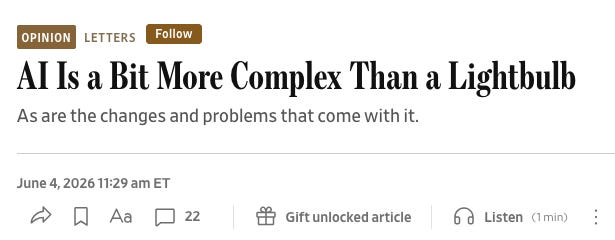
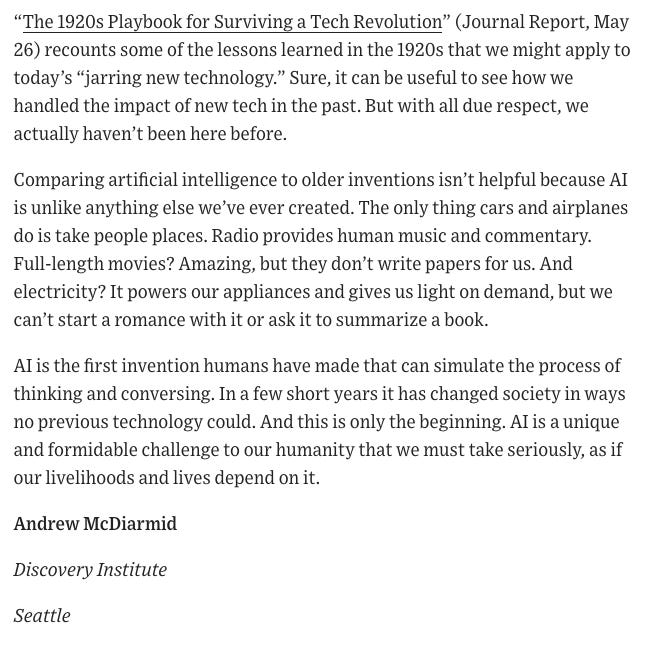
In a letter to the editor responding to the article, I made the point that we actually haven’t been here before: we are the first people in history to wrestle with the unique challenges of artificial intelligence. The Wall Street Journal published my letter in the print edition (June 5) and online. For those without a WSJ subscription, I include the full letter below:

So AI is not neutral, and I also argue that it’s not just another tool either. The moment a tool can think for itself, it ceases to be a tool. At that point, it is a stronger force, a partner perhaps. As such, if it does more of the thinking work than us, it will be the dominant partner, the driving force in producing output. Humans will need to stay in the dominant position when partnering with AI or else subordinate their creativity and sovereignty to AI.
Thanks for reading The Human Adventure! This post is public so feel free to share it.
No posts
Comments
Nothing yet. Say the first thing.
Sign in to join the conversation.