
Summer is the perfect time to kick back and relax with some great reads about energy and development. (What could be better?!)
Our team shares their recommendations, or what they plan to read, below.
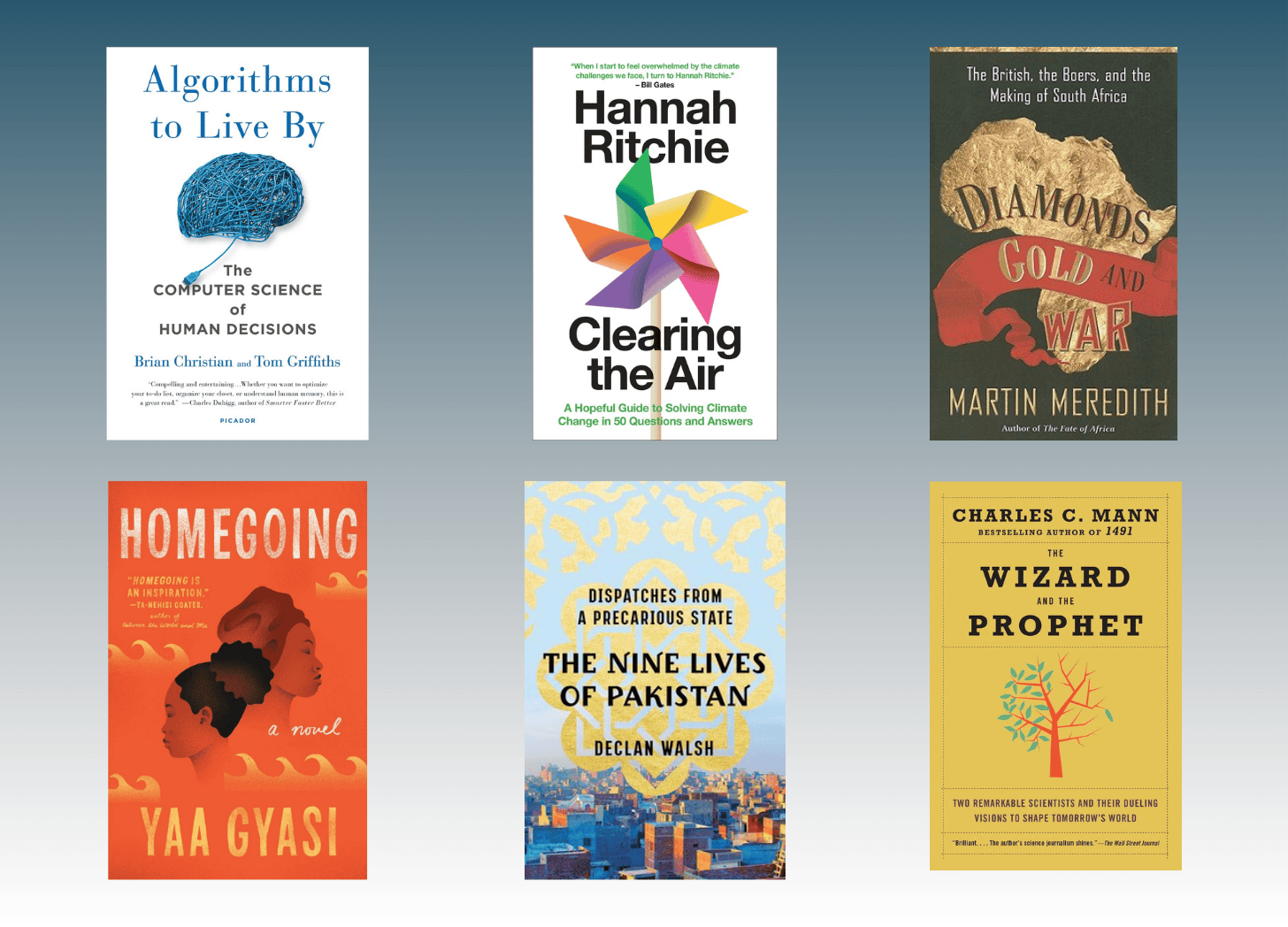
Algorithms to Live By: The Computer Science of Human Decisions, by Brian Christian and Tom Griffiths
Written for a general audience, this classic opened my eyes to how powerfully algorithmic thinking can improve the way we navigate everyday and societal problems. The authors describe how overly rigid clinical trial designs in medicine can cost lives, potentially on a significant scale, because they cannot adapt as new evidence arrives. I keep seeing the same lesson in electrification planning. This is a must-read for anyone who suspects improved information and decision-making can drive significant value in everyday life and across society.
- Stephen Lee, Director of Analytics
Clearing the Air: A Hopeful Guide to Solving Climate Change in 50 Questions and Answers, by Hannah Ritchie
I’m going to shamelessly recommend a book I have not read, but plan to! The enthusiasm and urgency that once defined climate conversations have clearly faded from everyday discourse. Much like after the COVID-19 pandemic, many people are struggling to recalibrate, unsure how to think about climate change, engage with it constructively, or separate genuine progress from rhetoric. This book offers a pragmatic, data-driven, and hopeful framework for doing exactly that.
- Meron Tesfaye, Innovation Director
Diamonds, Gold, and War: The British, the Boers, and the Making of South Africa, by Martin Meredith
This book explores how the diamond and gold rushes of the late 1800s shaped the region’s history and politics. Meredith highlights early industrialization, tracing how these resource booms established the labor and migration patterns that still shape the country today. He shows how early electricity infrastructure in Kimberley and Cape Town propelled growth by fueling economic and industrial expansion.
- Daniel Johansson, Research Associate
Homegoing, a novel by Yaa Gyasi
I read this in less than a week. It’s a beautiful novel about two half-sisters born in 18th-century Ghana/ Gold Coast and the very different paths their families take across generations. Each chapter follows a new descendant, showing how colonialism, racism, migration, and survival shape lives over centuries. What stayed with me is how each chapter ends just as a character’s life begins to take shape then the story jumps forward which left me with a profound sense of loss and how much of history is never remembered.
- Rushaiya Ibrahim-Tanko, Global Policy Director
Nine Lives of Pakistan, by Declan Walsh
This book emphasizes the difficulty of doing meaningful work with corrupt governments and how a few idealistic individuals can have the power to change a country for the better. One of the best books I’ve ever read.
- Hamna Tariq, Research Associate
The Wizard and The Prophet, by Charles Mann
This is the ideal book to understand today’s tensions within environmentalism and the climate movement. Mann’s storytelling has powerful parallels for energy, too, between competing visions of scarcity versus abundance.
- Todd Moss, Executive Director
Unlocking Global Geothermal Energy: Pathways to Scaling International Deployment of Next-Generation Geothermal, by Milo McBride for the Carnegie Endowment for International Peace
Want to get smart on a game-changing energy resource that could unlock clean, 24/7 power globally? Read this piece. It covers everything from the science behind the technology to where it is (and can be) deployed in emerging markets. And it happens to be a technology on which the US leads. After reading this report, you’ll be the hot topic at your next geothermal party.
- Casey Dunning Davis, US Foreign Policy Director
The case for geothermal power, by David Gelles in the New York Times
Geothermal is having a moment. Fervo Energy, a company that developed next-generation geothermal technology, went public in May and is valued at $10 billion after its IPO. For the Times, Gelles delves into the promise and challenges of this technology, and how soon it might become a reality. The Hub is working on what this means for emerging markets and examining whether the hype lives up to the potential.
- Shalini Rao, Policy Associate
Do Renewables Make Electricity Cheaper? by Jan Rosenow on Substack
Rosenow shows that while renewable energy can reduce generation costs, the prices ultimately paid by households and industries depend on a much broader set of factors, including network costs, market design, and regulatory choices. The piece is particularly relevant for debates on electricity affordability, industrial competitiveness, and the economics of power-sector reform.
- Ammar Mohammad Khamis, Policy Associate
This reading list was originally sent to our newsletter list. Sign up to receive occasional updates on everything the Hub has been up to.
Share this post with the avid readers in your life:
Comments
Nothing yet. Say the first thing.
Sign in to join the conversation.