
New York City has always been a place of capital. This has been true from the moment it was colonized, when the Dutch, astounded by the harbor they had “discovered,” decided to make the tip of Manhattan a trading post.
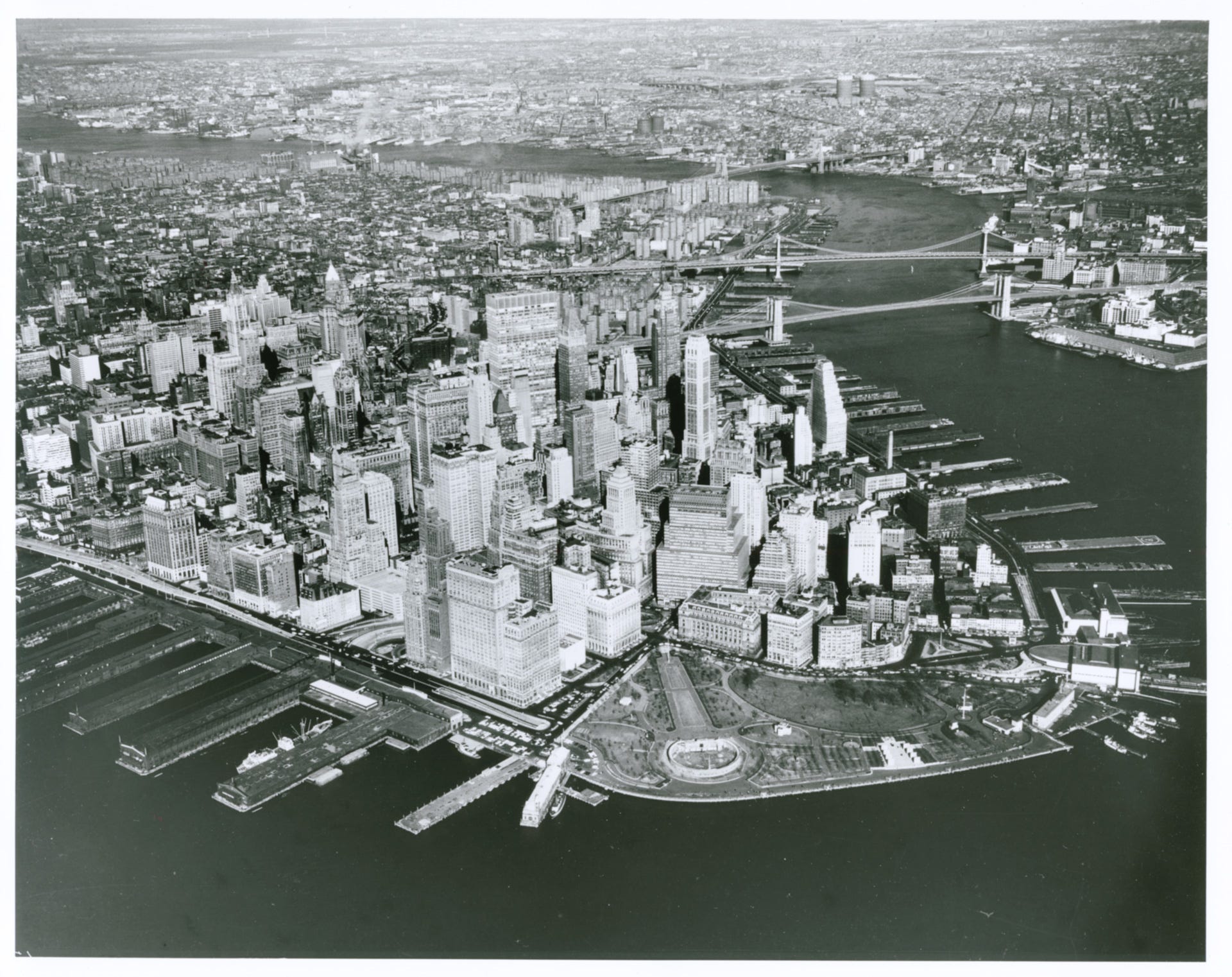
That idea of the exchange of money and property continues today. It’s hard to ignore the hustle and grind it takes to traverse the city, let alone just getting to and from work. To watch the people hanging onto the subway pole with their groceries on their arm, in hopes of eating dinner before 8 p.m.
When I worked in the fashion industry and had to do installs of window dressings starting at 4 a.m., I would ride the train to Upper Manhattan. I would be on the train with all the other invisible bodies who make the city run, knowing that we all probably wouldn’t be home until 8 p.m., trying to catch a few more minutes of sleep on the rocking A train.
And yet, despite exhaustion, cost of living, and nervous system overload, there has always been a bathing and leisure culture brewing below the surface—behind hidden doors or on the fringes—to escape the grind.
Sometimes quite literally, like at Spa 88 (the Wall Street Baths), where you can hear the subway in the steam, or Spa Castle, which backs into Powell Cove at the edge of Queens. If you look hard enough, you can find Brooklyn Banya in Bensonhurst, behind a metal stove gate, or Mermaid Spa at the tip of Coney Island.
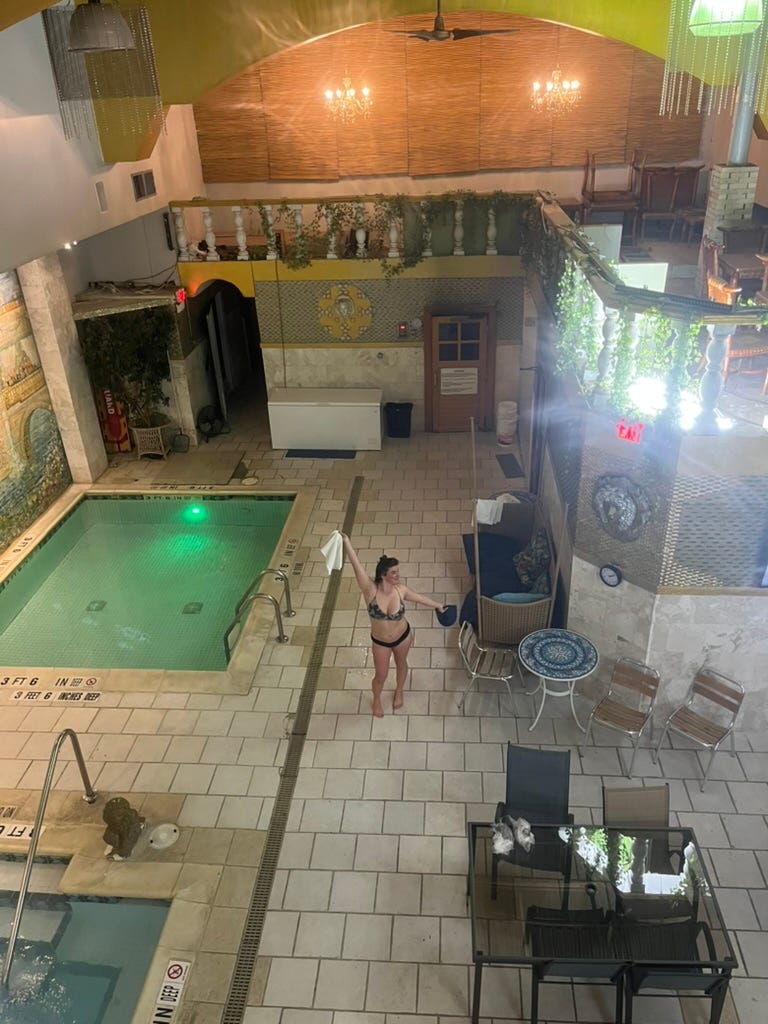
(Not to mention all the smaller bathing sanctuaries that stay out of the press as much: Healing Spa Woori, New York Spa and Sauna, Bathclub NY, etc.)
Recently, we have seen a surge of newer bathhouses (Othership, Lore Bathing, Akari, Bathhouse, and more). They all seem to have certain things in common, but most striking is their price point (most start around $65 and up, or are private memberships). There’s no denying that there is a price to pay for “wellness” in NYC, despite anyone’s good intentions, if they are there.
And yet, the irony is that if you dig deeper—even past the most visible “old school” spots of NYC—accessible public bathing and public leisure have been around long before some of the most well-known establishments.
Prior to the 1980s, the bath torch was carried mostly by gay bathhouses like the Everard Baths (1886–1986), the Continental Baths, and New St. Marks Baths. Not only were they affordable, but they were cultural pillars for safe space, creative expression, and yes, pleasure.
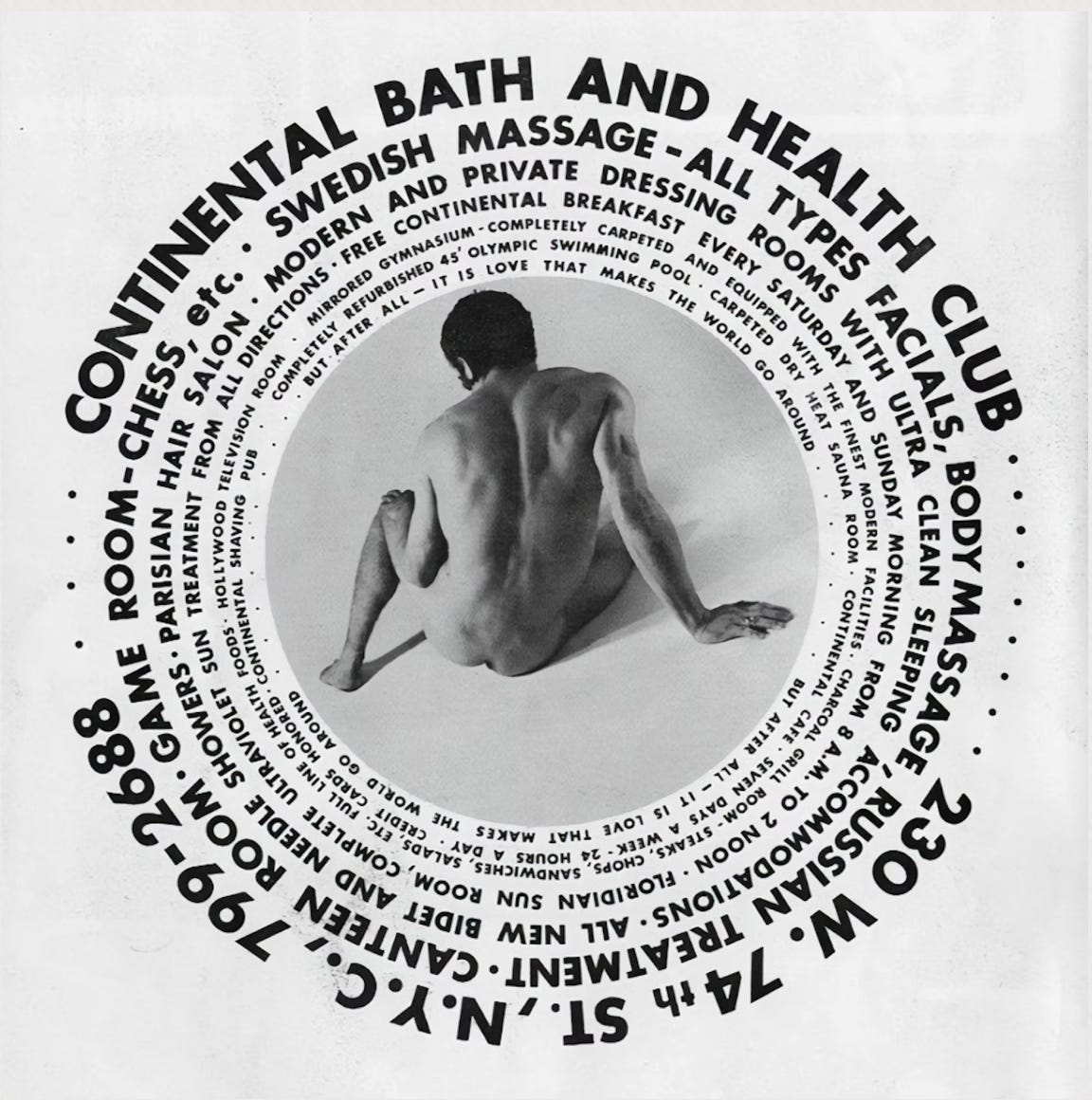
All were closed during the AIDS crisis, at a huge loss for the queer community. I think there is a reluctance to acknowledge these establishments, possibly from homophobia or fear around pleasure/sex, or a general denial of who, what, and where might be responsible for NYC “culture.”
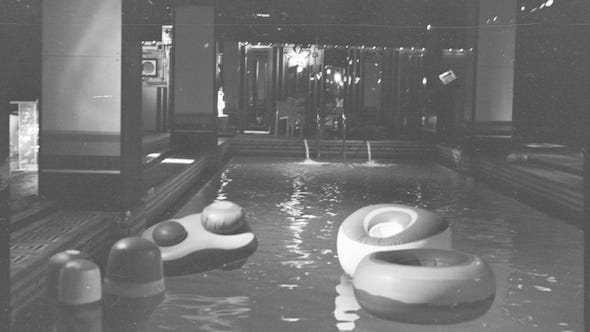
And even earlier than that, in the early 1900s, the city attempted to offer public bathing as a health and well-being resource—mostly to serve immigrant communities living in tenements on the Lower East Side who didn’t have access to bathing facilities. This is when the East 10th Street Baths began serving mostly Jewish and Russian communities living in tenements on the Lower East Side.
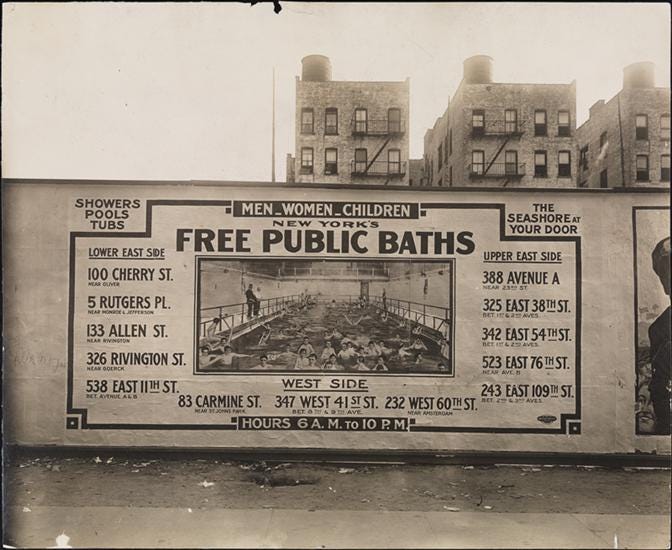
A city committee in 1897 decided that “cleanliness of person is not only elevating in its effects upon the mind and morals, but also necessary to health and to the warding off of disease.”
So the city went on a bath-building frenzy. A public bath (with a five-cent fee) went up on Centre Market Street in 1891.
In the next two decades, more would be built in tenement districts: East 11th Street, Rivington Street, Allen Street, Clarkson Street, East 23rd Street, East 38th Street, West 54th Street, and West 60th Street, among them.

As we saw recently with the first sauna village in New York put on by Culture of Bathing, it is obvious that New Yorkers want more access to saunas in a more visible and accessible way.
They want to go to many different saunas. They want to be by the river, in a park, and maybe even a parking lot (which has been happening quietly with some sauna operators like Red Hot Sauna, etc.).
But how did Culture of Bathing meet this public need? New York Magazine writer Madeline Leung Coleman, who visited the festival, stated:
“Maybe this is the uniquely American bathhouse culture: a steam bath of productivity and profit and a vague sense of origin, with the occasional plunge into the murky depths of public-private partnerships.”
I do think it is uniquely (white) American to mix commerce into everything and make it the priority. American culture does not know how to gather without it being for a lot of money—concerts, football games, weddings, to name a few. There are only the models of “nonprofits” that lean more toward community.
Within those confines, you are still put into what some friends call the “nonprofit industrial complex,” a vicious cycle that requires its employees to beg for money from the wealthy, with fiscal years being stressful and never quite the same.
And now, with shiny new bathhouses popping up, the stalwart bathhouse prices have gone up because of the arrival of these “new destinations.” It was not that long ago that you could attend most Russian and Korean bathhouses in NYC for $35 during off-hours or through Groupon. It is now common to pay $65 and up, which makes it a luxury or treat—not regular mental and bodily maintenance.
So as the SoulCycle-ification of sauna occurs, and it becomes something of a members-only club—or a literal club—my hope is that we can keep in mind this idea of “enough-ness” and temper our own greed. Especially in the capital of greed, NYC, which—with the recent election of a mayor running on a platform to make NYC affordable again—is something that is clearly desired.
What would it look like for operators to partner more with public spaces or public projects? How much would it really affect the bottom line if people had discounted days, or a few discounted tickets that were heavily advertised and distributed?
Can “American” sauna culture return to the idea of public health and honor the tradition of offering people space and time without needing to make so much money from that endeavor? I do think it’s possible, and I think it’s happening in smaller cities, where smaller sauna operators are responding to their communities and offering a health service at a reasonable price.
We’ve seen some of these larger-scale ideas allow for intimate connection and release, like with Public Sweat in Toronto. Originally a collection of small saunas curated and made by artists in 2023 (go look at them—they don’t allow more than six people in each one, and some are incredible), it now offers pop-ups for $10–$20.
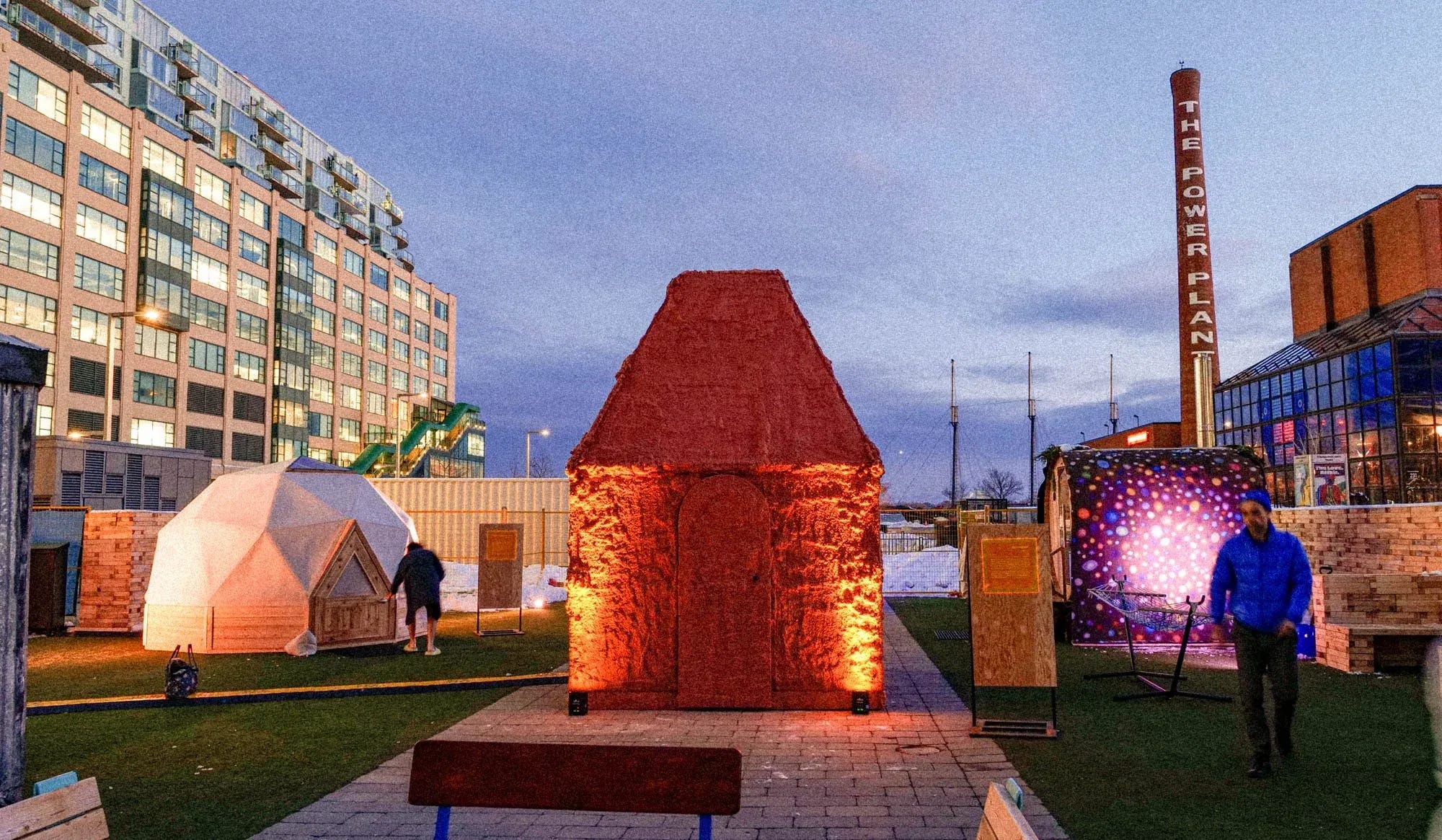
As war rages on and our dollar is less impactful overall, it is more important than ever for people to open their minds to a business model that may not include so much excess.
As a city girl, New Yorker, and Philadelphian, I hope that my fellow city dwellers can get a taste of a non-supersized version of relaxation—where you don’t have to pretend you are on the MTA and wish everyone would just shut up…
We’ll see you there!
No posts
Comments
Nothing yet. Say the first thing.
Sign in to join the conversation.