
In our third installment of our Hot Room Vol 2. journey we are sharing an interview with Morgan Evans from Business Casual. It is all about feedback, conflict, and how to see those things as generative to create a better world. If you are interested in some free resources around feedback check out this link to learn more!
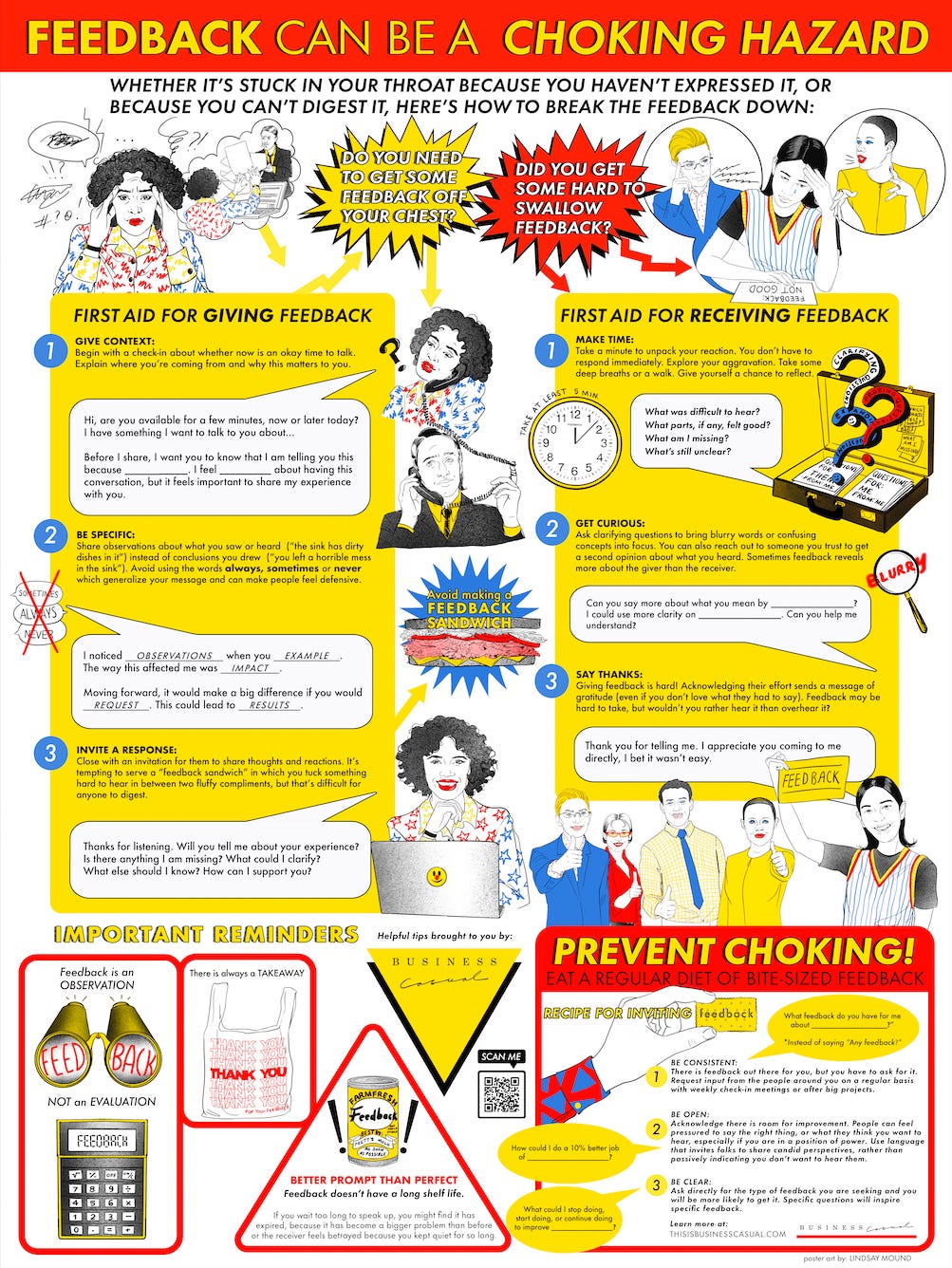
Can feedback change the world? Big Towel sat down with Morgan of Business Casual to talk it out.
BIG TOWEL: How would you describe Business Casual?
MORGAN: The way I describe business casual right now is I help provide scaffolding for real talk at work. So I lean on my expertise as a conflict mediator and my background in learning and development and in HR and being trained as a circle keeper and a group facilitator.
I straddle this line between being like a person who identifies as like like a queer person, a progressive person. But I’m also drawn to structures and frameworks. The real structures of how people gather and organize and build consensus, make decisions, deal with conflict, give feedback. So I try to package and borrow, beg, borrow and steal the corporate structures and then package them in ways that work for creative, non-corporate business owners and founders.
BIG TOWEL: You’re like a camp counselor kind of..
MORGAN: Yeah. It’s true. I did actually work as a camp counselor once at a hippie camp. Actually every Sunday, we would sit down and talk about all the campers and then we’d have a camp-wide circle meeting where everyone shared openly with each other 3 times a week.
BIG TOWEL: Um, sounds very similar to some of your work now. That’s so interesting.
MORGAN: It’s true. I really love being there. Like in moments of crisis, I just got off a call with a client who has to give feedback to her direct report. And she was like, is this real? Should I give it? Does it matter? And so we talk it through. So yeah, a coach hype, hype beast, you know, for the hard stuff.
BIG TOWEL: Love. Love. Okay. I am really curious about this answer to this question about why you think giving and receiving feedback is so important?
MORGAN: Thank you for asking. Um, honestly, this is all I ever want to talk about. I really do think that feedback can save the world. I think it allows us to have a more three dimensional sense of ourselves in space, physically and in our relationships. And I think that some of the most painful things we go through happen because of a lack of feedback. Feedback is fundamentally not chill, but trying to make it just feel a little less terrifying, a little less scary. I think it allows us to avoid some of the really most painful parts about life and work where relationships end, where projects get totally scrapped, where feelings get really hurt.
BIG TOWEL: How would you describe feedback?
MORGAN: Especially as our world gets more evil and more violent and more bullying, we really need to understand how to make people feel comfortable and feel heard. You’ve heard me say this analogy before, but if conflict is like a roaring fire, feedback is like the smoke that gets in your eyes and makes you tear up, or makes you cough. It’s the signal that something’s off and it needs attention before it flares up.
BIG TOWEL: ooo yea, I like that.
MORGAN: Yeah, it’s like, I’m not sick yet but I’m getting the tickle that tells me I am coming down with something. I think the concept of feedback is kind of a challenge because it’s so corporate and dorky and so cringe that everyone’s just like none for me, thanks.
BIG TOWEL: But it’s interesting because in the world that we live in, in the internet, feedback is really encouraged. Like everybody’s encouraged to leave reviews and talk about their experience, and yet in like a working relationship, it becomes so awkward or something.
MORGAN: Yes, exactly. The kind of feedback I’m training people to give is in the context of a two-way relationship. That’s the kind of feedback that can save the world, in my opinion. I think it’s really dark that we live alongside one another in society, but we are more comfortable going nuts anonymously on Yelp than being open and honest with a close friend or co-worker. It makes sense, because that kind of intimate feedback, where you are in dialogue with someone, has much higher stakes. It’s a long game, and there’s so much to learn about yourself in the process. But there’s also a huge opportunity there, and that’s why I do the work I do. I just think that if we get more comfortable with feedback, it makes work better, and honestly, it makes people better as well.
BIG TOWEL: What are some of the most common things that you encounter when you work with people about feedback?

MORGAN: Across the board feedback makes people escalate. Even hearing the world can make their bodies activate. It does something in the lizard brain, it makes you start to vibrate. Research has shown that it ticks off the same part in your brain that lets you know you’re in physical pain, because we associate it with a potential threat of social rejection or of, like, losing our job. Feedback makes people feel really anxious and the stakes are high when you’re giving it, the stakes are high when you’re getting it. And I think it’s hard. So yeah, the most common thing I encounter is people being nervous about it, and therefore avoiding it. What I try and do is help offer a perspective that makes feedback less threatening, encouraging people to think about it as an observation versus an evaluation. Feedback is vulnerable, whatever side of it you’re on, but the more we expose ourselves to it, the better.
BIG TOWEL: How do you think feedback relates to conflict resolution and larger societal transformation work?
MORGAN: One of my favorite quotes on this topic is from Priya Parker, an author and a facilitator, who writes about how more than unhealthy conflict, the bigger threat for our society is unhealthy peace. And I think that it’s because we are so resistant to conflict and to saying stuff out loud, partly because of fear of cancel culture. There’s another quote that comes to mind here, from a journalist named Sarah Jaffee who says, when you expose a problem, you pose a problem. Like none of us want to be the buzzkill or like the jerk or the one whose feelings got hurt last night, right? So we’re taught to kind of swallow that stuff. And I just think that this tendency has done us such a disservice, like we have such a backlog of things that haven’t been said out loud, and feedback that hasn’t been delivered. All of this silence and avoidance creates deeply destructive forces in our society, and can manifest in people doing serious harm to each other. There is a lot of social pressure to, like, keep the peace and go along with the status quo. And I think that’s a really, really flawed narrative to live by. Not just in terms of what makes our relationships work, but also what makes us happy in life. Friction is inevitable, conflict is inevitable and allowing safe space for these moments where the wires between us are frayed is what makes our relationships generative. When we never talk about it, or it doesn’t get acknowledged, that’s where we lose relationships or they end up leaving us aching, right? So much gets lost when we don’t speak up.
And that’s why I do honestly think feedback can save the world. Like if we got better, especially in social justice space or when working on radical projects, got better at being like, “when you use that word, this happens to me,” we could build more inclusive and authentic interpersonal relationships – which are a critical for collaboration.
I think it’s going to be a whole lot harder to do transformative work on the streets and in the public sphere if we can’t speak openly on a person-to-person level, especially in movement spaces. Giving and getting feedback successfully, curiously and kindly is a crucial foundation for the work that the world needs us to be doing right now.
BIG TOWEL: I agree. I love that. It’s so true. Those are uncomfortable and painful, and will move things forward. Feedback on yourself?
MORGAN: Running a business is a constant stream of feedback because I’m bouncing ideas and projects off of so many people and I’m constantly in rooms with strangers who have reactions to what I’m doing. The feedback I would give myself? Trust your gut, people can tell when you’re faking it.
No expert, no class, no book can tell you what to do with your time. You need to get clear on what is the thing that only you can do, the thing that brings you joy and then don’t let anything get in the way of you doing that. I’ve been trying to build my business around this and I think it’s working…
I’m a really busy person, in almost constant motion, so I am working right now on trying to cultivate stillness. I even quit coffee recently to work on settling my nervous system and get better at listening to my body. It’s wild how much more uncomfortable I am being still versus running around doing chores and checking things off a never ending list. Lots to explore there…
No posts
Comments
Nothing yet. Say the first thing.
Sign in to join the conversation.