
Nature is always my favorite teacher. And in this world of rapid technological transformation, where humans can lose their balance and sense of place as artificial intelligence takes over more aspects of our work and systems engagement, I invite you on a journey to my chicken coop…where life’s miracles continue to surprise and delight in magnificent ways.
My chicken coop is the Taj Mahal of chicken coops. It hasn’t always been this way. When we bought the farm in 2011, we inherited an old run-down coop. But what did we know about tending to chickens? We got a small flock going, cobbled together a bigger hen house from pieces and parts of scrap wood around the farm, and gave it a go. We learned lessons along the way on best practices for keeping the flock safe from predators while free ranging. Sadly, those lessons often come at the expense of losing birds.
After the ups and downs of several flocks over the years, we had winnowed down to about 5 birds by the Spring of 2025. When plans for a summer vacation went sideways because a friend’s passport wasn’t renewed in time for the international trip, we found ourselves in the vulnerable position of feeling emotionally tender while also being at the local farm feed store on a day when they had new baby guinea hens. How could we resist? We have always had guineas but were down to just one and he was lonely. Before we knew it, we came home with 9 new keets (baby guineas) and 16 pullets (baby hens).
This set off a domino effect. Where would they live when they outgrew their brooder pen? We cleaned out the lean-to on the side of the barn and devised an entire new spread of space that included a chicken coop with a sparkling new hen house, a run that covered 3 times the amount of square footage, a maternity ward for rearing chicks, and a guinea coop. We hired a contractor to get quality design and longevity from our investment. We spent way more on this coop than we would have spent on the vacation!
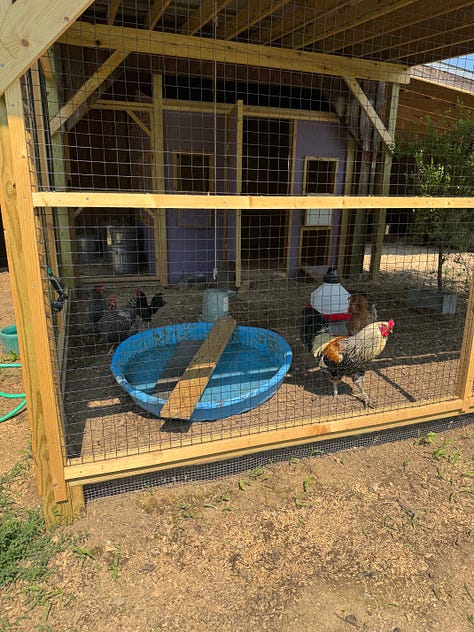
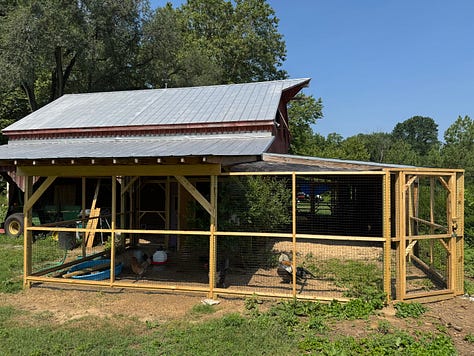

With the pride that comes from a new space like this, along with our love of these birds, I decided from day one that this coop was going to stay clean in ways our other coop hadn’t. I committed myself to daily cleaning of the space to keep down on odor, flies, and other unwanted mites and critters.
There’s a lot you learn from chickens when you hang out in their spaces on the regular. What you attend to begins to reveal itself to you.
I get to watch the ritual mating dance of the roosters (they extend a wing of feathers outward and dance around it like a little bull fighter) and learn about their special cooing sounds when they turn up a treat and want to give it over to an adoring hen.
I have learned the difference between the hen squawks expressing sociability and approval versus the ones that register complaints. I got to know which hens like to lay their eggs in the morning and which ones are the late afternoon stragglers. Hens fight over a favorite nesting box. Some protest with loud noises when their eggs aren’t coming out easily.
Chickens like to play. I made them a swing. And some climbing challenges. I got them a ball with a bell inside. And they think they are quite gorgeous when they have a mirror to stare at themselves.
I pick a buffet of snacks from around the farm. They like chick weed (ah, that’s why it’s called that!) and lamb’s quarters – but only if they haven’t grown too tall. And I’m blessed that our friends at Red Acres Hydroponic Farm give us lettuce scraps on the regular.
And their favorite snack of all – dried meal worms (at $100 per bag – these eggs are worth their weight in gold!) – gave me an opportunity to test if my chickens were trainable. I set up a triangle bell in the coop and rang it every time I gave them worm snacks. I wanted them to associate the bell with their treat. When the babies grew big enough to have free-range roaming privileges, I found I could ring that bell at night and something marvelous would happen: chickens running full speed from every direction of the farm, racing into the coop to get their worm snacks!
Yes, I have Pavlov’s chickens.
But perhaps by far, the thing that has charmed me most about my love affair with our farm’s flock, is being with one of our hens during her recent broodiness.
For the unfamiliar, chickens will sometimes get “broody,” which means they will sit on a clutch of eggs for 21 days to incubate them and try to hatch baby chicks. I was dubious whether these eggs were viable. Our beloved rooster, Chaz, died last year and left us with one tiny Bantam rooster who, by breed design, is about a quarter of the size of the other chickens. Let’s just say that while he is eager in the copulation department, he’s not quite mechanically getting the job done.
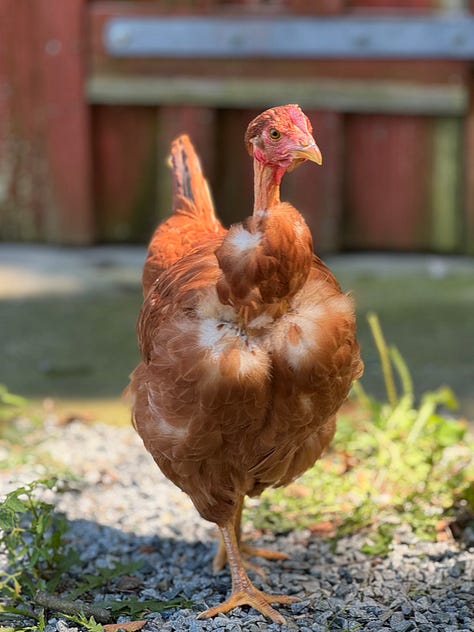
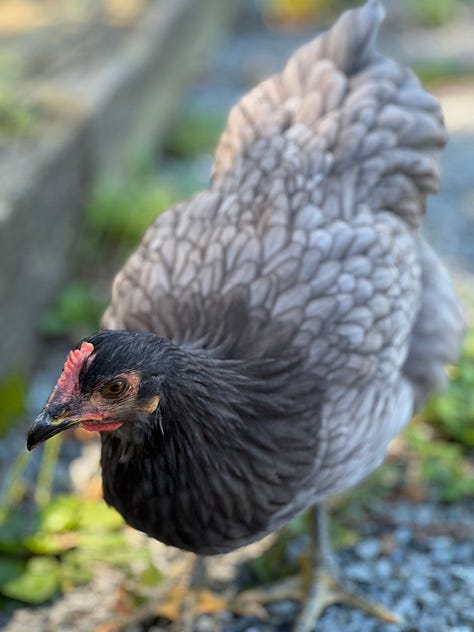
So I marked the date in late April and expected she might hatch by around Mother’s Day. How fitting. What happens if you don’t move a broody hen to their own space, though, is that every hen wants to lay in her box to make the clutch bigger. And then you have a bunch of eggs with different delivery dates. It becomes kind of a mess. But remember when I told you about our maternity ward? Well, the guinea hens decided to take it over with their communal nest – which felt a little like winning the lottery because guineas are notorious for hiding their nests in the wild. And we love guinea eggs! So I didn’t want to displace the guineas and just decided to roll the dice with this Dominique (her breed) in the hen house.
I candled the eggs about halfway through. This is a process of pulling them from under her in the middle of the night and putting them over a flashlight to see the progress of the embryo. Or in our case, with a little quarter rooster like Penguin, not seeing any signs of life inside the egg.
I felt bad for the hen. She’s clearly committed to this. I read that it’s not impossible for a Bantam to get the job done with a regular sized hen so I let some more eggs pile up and wished for the best.
By late May, it was clear no eggs were going to hatch and I tried my best to break her of being broody. The problem is that once a hen commits to being broody, instincts take over and she thinks she needs to keep sitting until the eggs hatch. I picked her up each night, removed the eggs, and forced her to stretch her legs and have some time outside. But she inevitably returned to her nest and her desire to keep those feathers (and tomorrow’s eggs) warm.
By mid-June I was getting worried about her health. Broody hens don’t eat or drink much and get almost no exercise. That’s usually fine for 21 days but after clocking two months, this was too much.
I decided to take the situation into my own hands. I called around to find a Tractor Supply store in my area that had brand new baby chicks. I drove to Middletown, Delaware, and bought four two-day-old Red Rock chicks. As I was selecting them, I said a little prayer, “Who wants to come to the farm with me? You are either going to be the most blessed chickens and have a wonderful mother or you might be cursed and die tonight. Who wants to take a risk?”
Mother hens are either great or awful. Almost no in between. They will either take to mothering or they might peck the babies to death.
I waited until late at night and then placed the babies under the broody hen (they are catatonic at night when they sleep). The hormonal shift from incubating to hearing peeps often causes a broody hen to accept any newly hatched chicks as her own. I prayed so much that she would wake up in the morning and be ecstatic that she finally did it!
AND IT WORKED!!!!
I got up early the next day after sleeping fitfully, worrying that if she rejected them in the middle of the night, the babies could have also died from getting too cold. I braced myself to find four dead chicks in the nesting box just in case my experiment failed. But much to my astonishment, her babies were running around with excitement – jumping playfully on top of mama’s back and darting under her feathers for warmth – and the mother hen was beaming with pride.


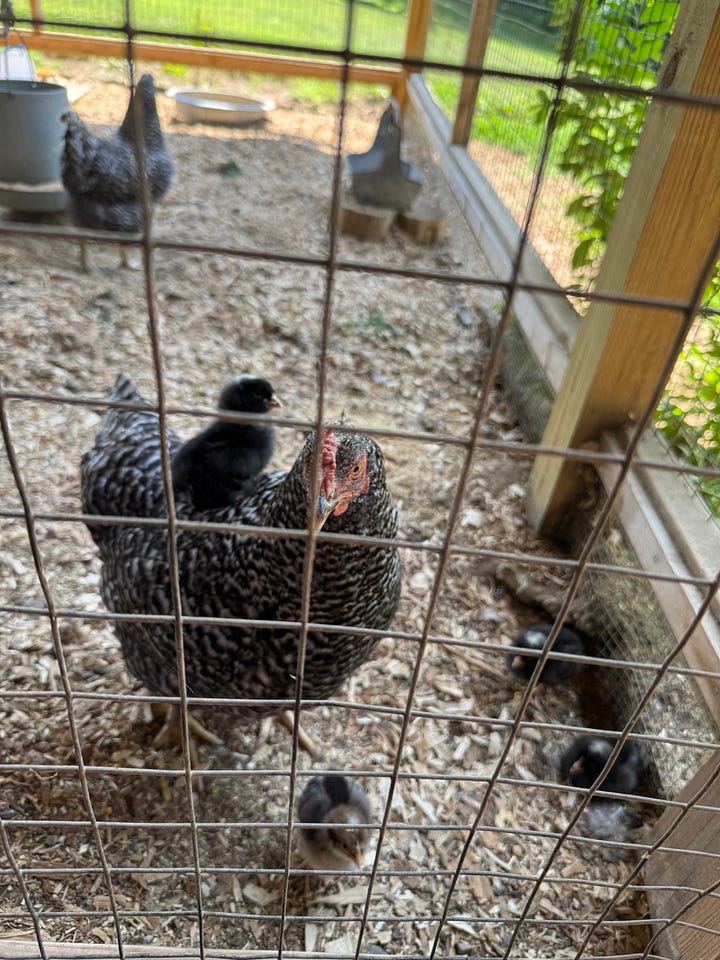
Through this ordeal, we decided that the new mother hen earned a formal name. When we adopted her, she was among five Dominiques and it was too hard to tell them apart to have any names stick. She has certainly cast herself apart from the others now.
We named her Mama Sisu. The word comes from Finnish, and it’s one of those beautiful concepts that’s hard to translate with a single English word. It encompasses quiet courage, grit, determination, endurance, resilience in the face of long odds, and continuing when giving up would be easier.
And I am, once again, a proud chicken Grandma.
I cry easily when I am moved by nature. And to be sure, I have been overwhelmed by tears many times in the past week while I have been tending to the new babies and watching them seamlessly integrate with the bigger girls – and, most especially, watching the beautiful way that Mama Sisu watches over them.
Their fuzzy little butts. Their sweet faces peeping from under Mama Sisu’s feathers. Watching them learn to hunt and peck and scratch. Seeing how well they run back to Mama’s side when she calls for them.
It’s moments like these that I touch into the wonder and beauty of life. I’m constantly reminded by the natural world around me that our planet is full of indescribable beauty, if only I stay away from my phone screen or computer work long enough to notice it and allow it into my heart. These experiences are golden and regularly help shift and reshape my relationship to life’s daily challenges.
Somehow the stress of national politics and what feels like the crumbling of democracy is soothed when I take in a new view. I’m not saying that my chicken coop erases what is happening in the world – nor am I an advocate of living in denial about it; however, it does seem to give me greater skills at knowing how to keep it all in perspective and not allowing it to become my dominant point of attention.
Energy flows where our attention goes.
In a world overflowing with noise—headlines, alerts, feeds, and endless scrolling— our attention has become one of the most valuable forms of currency. Where we place it shapes our reality, our relationships, and our shared future.
Nature trains our attention. It is calling you, too. Who do you see? What will you find? Where does your heart sing?
I honor your attention. It is sacred. Each time you read, listen, share, or engage with my work, my hope is that it helps you kindle the collective flame of compassion, connection, and courageous hope that we can co-create a better world together.
So, thank you. Thank you for choosing to read this story, to pause for a moment of reflection, and to give a bit of your precious attention to something I like to write and teach about: restoring faith in the heart of humanity.
And if you are inclined, say a little prayer for my new babies. As I write this, it is 100 degrees and all of us are struggling a bit. Time to go back out and refresh their water. More soon.
Comments
Nothing yet. Say the first thing.
Sign in to join the conversation.