
Folks might not see an inherent connection between military theory, strategy, and tactics and grassroots organizing. There are, in fact, inherent connections, and many folks make them subconsciously when protesting. For example, the recycled tactics of mass mobilization for direct confrontation/disruption and holding space/ground.
In analyzing modern protest movements, much energy and resources are put into mass direct disruption/confrontations and holding space and ground. Be it a street, a highway, or creating an encampment, etc.
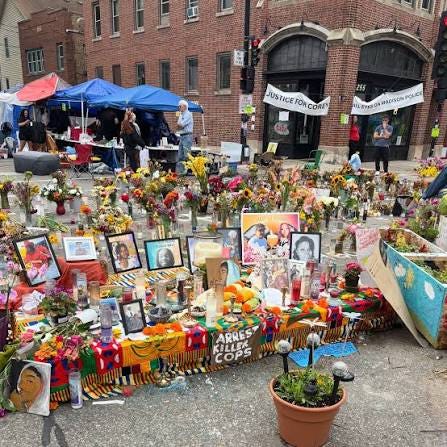
This partly happens because of a certain way people view military conflict. People mistake war for holding or taking ground by force; they evaluate war by the ground held and the people killed or wounded. Now, while these things do matter, they are far from all that does matter. This view of war ignores many pieces: logistics, resource mobilization and management, strategy, operational art, and most importantly, the politics of war and conflict.
A quick aside: I’ve been using the word “legitimacy” recently when talking about protest and resistance movements. Using that word has been an intentional, reductive rhetorical choice, instead of using the word “politics” or “political”— when you inject “politics” into these conversations, people far too often think solely of electoral politics. And while politics is the more encompassing term, legitimacy matters.
Legitimacy gives entities power and social currency; it isn’t about how justified you believe your cause is; it’s how legitimate the population that isn’t directly engaged in your movement or conflict sees your cause. Creating a populace that has passive support for your cause undermines the political capital of your opposition, while also enlarging the pool of people who you can move into the active support part of the spectrum of allies.
In war, holding ground and casualty rates matter less than we think. In fact, in certain scenarios, attempts to hold ground are a strategic and/or tactical detriment to your ends. There are many situations where you do not want to hold ground, where it becomes more advantageous to give up ground.
When it comes to protests, the smart police departments give up ground for a certain period of time. Especially when the legitimacy of the protests rises higher than the government or police. They’ll let an encampment stay for a while; they’ll let you shut down the road or highway for a while; they’ll let you wear yourself out and let the public lose interest. Then, as the protest dwindles, they’ll come in, many times heavy, and break it up. They give up ground as a tactic to regain the strategic initiative, knowing the protesters can’t keep it up in the long run. Meanwhile, the police officers are making overtime pay, pay that drains cities of their resources for broader city services from taxpayers.
After the initial shock of Nazi Germany’s Operation Barbarossa wore off, the Soviet Union was able to recover, partly because they changed their defensive strategy. They used an old Russian tactic to gain a strategic advantage— they gave up space. In 1942, when Germany relaunched their offensives, the Soviets would let them take the land rather than attempt large confrontations (This is a generality, as there are always exceptions, looking at you, Stalingrad- which, yes, did create time for the Soviets to gather enough forces to launch a massive offensive). This meant they were able to keep their still fragile military intact and reduce casualties and loss of material as they built offensive strength. It was to their advantage to minimize the amount of large, massed battles, so they prioritized giving up space while prioritizing strategic areas of defense.
You can find lessons in the American Revolutionary War. George Washington knew the most important strategic task was keeping the Continental Army together. He knew that if he could keep the Army in the field and fight where they could, he could draw out the conflict to the point where it was no longer worth the headache for the crown. He lost most of the battles he fought in, but he never risked his army’s existence in battle. He would retreat, regroup, and come back again. Then, with a lot of help from the French, he was able to close the deal at the Siege of Yorktown.
You can find similar lessons with the North Vietnamese, who also implemented another strategy— developing goodwill within the populations of South Vietnam. The NVA largely avoided large pitched battles with the US Military, opting for a guerrilla warfare approach. This meant they were able to withstand the attrition of war in people and material, while increasing the cost for the US to maintain its efforts. In doing so, they dragged the war on, understanding that there would eventually be increasing political opposition—active and passive—to the war itself.
There are multiple lessons here; the first is understanding the strategic position you are in and your opposition is in. Then it becomes about orienting yourself around that, as you figure out your capabilities and raise forces. If you’re in a position where you can’t raise enough force for sustained direct confrontations, your goal is to stay in the field, then plan strategic operations and design tactics based on your capabilities to sustain the conflict and friction; that shifts passive support in your direction and becomes too politically costly for your opposition to keep up their efforts.
When a crisis happens, we often believe those are strategic moments to gather mass for a direct confrontation with municipal, state, or federal government. Most of the time, this is a poor strategic decision; it burns out your resources far quicker, while you face an opposition with far more resources, far more ability to sustain engagements, far more tools to dictate the pace and type of conflict, and far heavier resources.
To put it another way, if you create an encampment, there’s a mistaken belief you’re making them engage on your terms, but ultimately it is on their terms. You have to perpetually raise resources to keep it running. They can wait it out, and the opposition can crush it at any time. And in the end, you lose time, energy, resources, generate casualties, and things effectively return to the status quo.
The question becomes, if that’s not what we should do, then what do we do? You have to design strategies and a tactical toolkit that play to your strategic strengths and to your opponent's weaknesses. Then mobilize resources to execute those strategies and tactics, and then you design the operations (this is called Operational Art) to execute those tactics to your strategic ends. With, again, keeping to the idea that your goals are sustainment, and then undermining your opponent’s ability to execute their goals. What, in essence, you’re doing is strategic planning.
To put it clearly: You’re doing strategic planning to include the creation of a tactics tool bucket— every situation is different. It is incumbent to learn how to read each situation for what it is, develop the proper strategic goals and accompanying tactics to reach your goal, then design the operations (operational art) to execute those tactics. To do this, you have to adopt ideas of asymmetrical conflict.
Designing your strategic goals and larger strategy has to be more than a list of demands. To help, I created a list of strategic tenets of asymmetrical resistance:
Strategic tenets of asymmetrical resistance
Endearing yourself with the populace;
Strategic creation of tactical friction;
Division, dispersion, and coordination of efforts;
Sustainment of efforts;
Legitimacy as a resource.
From there, you start constructing your strategy, which should take the shape of a strategic planning process.
Strategic Narrative: You have to create a strategic narrative vision of the world you would like to see, what and who is currently in the way, and a unifying vision of how we can achieve the world together. Narratives give reality meaning; they make everything else actionable. Within this, you have your long-term goal, then create medium-term strategic goals, and short-term goals. While short builds to medium, to long, you want to start with your long-term narrative; that is the foundation. For demands, Amadi Ozier wrote a great piece on How To Win Your Demands. But designing these strategic goals brings us to the next step.
Nationalize a local cause: Create a narrative, built off your strategic narrative, connecting local issues, such as killer cops, local corruption, etc., to national issues like ICE and Trump's corruption. This helps those who might struggle with, say, seeing our current form of policing as generally good but seeing ICE as bad. People are less likely to see local issues around racism, economic disparities, and corruption in the same way they view national politics. When you make those connections, it becomes easier to activate people on local issues. And then the work you do on local issues builds your efforts towards a national project.
Power mapping: Identify the strengths and weaknesses of you and your opposition, in terms of resources (monetary, people, skills, material), organizational structures (decentralized, centralized, bureaucratic), and power. You will have fewer resources to bring forward, but this is where thinking asymmetrically comes into play as a strength. Power mapping is a good tool to use here.
Tactical toolbox: Start designing tactics around your strengths and your opponents’ weaknesses. This should be a toolbox, not one or two tactics, but an array of tactics that can be deployed to fit different situations, and that attack different weaknesses and pillars of your opposition.
Strategic Assessment of Opposition
Governments, at all levels, have far more resources to come to bear on resistance movements, organizers, and protesters. The habit of attempting to use crisis situations to mobilize en masse for confrontations eats up resistance resources far faster. Governments know this, and have designed their individual tactics and strategies to defeat them. With this knowledge, then a change of strategies and tactics need to be made— the need to take a more asymmetrical approach is prudent.
Not just that, but we need to understand the population; while these are indeed mobilization moments, the idea that disrupting the everyday lives of everyday people by interrupting daily city operations (shutting down streets, encampments, etc) will create change— based on evidence of the past 30+ years— seems to be a faulty theory of change.
We know their playbook, so it’s time to use it against them. Governments are large, bureaucratic structures that have a hard time changing course when unexpected or unplanned-for situations arise. And because of their size, they can also be stretched thin at certain points. Separate individuals out from the bureaucracy to be targeted—Mayors, DAs, Council Members, police. Don’t give them a situation where they can mass their resources to bring down upon you.
Example Part 1: If you have cop watchers, like ICE watchers, it becomes a point of friction and agitation. You’re not disrupting the flow of the city, so you maintain a good relationship with the wider populous, but you’re still creating targeted friction in how they expect to operate and like to. Not only that, we know officers' morale has been impacted by years of protest already; by such harassment, they will become increasingly agitated. And if an officer overreacts, your cause gains legitimacy.
On legitimacy: All states, all rulers, etc. throughout history have relied upon legitimacy to hold onto power. Once they lose enough legitimacy, their ability to govern starts to evaporate, and if they’re not willing or capable of wielding physical force to an extreme nature, that tenuous nature increases. So, let’s think through this.
Governments rely upon legitimacy, be it through force, services, meeting needs, keeping life running, etc. So the goal becomes decreasing their legitimacy in the eyes of the wider population. While this can be done through confrontation, it has to be done in a way that increases your own—disrupting everyday life decreases your long-term legitimacy, as it relies upon the goodwill of the people. And again, burns through energy, people, and monetary resources. Confrontations need to be held to a minimum and used judiciously as a tactic.
We know every level of government is failing to meet many basic necessities of the people. In fact, this is where we should look to the Black Panthers. The Panthers worked to meet the needs of the people and provided political education along with it, in ways the government wasn’t. Food programs, education, etc. This increased their legitimacy in the eyes of the community while decreasing state legitimacy.
Use the crisis moment to mobilize resources wisely, while taking into account all the available resources. Asking for skills, monetary resources, and strategic use of human resources. An early march or two makes sense to grab that energy to marshal resources, but organizations should quickly pivot. But start taking account of resources: people, money, food, shelter, skill sets, etc. With an already defined tactical toolkit, you can start directing those resources to the appropriate tactics. When you use these crisis moments to mobilize resources, not for direct mass confrontation, but for sustained efforts, your resource use is maximized, creating more favorable conditions for sustainment of efforts.
Judicious confrontations, with an asymmetrical mindset, are part of this as well. You can still organize direct confrontations, but most should not be en masse; instead, use small rotating groups designed for specific types of confrontations. Are you disrupting a city meeting? Bird dogging a politician? etc. Smaller confrontations that can quickly be executed and dispersed use far fewer resources, yet maintain friction and pressure on your opposition.
Identifying potential tactics before the crisis event is a must; this way, you can quickly allocate resources to already identified tactics to meet the specific individual conflict.
With tactics, keeping an asymmetrical approach is necessary. While also keeping strategic disruption and decreasing opposition legitimacy in mind, while increasing your own.
What services is the state failing to fully meet, and what organizations engaging in services might be allies? How can you help meet those services?
Who are the power holders of the state, who are elected, who are appointed, and who are their main backers? Where can you confront them, be it public meetings, their offices, bird dogging? What are asymmetrical ways where you don’t have to deploy large numbers of people, but perhaps a rotating small group, to create conflict in a way that exposes and undermines legitimacy and puts pressure on your opposition?
Continuing Example: Looking at Minneapolis ‘ response to ICE is a perfect example of much of this. They coordinated mass resistance through distributed networks and marshaled resources. They identified how to create friction in ICE’s operations by disrupting their operations through ICE watchers and whistles, harassing them at their hotels, making sure they weren’t welcome in restaurants, bringing food to immigrant neighbors, and so on. What this did was create friction for ICE, interrupting the way they want to operate; it decreased their morale, and confronted them in an asymmetrical way that made them escalate in a way that decreased their legitimacy, moving more people to the side of resistance.
Ask yourself questions:
How does your opposition like to operate?
How can you create friction?
How can you put pressure on them in ways that force them to escalate in ways that damage their legitimacy in the eyes of the public?
What are their levers of power? Currently, local democratic parties are ripe for hostile takeovers. This isn’t about “change from the inside,” but about capturing levers of power and then wielding them. Controlling local party structures means control of resources and infrastructure that can help grab further power structures. It also creates a way to keep allied electeds in line through carrots and sticks.
When a mobilizing event happens, see it more as a resource event than as a mass confrontation. People will be more willing to donate different resources: time, materials, and money. Some might be willing to add a donation “chip” to a local non-profit. You could identify a local non-profit willing to be a fiscal sponsor and hold the money while you organize businesses to add this donation chip, making it easier to build resources. You can work with allied and respected homeless providers, food banks, and more. You can mobilize people under your banner to help meet these needs. You can organize people to be police watchers. You can organize people to fill public comments, with small groups showing up to meetings. People who are writers and social media savvy can create a bank of social media toolkits and videos; they could bird-dog city leaders. Organize residents to put their property taxes in a public holding.
In essence, you generate ideas for tactics, then conduct broad outreach to mobilize resources through sign-up forms that ask people for their skills, time, and what they might be willing to do. Set up action meetings that break people into designated tactical groups: propaganda, research, disruption, organizing, services, etc. Those in charge of organizing each group synchronize and coordinate the larger direction, while these tactical groups are then deployed in mutually supportive ways.
Accomplishing these efforts will take a massive shift in mentality and how we operate. Reacting off of emotion and using the same playbook can no longer be an option; it is not to say there are no moments of mass confrontation, but those tactics need to be strategically deployed when it is identified as advantageous to do so, and they absolutely cannot be the tactics we reach to the most. Breaking habits is difficult, but one cannot look at the last 30 years of protest movements and believe they have achieved their strategic ends, let alone that they have been sustainable efforts. This playbook is also one the opposition expects to be used, and they are well prepared for it. It’s time to try something new.
Further Readings
On Strategic Nonviolent Conflict: Thinking About the Fundamentals by Robert L. Helvey
Waging a Good War: A Military History of the Civil Rights Movement, 1954-1968 by Thomas E. Ricks
On Operations: Operational Art and Military Disciplines by Brett A. Friedman
No posts
Comments
Nothing yet. Say the first thing.
Sign in to join the conversation.