
General Omar Bradly rose into the leadership ranks of the US Military during World War II. He was brought into the front lines as General Patton's deputy, but by 1944, Patton was serving under his command.
Bradly understood infrastructure and logistics, as well as the importance of political goals in conflict. This stands in stark contrast to the Trump administration, pushing for the idea of a “war fighter,” which is more akin to the Nazi German idea of “Kampfgeist” or “Fighter’s Spirit.” The concept of a fight of wills emphasizes a battle-centric perspective of conflict.
There is also another specific irony of this battle-centric view of conflict adopted by MAGA, which stands in contrast to the conservative project of the last 40+ years. The modern conservative movement has been carefully developed and refined over time. Wealthy conservatives built infrastructure and the logistics to wage social and political war against the America of the New Deal and Civil Rights Movement. The same forces that attempted to orchestrate a coup against President Franklin D. Roosevelt— The Business Plot.
The infrastructure that the right-wing built and bought, such as Fox News, The Federalist Society, Turning Point, The Heritage Foundation, Koch Network, OAN, Truth Social, Twitter, FreedomWorks, and many, many more, has brought America to this Fascistic Authoritarian moment. And not only are the leaders now focused on turning the military into a battle-centric force, but they are also caught up in battles against America and Americans. They are symbolically “stretching their logistical lines.”
While Democrats, Progressives, and the left have also built infrastructure, this infrastructure was built with far less interlocking coordination, vision, and different intent. Much of the Democratic Party and Democratic Party-aligned infrastructure was built around an electoral framework, understandably so. Progressive and “left” organizations built mostly issue advocacy organizations, but over time, many became part of Democratic Party-aligned infrastructure —and, again, were trapped within electoral focus.
There was some infrastructure built around deep canvassing and support. There was once a robust progressive media ecosystem as well, but the former turned primarily into issue advocacy and lobbying, with the latter dismantled to help fund the former.
We’re seeing the trap of that now: funding rises and falls within cycles, with no real interlocking coordination, no media machines, service organizations detached from political education, no community or relationship building, and no long-term vision for reshaping America—just theories of change, issue advocacy, and Getting Out The Vote (GOTV).
Simply put, the broad left has long been trapped by a battle-centric mentality, neglecting long-term infrastructure building. However, it doesn’t have to be that way, and if we invest now, we can outmaneuver a movement that appears weaker than it is.
Before diving into the rest of the piece, I want to reiterate an idea: the sustainment of efforts—our efforts must be perpetually sustained, not built around election cycles. While we might scale up during election cycles, everything we do must continue pre- and post-cycles; at no point should any effort cease. Only the scale should change.
Sustaining efforts creates ongoing pressure on our opposition, helping us gain the initiative and putting them in a position to react to us; in sports terms, this is dictating the flow of the game.
But one of the most essential concepts to carry through everything is that “battles don’t decide, the reveal.”- Phillips O’Brien. What do they reveal? The state of the fight between you and your opposition—elections and mass-mobilization events are our battles. And they reveal where we stand in contrast to our opposition— Infrastructure dictates our ability to conduct battles and sustain efforts.
Investing in infrastructure is more than just pouring money into things or chasing trends, such as investing in “influencers,” or a new, better mass-texting app. It is a form of strategic planning. The first step is identifying the infrastructure that is needed to launch strategic operations, for example:
Information/Communications
Person-to-Person: Person-to-person is the most traditional service; we often think of canvassing, phone banking, and texting, along with relational organizing. How we think about person-to-person needs has to evolve, though, even if it remains foundational infrastructure in communications. I’ll be exploring further what an evolution could look like when I explore tactics.
Media: Proxy and Official— Proxy media is designed for more narrowly targeted efforts, while official media is the parent organization’s branded media.
New Media: Social Media, Streaming, emails, digital ads, forums, etc. The need here is to identify which new media make sense. When developing strategic plans and operations, it becomes vital to think through how to allocate resources to each to execute different strategic operations and campaigns.
Traditional Media: TV, Radio, Print. While traditional media is no longer as foundational as it once was, it remains vital for shaping the narrative. Be it ads, interviews, or better yet, owning distribution networks like CivicMedia. The latter is the most impactful choice, and one progressives and the left are sorely missing.
Owned and Earned: The left has minimal owned media, and this is slowly changing — just not fast enough. For example, communication organizations like Progress Now use only official new media platforms, with some paid media on TV and in digital ads. But the creation of proxy press, which can serve as more grey propaganda, is a significant piece missing. You can build multiple proxy stations for different target audiences, pushing the same narratives as your official channels while mutually supporting one another.
No Joe-Rogans of the Left: It isn’t about finding the one or a few people that are a hit in any particular media ecosystem. But instead, it is about investing at the scale of ecosystems. Every audience should have multiple official, proxy, organizing, and influencer channels targeting them—it is about perpetual bombardment and persistent effort. Wonder weapons don’t win wars of attrition; sustained efforts across as many fronts as possible do.
Internal: This is more than email or Slack; it also involves secure communication networks to coordinate efforts between entities. This falls more into organizational redesign and deepening of coordination. While there are technical tools, this is about designing cross-organizational and internal organizational communication channels.
Training
Staff and volunteer training must go beyond onboarding, on-the-job training, and one-off training. Training must become a regular occurrence, using scenarios, post-campaign debriefs, or campaign-focused efforts. The Marshall Ganz model of organizing is instructive here in the effects of ongoing training—the snowflake model of leadership development, where part of the ladder of engagement is training the trainer for volunteers and organizers.
Staff: Staff must do more than traditional professional development to build technical skills. Organizations/coalitions need to implement scenario-based training during downtime, so cross-organizational teams can learn to coordinate and execute campaigns together.
Volunteers: Similarly, volunteers need more in-depth and ongoing training, especially when it comes to protests—note: it’s not that this is nonexistent; it’s not robust or expansive enough. People need to be confident in the tasks they are executing, from rudimentary to complex. We need to get them to a point where their tasks feel second nature, they can understand what to do in specific scenarios, and they can act once given orders with minimal instructions. In addition, enough must be trained to help less-trained volunteers in the action.
Organizing
I’ll speak more about it when I move into tactics, and I already mentioned the idea of integrated action teams, where organizing, digital, and communications are integrated at every level. But when it comes to organizing, we need to think longer term and design institutions for that. Primarily, deep organizing needs to take place; traditional canvassing, phone banking, and Get Out The Vote (GOTV) efforts should be secondary.
Infrastructure to enable people in third spaces, such as barbershops, churches, rec leagues, etc., to organize is a priority. People need to be developing non-transactional relationships, connecting with services that help meet community needs, or engaging in community events, which will pay dividends when it is time to GOTV.
Intelligence
Intelligence needs to move far beyond traditional opposition research and must also be deeply integrated into organizing and communications efforts. As Ravi Mangla succinctly said his piece, A New Blueprint for the Information War:
“Opposition research isn’t just for campaign cycles. It should be a year-round practice (this includes deep social listening). We cannot beat our opponents if we lack crucial information about their plans and aren’t actively tracking down information that could put them on the defensive or drive a wedge in their coalition.”
We need to expand and develop intelligence gathering strategies and tactics, creating profiles and databases of actors, organizations, and efforts by the right. All that to say, we need network mapping of funders, actors, and organizations. We need to start laying out different campaigns and operations, from Twitter bots pushing a narrative to the White House rhetoric that reinforces it.
We need to understand all the different network connections clearly, lay them out, and share them across organizations—no one should be operating without the clearest possible intelligence picture within their arena.
Coordination: I already wrote a lengthy piece on coordination, but creating deeply integrated coalitions is a part of the infrastructure and a key part of the effort.
Funding: Diversify your funding. Yes, continue working with large donors and foundations, but also strive to become a member-driven organization if possible. Develop what a member looks like—how involved they are in your operations, what roles they play, etc. Getting people to “buy in” creates more belonging and skin in the game while also creating more flexibility.
Additionally, through strategic planning efforts, some more creative funding mechanisms may appear.
DONORS— No more project funding; it's about infrastructure funding: it’s not about funding one specific initiative and hoping for results. But it is about funding a process of strategic planning and infrastructure, and coordination. Coalitions and organizations need the flexibility to distribute as they see fit, especially into what works for them. It can’t be a one- or two-year cycle, results can take time depending on what is being developed. We need to think half-decades, even a decade and beyond, not years or election cycles. The far-right is where they are at because they focused on long-term building— to win a long war, you have to fund a long war. It is about financing the broader effort and knowing that, through a rigorous strategic process, they are deploying the best way they see fit, based on that effort.
I’m sure there are pieces I’m missing, but I wanted to ensure to provide examples. Identifying infrastructure is the first part of strategic planning, but knowing what to invest in is just one step. You then have to figure out how much to invest, how to build the infrastructure, and how to execute the strategy and operations through it—simply investing isn’t enough if you don’t have a coherent plan for using it.
Next is developing a Grand Strategy, which, again, must be done with deep, integrated coordination between entities. I introduced strategic levels and concepts in another piece. We also have to execute strategic planning with a theory of victor.
I’ll go over them again for a quick refresh.
Grand-Strategy: The what we’re trying to achieve for our end goal, ally recruitment & coordination, and identifying needs to achieve our end goal.
Strategic: Development of the operational plans to meet macro goals set by the grand strategy. How do we achieve it? Through what theaters? What path to victory should we take? This is where we plan campaigns and their pieces. It’s also where we begin our communications, digital, and field planning, and how they integrate.
Operational: Putting everything in place to tactically apply, getting the needed supplies to the right places, the details of the strategic plans, and creating a communications calendar. Ties together macro and micro.
Tactical: Localized/micro application/operations of plans.
Theory of Victory: This idea sits at the grand-strategy level. It asks what the end goal is. Not just the issue or policy changes, or electoral win, but the end goal? How do we go about figuring that out?
What is our opposition’s end goal? MAGA has a maximalist agenda, the end of democracy, and into a form(s) of authoritarianism. This informs our end goal.
What are the conditions needed, based upon our opposition’s end goal, to successfully implement a new socio-political paradigm?
Once you plan your Grand Strategy, you move to the strategic level; in combination, this is where you can identify how many resources to allocate to which infrastructure and the shape of that infrastructure.
But when planning your Grand Strategy and Strategy, you need a clear picture of your opposition’s levels of strategy, goals, and operations. We have to fully understand how to take the fight to our opposition, not just react, disconnected from our Grand Strategy—this is about learning to take the initiative and dictate the flow of engagement.
To reframe a bit, what is our opposition’s infrastructure, how do they like to operate, and how can we systematically target and destroy their infrastructure to reduce their operational capabilities?
Your operations and tactics depend on your Grand Strategy, Strategy, and resource allocation.
Grand strategy first: Grand strategy and then strategy—this will help inform the infrastructure, even if we can already identify the type we need. However, we must first understand our end goal, as this helps inform the form of the identified infrastructure.
Developing Organizational and Operational Doctrines: This is how efforts will be integrated and how your organization will operate. What this means is that people operating at their appropriate strategic level have clear expectations and ideas about what they can execute independently, what they need approval to execute, and how to execute—this is why continuous training is so necessary.
You want people to walk in every day and know how to operate with minimal supervision. This helps create operational flexibility; it is about becoming nimble and enabling “people on the ground” to act as independently as possible in changing situations.
Example: In good military operations, commanders on the ground can react to live situations as they see fit, as long as it remains within the goals of the operation. They don’t have to run every decision up the flagpole before they act; they have the freedom to act. Digital volunteers, or influencers, should receive sufficient training so that when given directions, they know how to execute them in line with expectations— influencers should not have scripts, but instead political education. During a rapid response situation, they can act freely under an organizer’s direction and execute.
Integrated Field Teams: Integrated operational teams that can operate semi-independently, empowered to take initiative or react to situations on the ground
Right tools for the right job: Just because there’s an app for it, doesn’t mean you should use it. As you design your strategy and operations, identify the tools you need to achieve your goals and who should have them. Ask yourself whether the technology can be operationalized-Does it help us meet our strategic goals? or is it a shiny new toy?
If so, how can its benefits be maximized, and what will it look like?
Is it redundant, or is the so-called improved effectiveness enough to justify the cost?
Are there other, cheaper ways to generate the same approximate results?
Good enough to get the job done, saves resources for other investments. The V-2 Rocket was a funding sink for Nazi Germany and served no strategic purpose. While the B-29 cost more than the Manhattan Project, it served a strategic purpose, especially in the Pacific theater. Both were leading technologies during the war; both cost a massive amount, but only one served a broader strategic purpose.
The Sherman Tank is maybe the best example during the war of “good enough.” While it was inferior to Germany’s Panther and Tiger tanks early in its deployment, the Sherman served a more strategic purpose and aligned with operational doctrine. It was meant to help take out enemy strong points first, while also engaging tanks. It was cheaper, easier to maintain, and transport than the massive German tanks. The Panther, especially the Tiger, would be hard to maintain, repair, and produce. And over time, through iterative improvements, the Sherman could stand on its own legs 1-1 against so-called German superior tanks.
Strategy for sustaining efforts: Every team sport involves a rotation. Similarly, in combat, people are rotated off the frontline. Organizers and volunteers often burn out and leave the movement. Find ways to rotate people on and off the line. Get people time to rest, train, and teambuild before sending them back out.
Only at this point do you start identifying tactics.
What I’ll go through below are more examples of tactics than of what we should do. This is from my belief that we must approach developing tactics intentionally—to meet our goals, there is no check-box, and then victory—this is true at every strategic level, not just tactics. We have to take a strategic planning approach that views everything as a blend of “science” and “art.” Through study, we gain knowledge, but the art comes from experience more than anything.
This is important because once you start thinking of things as check boxes, you trap yourself into a less flexible way of thinking, where you miss opportunities or second-guess yourself— boldness in action is as important as anything.
My goal here with the tactics is to provide examples based on the infrastructure above and how that infrastructure can be operationalized, as well as to offer examples of how to think about a more expansive view of tactics than we traditionally do. i.e., canvassing, phonebanking, texting, posting, etc.
Dopamine theater: Think beyond political messaging, and instead think viral marketing, WWE, and Reality TV. Use drama, conflict, create controversy, and don’t hesitate to be salacious. Consider how you can spark interest and encourage people to investigate further. We have theater kids —let's use them.
“Owned” media: Traditional news relies upon conflict and controversy; they have to think people are talking about something. It also takes a lot of energy to land a pitch, and we know a lot of pitches don’t end up landing. Use a combination of your organizational channel and proxy channels that have different target audiences.
If you have a story to tell, consider sharing it through multiple channels, not just your organization's branded one. This will help amplify it, pushing it out into the world to numerous target audiences and increasing the likelihood of earned media.
Affinity to Political: Train volunteers and work with content creators to use their affinity interests for content creation. Within their content, you slowly integrate political education into their regular posts—this political education and messaging must be in the creator's own voice; it can’t be top-down approval but organic implementation. You give them the support and political education they need, along with any necessary tools and light guidance, rather than a heavy hand.
Disruption/Confrontation: What is the goal of blocking highways? What is the strategic aim? We need to think of disruption differently; instead of disruption for the sake of it, think about 1. How is this interrupting the regime or the GOP’s ability to operate? 2. Is this disrupting something they’re trying to implement?
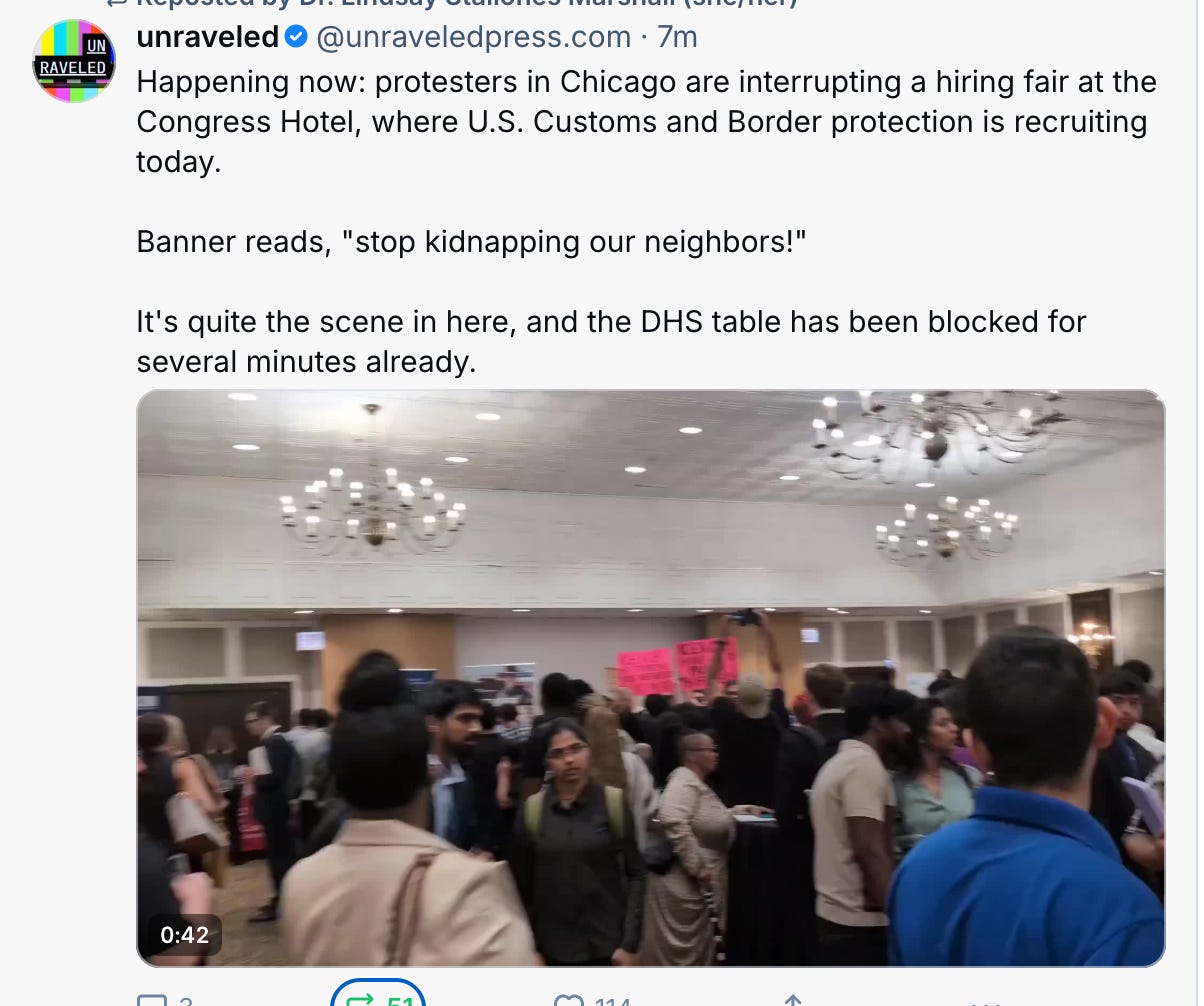
Civil Rights restaurant sit-ins and ICE raid disruptions are great examples of good disruptions: The sit-ins directly targeted segregated establishments, forcing a reaction from those who wanted segregation, causing conflict, but more importantly, interrupting the daily operations of an apartheid social structure. The ICE raid disruptions achieve a similar outcome.
It is essential to consider our opponents' operational methods, identify their key logistical points, and understand their objectives. Then strategize tactics to disrupt those things.
Volunteer and member skills
Empower your volunteers’ skills and interests, let them create content that isn’t top-down controlled. It can be beyond affinity and strictly political. Empower field staff, members, and volunteers to take action.
We have theater kids, damnit!
Stop the damn fundraising texts, unless they're actually about relationship building or sharing resources/information. Stop the dramatic fundraising texts.
During onboarding, ask volunteers what their professional or learned skills and interests are. If there are accountants, have them dig into the financing of GOP donors, churches, and infrastructure. Are they a skilled networker? Develop a deep organizer. Our volunteers have a wide array of skills and interests; we need to tap into that pool of resources to broaden our operations.
Create a volunteer intake that takes into account their interests and skill sets, then group them with other folks with a similar set of skills to train them on specific types of operations fitting those skills.
Volunteer skills can serve as the basis for a political education effort.
They can help with opposition research.
They can run proxy citizen news channels
Street teams to put up propaganda posters and signs
Disruption teams
Do we have former MAGA members or Evangelical Church members? They can be great at creating targeted propaganda for MAGA for different purposes. They can disrupt, demobilize, cause chaos and division, and hinder deep organizing efforts.
The list is longer than I can imagine!
Deep organizing: This will tie into number seven, but deep organizing is effective. We know how impactful relationship building is; by returning to these organizing roots, we will bring in more volunteers, activate more potential volunteers, and mobilize far more people ready and willing to act. And who can act when it is time for mass mobilization events, they already know what to do.
Service as political education: Some organizations already do this by engaging their communities locally and providing services such as job application fairs, resume writing assistance, read-ins, food drives, etc. And when you hold it, provide political education alongside it. This will build trust with community members, making them more likely to trust you when you’re providing political education, making traditional calls to action, and engaging in other forms.
Demobilization: Target MAGA through different means, propaganda, infiltration, and deep organizing to demobilize them. We don’t need to bring them over; we need to start demobilizing and deradicalizing them.
Infiltration & Intelligence gathering: We have to think beyond traditional opposition research and start digging into what the GOP, its organizations, and funders are trying to accomplish. What are their operations, what are they trying to achieve within those operations, and how can we interrupt them?
One example is something we can take from an old, largely out-of-fashion labor union practice. Salting. We can have a volunteer work to get hired by a GOP organization, or infiltrate a church (maybe they were once part of an Evangelical Church). From there, they can work to understand how that church supports local and regional GOP efforts, find dirt on the leaders, spread rumors, and cause division within the Church. Maybe there are rumors of shady bookkeeping, so you use another volunteer to dig into it.
Someone could get hired by the Federal government or a GOP organization, work to sabotage operations, give you intelligence about what is going on, who the players are, and more.
My next piece will return to diving deeper into narrative operations—Propaganda and Psychological Warfare. These efforts are integrated into every strategic level. Now that we have a solid base, we can dive into these concepts.
While I lightly touch on my past pieces before getting into the meat of Propaganda and PSYOPS, I do suggest going back to them for a refresher; just some light, easy reading /s.
No posts
Comments
Nothing yet. Say the first thing.
Sign in to join the conversation.