
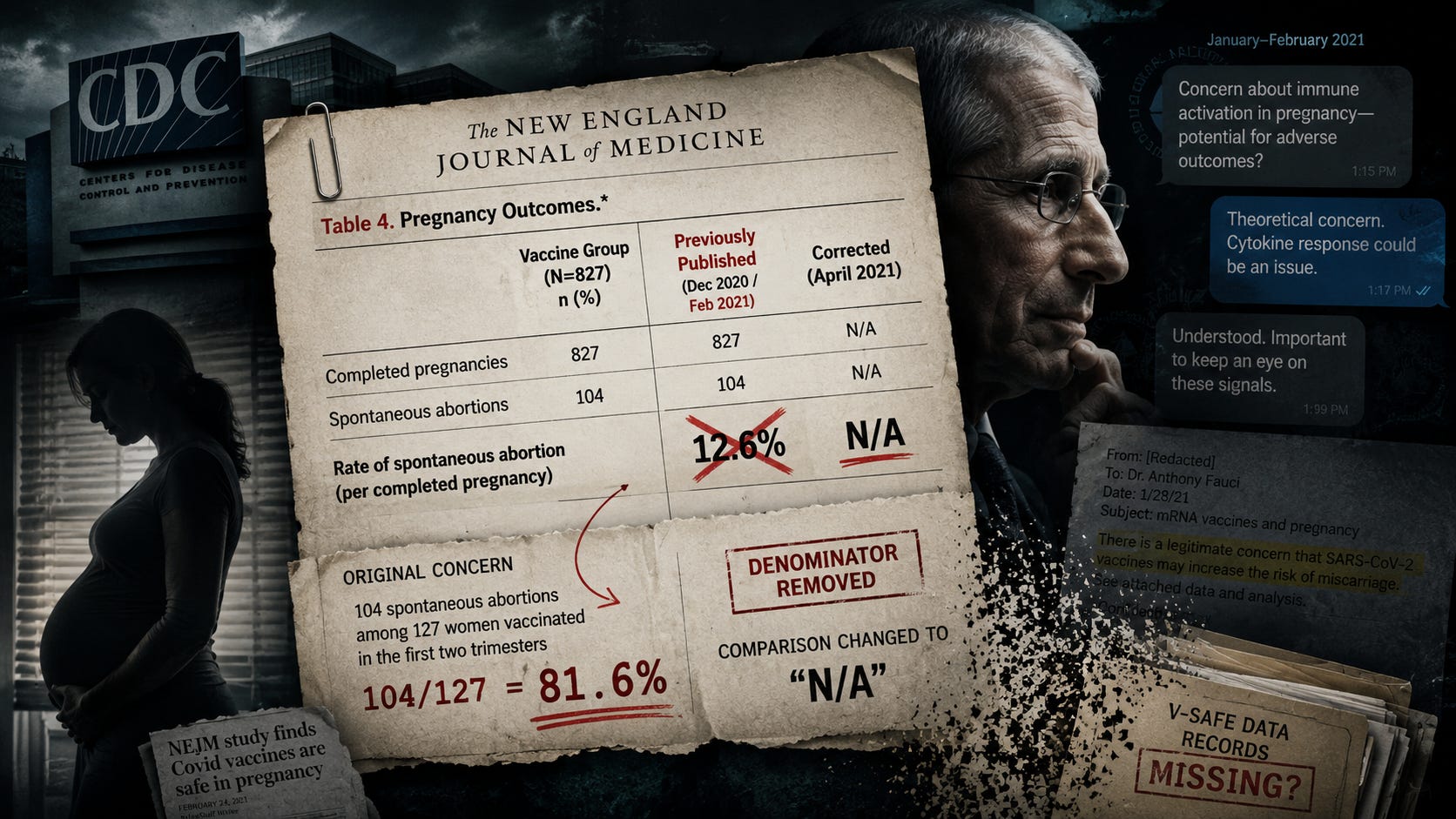
The controversy over mRNA COVID-19 injections and miscarriage is back in the news, as newly released communications show that Dr. Anthony Fauci and other officials were privately discussing the safety of mRNA injections in pregnant women. The communications not only included Dr. Fauci brushing aside concerns from Nobel-Prize-winning scientists in the area of reproductive health and the mRNA technology, but also text messages in which the former White House advisor and NIAID Director openly admitted theoretical concerns involving cytokine responses from the injections among pregnant women.
That makes it worth revisiting one of the most disputed pieces of early pregnancy-safety data that is still cited today: the CDC-authored study, published in the New England Journal of Medicine (NEJM), which became the basis for widespread assurances that the injections were safe during pregnancy. Thousands of media stories were generated on the basis of this single study, which used extremely poor, potentially fraudulent statistical methods.
We previously examined this controversy after Dr. Kirk Milhoan was attacked for citing the paper’s original iteration, which showed an 81.6% miscarriage rate among those who took the mRNA injection in the first two trimesters of pregnancy. Now, critics who supported lockdowns are joined by others within the health freedom movement, who argue the data is not as alarming as it seems.
However, the weakness of all population-level miscarriage data, and the clear political and statistical manipulation in the case of this NEJM paper, only point in the direction that more scrutiny was, and is, warranted.
We Still Don’t Have Good Data
The 81.6% figure isn’t perfect. In fact, none of the available numbers are. The problem is that it remains one of the most concerning signals in a single dataset, and the original publication itself was seriously flawed. When the data supported vaccination, NEJM and the CDC were fine with sharing a percentage—when it conflicted with the narrative of safety, it disappeared.
NEJM initially reported 104 spontaneous abortions among 827 completed pregnancies—a rate of 12.6%, which they declared to be normal. But that denominator included hundreds of women vaccinated during their third trimester, when they were already beyond the period in which the study classified a pregnancy loss as a spontaneous abortion. After criticism, the authors acknowledged that 827 was not an appropriate denominator for calculating miscarriage risk. NEJM corrected the paper. But it did not replace the 12.6% figure with a corrected miscarriage rate with an appropriate denominator. Instead, the denominator disappeared, and the comparison was changed to “N/A” because they said many women in that group had not yet reported their outcomes.
In other words, after months of headlines reassuring pregnant women about the injections, the journal effectively acknowledged that the original dataset could not support the miscarriage-risk calculation it had initially presented. The original Table 4 was subsequently changed, but we kept the original version in our earlier article.
That history cannot simply be ignored in order to dismiss the 81.6% figure so easily. Until sufficiently reliable data emerge to replace it, the original dataset remains an important—and deeply concerning—reference point. The more important factor is the lack of rigorous studies investigating this risk responsibly.
The Supposed Answer Raises Its Own Questions
Some critics now point to a subsequent paper looking at the same pregnancy and vaccination dataset studied in the paper over the following months, as evidence that the original miscarriage concerns have somehow been put to rest. But that isn’t nearly as clean as it sounds, and this second paper has been sitting in preprint without peer review for over 5 years despite its importance for the public. Additionally, this follow-up analysis has a substantially different set of authors from the original paper (16 authors from the first paper were dropped and 5 new authors added), including a different lead author who was not included in the original paper.
As critics have noted, the second paper’s statistical methods deviated from the original, as did the presentation of the data and risk levels, and it crucially included thousands of new enrollments from February through July (after the initial concerning data was published and pushback occurred). This kept the original cohort of women from being neatly analyzed without potential bias to “undo” the previous, inconvenient findings that were bringing so much scrutiny to the authors and the NEJM. The second paper also relies on data whose handling and preservation have since become the subject of public and congressional scrutiny.
Indeed, a Senate investigation has raised questions about potentially missing or destroyed CDC records associated with vaccine-safety monitoring as it pertains to the original NEJM paper, and therefore, to the second as well. This makes treating any information from these papers as a definitive answer to the controversy difficult, particularly when questions remain about the underlying, missing public data, its treatment, and its chain of custody. So why are we pretending the underlying question has been settled?
What About Fertility Rates?
Another argument is that if the injections substantially increased miscarriage risk, fertility should have completely collapsed. That assumes far more women received the injections during early pregnancy than likely did. The relevant population isn’t everyone who received a COVID injection. It isn’t even every pregnant woman who eventually received one at some time. The relevant population for the original miscarriage question is women vaccinated during the first two trimesters at the height of the campaign, which took place after an already-aberrant, historical dip in pregnancy rates in 2020.
Polling even at the height of the public fear campaign related to Covid-19 in March of 2021 suggested roughly half of pregnant women planned to receive the vaccine, specifically provided that the vaccine was guaranteed to be 90% effective at preventing disease. Therefore, the actual number vaccinated during the relevant gestational window may have been far smaller, as women learned that the vaccines did not successfully stop transmission as the media was assuring them, nor were they studied in that capacity. Polling often overestimates vaccination rates for a variety of reasons. In fact, major media outlets bemoaned in 2021 that only about a quarter of pregnant women seemed to have gotten the mRNA injection.
Meanwhile, the U.S. crude birth rate is in fact lower than it was in 2021—10.7 births per 1,000 population compared with roughly 11.0 in 2021 per CDC. That doesn’t prove the mRNA injections caused widespread pregnancy loss, but neither can national fertility statistics remotely disprove a safety signal involving a limited subset of pregnancies during a relatively short period of the initial rollout. We simply don’t have a reliable counterfactual showing how many births would otherwise have occurred during the unprecedented demographic disruption surrounding lockdowns and their aftermath.
The Questions That Still Demand Answers
The real issue now isn’t whether the CDC’s own flawed methodology was perfect in the NEJM article, when it showed an 81.6% risk of spontaneous abortion among women who were vaccinated in the first trimester, as of February of 2021. It was, and is, a flawed CDC study that should never have passed NEJM’s editorial process. The issue is why, five years later, we are still left trying to reconstruct what happened from deeply flawed data, questionably “corrected” publications, follow-up analyses with uncertain continuity, and federal records that Congress is now investigating for possible destruction or deletion. Some specific questions that remain:
Why was the original NEJM data presented in a way that produced a reassuring 12.6% miscarriage rate, only for the denominator behind that rate to later be removed? Do percentages only count when they support the CDC’s prior assumptions? Why not follow up only the women in the first study to keep it legible and statistically clean?
What happened to the underlying, publicly funded CDC database, and why has its management been so poor that serious questions about provenance and chain of custody remain? What did federal officials know at the time?
Why should a later, unpublished analysis with different methods—produced with substantially different authorship and after the original data had already become controversial—be treated as definitive enough to dismiss the troubling signal in the original dataset?
We now know Dr. Fauci was receiving highly concerning communications about potential risks to pregnancy from prominent scientists, including Nobel laureates, while privately texting with senior health officials about the possibility of miscarriage associated with the inflammatory response following mRNA vaccination.
The federal agencies charged with monitoring safety should have produced public data capable of answering that question. Instead, years later, we are debating competing interpretations of inadequate datasets and dubious journal corrections, all while questions remain about missing records. Unfortunately, this is no longer only about the COVID-19 injections. Uptake of those shots has collapsed, but mRNA technology is now being approved for additional vaccines, including influenza.
The unresolved questions surrounding the use of mRNA injections during pregnancy warrant analysis using rigorous, publicly available datasets that can withstand scrutiny.
Originally posted on HealthFreedomDefense.org.
No posts
Comments
Nothing yet. Say the first thing.
Sign in to join the conversation.