
On March 16, 2015, Darren Indyke sent a one-page memo to an employee at Southern Trust Company, Epstein’s crown-jewel corporation in the U.S. Virgin Islands, instructing her to wire one million dollars to a bank account in Tel Aviv. The account belonged to a company owned by Ehud Barak, the former Prime Minister of Israel, and the money was headed into a tiny startup that wanted to plug itself into 911 systems. The reference line on the wire, in Epstein’s own files, reads “Reporty investment”. They labeled it themselves.
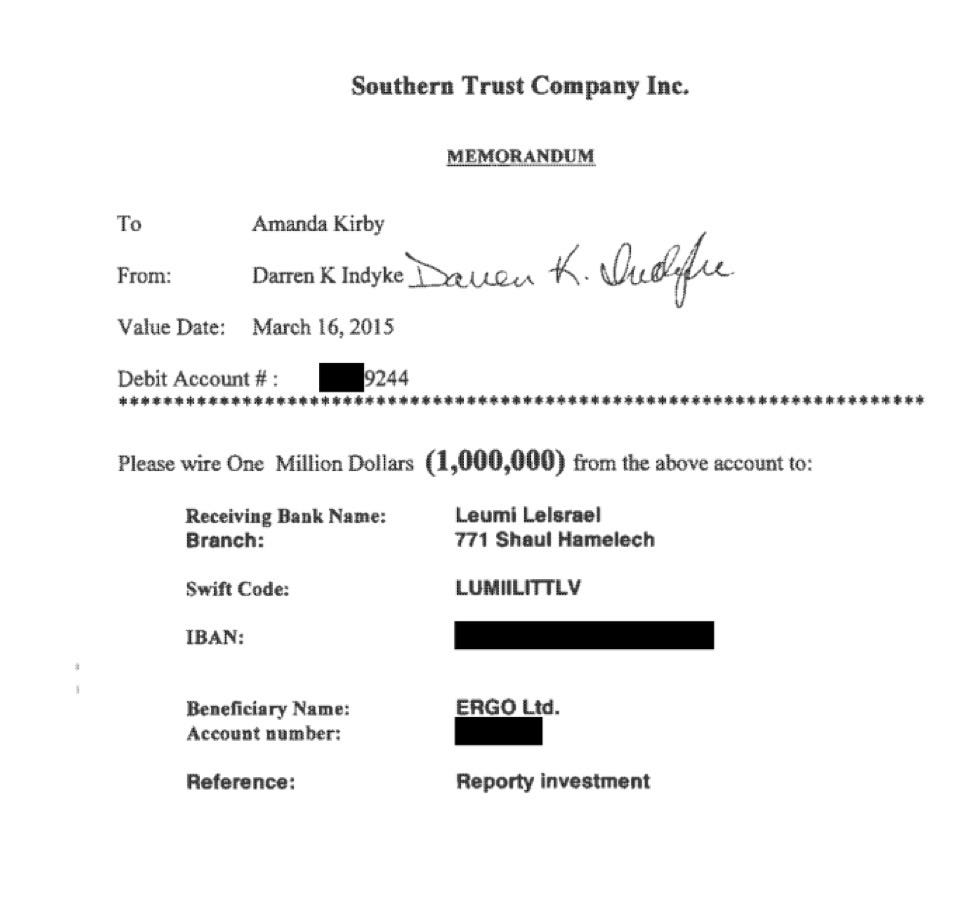
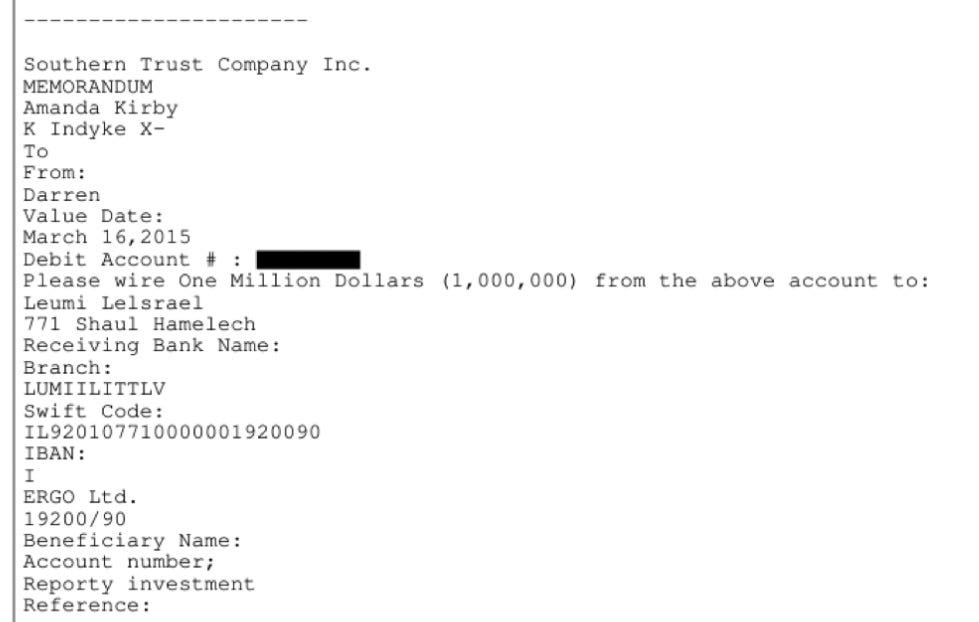
That startup is now called Carbyne, and on February 18, 2026, Axon completed its purchase of the company at a $625 million base price, per Axon’s own SEC filings. Axon is the company formerly known as TASER International. It makes the Tasers, it makes the body cameras you see on American police officers, and it runs the evidence cloud where the footage lives. One corporation now touches your emergency call, the dispatch, the officer’s camera, the evidence file, and the less-than-lethal weapon - and the emergency-call piece traces right back to money Jeffrey Epstein structured, on purpose and in writing, seemingly…so his name would never appear anywhere near it.
Every EFTA number below is a document from the DOJ’s Epstein files. I encourage you to click them and read for yourself.
How the deal started
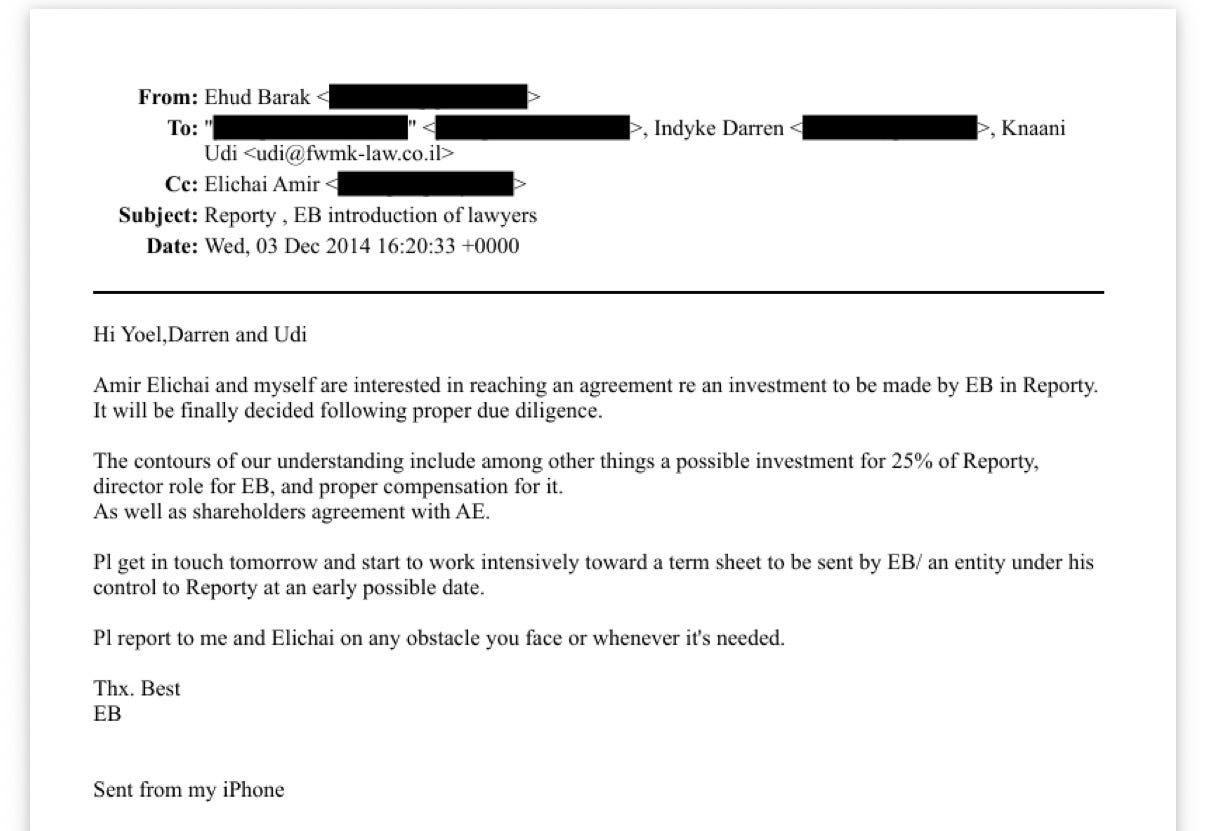
On December 3, 2014, Barak emailed three lawyers to get an investment moving (EFTA01001753). His greeting names them, “Hi Yoel, Darren and Udi.” Yoel Keinan was Reporty’s lawyer. Udi Knaani was Barak’s. And Darren was Darren Indyke, Jeffrey Epstein’s personal lawyer of decades. In a deal, each party at the table brings its own lawyer, so the lineup on this email tells you who each of the parties actually were - the company, Barak, and Epstein. Yet the email itself describes “an investment to be made by EB in Reporty,” roughly 25% of the company plus a director seat for Barak, with the term sheet to come from “EB/ an entity under his control,” and it tells the three of them to “get in touch tomorrow and start to work intensively toward a term sheet.” If the investment was really Barak’s alone, there was no reason for Epstein’s personal lawyer to be one of the three people working intensively on it from day one.
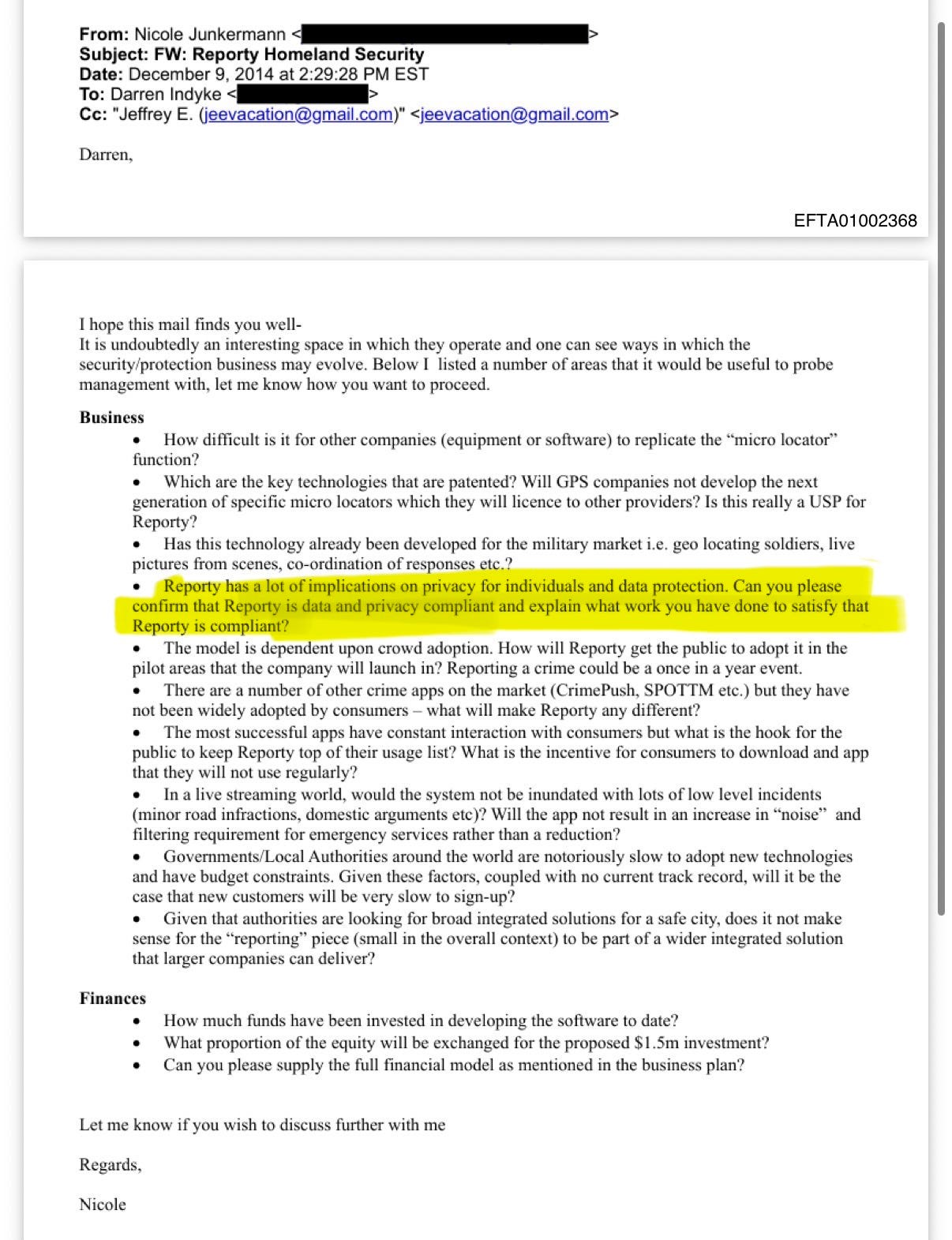
Six days later, Nicole Junkermann sent Indyke a full due-diligence question list for the startup (cc Epstein), asking how hard the technology would be to copy, whether it had been built for the military market, and, in a line that reads differently now, “Reporty has a lot of implications on privacy for individuals and data protection” (EFTA01002368). Indyke forwarded her list to Epstein and asked whether he’d sent it to Barak yet. Epstein passed it along a few hours later. So within a week the actual division of labor was on paper - Junkermann wrote the diligence, Indyke routed it, Epstein connected the pipes, and Barak was the name on the front.
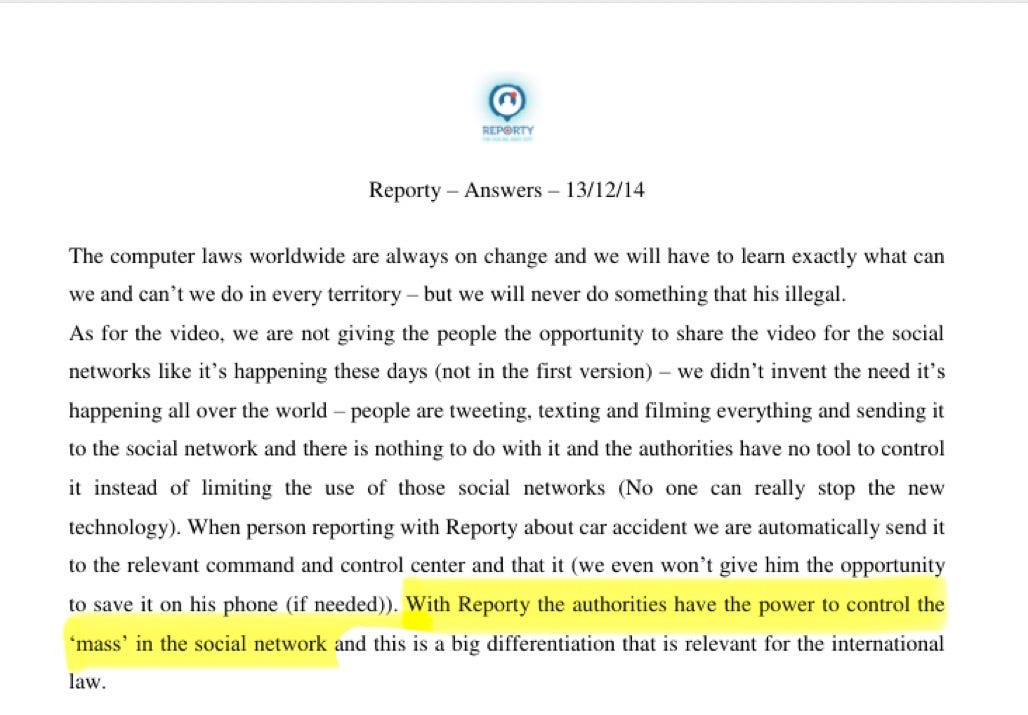
The company’s answers came back on December 13th (EFTA01074432), and this document is a time capsule from (what I can only assume) was before Reporty had a PR department. Asked about its product, the company wrote that “the authorities have the power to control the ‘mass’ in the social network.”
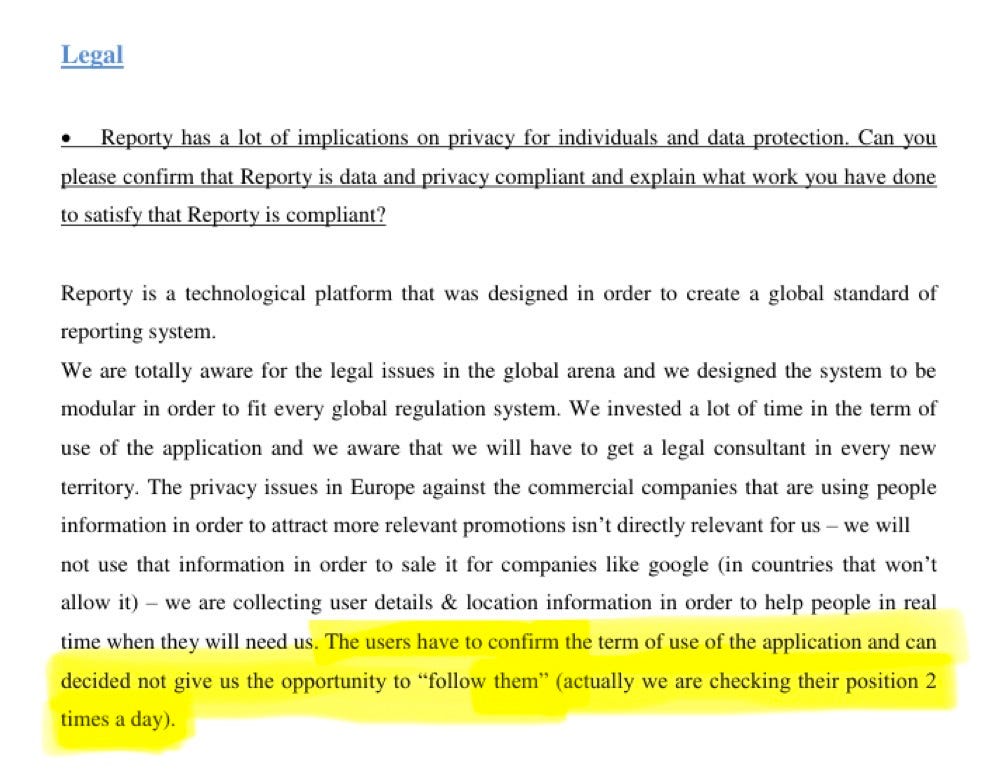
Asked about privacy, it said users could decline to be followed, then added in parentheses, “actually we are checking their position 2 times a day.”
Asked why it hadn’t patented its indoor-location technology, it explained that patents are public and it preferred not to disclose. Its view of its future users, in its own words - “people are voyeurs.”
In December, the pitch was $1.5 million for 25% of the company. By January, Indyke had run the numbers: the whole company was worth $4.5 million (EFTA02512043). And the email breaking all of this down didn't come from Barak's side - it went out from Epstein's own gmail, with Indyke's name signed at the bottom. Barak wrote back calling it "Darren's remarks." Epstein's lawyer did the valuation math on "Barak's" investment.
Under "Track Record," the company named E.B as "a strategic investor for Reporty.” That was written before any of Barak’s investment entities actually existed. He wasn’t recruited into this deal so much as the deal was built around renting his place within it.
Then, on December 17th, Epstein’s longtime assistant Lesley Groff relayed the boss’s instructions on who could join the diligence call with Reporty’s founders. Indyke had asked whether “Je” would participate. Groff’s message back was “Did you see prior email? JE says you and Nicole only?” (EFTA00356793). Jeffrey Epstein, in December 2014, was personally deciding who attended the due diligence for what the world would later be told was Ehud Barak’s investment. The calls became a weekly series with Indyke handling the logistics - he distributed the dial-in numbers, told the scheduler “I will be the leader,” and when Barak sent the next week’s reminder, the question about access codes went to him by name: “Darren, I understand we use the same lines and access codes, is this true?” (EFTA00627775).
And the calls weren't the half of it. On December 24th, Barak forwarded Epstein the startup's first-year forecast and financial model "following yesterday's night discussion," opening with "Thx for your time, attention and advice" and asking to continue over Skype that night (EFTA01201699). Two days later, trying to schedule the next call, Barak asked him "RU in LSJ?" - “LSJ stands for “Little St. James,” Epstein's island - to which Epstein answered "palm beach," then told him to set a time, and closed the thread with "ok" (EFTA01003212).
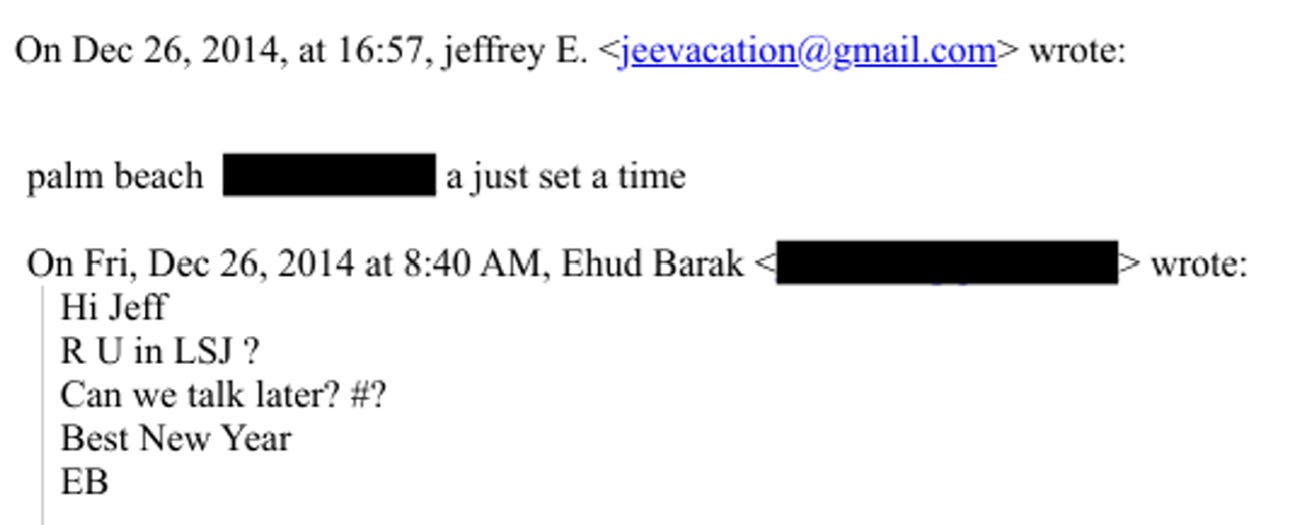
Whatever this investment was, by Christmas 2014 it ran on late-night strategy sessions and standing calls between a former Prime Minister and a man reachable at either his private island or Palm Beach. Days after that first diligence call, Barak registered a new company in Israel called Ergo.
The structure, and the joke inside of it.
Barak built three Israeli entities to hold the investment. In order of creation, they are Ergo (E.B. 2014) Ltd., company number 515175495, Cogito (E.B.) 2015 Ltd, company number 515228021, and Sum (E.B.) 2015, a limited partnership, corporation number 550260459, which I pulled directly from Israel’s corporate registry. (Note: I included the link to Israel’s corporate registry because that’s where I originally confirmed the companies and want you to be able to do the same if you wish, however, please know the site is not always stable, needs to be translated, and does time-out often. It does seem to function more reliably if you search the company numbers as opposed to the company names - I have also hyperlinked other documentation of the companies.)
“Cogito, ergo, sum” is “I think, therefore I am.” The former Prime Minister of Israel named the structure hiding Jeffrey Epstein’s money after the most famous statement in Western philosophy.
The mechanics are honestly simpler than they look. Sum is the box that holds the startup shares, Ergo manages the box, and Cogito started out owning it.
All three sat at the same Tel Aviv address, and when Ergo and Cogito formed the partnership in April 2015, the total capital they put in was one thousand shekels, which is about $250 USD, per the capital table in the original April 6, 2015 partnership agreement, attached as Schedule B inside (EFTA01093124).
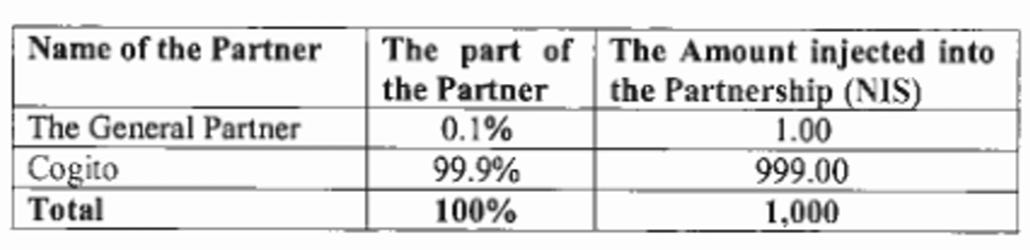
The vehicle built to own a chunk of a “homeland security” company was funded with lunch money, because the real money was already sitting in Ergo’s account at Bank Leumi. It had arrived by wire from St. Thomas on March 16th, a week before anyone signed anything.
A loan that was never a loan
The paperwork caught up on March 23rd, when Ergo signed a promissory note promising to repay Southern Trust the million dollars (EFTA01093124), and the terms of that note are where the whole operation lives.
The interest rate was a whopping 1%, and we know exactly why, because the DOJ files contain an earlier draft of the note with a lawyer's comment written in the text (EFTA01198559).
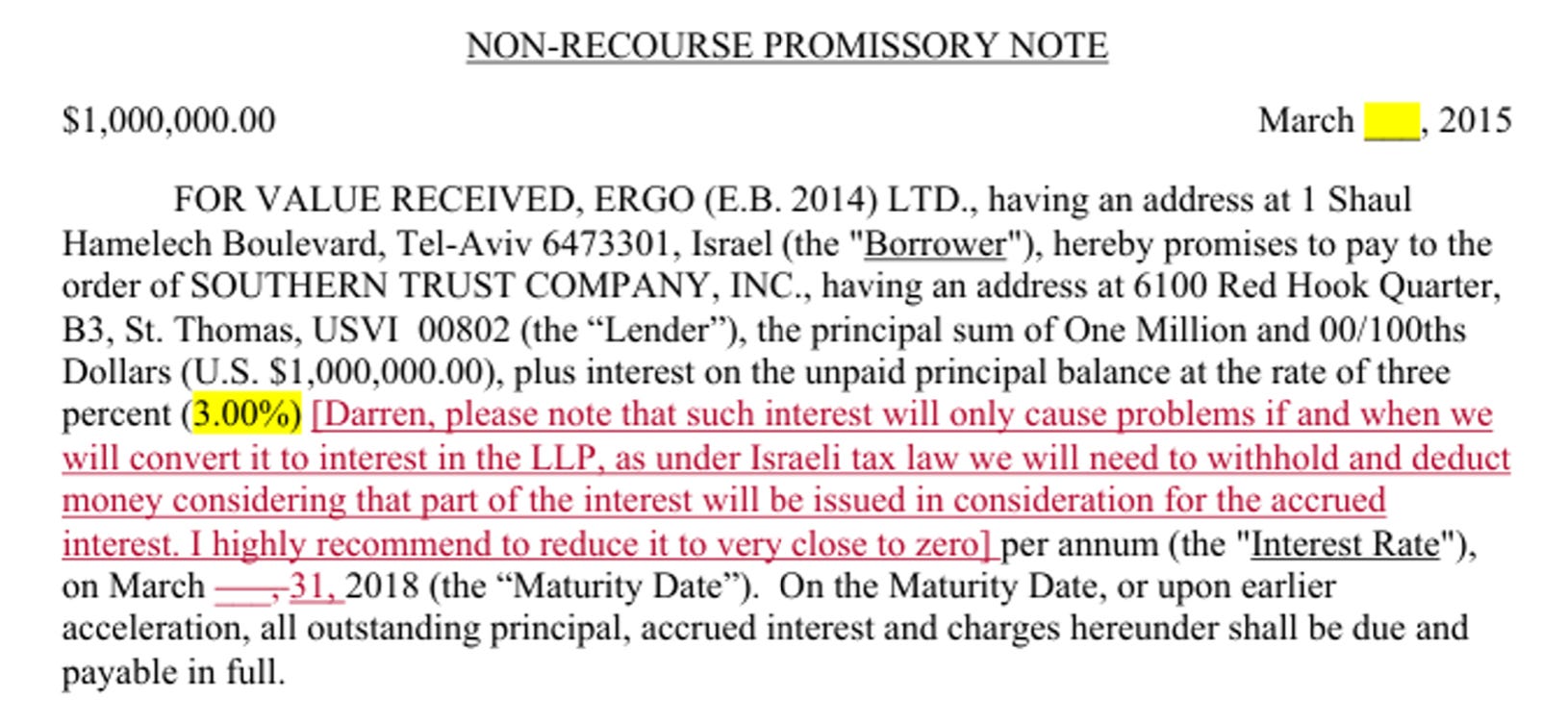
The draft rate was 3%, and the comment, addressed to "Darren," recommends reducing it "to very close to zero" because of the Israeli taxes that would apply "if and when we will convert it to interest in the LLP." Converting the loan into an ownership stake wasn't a possibility being priced in - it was literally the plan, typed into the draft, before a single document was signed.
The repayment terms give everything else away. Under “Payment Currency,” the note says repayment happens “by a transfer of the Purchased Shares” - the startup stock itself, with cash only as a fallback if both sides agreed.

It was also non-recourse, meaning that if Reporty failed, Southern Trust could only take the shares and Barak owed nothing personally. A lender who carries all the downside and collects the company’s stock on the way up isn’t a lender, he’s a shareholder with a cover story. The note also required that Barak remain “the sole beneficial owner” of Ergo, listed Barak’s death as an event of default, and routed all legal notices to Darren K. Indyke, PLLC, 575 Lexington Avenue, New York. (EFTA01093124)
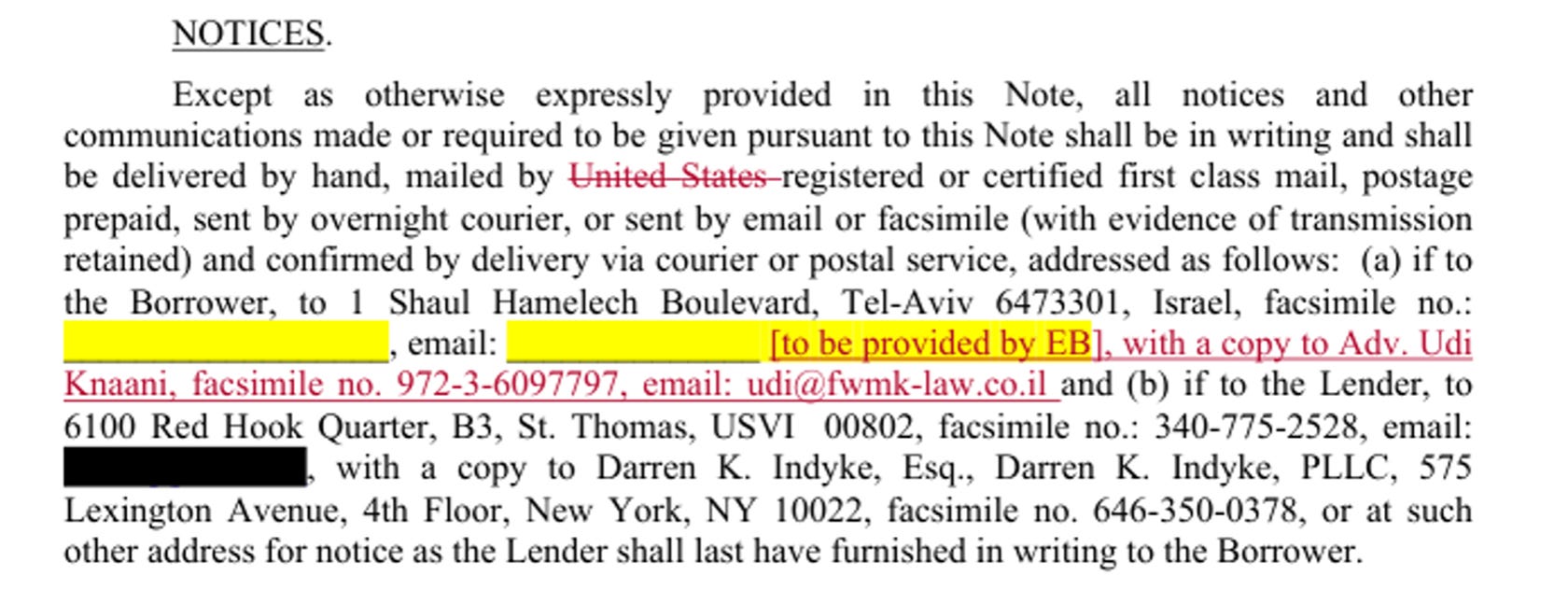
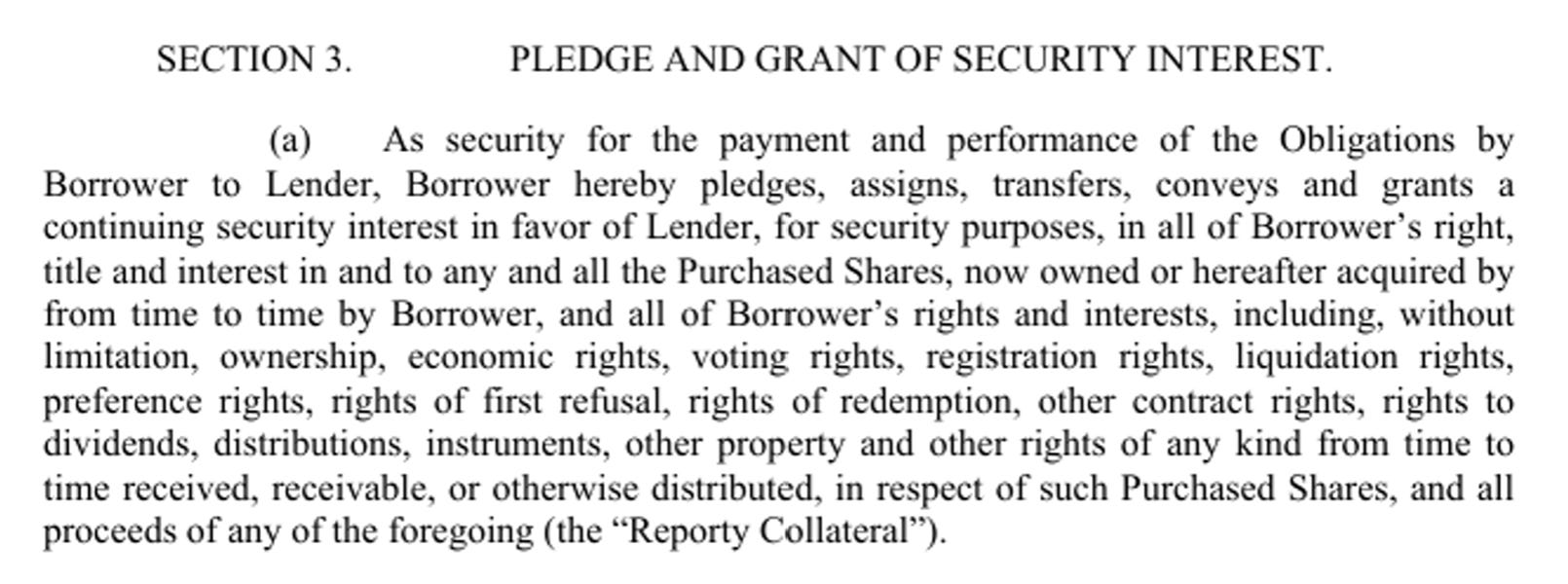
A same-day pledge put the Reporty shares up as collateral (EFTA01172818).
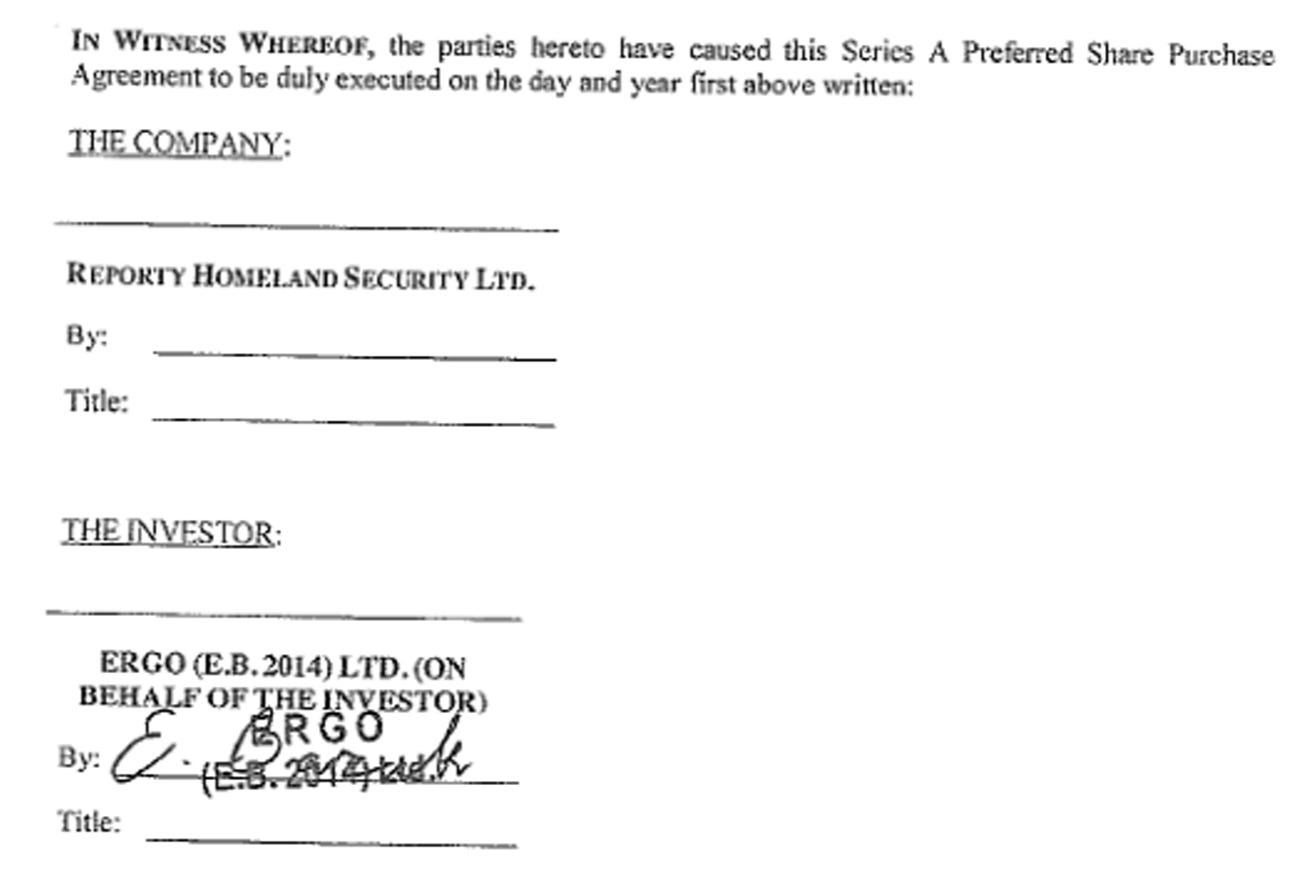
On March 29th the partnership bought Reporty’s Series A preferred shares, and the signature page is in the files, executed by “Ergo (E.B. 2014) Ltd. on behalf of” a partnership that technically didn’t exist yet (EFTA01116578, EFTA01093124), alongside a shareholders’ rights agreement giving the investor a standing flow of inside information about the company (EFTA01116583).
The closing confirmation went straight to Epstein's lawyer. On March 30th, Barak's counsel wrote to Indyke, "Just to inform you we signed and closed the investment transaction" (EFTA00670642). The day before, in the same chain, an associate had circulated "the signatures pages of Ergo/Ehud Barak" and added "We will ask Ehud to wire the funds according to the wire instructions provided by Amir." Barak's role at closing, described by his own side's lawyers, was moving money on instructions - Epstein's million, already sitting in Ergo's account, now heading into the startup.
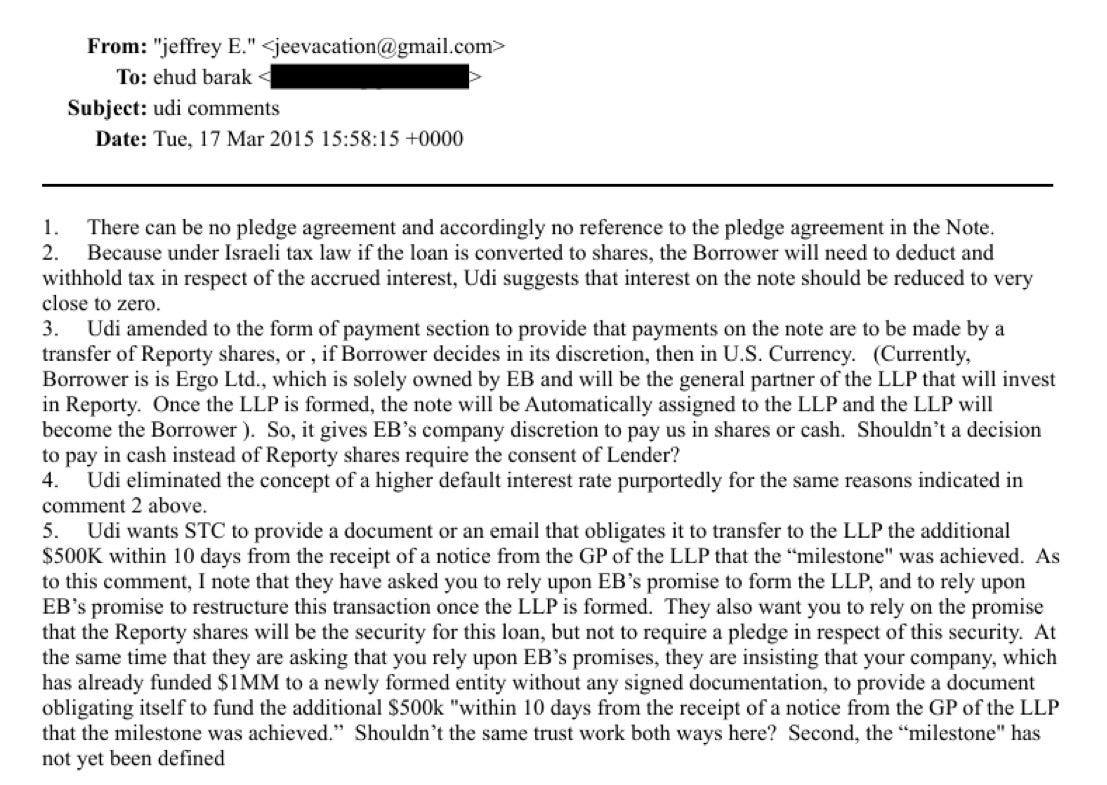
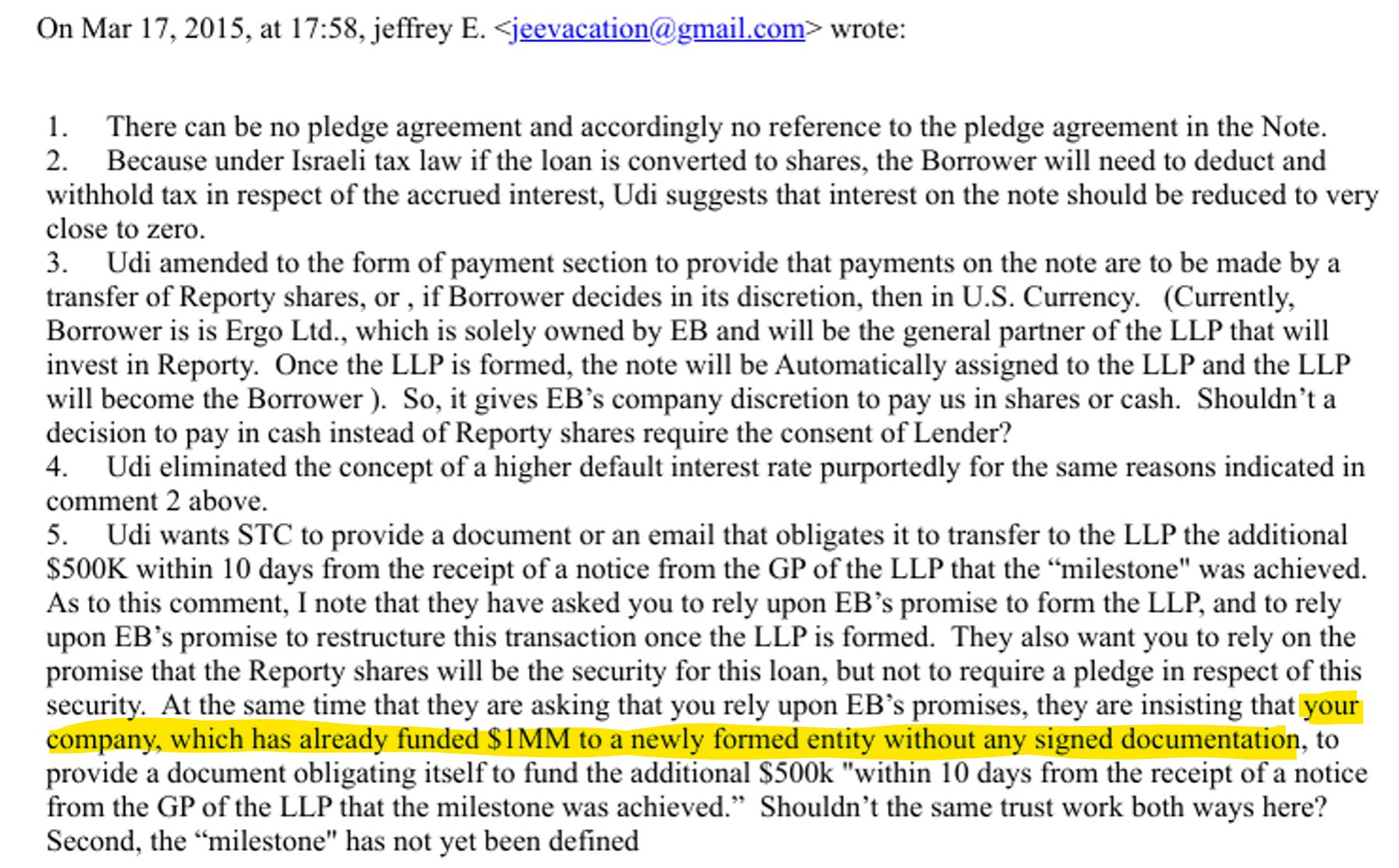
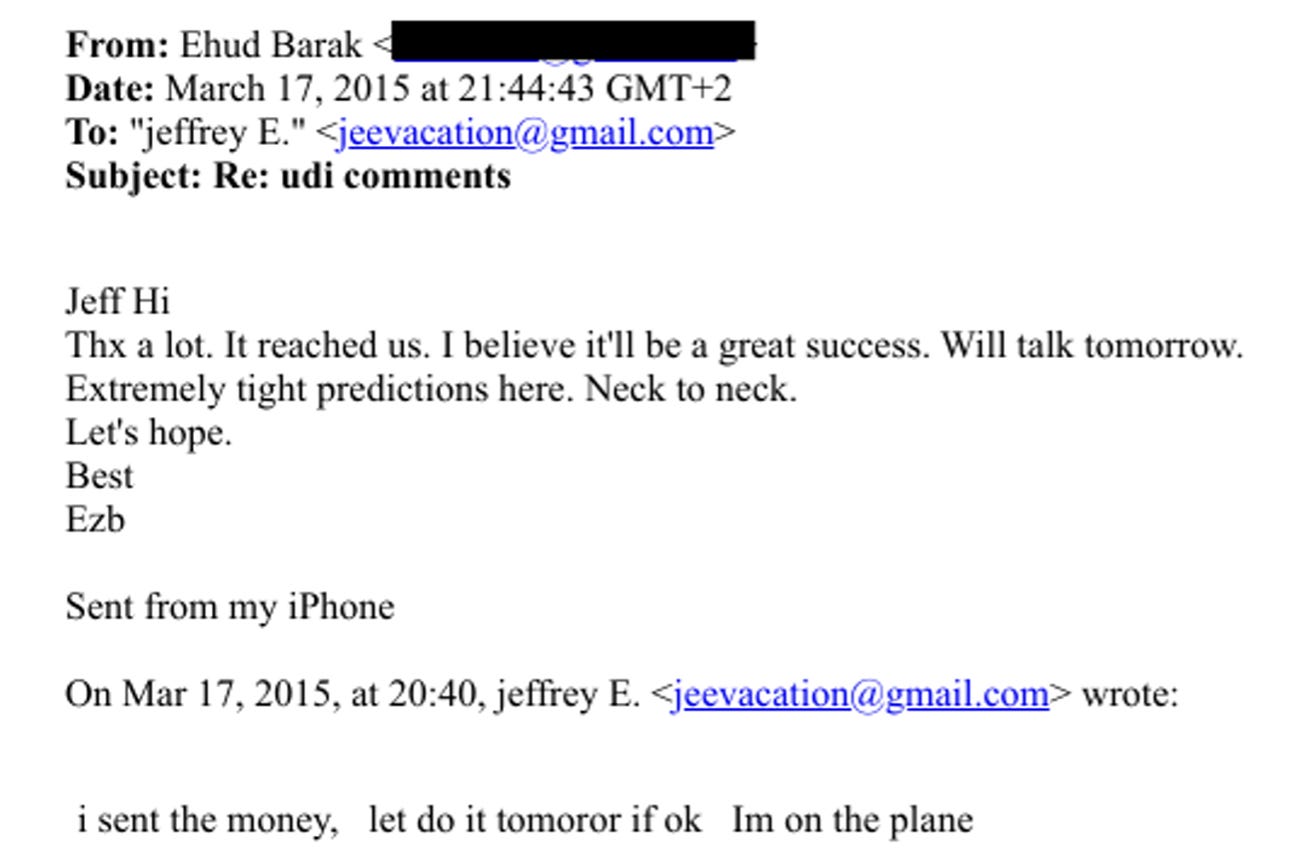
And if any doubt remains about who was doing the negotiating, the files contain an email from Epstein himself to Barak, dated March 17, 2015, one day after the wire, under the subject “udi comments” (EFTA00721254). In it, Epstein walks through Barak’s lawyer’s edits to the note point by point. He confirms the interest rate was dropped toward zero for Israeli tax reasons “if the loan is converted to shares.” He notes that the lawyer’s draft let the borrower choose between repaying in Reporty shares or cash, and pushes back with “Shouldn’t a decision to pay in cash instead of Reporty shares require the consent of Lender?” - Jeffrey Epstein, personally insisting on the right to be paid in the startup’s stock. He narrates the whole structure in advance, writing that Ergo “is solely owned by EB and will be the general partner of the LLP that will invest in Reporty” and that the note “will be Automatically assigned to the LLP.” In point 5, pushing back on one-way trust from Barak’s side, he describes “your company, which has already funded $1MM to a newly formed entity without any signed documentation.” His company. Already funded. No signed documentation. The money-before-paperwork sequence, stated by the investor himself, in a contemporaneous email, the day after his million landed in Tel Aviv.
Then, at 8:40 that evening, Epstein himself, verbatim, typos and all: "i sent the money, let do it tomoror if ok Im on the plane." Barak, an hour later: "Thx a lot. It reached us."
By spring 2015 it was complete. Epstein’s million, wired from the Virgin Islands, sat inside an Israeli box named after Descartes, holding a piece of a company that was building far more than an emergency app. Per its own diligence answers, Reporty could locate a smartphone indoors to within one meter with no special hardware, was assembling a crowd-built worldwide database of labeled indoor locations it called the holy grail of the field, checked users' positions twice a day, streamed live video from their phones, and had deliberately declined to patent its location algorithm so the capability would stay undisclosed. That is what Epstein bought a hidden piece of, and his name appeared on none of it. The startup's own co-founder, Pinchas Buchris, later told Haaretz that as far as the company knew, the money was Barak's. From inside Reporty, the concealment worked perfectly.



The second investor was already in the room
On December 1, 2015, Barak’s Israeli lawyer emailed Indyke with a deadline. Under the purchase agreement, the partnership owed Reporty another $500,000 by the end of January 2016 (EFTA00839668), and if no outside investor materialized, Southern Trust itself was on the hook for that exact amount - section 3.1 of the conversion agreement has Southern "irrevocably undertak[ing]" to fund it (EFTA01124027). Epstein forwarded the deadline email to Junkermann the same day with the note “i think it is good with good timing.” She asked whether he had any objection to her contacting the company directly, and his complete reply was “no please do” (EFTA00839630).
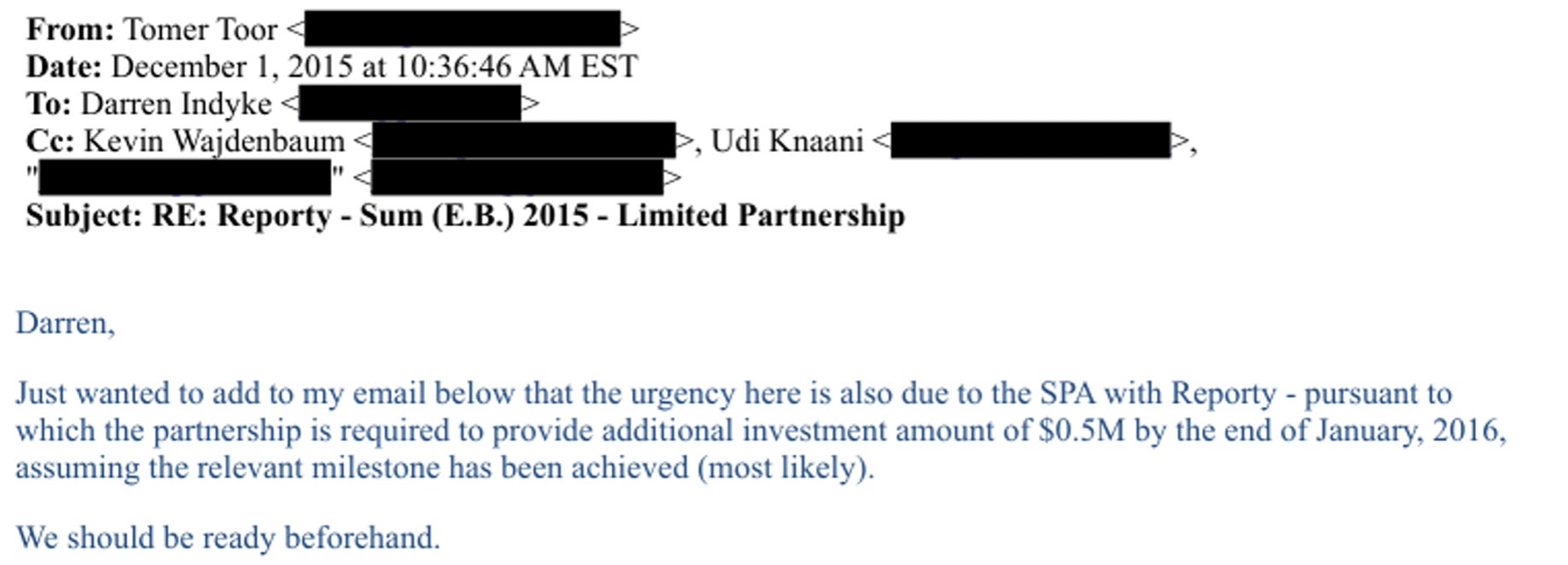
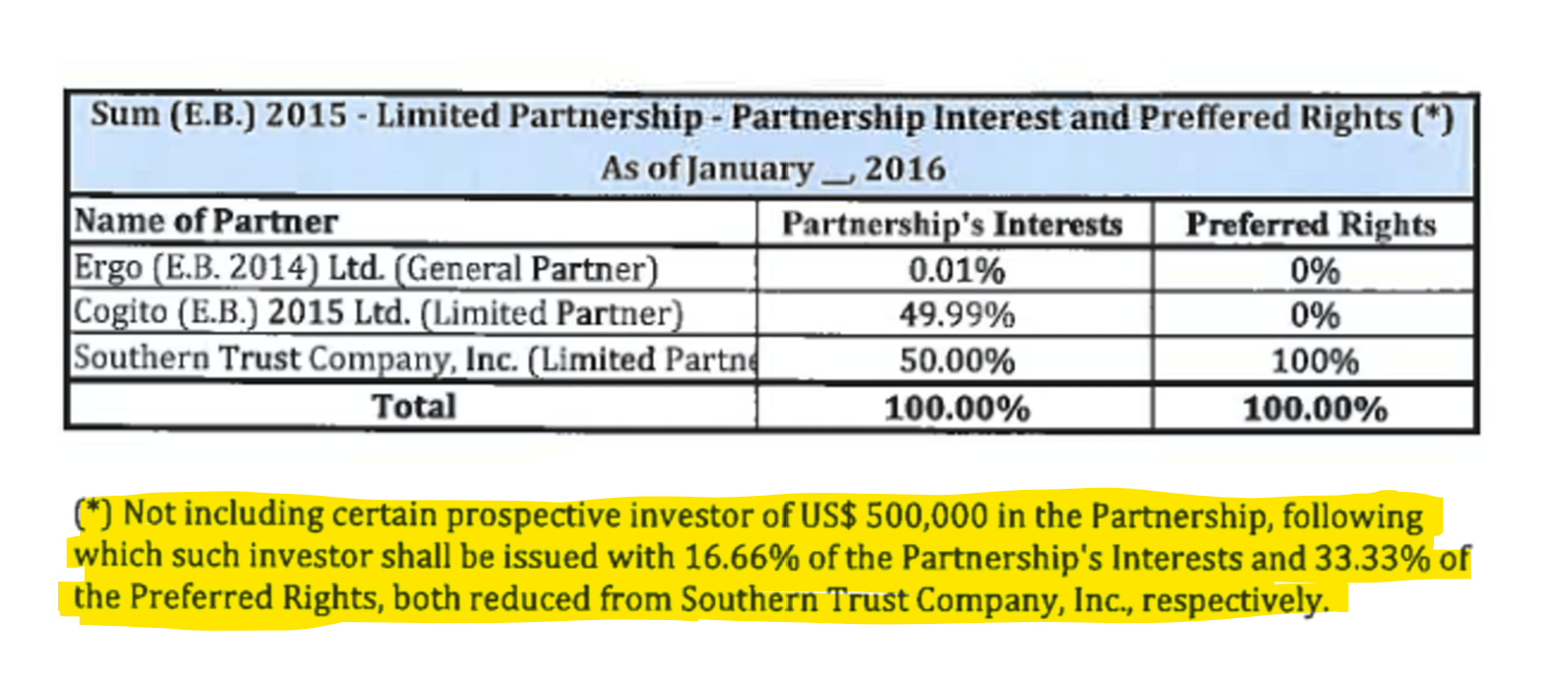
The conversion came on January 27, 2016. Epstein's "loan" became ownership, with Southern Trust taking 50% of the partnership and 100% of its preferred rights, per the conversion agreement and its Schedule D ownership table (EFTA01093124). Preferred rights means that if/when money ever comes out of the box, Epstein gets repaid first, with 5% interest, before anyone else sees a shekel, and then takes half the remaining profit. The files even contain the marked-up draft of the conversion agreement with the tracked changes visible (EFTA01124027) - edits moving money and control toward Epstein's side. Somebody negotiated hard for a passive investor.
Two weeks after that, on February 11, 2016, Montilla International Corporation, Junkermann's British Virgin Islands company, signed on for exactly $500,000 - and that same day, Barak emailed her an invitation to Reporty's Advisory Board (EFTA00810711, EFTA02474299 - the DOJ did an absolute ass job trying to hide who sent the email).
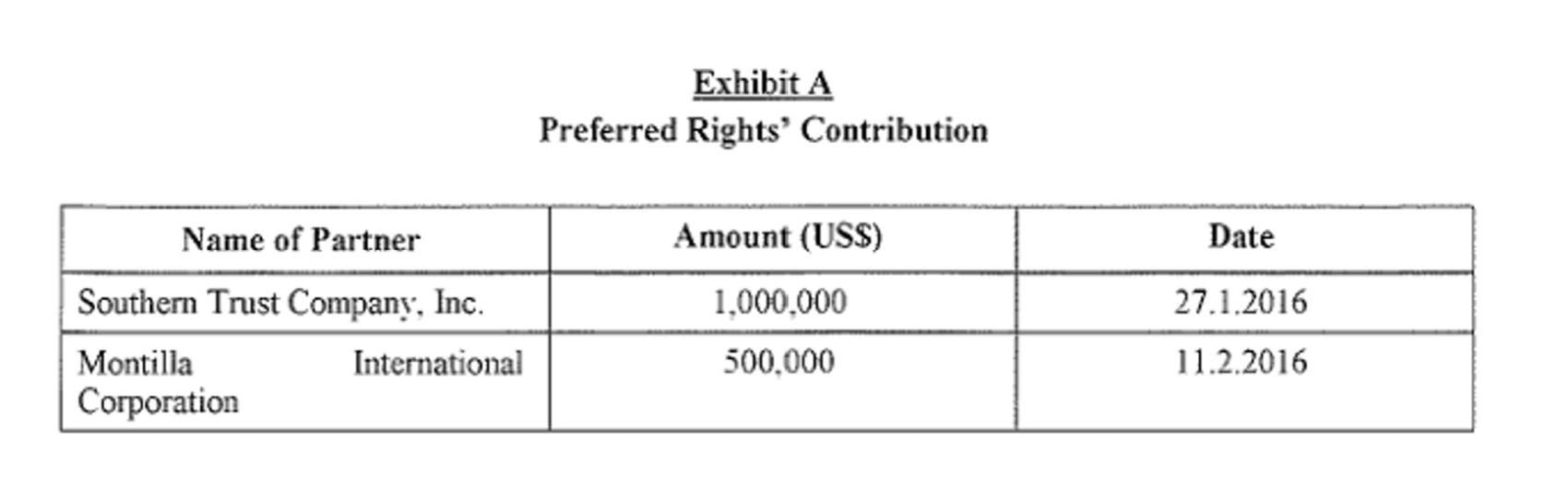
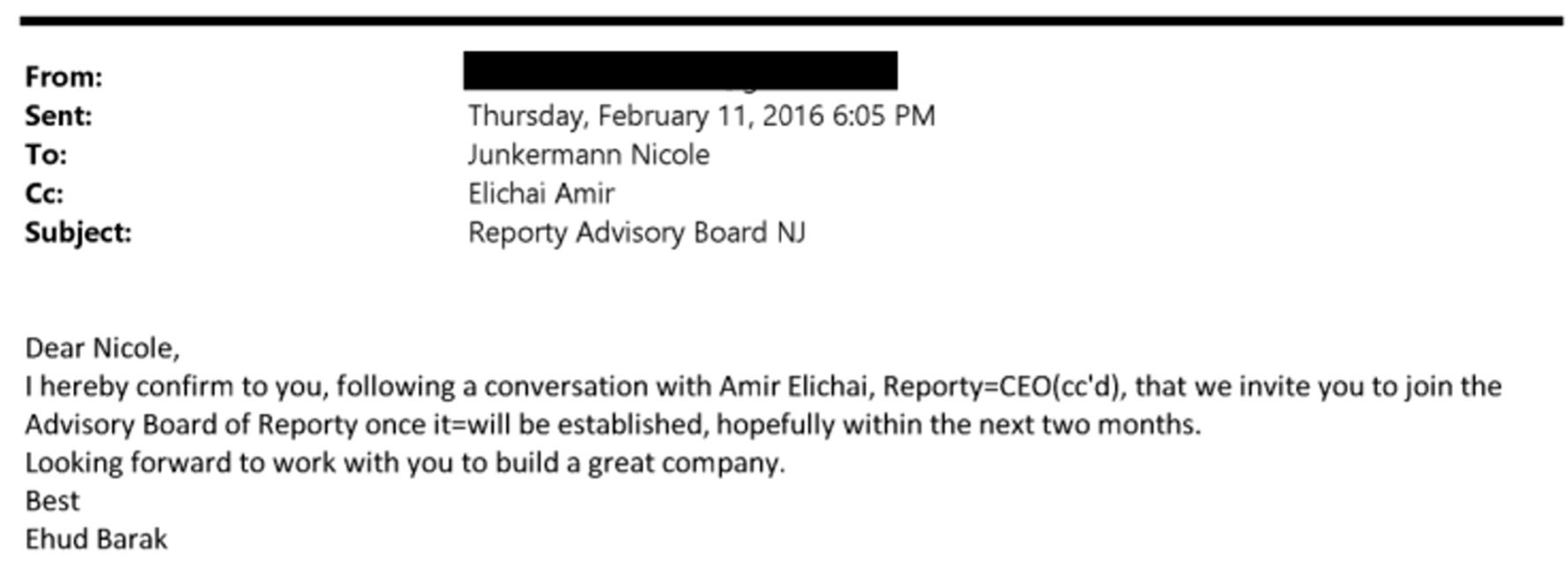
Papers in and a board invitation out - all in the same day. (She was listed as a director on Carbyne's website until 2020, however, the CEO told Forbes she was never a board member and the listing was a marketing-team mistake.)
That same day Barak also sent Epstein and Junkermann the CEO's monthly report, and buried in his cover note is the sentence that settles, in real time, how the concealment actually worked: "Please note that neither Amir nor Buchris are fully aware of your partnership with me." He follows it with "In the meantime feel free to pass through me any remarks you might have" (EFTA02704699). The chairman was telling the hidden investor, which of the company's own founders didn't know he existed, and offering himself as the channel for the hidden investor's input. When Buchris told Haaretz years later that as far as the company knew the money was Barak's, it doesn’t look like he was covering for anyone. He was describing an arrangement Barak put in writing.
Four days after that, Junkermann confirmed the acceptance of her new position to Barak and Epstein, writing "Delighted to be part of the team now, and tedious paperwork behind us! The funds should be with you tmr." She then mapped out her priorities for the company - the Uber and Microsoft opportunities among them, and noting that "from 'our' narrow perspective" the key was how far the company could advance before the warrants expired (EFTA00680244). And those were her quotation marks around "our," not mine.
The “warrants” she’s referring to, came with the 2015 share purchase. A warrant is a price freeze - the right to buy a set number of additional shares later at a price fixed at the start of your investment. On its own that's worth nothing special. It only becomes a bargain if the company grows past that frozen price - you know…how big Reporty can get before the freeze expires.
For the record, Junkermann had been inside this deal’s diligence since December 2014 at Epstein’s specific direction, which tracks - an investor who’d been at the table for a year, committed the exact sum, in the exact window, that erased Epstein’s own $500K obligation, with his written blessing. According to the Telegraph, her spokesperson said Epstein deceived and misled her and she “deeply regrets” their personal and professional conversations. The emails above are her own. Nothing beyond what's on these pages should be attributed to her..
Epstein signs
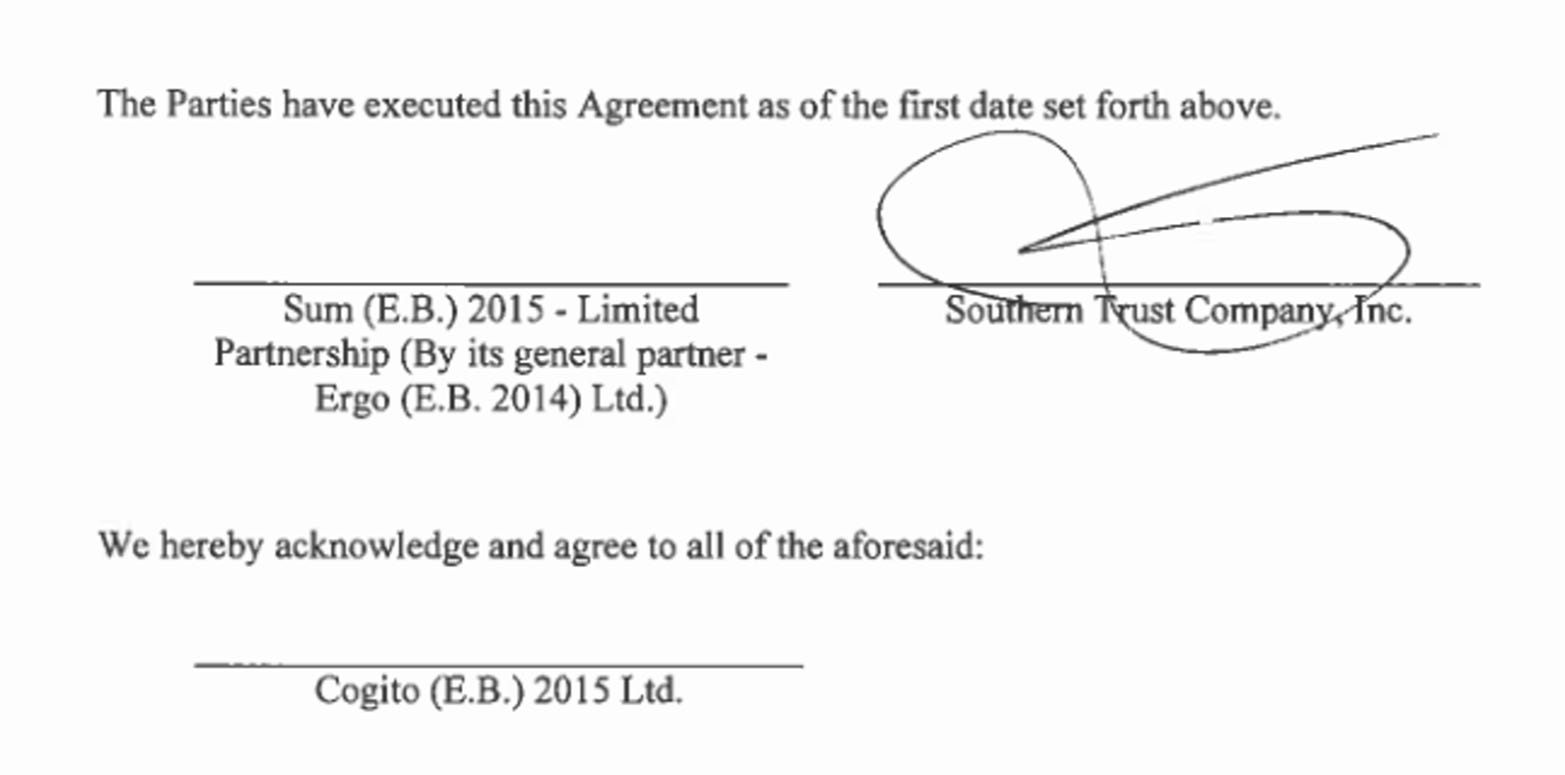
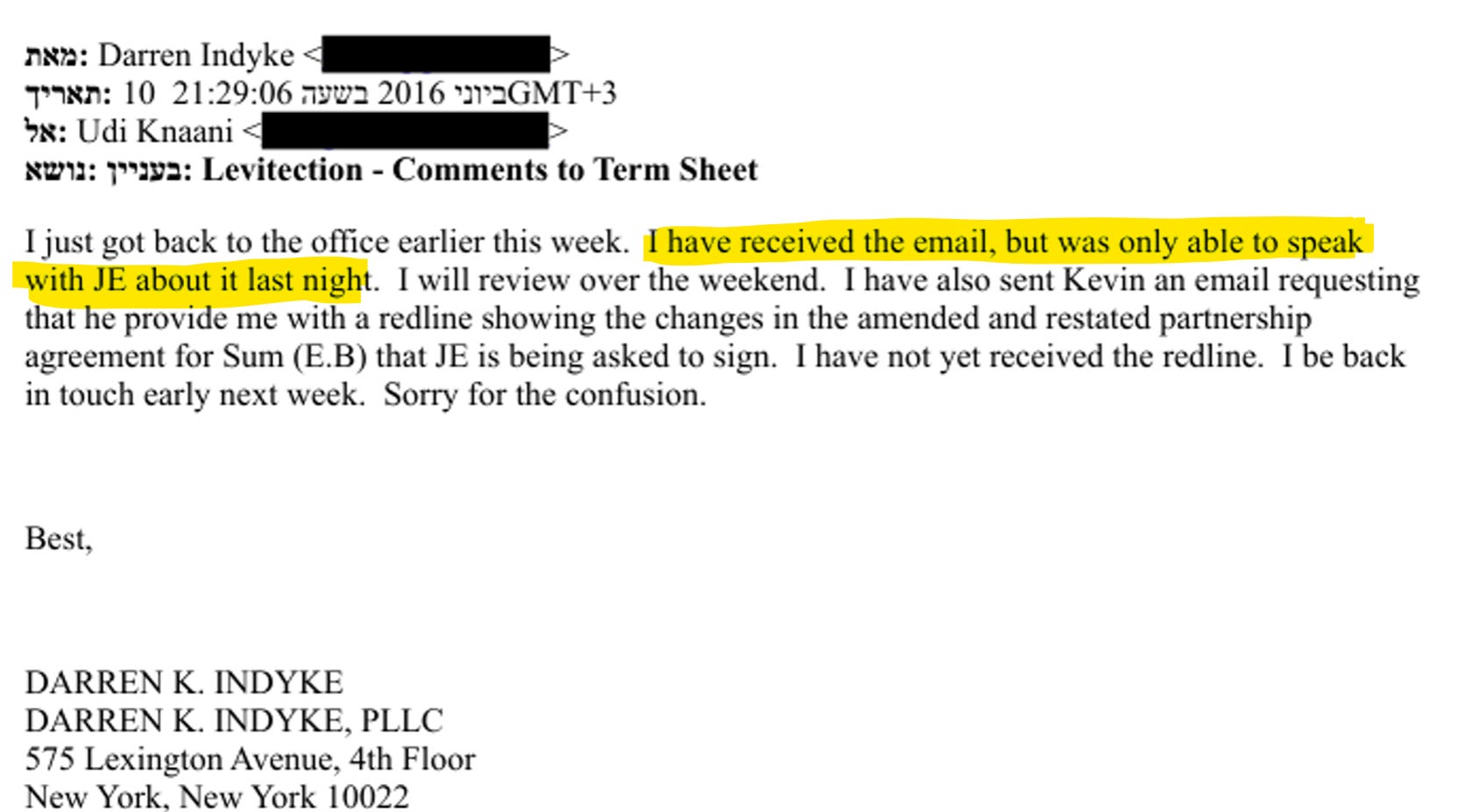
The final partnership agreement needed one more signature in June 2016, and Indyke’s email to Barak’s lawyers on June 10th removes any remaining ambiguity about whose signature that was. He wrote that he’d been “only able to speak with JE about it last night” and was waiting on a redline of “the amended and restated partnership agreement for Sum (E.B) that JE is being asked to sign” (EFTA00822259). Not Southern Trust the corporation. JE, the person, on the phone with his lawyer, reviewing the deal.
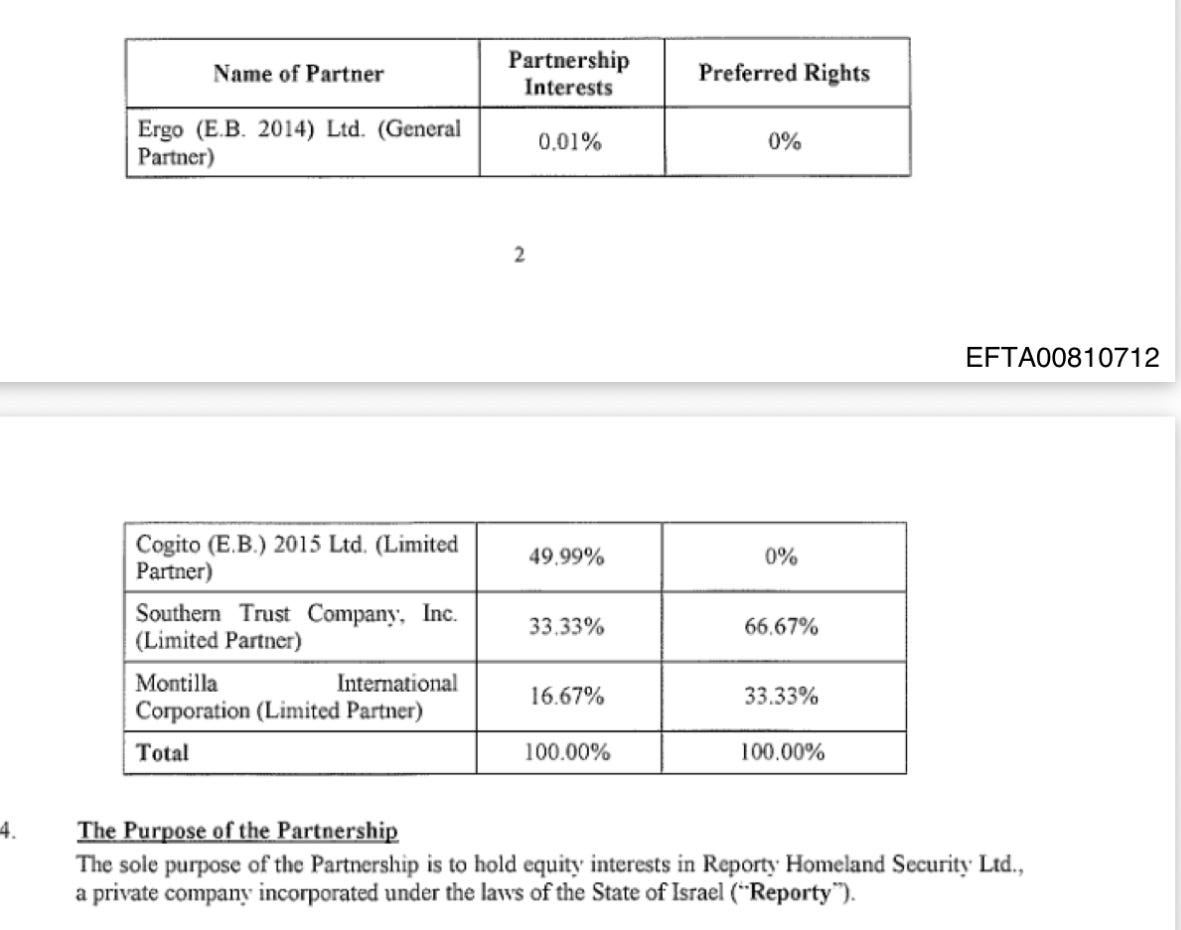
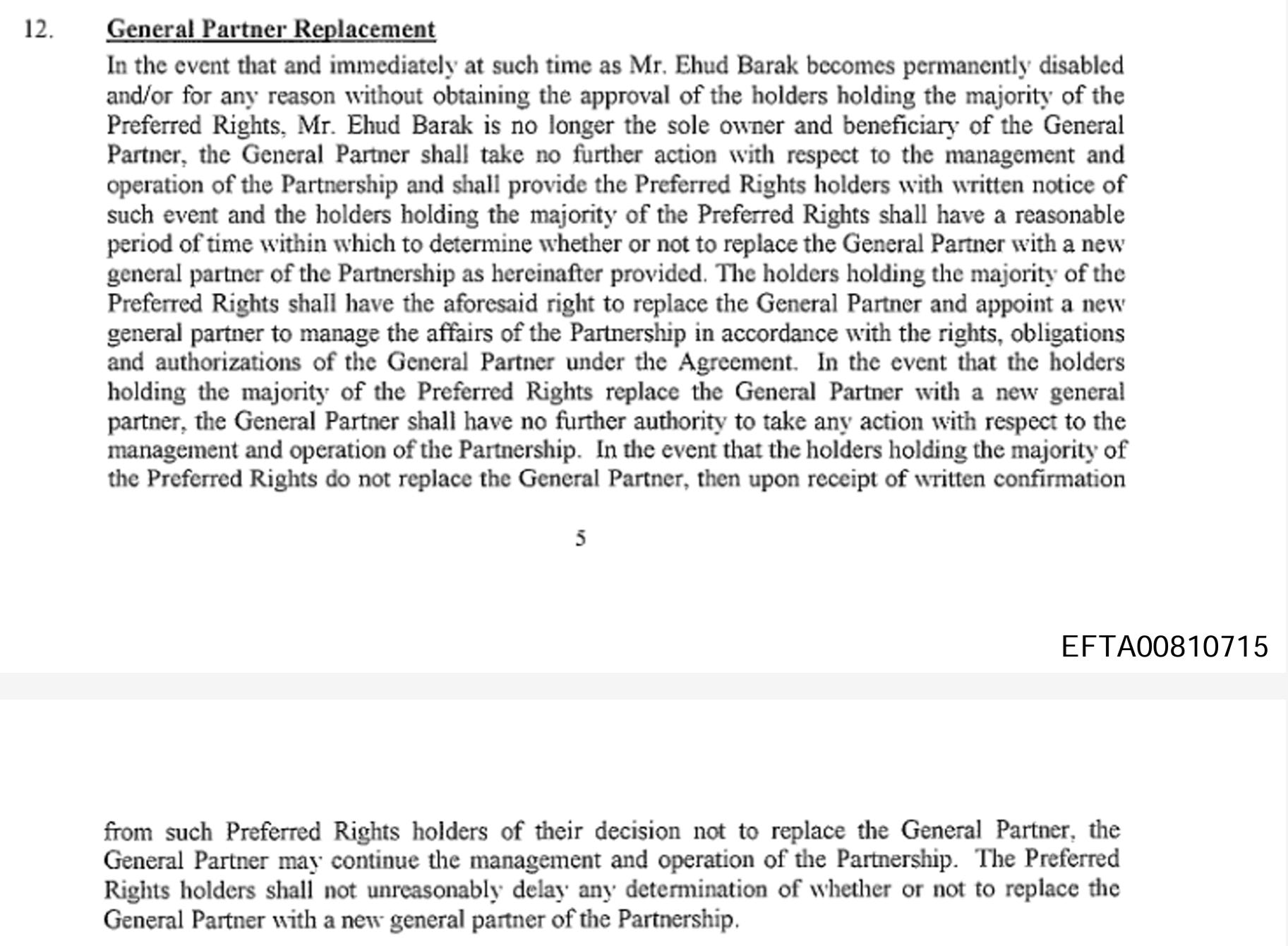
The executed agreement, dated June 30, 2016 (EFTA00810711), is the master file of the entire affair. Its ownership table splits the partnership exactly down the middle, with Barak’s Cogito and Ergo holding 50% and the Epstein side holding the other 50% (Southern Trust at 33.33% and Montilla at 16.67%), matching their million and half-million to the decimal. Section 4 states the partnership’s sole purpose, which is holding shares of Reporty. And section 12 says that if Barak ever stops being the sole owner of the manager company, the majority holder of the preferred rights - Southern Trust - gets to replace the manager. The contract Barak signed says that if Barak leaves, Epstein’s company picks his successor. Nobody writes that clause for a silent partner. You write it for the boss.
Running the company from the cc line
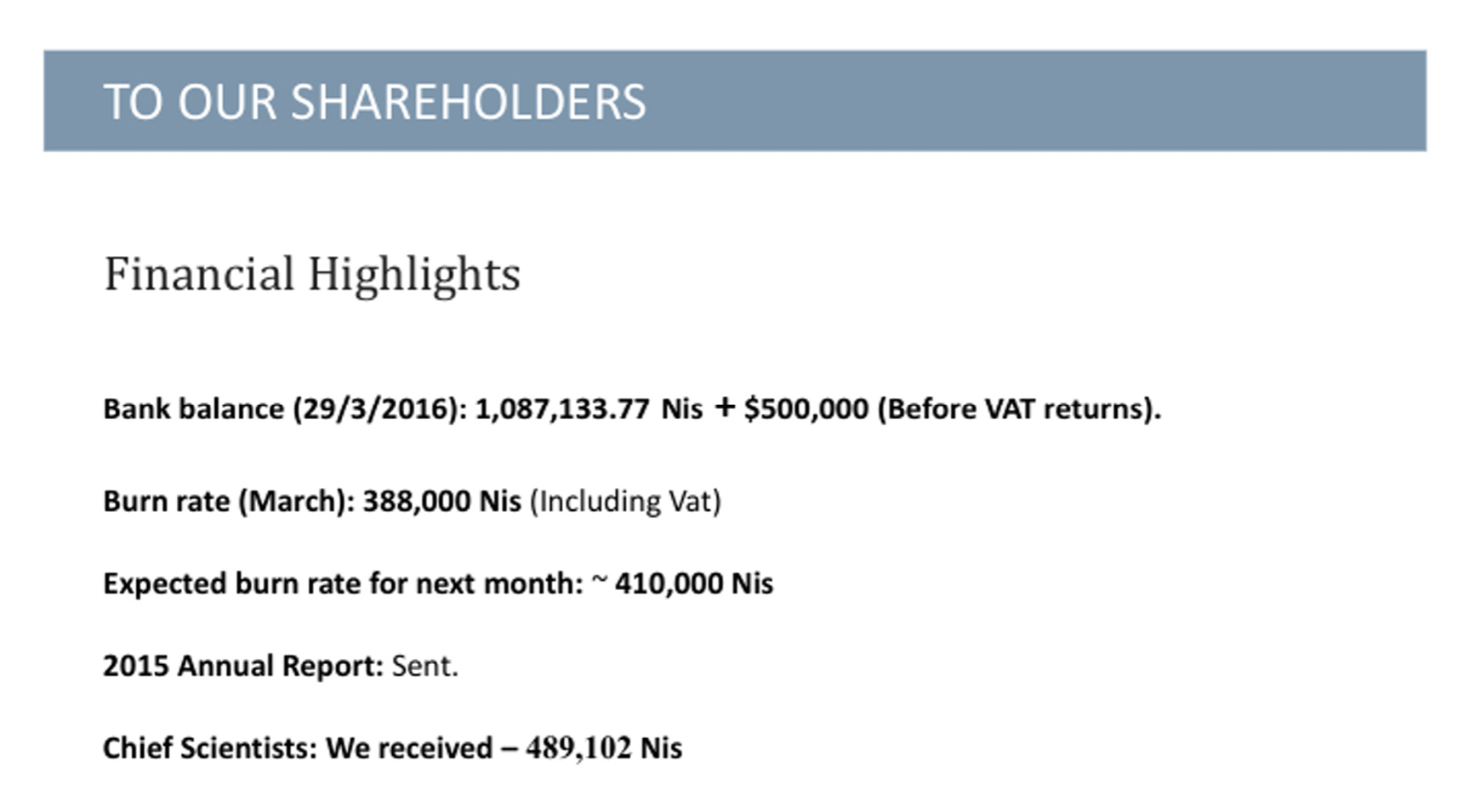
For the next three years, the company's confidential paperwork flowed to Epstein like a subscription, and the subscription started early. Its monthly shareholder reports, each stamped "This Report is classified and isn't transferable," sit in his files for August 2015 - when his money was still, on paper, nothing but a “loan” - and then for February 2016, March 2016, and December 2016. The March report shows a bank balance with a $500,000 line, weeks after Montilla's dollars arrived. Under financial highlights, read "Chief Scientists: We received - 489,102 Nis." That’s grant money from Israel's Office of the Chief Scientist, the government's startup-funding arm, which is routine for an Israeli startup and means state funding and concealed Epstein money shared one small balance sheet.
Board minutes from December 2015 are in his files too (EFTA01074544), and that document pairs with another to show the delivery chain working. The minutes list the directors present, Elichai, Dizengoff, Barak, and Buchris. Thirteen days later, Barak forwarded those same minutes to Junkermann and to Epstein (EFTA02676269). Buchris sat in the boardroom, then - the paperwork from his own meeting traveled through Barak, to the investor Barak would soon note, Buchris wasn't fully aware of.
In April 2017 Barak forwarded the investor report personally, with the note "Hag Same'ach [Happy Holiday] Jeff. Looking forward for our next meeting" (EFTA00631912), and in January 2018 another arrived that read, "Please have a look. Seems to move on very well" (EFTA01013926). A man with no board seat, no disclosed shares, and no official existence anywhere near this company received its board-level paperwork for years.
One week in July 2017 shows how the arrangement worked in action. On the 17th, Junkermann, by then an investor advising the company, emailed Barak about the next fundraise and where to put the company’s European subsidiary - Epstein was cc’d. She suggested “getting Carlo Slim’s [sic] company on board in the Latin American subsidiary,” and on Europe, where Elichai was considering Cyprus, her advice was “Cyprus is raising eyebrows so I would propose Luxembourg” (EFTA02355293). Hours later Epstein weighed in, and I want you to savor this sentence from the man whose own money in this company was routed through the Virgin Islands into a Latin-named Israeli shell. “I agree. the israeli trick of using cyprus to avoid taxes is silly antiquated and dangerous” (full chain at EFTA00640254).

The next day Barak reported back to the group with, “I ordered AE to stop all steps re the Cyprus co.” AE is Amir Elichai, the CEO. A week after that, the actual board met in Tel Aviv and, per the signed minutes, “rejected the formation of a new Cyprus subsidiary as a European base.” On August 7th Junkermann emailed those exact signed minutes to Barak and Epstein (EFTA01038557). Board member proposes, Epstein concurs, the former Prime Minister orders the CEO, the board ratifies, and the paper goes to the hidden investor, all in 21 days.
As for the Carlos Slim suggestion, he never shows up as an owner of anything here, but 15 months after that email, the company, which by then had renamed itself Carbyne (more on that in a minute), announced its Latin America partnership with Global Hitss, a subsidiary of América Móvil, which is Carlos Slim's company. Whether one caused the other, the documents don't say.
The rebrand and Peter Thiel
In early 2018, Reporty Homeland Security renamed itself Carbyne, shedding the words “Homeland Security” right as it started courting American cities and American venture capital money. Regular readers have seen this before - the names in Epstein’s financial universe get friendlier as the scrutiny gets tighter.
The American money arrived on schedule, and the DOJ files contain the entire day it started: May 21, 2018, four emails, one thread (EFTA02656963). It opens that morning with an investor named Chris Hopkins introducing Elichai to Trae Stephens of Founders Fund, Peter Thiel's venture firm: "Nicole and I thought that Trae Stephens at Founders Fund would be a good person for you to discuss Carbyne's progress to date with," adding, "Given Trae's background at Palantir, we figured there would be a fair amount of serendipity." Palantir…being the data-surveillance company Thiel co-founded, and Nicole being the only Nicole anywhere in this story. Elichai responds with his pitch. Stephens answers later that day with, "[dropping Chris and Nicole to bcc and adding my colleagues Kevin, Elena, and Stacy to the thread]," then tells Elichai that he and his partner Kevin Hartz "have spent quite a bit of time talking about next-gen 911, so this is super interesting to us." At 5:12 that evening, the entire thread is forwarded to Epstein, cc Barak, under a cover note reading "Dear both, We made the connection to Founders Forum from Peter Thiel. (see below) If you want to put in a word with Peter maybe :)."
Epstein did put in a word. That same day he emailed Peter Thiel directly, and the entire message was one line: "FYI trae is meeting carbyne Ehud Barak co" (EFTA01052344).
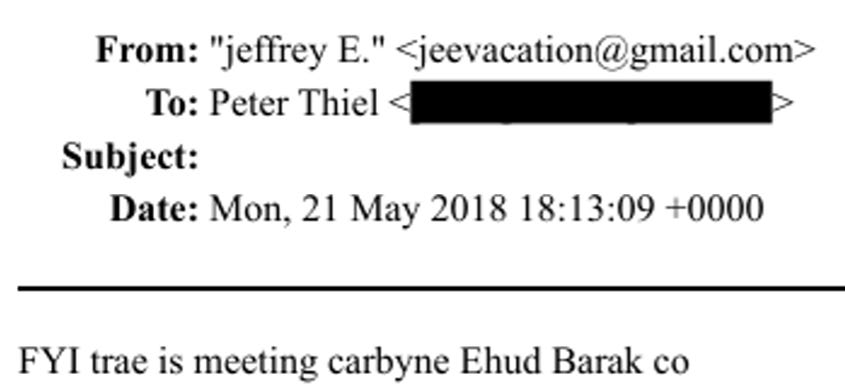
Months later, Founders Fund joined Carbyne's Series B, the fund's first Israeli investment ever. How much weight a personal FYI from Jeffrey Epstein carried with Thiel, is anyone’s guess. That he was asked to put in a word, and did, within hours, is not.
Over the years Carbyne’s investor list and advisory board collected Michael Chertoff, the former U.S. Homeland Security Secretary, and Andrew Intrater, cousin of a sanctioned Russian oligarch. Neither man is accused of anything here. For a small foreign startup selling 911 software, it is simply a remarkable amount of national-security royalty on one cap table, and it tells you what kind of company this was built to be.
2019
The last year of Epstein’s life produced the most quotable documents in the entire file.
On January 1, 2019, Barak emailed a Qatari royal he addressed as "Jabor Al Thani,” cc Epstein, pitching Carbyne for security at the 2022 World Cup. He described Carbyne as a “public safety company of which I’m the chairman and leading investor” and offered that “We can work through a European company of your choice and minimize Israeli profile” (EFTA02607775). By February the CEO himself was on the thread, still cc Epstein, as the Qatari side connected them with a local partner (EFTA02628761). An Israeli security company offering a Gulf monarchy a European wrapper to hide where its product comes from, with Jeffrey Epstein copied on the negotiation, is getting its own piece here soon.
On February 18, 2019, in the middle of an exchange with Epstein about a China-related deal, Junkermann wrote out the internal accounting of their Carbyne position. In her own words: “Carbyne invested 1.5m (1m you and 0.5m me)” (EFTA02630779). One million, you. If four years of wire memos and partnership agreements somehow hadn’t settled whose million it was, here is the co-investor typing it out in an email.
And then there's March. The warrants (shares) paperwork moved through the whole syndicate that week. On March 9th, with documents circulating among Epstein, Junkermann, and Barak - the chairman signed off "Hi J&N, I'm sure it'll be all ok" (EFTA01030782).
And this wasn't paper-shuffling. Sum was exercising its warrants - 61,251 preferred shares for $3.5 million plus expenses - and on March 11, Barak's lawyer confirmed "the requested fund ($3.6m) were received" in Ergo's account - $2.4 million of it Southern Trust's, $1.2 million from Junkermann's renamed company (EFTA02634615). The exercise roughly doubled Sum's stake in Carbyne, from about 13% to about 26% fully diluted.
That paperwork required identifying the controlling person of Southern Trust…you know…the actual human behind the company, and Epstein evidently hesitated, because on March 11th Barak sent him this: "That's the Israeli banks paranoia after they paid the penalties they've paid to the US authorities for past mistakes. According to our experience it was never leaked out of the banks. Just kept with them as an insurance policy. We have to follow on it. On a minimal but satisfying base" (EFTA02632339).
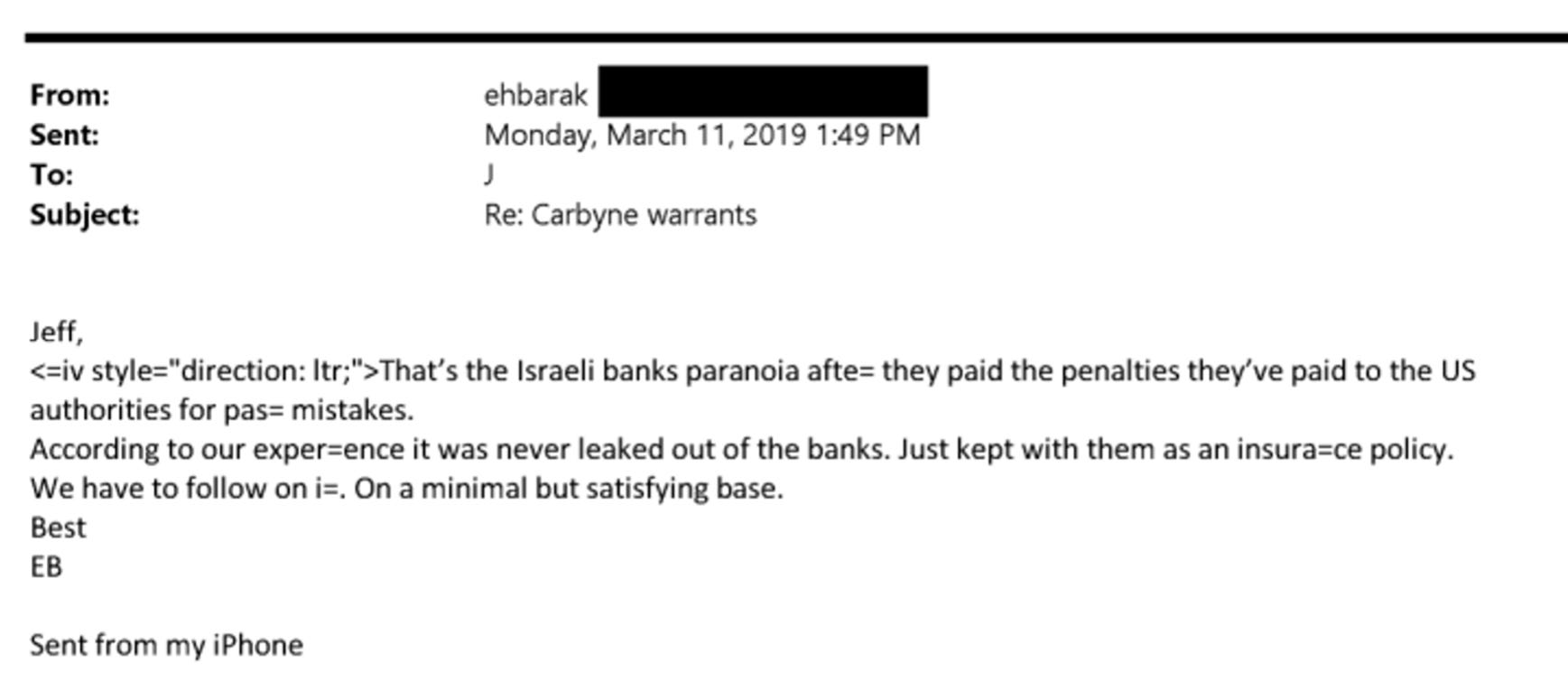
The former Prime Minister of Israel, reassuring Jeffrey Epstein that his name would stay inside the bank's own files, and coaching him to disclose as little as he could get away with. Then, on March 12th through 14th, Indyke closed the loop under the subject line "Re: Carbyne warrants" (EFTA02634615), asking, "Am I correct that by your 'ok' you mean that I may confirm that you are the controlling person of the STC?" Meaning, may he give Epstein's name and citizenship to Barak's lawyer? Epstein's complete reply, less than four months before his arrest…was one word. “Yes”
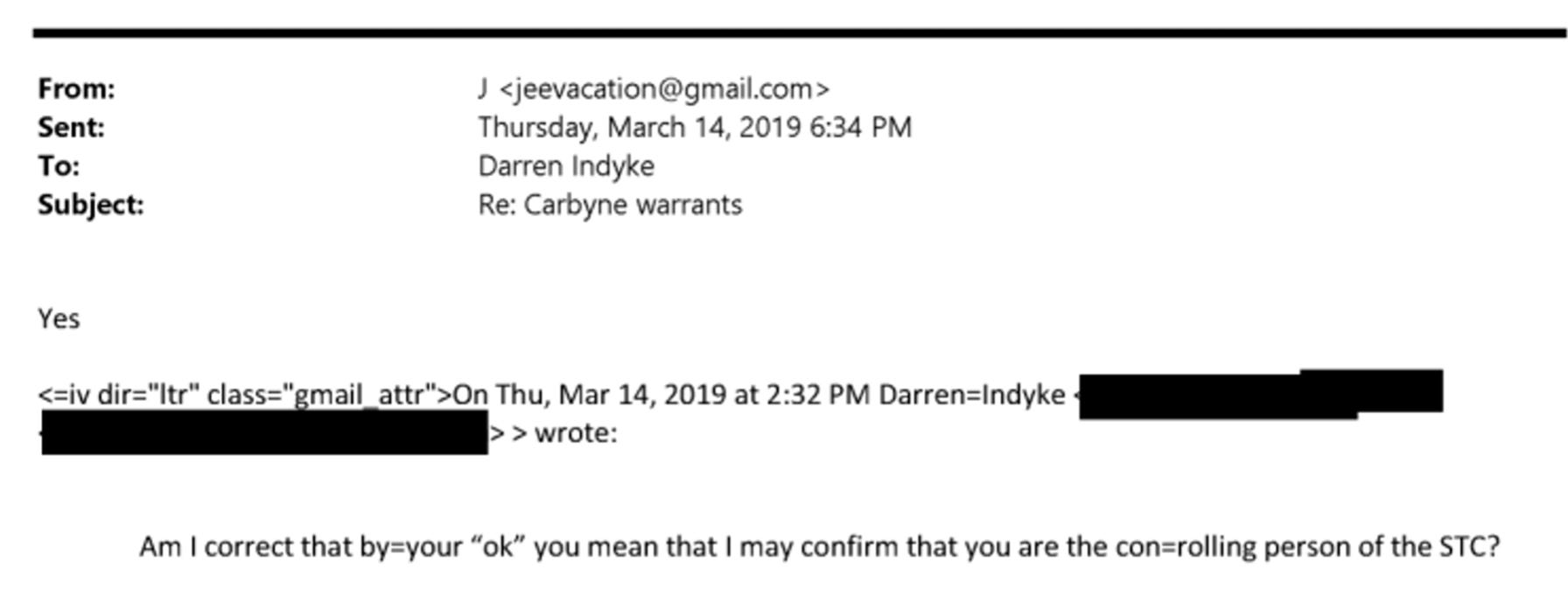
Every soft phrase ever printed about this arrangement, “a firm linked to Epstein,” “Barak’s business partner,” “a passive stake,” dies against that word, in his own email, released by the United States government. But the email thread holds one more ghost. Indyke mentions that “Stewart Oldfield is trying to find out what kind of letter he can get for us,” and Oldfield, per Fortune's reporting on the DOJ files, was Epstein's Deutsche Bank wealth director - the banker who kept his accounts open months after the bank claimed to have cut him off and who was later terminated over diligence failures for "a particular client." Deutsche had told Epstein in writing, in December 2018, that it was done with him, and his accounts spent 2019 winding down. Regulators later flagged reference letters a Deutsche banker drafted for him that July. So in March, the man being shown the door by his own bank was shopping for whatever letter it would still write him.
Come July 6, 2019, federal agents arrested Epstein as he stepped off his private jet at Teterboro Airport.
Barak told reporters he was looking into removing the Epstein-connected entity from the partnership, and when Haaretz first asked him about Sum, his answer was that “I saw a business opportunity and registered a partnership under my control in Israel,” with “a small number of people I know” invested, whose identities it would be “inappropriate and wrong” to reveal. Inappropriate and wrong…for whom? He has consistently maintained the investment was legal, reported, and taxed, and no document contradicts him on that. It should also be noted that no one has been charged with any crime over any of it.
Epstein died in his cell on August 10th. Whether Southern Trust’s stake was ever actually bought out is a question nobody has answered, and it now has a $625 million price tag attached, which is where we’re headed next.
The Taser company
Carbyne thrived without its dead, hidden investor. It raised well over a hundred million dollars, put its software into 911 centers across the United States, and became Google’s delivery partner for Android’s Emergency Location Service to call centers across Mexico, which within months covered 11 states and sixty million people. Carbyne is not inside your phone, but when an Android in Mexico dials for help, its location data reaches the dispatcher through Carbyne’s pipe. The company’s own marketing describes live video from callers’ phones, integration with city camera networks, and a future of emergency response it calls “proactive, preemptive.” The 2014 diligence answers said the quiet version, and the 2025 brochure says the polished one.
Then…Axon Enterprise (formerly Taser International) came shopping. It had previously purchased Prepared, another 911 startup backed by Andreessen Horowitz and Google’s AI fund, Gradient Ventures, for $728.2 million per Axon’s SEC filings - then led Carbyne’s $100 million round in August 2025, taking about 11% of the company. Axon announced the full acquisition on November 4th and closed it on February 18, 2026. Axon paid roughly $549.7 million in cash at closing for the roughly 89% it didn't already own, against the $625 million base price.
Axon's own letter to shareholders explains the prize in its own numbers: The combined system will cut high-priority response times "from seven to ten minutes to as little as 120 seconds," and the two 911 deals add "$5 billion to a market opportunity now exceeding $74 billion" inside what Axon calls its "$159 billion total addressable market." The road into America's emergency calls was privatized by a handful of Silicon Valley funds, including Thiel's, and sold to the company that makes the Tasers - a company that values the territory it's assembling at $159 billion.
If your instinct says a company like Axon must be careful with power, here is one data point. In 2022, nine of the twelve members of Axon's own AI ethics board resigned after the CEO announced plans for Taser-armed drones in schools, over the board's objections. Axon paused the drones. The nine never came back.
A shareholder, the Nathan Cummings Foundation, asked Axon to disclose its political contributions; expenditures, recipients and amounts included. Axon's lawyers argued the request would micromanage the company, and on February 10, 2026, the SEC staff agreed not to object to burying the proposal, "based solely on that representation," under a streamlined process that now takes companies at their word. With that, the foundation sued in D.C. federal court on February 17th, one day before the Carbyne closing. Three weeks later, Axon settled, agreeing to annual public disclosure of its political-spending policies and certain contributions for the next five years. The transparency it told the SEC would micromanage it, turned out…under the lukewarm pressure of an actual lawsuit, to be perfectly manageable after all.
But they’re not out of the legal whirlpool just yet. The Carbyne sale itself is also in court, with a minority shareholder suing in Tel Aviv over roughly $20 million in founder bonuses and about $40 million in Axon shares - that it says - created a conflict of interest. Those are allegations in a live case, they’re not findings, and for the record, the founders will have their say.
Who gets paid
Here’s what the record supports, and what it doesn’t.
Epstein doesn’t run Carbyne from beyond the grave. His documented position was a concealed stake bought in two rounds: The $1.5 million entry - his million and the half-million he green-lit - and Southern Trust's $2.4 million share of the March 2019 warrant exercise, in a company that went on to raise a hundred times his entry cost.
A convicted sex offender helped pick a surveillance-adjacent company’s investors, received its classified monthly reports and signed board minutes, weighed in on its corporate structure, and personally messaged Peter Thiel on its behalf, while appearing on zero of its official records, and every mechanism involved was legal. Lawyers drafted it, a bank’s compliance department ran its callback checklist on the wire and ticked every box. If Jeffrey Epstein could sit invisibly inside a company selling access to 911 systems for five years, the honest question is - who else is sitting inside what right now, with better lawyers and no arrest prompting the release of a trove of documents?
And someone…somewhere…has to have collected. Money moved when the deal closed in February, and the Intercap lawsuit says even unwilling minority holders were effectively forced to sell - which means every shareholder of record got paid out, whoever they were.
So the obvious question is whether Epstein’s estate was one of them.
Epstein's side held 50% of Sum - Southern Trust with a third of the partnership and two-thirds of its first-money-out preferred rights - as late as March 2019, which is what the "Carbyne warrants" email was about. Barak said in July 2019 he’d look into removing the Epstein entity. And then, on the record to Forbes this February, CEO Amir Elichai said that Epstein's estate "did not keep any company stock" and that Barak "no longer has a stake in the business."
Taking that at face value, the estate collected nothing from the $625 million. However, face value is not the same as a paper trail, and the public one has a gap.
Nobody has shown the document that moved Southern Trust's stake out - when it happened, at what price, or to whom. The estate's own probate inventory, filed weeks after Epstein's death, lists $194,986,301 in hedge fund and private equity investments without itemizing a single one, and its co-executors are Richard Kahn and Darren Indyke - the same lawyer who helped build this house of cards. That doesn’t offer much in the way of confidence.
Elichai's word settles what the company says or believes - it doesn't produce the transfer deed. So where we’re at is…the CEO says the estate holds nothing, and the registries that would prove exactly how and when that became true, are Israel's partnership file for Sum, the Virgin Islands probate accountings, and/or the Tel Aviv lawsuit's cap-table disclosures - I'm working on going through all three. The side-quest that took me on is a whole separate article for another day.
The men who built this structure were betting that nobody would ever read the paperwork, and for six years they were right. But...then the files came out, and now the paperwork is the story, this story, including countless screenshots of signed and stamped documents running in a straight line - from a phone call “JE” curated in December 2014 to a $625 million payout that cleared in February 2026, long after Epstein’s death.
All EFTA documents are from the DOJ release at justice.gov/epstein. Israeli registry numbers, Sum 550260459, Ergo 515175495, Cogito 515228021, Reporty/Carbyne 515106409. Outside reporting credited inline. Everything hyperlinked so you can read the documents for yourself.
No posts
Comments
Nothing yet. Say the first thing.
Sign in to join the conversation.