
I’m Emily Grabatin, and this Welcoming Slow Growth Podcast is a space for God led writers, entrepreneurs, and creatives called to bring hope and healing through your work. This season, we’re exploring stories of like-hearted people who chose one word to guide who they’re becoming…and what happened in the process.
Take a deep breath and let’s settle in together.
I love chatting with serial word-of-the-year practicers. Their journey fascinates me because as they string together their story of their words and defining moments and reflect on how much they’ve changed through the process, I can see how each word ushers them into the next season’s word.
In life’s quick pace, it’s easy to get swept up in looking for the moments we can turn into our highlight reels. But in slowing down, we get to see what God has been artfully shaping all along.
Joanna Mumford is one of those people whose story shows just that.
Joanna is a writer and a student with a heart for grassroots peacebuilding and interreligious hospitality. She’s a traditionally published author of multiple fantasy novels and is currently completing her master’s in peace and justice from St. Stephen’s University in New Brunswick, Canada — where her thesis focuses on storytelling and the inner transformation of the peacemaker.
We’ve been having versions of this conversation for years. Checking in on our word of the year and on what God seems to be doing and noticing the slow shifts. So sitting down to record felt like an excerpt of an ongoing conversation we wanted to invite you into. What I didn’t expect where some of the thought-provoking quotes she shared and the language to things I’ve been mulling over as we well.
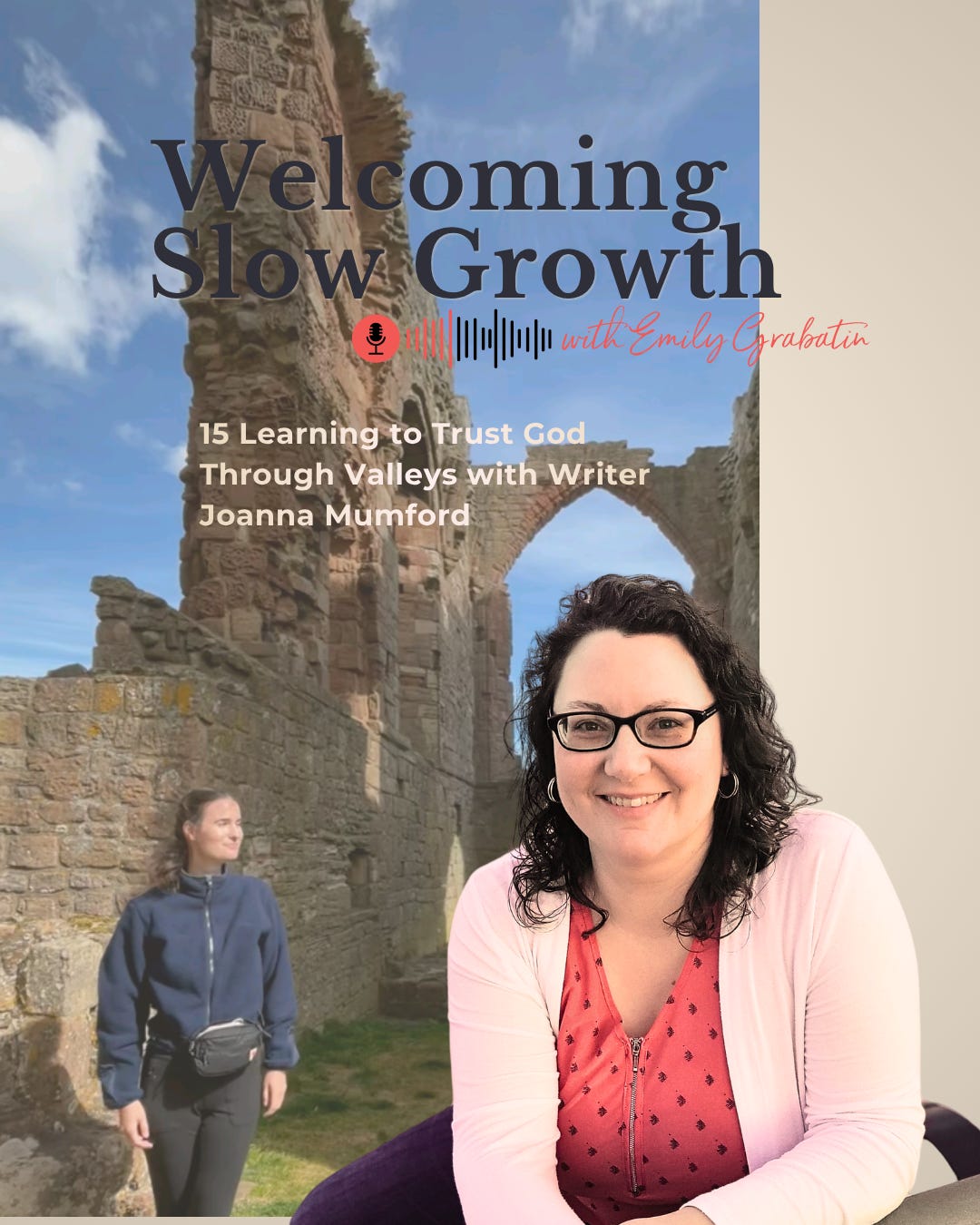
Before Joanna could talk about her words, she needed to back up to the year that set everything in motion.
“I’m goanna back up to 2022,” she said, “because I do think that was a particularly transformative moment for me — spiritually, personally, all the things in my life. I like to think of it as my own personal ‘divine revelation of love,’ to quote Julian of Norwich.”
Joanna grew up in a standard evangelical Christian environment. She knew God from a young age. But she describes a kind of subtle separateness that existed between her felt experience of God, which was warm and present, and her intellectual picture of him, which was more distant.
And then 2022 happened.
“God just revealed himself to me in a new way,” she said. “And I really finally understood that presence I’d always known — that is truly who God is in God’s deepest heart. God is light, and in him is no darkness at all. He is love.”
She started reading George MacDonald1. She encountered Julian of Norwich2 in a new way. And her picture of God completely changed.
“Letting go of the more intellectual ideas I had about God — it just blew the roof off. I was able to experience way more of God once those limitations were gone.”
She wanted to share one of Julian’s most famous revelations before moving into her words — because, she said, it set the stage for everything that followed.
For anyone unfamiliar: Julian of Norwich was a woman, an anchoress, living in 14th-century England during an extraordinarily tumultuous time. She went through devastating grief and loss and prayed that God would reveal himself to her in a way she could truly understand. What followed were a series of revelations she spent the rest of her life writing down.
Julian of Norwich’s most famous quote is:
“All shall be well, and all shall be well, and all manner of things shall be well.”
Joanna admits that when she first heard it, in a season of suffering, it felt a little too easy. Too simple, like brushing pain under the rug. But then she heard someone unpack it differently — and it all came together for her.
“All shall be well — the first ‘all’ being everything.
And all shall be well — the second ‘all’ being people.
And all manner of things shall be well — that ‘all’ being the whole cosmos, everything in existence.
Those three ‘all shall be wells’ in a row encompass everything.”
That reframing changed it for her. And with that as the foundation, she moved into her words.
After an experience like 2022, you might expect what follows to carry the same electricity. Joanna did.
It didn’t.
“After such an incredibly mind-blowing, heart-moving experience, to then find yourself feeling very stuck and restless and nothing seems to be happening — that was really hard. I sort of expected that after this experience, that would be how the rest of the journey would be. And it’s not like that.”
She described what followed as two years of pilgrimage in the dark.
It’s a phrase that stood out to me since our conversation. Pilgrimage in the dark. Someone on a journey, not lost but unable to see more than a few steps ahead — and learning, slowly, to keep walking anyway.
“We often can’t see more than a few steps ahead. Sometimes we can’t even see the next step because it feels like we’re walking in the dark. But there is this trust-building that goes on in that experience.”
Think about being on a mountaintop. You catch a glimpse of where you’re headed and your mind fills in the shortest path there — the most reasonable route. But viewpoints have a way of tricking your sense of distance. The path is never quite straight. You have to go around a mountain or through a marshland, and what looked like a reasonable journey turns out to take much longer than you planned. (I picture that scene near the end of The Hobbit: An Unexpected Journey when Bilbo and the Dwarves walk out on a mountain ledge to gaze on their destination – the Lonely Mountain far off, unaware of the hidden dangers they would face crossing the lowlands to get there).
Patience is one fitting word for that in-between space when you don’t know the terrain, and you can’t see how long it’ll take.
For Joanna, the in-between had very real contours. As a writer, she was working on multiple stories she felt God had given her. She resonates deeply with something Madeleine L’Engle3 said:
“We serve the work, and it is holy work…”
And she was trying to do exactly that — tending the seeds and showing up faithfully, working away at stories that didn’t seem to be going anywhere professionally.
“Publishing is a profession where you need a lot of patience. It’s slow in its nature. But mine was even slower than normal.”
She kept trusting, kept tending. And she was honest about the complexity of that — the not-knowing whether the stories would ever find their way, and having to make peace with both possibilities.
“His will is always the most beautiful way. And I think that it doesn’t mean there’s not suffering and grief. It’s hard. But He always comes through — maybe not in the specific way that we had been praying for, and I know that firsthand — but in the true heart of what it is we’re longing for.”
When I asked her what the fruit of that long, slow season of patience looked like, she did name something tangible — a book deal, eventually — but she was cautious to put too much weight on it.
“I hesitate to always point to these tangible markers as signs of success or fruition in this journey, because so much of it really is these internal treasures. In a more general sense, I can say that my life in the last two years is more saturated with peace. It’s more saturated with creativity. These things are more important to me ultimately than the tangible successes.”
What if that was the point all along? That God was more interested in shaping who she was than delivering a particular result. The opportunities and joys are real, but those internal treasures Joanna mentioned tend to carry over into the next thing, and the next.
Patience cultivated the ground for transformation.
Before Joanna described what this looked like, she wanted to share another quote — because, she said, someone else had put into words what she was still trying to articulate.
The quote is from a writer named Jonathan Bailey (co-founder of the Dwell app4), whose blog is focused on slow growth and presence with God. He has a book forthcoming called Dwelling in Christ,5 but this quote is from his blog.
“God wants to give us virtue, but he’s designed us with such terrifying dignity that we cannot receive even good things against our will. The challenging work in the spiritual life is making ourselves ready to receive.
To recognize God’s best gifts are less like being given a rare wine and more like receiving your first violin. The pleasure we draw from the wine is wonderful, but once enjoyed, it is gone. The violin, however, is a far richer gift. If we give ourselves to it, if we train with it, if we listen to what it wants to tell us, it can deliver a deeper pleasure. It’s the kind of pleasure that never recedes but grows stronger with use. The more we give to it, the more it gives to us.
These are the best kinds of gifts — the ones that draw us into themselves and yet pull us out of ourselves. The ones we thought were for us alone and yet, over time, beg to be given away.
This is virtue, this is goodness, and this is what God wants to give. If we’ll pursue it, if we’ll train for it, our hands will slowly open, the key will start to turn, the bud will begin to bloom.” — Jonathan R. Bailey
There was a pause after she read it.
“If I had to summarize what the year of transformation looked like, it was like that,” she said. “It was the realization that I had gone through the season of patience, and in fact was slowly being changed through what was happening to me and in me. And then the recognition that this isn’t only for me.”
That shift from receiving to giving away was at the heart of what transformation meant for Joanna. Five years ago, she says, her creative life was largely about her own stories. Now the focus was changing.
“Really the focus has shifted so much to less about my stories and more about the people around me on this journey — the readers, the professional editorial friends I’ve made along the way. That’s the focus of this journey for me.”
That resonated with me.
I think when we’re starting out, the creative life can be transactional. How do I get to my goal? What can this person do for me?
But the further along we go, the more we see that each person is an encounter. They’re in their own story. Our roads intersect for a moment, or maybe we journey alongside each other for years. And those moments add up to something — bridges, relationships, the slow realization that because of that person, you aren’t quite the same.
When I asked Joanna what meaningful moments stood out to her in this “Year of Transformation”, it took a few minutes to mentally sift through them. So often they seem like stand along memories until we can look back and connect the dots.
For Joanna, it was challenging because it involved both hard things and beautiful things. Hard thinks like facing past mistakes and the hurts that come with being human and interacting with hurt humans who hurt each other. Beautiful things like A new book. A master’s degree nearly complete. A relationship she’d been waiting for.
And underneath it all, there was a wrestling. Of course transformation is an ongoing process, but it was both meaningful and difficult to find way to live in the tension of understanding of how those hard things ultimately lead to the better horizon she was working towards.
“I wish I hadn’t had to go through some of the hard things, and yet if any one of those things hadn’t happened, would I be standing here right now in this place?”
She talked about the difference between finding purpose in suffering and finding meaning in it. She doesn’t believe God wills hard things upon us. But she’s made a certain peace with the mystery of how it all weaves together.
“We don’t have to understand how God actually works. What is that interplay between our will, the will of others, God’s will? It’s all weaving together. And I just have to trust — that whatever God’s tapestry is, He’s going to make sure that happens.”
She also offered a word of caution about looking backwards that she’d heard from a theologian that made sense. Looking back with gratitude, to see how God has sustained and provided, is good. It’s part of the story. But looking backwards with bitterness or sadness or grief — that’s a different thing. God is in the present. And we’re always moving forward.
That image of mystery brought to mind YouTube video I had just watched of a pastel artist. I saw the finished landscape first, and then she starts from the beginning by adding colors in what seem like random places, smudging, layering, building texture that didn’t make sense yet. I kept wondering, how is this going to come together? And then it did—suddenly the random colours and smudges take shape into the beautiful picture.
That’s what mystery feels like in the middle of it. All these layers and colors that don’t yet make sense, but I’m trust that they will and observe with curiosity.
I paused the conversation so we could continue it in the next episode of Welcoming Slow Growth.
You know that moment at a table with friends when someone is pouring the water and they’re so caught up in the story they’re telling that they don’t notice your glass has filled up and started to overflow? That’s about how I was feeling.
The thread I kept noticing was TRUST.
Trusting that God is as present in the valley as he was on the mountaintop.
Trusting that in the midst of pain and suffering, he is still good and light and love — and he can bring meaning.
Trusting that His presence in the tension and the mystery can be enough to keep going. And that when trust wavers, it can be renewed by looking back and seeing how far you’ve come and how much you’ve grown — and what you’re now able to hold that you couldn’t have imagined before.
And Joanna’s third word (the one that followed patience and transformation) is coming in Part Two. It’s worth the wait.
Let’s absorb what’s speaking to you so far from our conversation. What quote stood out to you the most?
What thread did you notice in our conversation that you want to chew on a while?
Joanna Mumford is a writer and student with a heart for grassroots peacebuilding and interreligious hospitality. The traditionally published author of multiple fantasy novels, she is currently completing her Masters in Peace & Justice from St. Stephen’s University (New Brunswick, Canada) where her thesis will focus on storytelling and the inner transformation of the peacemaker.
Connect with her on Substack at skyejo.substack.com
Thanks for listening to this bi-weekly podcast: Welcoming Slow Growth. If today’s conversation encouraged you, would you share this episode with a friend or colleague who needs to hear it or leave a thought in our Substack community? Until next time…keep welcoming the slow growth.
Click here to listen in your favourite app.
Connect with Guest
Substack
Website
Read her book
Connect with Emily Grabatin:
Substack | Podcast | Author Tips | Coaching | Book
George MacDonald (1824–1905) was a Scottish author, storyteller, poet, and minister. He’s known as the “grandfather” of modern fantasy literature and was a major influence on writers like C.S. Lewis and J.R.R. Tolkien.
Julian of Norwich and her Revelations of Divine Love — I wasn’t familiar with her before Jo mentioned her in our conversation. However since then, I’ve started seeing Julian of Norwich mentioned and quoted everywhere!
Madeleine L’Engle authored A Wrinkle in Time. A quick search didn’t find her quote “we serve the work, and it is holy work” that Jo mentioned, but I realized she has a lot of gold in her other works such as Walking on Water: Reflections on Faith and Art.
Dwell app - Several friends have recommended this app to when I said I prefer to listen to Scripture. https://dwellapp.io/
Comments
Nothing yet. Say the first thing.
Sign in to join the conversation.