
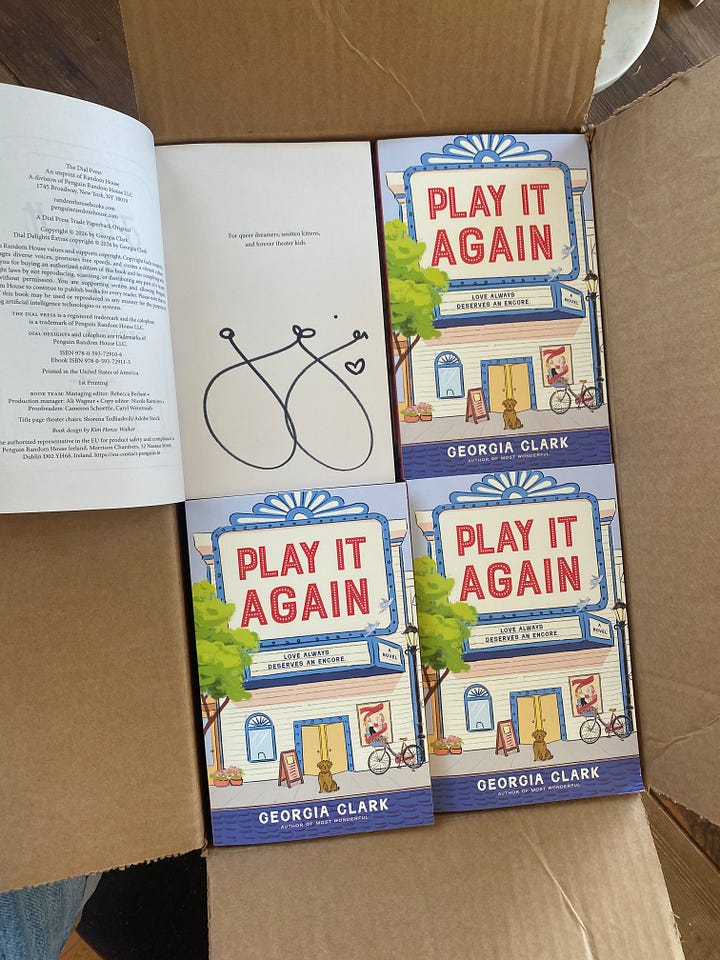
When I tell people I’ve published eight novels, the reaction is almost always the same: How? And honestly, when I look at the list of previously published titles in the front matter of my own book, my bewilderment matches theirs.
I’ve long maintained that the secret to creative success isn’t talent — although ofc it’s a factor — or luck, which plays a larger role than most people imagine. It’s perseverance. Determination. Grit. Stubbornness, even. I attribute my publishing track record entirely to not giving up in the face of what often felt like insurmountable odds. That’s meant pushing on through two unpublished novels and many more unrealized proposals, navigating quieter books, big life changes like having kids, and all the other things that make writing hard — including, until I got some therapy to help manage it, fairly consuming professional jealousy.
But despite all of it: launch days are a time to celebrate.
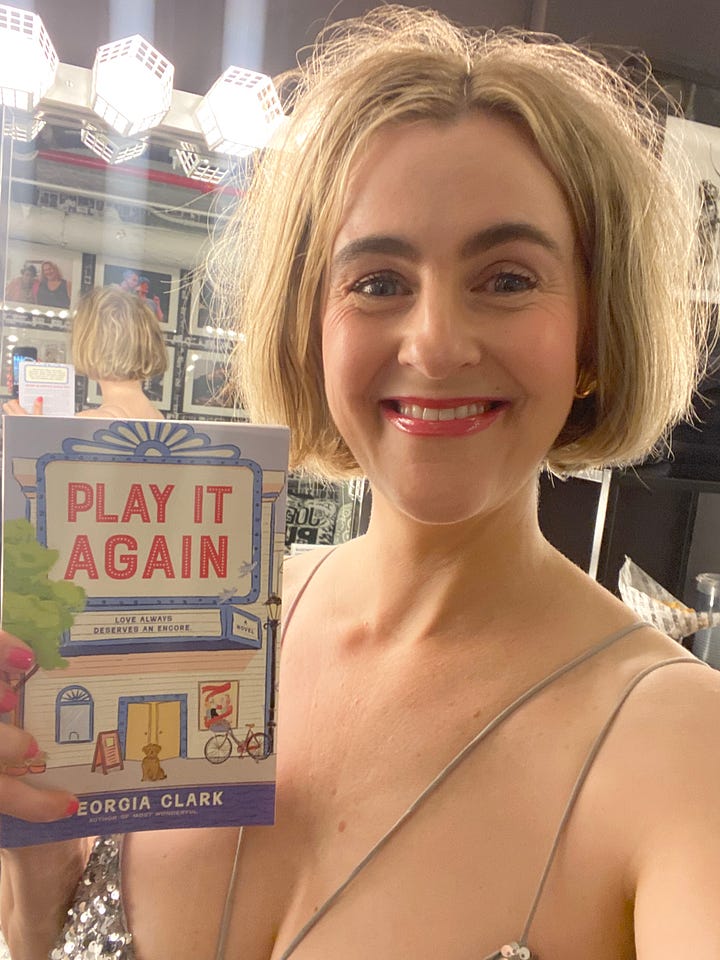
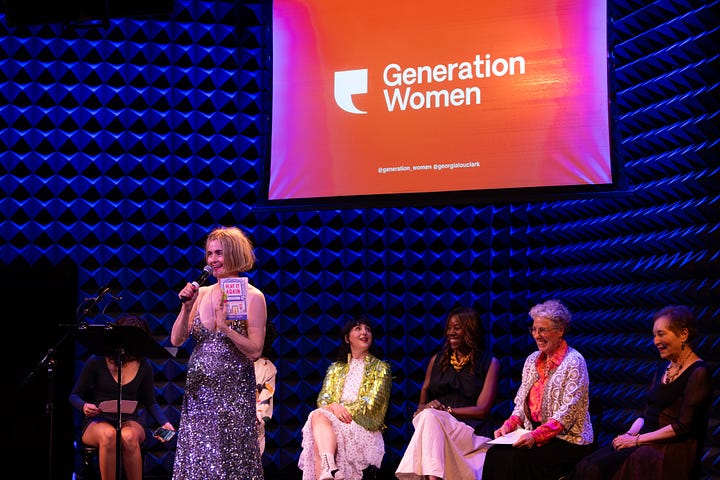
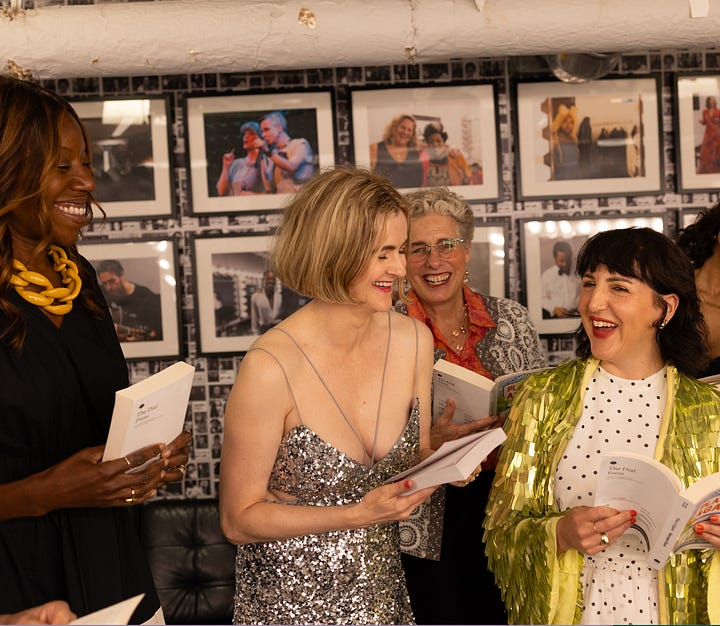
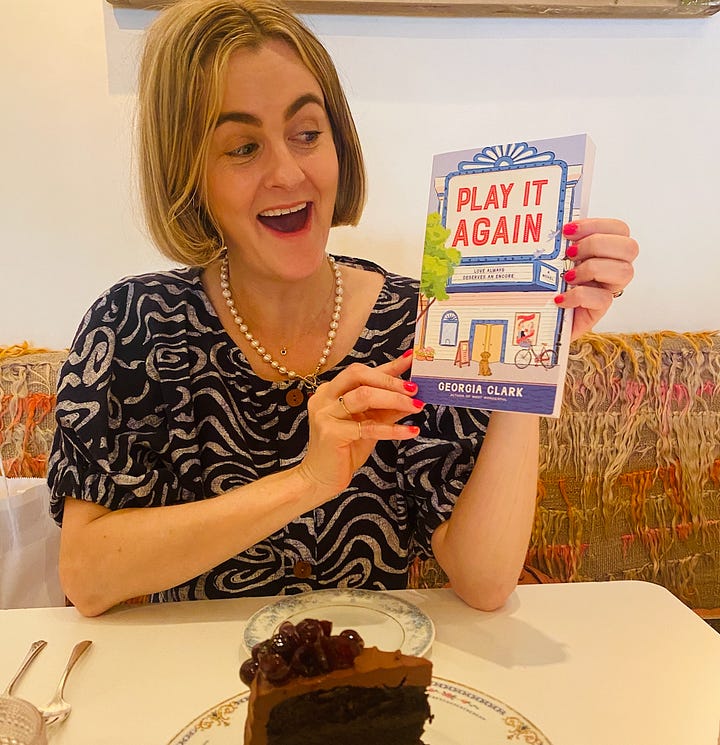
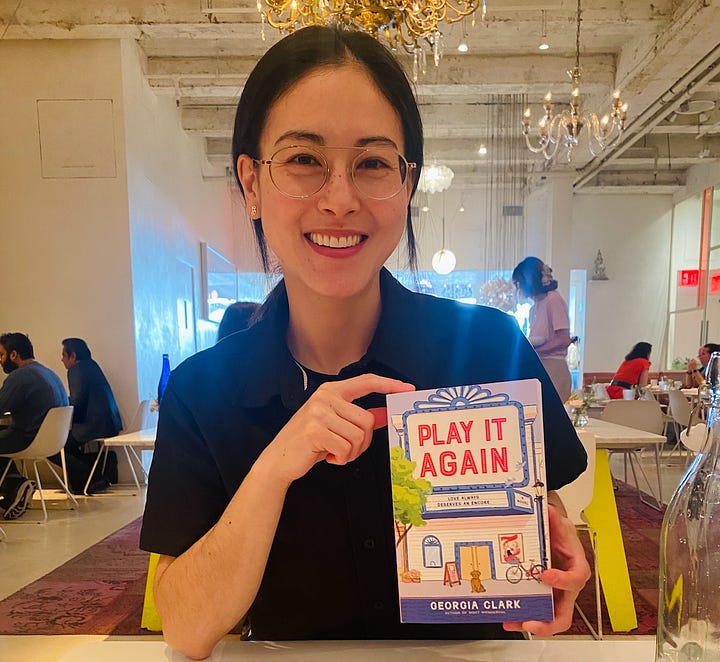
I had lunch with my editor Katy Nishimoto at abcv — the best vegetarian restaurant in New York City — where we demolished fancy veggie mains and a fat slice of chocolate cherry cake. Then came the main event: the Generation Women book launch show. I’ve done this for multiple books now, folding a storytelling night into a launch celebration, and it never gets old. For Play It Again, the theme was Play — but what emerged through the stories wasn’t so much play as something deeper: the yearning to live authentically, to say yes to joy, to take an active role in your own life. It was a perfect fit for a book that is, at its heart, a celebration of doing things not for money but for fun, for community, for connection, for creative fulfillment.
Which is, ultimately, why I’ve written eight novels. I chose creative fulfillment over financial certainty, again and again, and I’m proud of that decision every time.
It was a wonderful night. I wore a sparkly dress. We drank champagne. We laughed. We cried. I welcomed back many beloved performers and a few wonderful new ones.
Thank you to everyone who came out. And if you haven’t yet picked up a copy of Play It Again — now’s the time. 💕
It was cathartic to write and, judging by your responses, deeply relatable.
This month I’m doing something similar but different: a look back at all the gatherings, programs, courses, and events I’ve organized over the years. Not from the angle of failure — I don’t see any of these as failures — but more as a kind of origin story. A paper trail of the person who would eventually create My Novel Year. Some of these things ran their course. Some just didn’t quite work. Some evolved into something else entirely. All of them taught me something.
So! A brief and lightly chaotic walk down memory lane.
When I sold my first novel in 2015, I didn’t know a single other novelist in New York City. Rather than accept this, I did what I always do: I organized something. I asked my editor for names of other local writers, sent cold emails inviting strangers over for cheese and wine on a Sunday afternoon, and waited to see who showed up. The first session: me, my then-girlfriend-now-wife Lindsay, my visiting mother, and two other writers. Modest. Cozy. Immediately useful — at that first meeting I learned that if you hated your cover, you could actually request a new one. I had no idea. I thought you just had to live with it.
The salon ran monthly for five years, eventually co-hosted with the wonderful Amy Poeppel, alternating between our apartments. So many novelists passed through those doors — Fiona Davis, Hannah Orenstein, Brian Platzer, Lexi Freiman, Jamie Brenner, Lynda Cohen Loigman, Corinne Sullivan, and many others — and it remains one of the things I’m proudest of building from nothing. The secret formula, I have since confirmed, is: wine, cheese, a room with a view, and one very tenacious organizer.
After going all-in on the launch of The Regulars and learning an enormous amount about self-promotion and publicity, I channeled all of that hard-won knowledge into an eight-week self-study digital course called The Proactive Author. A step-by-step guide to proactively and effectively launching your book. It was my first real foray into digital course creation and, honestly, it was pretty great. It’s no longer available, but a lot of what I learned building it lives on in My Novel Year.
My first foray into organizing a writers’ retreat — and yes, it was held in my own apartment. I need to acknowledge the low-key audacity of this. My wife and I still live in the same place on the Williamsburg waterfront, which is beautiful, but it is also our home, and I once hosted half a dozen writers in it for a long weekend of writing, coaching, food, drink, and sharing work. Originally scheduled for 2020, postponed to 2021 (you may recall there was a thing), it only worked because we had a spare room pre-kids. This was the earliest iteration of what would become the Generation Women Writers’ Retreat.
Possibly my most unhinged and beloved project. This comedy storytelling concept — performers writing erotic fan fiction about unlikely pairings from pop culture — originated in Sydney, where it became something of a cultural phenomenon, before we brought it to New York as a late-night comedy show at Caveat.
Based loosely on the Generation Women model but with, shall we say, a different energy.
My own flagship piece centered on the unspoken sexual tension between Prue Leith and Paul Hollywood from The Great British Bake Off — a very silly story rich with puns about soggy bottoms, golden handshakes, and the emotional weight of a Hollywood Handshake finally, finally meaning something more. Pure late-night chaos energy.
Ultimately, the brutal reality of 6am baby wake-up calls made running a late-night comedy show increasingly untenable, and we let this one run its natural course. No regrets. Only fond memories and one very compromising Word document about a soggy bottom.
My first foray into working with writers in a substantial, structured way — and the direct predecessor to My Novel Year.
Born out of the pandemic’s normalization of online teaching, this four-to-six week workshop was where I first began formalizing my ideas around structure, craft, and industry readiness in a group setting. Every cohort was a wonderful group of largely women who were passionate about romance fiction, and the work was real: substantial developmental feedback, craft lectures, honest industry conversation.
It ran for four years and taught me more than I expected — about how writers learn, what they need, and how to deliver feedback that actually lands. Many of those writers went on to work with me as private clients, and some are now in My Novel Year. The through line is obvious in retrospect.
Looking back at all of this, what strikes me isn’t how much didn’t last — it’s how much each thing taught me, and how clearly one thing led to the next. The salon became the retreat. The course became the coaching. The workshop became the mentorship. The shows became the community. None of it was wasted. And all of it — every cheese plate, every soggy bottom gag, every cold email sent into the void — eventually became My Novel Year.
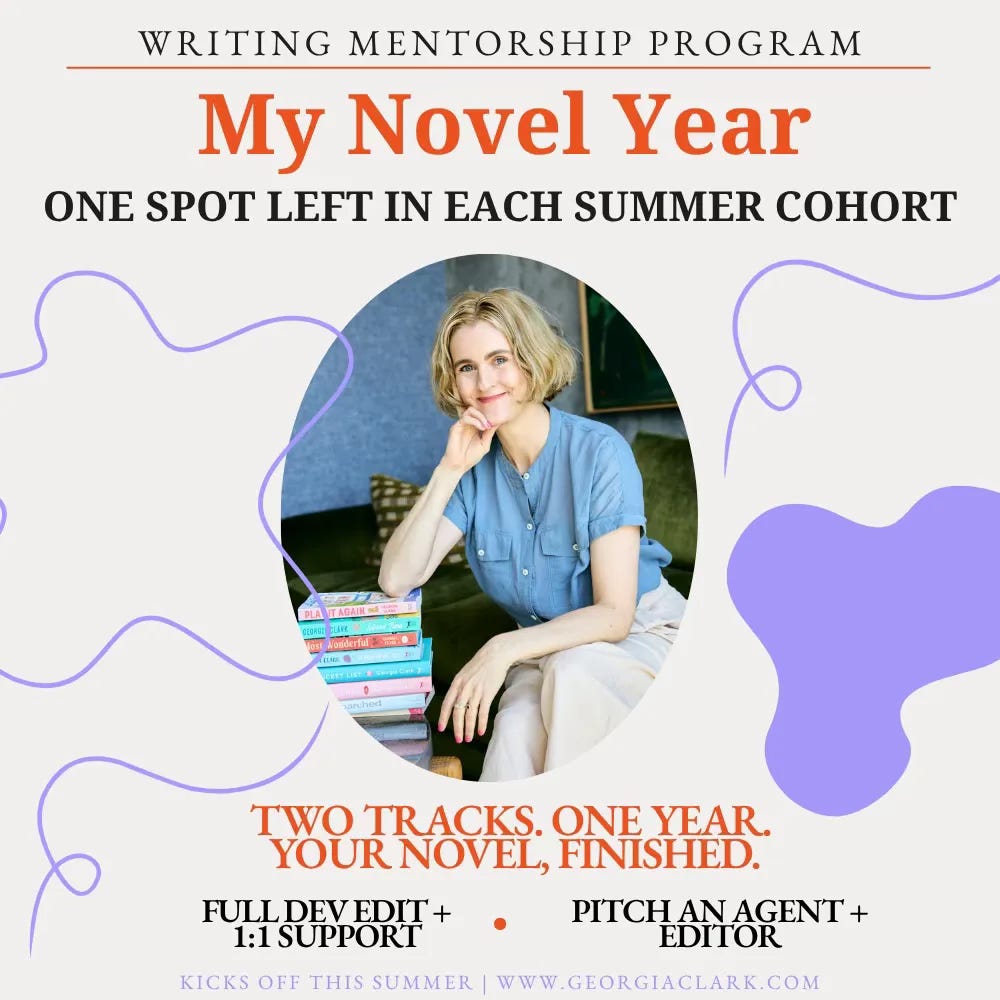
I designed these programs to draw on everything I wish I’d had coming up as a novelist: the craft knowledge I’ve accumulated across eight published books, the editorial eye I’ve developed working with developmental editors, acquiring editors, and agents, and the industry access I’ve been lucky enough to build over a long career. I’ve also been on the other side of these programs — I’ve taken courses and mentorships, some of which were truly transformative, and some of which were frankly disappointing: underdeveloped, unprofessional, not worth the investment. Every one of those experiences shaped what I was determined to create and determined to avoid.
My Novel Year is designed for serious writers — people for whom novel writing is a meaningful part of their personal and professional identity. It’s not for hobby writers, and it’s not for anyone looking for a ghostwriter or co-writer. It’s for the writer who has a story that matters to them, and who is ready, finally, to do the work to get it finished and into the world.
I truly believe this program offers exceptional value. If you’d like to see a sample of my developmental editing before you commit, just reply to this email — I’m happy to send one through.
We won’t be running new cohorts until 2027 at the earliest, and even those dates aren’t set. This is your last chance to work with me on your novel this year.
Explore the page. Ask for a sample. Book a free discovery call. Let’s get writing.
I had been putting it off for the obvious reasons. The procedure involves, to be frank, a camera up your butt, which just sounded deeply weird. But after my agent Allison Hunter bugged me about it, I finally bit the bullet and booked it in.
Here’s your TLDR: you fast for 24 hours prior, then spend the 12 hours before the procedure on a liquid diet plus an industrial quantity of laxatives. You will become very familiar with your loo. The hardest part for me was drinking half a bottle of Miralax mixed into a large blue Gatorade at 6am — not because it tastes terrible, but because who wants blue Gatorade at 6am? I was gagging purely on principle.
The hunger was less bad than I expected. You can have calories on the liquid diet — apple juice, broth — so it’s not like fasting, which I’ve also done.
The procedure itself? I had never had general anesthetic before and was nervous. Turns out: sign me UP. It was my fave part of the entire thing. One moment I was lying on my side in a hospital gown surrounded by nurses with an IV in my arm, the next I was waking up in a completely different room an hour later feeling entirely normal. I sometimes have trouble sleeping, and honestly, if I could arrange a wee GA every night, I’d be living my best life.
Results: all clear. I walked out, went home, had a slightly early night, and then returned to work the next day.
So consider this your PSA: if you’re 45 or older, go get a colonoscopy. It’s so much less scary than you think, and the peace of mind is everything. And best of all, you’ll have a really great nap.
Can’t wait to hear from you in the comments — keep writing, keep reading, and thanks for following along!
Comments
Nothing yet. Say the first thing.
Sign in to join the conversation.