
The August series on writing in community continues…
For the last week or two I’ve been putting together a guide for starting your own feedback group, in which I have tried to distill what I’ve learned about writing in community over the last eight years of leading The Habit Membership for Writers. On top of that we’re in the last two weeks of the Writer Development Cohorts, in which the workshopping starts in earnest. So I’ve been thinking a lot about the exchange of feedback between writers.
A lot of writers feel a lot of anxiety about giving feedback to other writers. They’re afraid they won’t know what to say, or, worse, that they will give advice that does more harm than good. There’s also the question of how to give helpful feedback to a writer who is more experienced and further down the path.
I have written elsewhere about the Guidelines for Feedback that we use in The Habit Membership. The heart of those guidelines is simply this: When you give feedback to another writer, your job is not to give sage advice, but simply to tell what you experienced when you read the piece under discussion. In the context of a writers’ group, the most helpful feedback literally requires no writing expertise. It only requires that you be a reader who can pay attention to your own experience of reading.
I’ll go a step further and say that as a feedback partner the great gift you bring to another writer is the gift of ignorance.
You’ve probably heard of the “curse of knowledge.” I’m convinced that mot writing problems erive from the fact that writers already know what they’re trying to say, so it’s hard for them to know whether they have expressed it clearly or not. As Verlyn Klinkenborg has put it, “Knowing what you’re trying to say is always important. But knowing what you’ve actually said is crucial.”
A feedback partner can help a writer know what she has actually said. A feedback partner comes to a piece of writing with the dewy freshness of ignorance. Not knowing what the writer knows, the feedback partner enjoys a kind clarity that is very difficult for the writer to achieve when she looks at her own work.
So then, when you give feedback to another writer, ignore whatever expertise you might have and lean into your ignorance, which is a kind of super-power. Instead of “Here’s what you ought to do here…” and “This is how I would have handled…” (statements from a position of expertise), try these kind of expertise-freeI statements:
I think you were saying X. Do I have that right?
I got a little confused here.
I especially liked this part.
This sentence made me lean in.
This sentence pulled me out of the piece.
I’m still curious about X.
One last ignorance-centric observation: Question-asking is an excellent form of feedback.
For more on the giving and receiving of feedback, go get The Habit’s Guide to Starting Your Own Feedback Group.
Thank you for reading The Habit Weekly. My posts are always public, so feel free to share.

Virtual Writing Rooms on Monday, Tuesday, Wednesday, Thursday and Friday
Wednesday Afternoon: Publishing Support Group
Thursday Afternoon: Office Hours
Habit Portfolio submission window NOW OPEN
There’s a place for you in this vibrant community of writers. Find out more about The Habit Membership here.

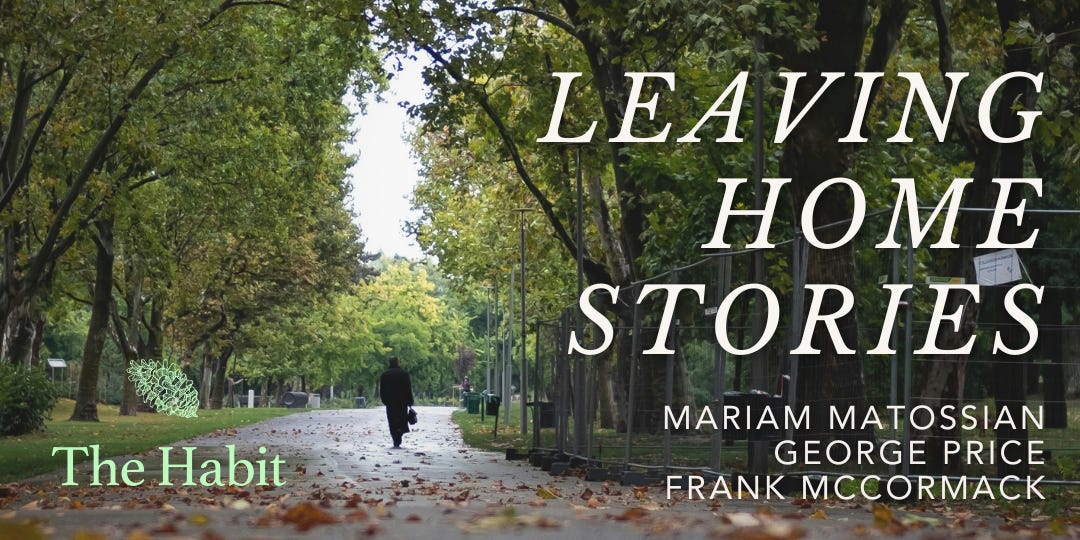
This week’s episode, featuring Mariam Matossian, George Price, and Frank McCormack, will swing from the hilarious to the poignant. Expect door-to-door sales, a road trip in a hearse, and a hallucinated raptor.
“Leaving Home Stories,” is a special summer series in which writers from The Habit Membership read personal narratives on the theme of leaving home, literally or metaphorically, temporarily or permanently.
“Leaving Home Stories,” is a special summer series in which writers from The Habit Membership read personal narratives on the theme of leaving home, literally or metaphorically, temporarily or permanently.
Sponsored by The Habit Membership.
Comments
Nothing yet. Say the first thing.
Sign in to join the conversation.